
“Try to imagine a world where there isn’t a vast unspoken consensus that black men are inherently scary, and most of these police assaults would play in the media like spontaneous attacks of madness. Instead, they’re sold as battle scenes from an occupation story, where a quick trigger finger while patrolling the planet of a violent alien race is easy to understand.”
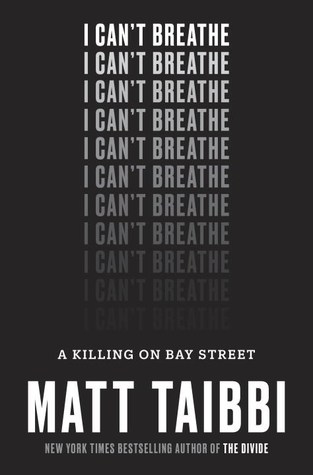
I received an advance review copy of I Can’t Breathe: A Killing On Bay Street, courtesy of Random House and Net Galley. I had expected this civil rights title to be a good read but also to be anticlimactic, coming out as it did just after publications by literary lions like Ta-Nehisi Coates and Angela Davis. I am surprised and gratified to see that Taibbi, a journalist for Rolling Stone, holds his own quite capably. The title is for sale, and if you care about justice and an end to cop violence in the US, then you should get it and read it.
Many readers will recognize the title, which constitutes Eric Gardner’s last words and became a rallying cry for protests that spanned the globe. Why would any cop, especially one not acting alone, find it necessary to put an elderly man, a large person but not a violent one, in a choke hold over what was, after all, a misdemeanor at most? Taibbi takes us down the terrible urban rabbit hole, deftly segueing from Garner’s story, the events that led up to his death and the legal and political fight that took place afterward, to the cop killings of others, and the bizarre, farcical prosecution that takes place in the unlikely event that a cop is ever charged with having unlawfully killed another person.
Though my own life is free from this type of harassment and though I benefit from White privilege and have done so since birth, I found it hard to breathe myself as I read Garner’s story, and the behind-the-scenes machinations that result in the maintenance of the status quo. And I trembled, and still do, for the Black men in my family.
I think many people over the age of 40 understand that the attacks we see publicized online, one by one, Black boys and men that have done either nothing wrong or committed a minor offense that most Caucasian people would never be stopped for, have been taking place for a very long time. What we didn’t have was proof; what we didn’t have was the long view that allows us to see into cities, rural areas, and small towns in America such as Ferguson, where Michael Brown was killed. And there’s one other thing: we didn’t have to look at it before if it wasn’t happening in our own community, our own neighborhood. Even those of us with racially mixed families didn’t see the scope of it. Some would prefer not to know.
Here’s Taibbi’s take on how it unspooled:
“The civil rights movement ended in a kind of negotiated compromise. Black Americans were granted legal equality, while white America was allowed to nurture and maintain an illusion of innocence, even as it continued to live in almost complete separation. Black America always saw the continuing schism, but white America has traditionally been free to ignore and be untroubled by it and to believe it had reached the “postracial” stage of its otherwise proud history. That was until cell phones and the internet came along. When the murder of Eric Garner hit the headlines, it at first seemed to lift the veil.”
Taibbi’s smooth narrative and expert pacing doesn’t make this any easy book to read; nothing can. If it’s easy, you’re not paying attention. But if we ignore Eric Gardner, Michael and Trayvon and Freddie and Sandra and all the rest, we are complicit in their deaths. Highly recommended, even at full jacket price.
 Ta-Nehisi Coates is pissed. He has a thing or two to say about the historical continuity of racism in the USA, and in this series of eight outstanding essays, he says it well. I read it free and early thanks to Net Galley and Random House, and I apologize for reviewing it so late; the length wasn’t a problem, but the heat was hard to take. That said, this is the best nonfiction civil rights book I have seen published in at least 20 years.
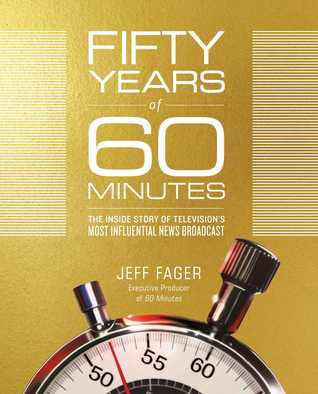 60 Minutes first aired in 1968, a year for news if ever there was one. It was brilliantly conceived as a television news magazine, covering multiple unrelated news stories in a single broadcast. Executive producer Jeff Fager offers the reader an insider’s peek; lucky me, I read it early and free thanks to Simon and Schuster and Net Galley. It’s for sale today.
 Unless you’ve been hiding under a rock somewhere, you already know that Allende is a luminary that owns the literary lane of magical realism, and is renowned for her fictional immigration stories. But it’s her accessibility, the way she spins her tale as though speaking to a good friend, along with her sparkling great humor and feminist spirit that keep me coming back for more. My bookshelves may be crowded, but when I have to clear old books away to make room for new, my Allende shelf is never up for grabs. These are books I will read again, and that’s a thing I don’t do much. In the Midst of Winter is one I read digitally and free, thanks to Net Galley and Atria Books in exchange for this honest review, but sooner or later I will have to find a hard copy to complete my shelf. You will want to read it too.
 I received an advance copy in return for this honest review, thanks to Net Galley and G.P. Putnam. I expected to absolutely love it; I came of age when the South African revolution against the Apartheid state was in full flower and before anything about it showed on mainstream media, which was all we really had then apart from underground films shown in the basements of coffee houses near campus. I loved Mandela’s Long Walk to Freedom, and had attended dozens of talks given by members of the African National Congress that were forced into exile. So when I saw that this novel was set in revolutionary South Africa, I was pumped. Popular fiction about one of the greatest political events to occur in my lifetime? Oh yes indeed. Count me in!
 A hard look at the American penal system–from cops, to court, to prison–is past due, and within this scholarly but crystal-clear series of essays, the broken justice system that still rules unequally over all inside USA borders is viewed under a bright light. Isn’t it about time? Thank you to Doubleday and Net Galley for the DRC. It’s for sale, and anyone with an interest in seeing change should read it. Caucasian readers that still can’t figure out why so many African-Americans are so upset should buy this book at full price, and they should read it twice. If you read this collection and still don’t understand why most Civil Rights advocates are calling out that Black Lives Matter, it likely means you didn’t want to know. But bring your literacy skills when you come; well documented and flawless in both reason and presentation, it’s not a book that individuals without college-ready reading skills will be able to master.


 Devlin write this, her autobiography, when she was all of 23 years old. Had it been anyone else I would have considered it ridiculous, a juvenile pretention, but Bernadette Devlin was one of the primary fighters for Irish freedom during the tumultuous 1960s, ‘70s, and ‘80s, and given how events played out, it is likely that she wrote this while fully anticipating that she’d be killed in the struggle fairly early on. Goodness knows, the British cops tried. Here’s a bit of background information from Wikipedia:
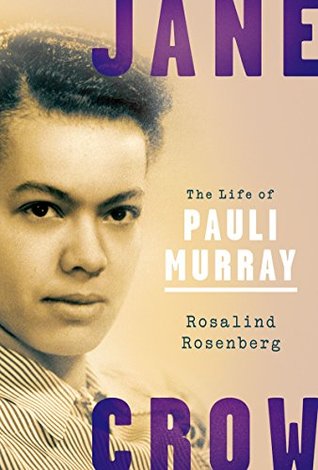 Pauli Murray is the person that coined the term “Jane Crow”, and was the first to legally address the twin oppressions of color and gender. I had seen her name mentioned in many places, but this is the first time I’ve read her story. Thank you to Net Galley and Oxford University Press for the opportunity to read it free in exchange for this honest review. This biography is for sale now.
 Seattle Book Mama