
 If there is a prize for courageous literature, Picoult deserves to win it. I have grown frustrated over the years as I have watched countless novelists dodge and weave to avoid the mere mention of abortion as a means to deal with an unplanned, unwanted pregnancy, and I wanted to do cartwheels when I read the teaser for this book. I thank Net Galley and Random House Ballantine for the review copy, and the author and publisher for having the integrity to go there. This book is for sale now.
That said, this isn’t a fun read, and it in no way resembles the character based escapist fiction that is the hallmark of many of Picoult’s other novels. This one is about social justice, and fiction is an approachable medium with which to discuss it. Those seeking to avoid tension and who don’t want to think critically should read something else.
The story opens at a women’s clinic in the Deep South, and a shooter has just killed the owner of the clinic and taken others hostage. Our main characters are the shooter, George Goddard; Hugh McElroy, the hostage negotiator; Wren, Hugh’s daughter, who has come to the clinic without her father’s knowledge to procure contraception; and Louis, the clinic’s doctor. There are a host of second string characters, and they include clinic workers, clinic protesters, patients, and a spy that has wormed her way inside the clinic in search of the damning proof that fetal tissue is being sold illegally.
Because we start with the shooting and then work our way backward in time, with the narrative unspooling the background and viewpoint of each of about a dozen people, the first third of the book is agonizing. I am not usually one to peek at the ending of a novel, but frankly I couldn’t stand it. I couldn’t read the fine details until I knew who was going to make it out alive and who wasn’t. I suspect that some of the negative reviews I am seeing are because of this aspect of it. It’s a tribute to how effectively Picoult is able to create tension within a story, but she may have overshot the mark a wee bit.
The first half of the book examines the various reasons why some people are opposed to abortion, and it does it in painstaking detail. I began to feel as if she was doing the work of the Right-to-Lifers for them. More than anything, though, we see inside the troubled mind of the shooter himself. Goddard may be the best developed of the characters present here (though the story is primarily plot based in any case).
We also see the reasons why women choose to have an abortion, and we see the ambivalence and sometimes the regret of those that do so. In fact, my one real issue with this story is that there isn’t a single woman here that is having the procedure, not because she’s been raped or because she’s impoverished or abused, but because her contraception failed and she doesn’t want to be pregnant. These women exist; I know them. In fact, I have been one of them. Not every woman that seeks to terminate a pregnancy is traumatized, and apart from one character that passes in and out of the plot inside of a brief paragraph, these women are not represented here. But this is a relatively minor concern, and my rating reflects this.
Appropriately enough, the empirical voice of reason belongs to Louie Ward, the doctor. He’s seen a lot:
“Indeed, when the pro-lifers came to him to terminate a pregnancy and told him that they did not believe in abortion, Louie Ward said only one thing: Scoot down.” Louie respects the women that come to him, and during the conference the state requires him to have with those that have signed on for the procedure,
“He looked into the eyes of each of the women. Warriors, every one of them…They were stronger than any men he’d ever known. For sure, they were stronger than the male politicians who were so terrified of them that they designed laws specifically to keep women down…If he had learned anything during his years as an abortion doctor, it was this: there was nothing on God’s green earth that would stop a woman who didn’t want to be pregnant.”
I like the ending.
Picoult has done her homework here, observing abortions conducted at various stages of pregnancy and interviewing over one hundred women that have done this. Her end notes show the level of research on which this story is based. Few fiction writers go to such lengths, and I doff my metaphorical hat to her.
Highly recommended to feminists everywhere, as well as to the tiny sliver of the population that isn’t firmly planted in one camp or the other where the topic is concerned.
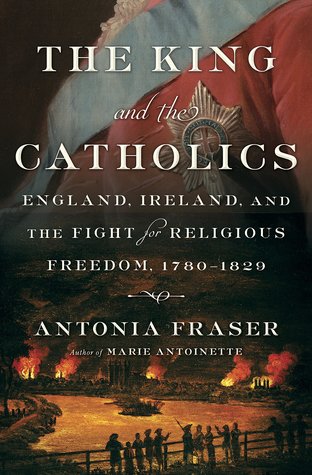 I was rooting around on Net Galley looking for some good nonfiction when I ran across this title. Many thanks to Net Galley and Doubleday for the DRC, which I read free in exchange for this honest review. This book is now available to the public.
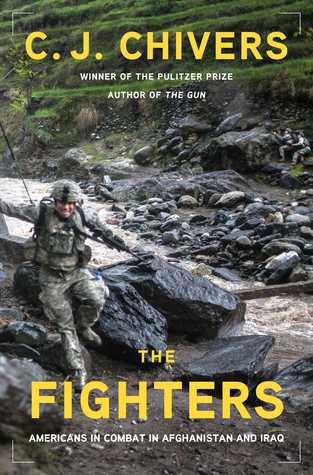 Chivers is a senior editor at The New York Times, and has won the Pulitzer for journalism. This meaty but readable book is the culmination of his years covering the U.S. wars in Iraq and Afghanistan. It is not the creation of a man parked in a library behind his laptop; he has personally gone to Iraq, Afghanistan, Syria, Ukraine, and Libya, and has either accompanied the people he writes about or retraced their footsteps. He covers the lives of six servicemen in the lower and middle ranks of the armed forces, and so he primarily uses eye witness reporting and interviews, in addition to American military data. I read it free courtesy of Net Galley and Simon and Schuster in exchange for my honest review. The Fighters will most likely be regarded in future years as the go-to book for those that want to know more about this war and the people whose lives were changed by it—including many of those whose homeland is or has been part of the war zone.
 Thanks go to Net Galley and Simon and Schuster for the DRC, which I received free in exchange for this honest review.
 I received a review copy of this book from Net Galley and Three Hills Publishing, which is affiliated with Cornell University, free of charge. This book is now for sale.
 “Even as a federal agent, I have been on surveillance or supporting an operation and have had an officer approach me and say that the neighbors called about a “suspicious” vehicle, which meant it was a black guy driving a car. I’ve been the man in that suspicious vehicle.”
 3.5 stars rounded up. Thanks go to Net Galley and Doubleday for the DRC, which I received free and early in exchange for this honest review.
 I’ve never understood why so many Americans revere the memory of Robert E. Lee, the general that turned Lincoln away at the outbreak of the American Civil War and instead commanded the treasonous Army of Northern Virginia. When I saw this title, I leapt at the chance to read and review it. Thanks go to Net Galley and Rowman and Littlefield Publishers for the DRC. The book will be available to the public June 1, 2018.
 Those that admire and stand in solidarity with the Cuban Revolution will not find any measure of satisfaction here. When I read the promotional blurb, I noticed that this account was written by a Rolling Stone Magazine journalist, and that it was written soon after President Obama opened relations between the US and Cuba. I thank Net Galley for permitting me to read a review copy free of charge, but that cannot diminish my disappointment and irritation (thus one star) at the patronizing, reactionary vantage from which Symmes writes.
 Cooper has had enough, and who can blame her?
