
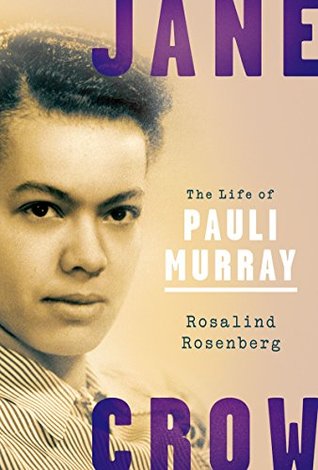
 Pauli Murray is the person that coined the term “Jane Crow”, and was the first to legally address the twin oppressions of color and gender. I had seen her name mentioned in many places, but this is the first time I’ve read her story. Thank you to Net Galley and Oxford University Press for the opportunity to read it free in exchange for this honest review. This biography is for sale now.
Murray was born in North Carolina and was a labor activist during the turbulent 1930s. She was academically gifted and hardworking, but tormented by the issue of gender. 100 years ago, in the time and place into which fate dropped her, there was no recognition of trans people, and so her sense of herself (the pronoun she used) was that surely there was some unseen physical aspect to her body that must be male. She searched high and low for a surgeon that would perform exploratory surgery to discover whether she had an undescended testicle or some other material explanation to explain why she was convinced that she was actually male. It hurts to think about it. Those born after the early-to-mid-20th century cannot comprehend how the suggestion that gender could be binary was seen, and Murray was a devout Christian as well, and became an ordained Episcopal priest. By the time trans people gained respect from a significant percentage of Americans, Murray was no longer here.
Despite the misery and confusion that was inherent in such a life, Murray was prolific. She was declined a place at the University of North Carolina because of her race, and later denied a place at Harvard Law because of her gender. She graduated at the top of her class at Howard Law, the only woman in her class. Later she would be largely responsible for inclusion of the word “gender” in the title VII in 1964. Those of us that have benefited from that law—and there are a lot of us—tip our hats to her memory in gratitude.
Rosenberg has done a fine job in telling us about Murray. Her documentation is flawless and her narrative clear. At times—particularly in the beginning, before Murray’s career really catches fire—it’s a trifle dry, but I would prefer a clear, scholarly, linear narrative such as this one, over an exciting but sensationalized, less well documented telling any day of the week.
Those interested in the American Civil Rights movement and the history of the women’s rights movement in the USA should get this book and read it. Even if used primarily as a reference tool, it’s an indispensable resource, particularly to those with an interest in legal matters relating to discrimination and equity.
 I was invited to read and review this title by Net Galley and Open Road Media. At first I thought it looked like a real winner, and in many respects it is. For me, one glaring problem made it impossible to finish; more on that in a minute. For those interested in the Resistance during World War II, this may prove a successful read and an interesting one if you can get past the hurdle that stopped me.


 I was browsing the pages of Net Galley and ran across this gem of a memoir. Often when someone that isn’t famous gets an autobiography published by a major publisher, it’s a hint to the reader that the story will be riveting. Such is the case here; my many thanks go to Net Galley and Atria for the DRC, which I read free in exchange for this honest review. You can order it now’ it comes out Tuesday, May 9.
 History buffs rejoice; the definitive Nixon biography is here. John A. Farrell is the renowned biographer of Clarence Darrow. Now he gives us a comprehensive, compelling look at the only US president ever to resign from office under the cloud of imminent impeachment. This is the only Nixon biography that answers the many questions that left Americans—and those around the world that were watching—scratching our heads. Why, why, and why would he do these things? Farrell tells us. I read this book free and in advance, thanks to Net Galley and Doubleday, but it would have been worth paying the full retail price if I’d had to. It’s available to the public now.
 “I wanted to write novels for the girls like me, the ones who never got to see themselves on TV or in the movies, the ones who learned to flip through the fashion spreads of Elle and Vogue because nothing in those pictures would ever fit, the ones who learned to turn away from mirrors and hurry past their reflections and unfocus their eyes when confronted with their own image. I wanted to say to those girls, I see you. You matter. I wanted to give them stories like life rafts…I wanted to tell them what I wished someone had told me…to hang on, and believe in yourself, and fight for your own happy ending.”
 John Dean was counsel to the president during the Nixon administration, and was the first to testify against all of the Watergate conspirators, including Nixon and including himself, a bold but necessary decision that led to Nixon’s resignation—done to avoid imminent impeachment—and Dean’s imprisonment. Dean’s story is a real page turner, and Nixon-Watergate buffs as well as those that are curious about this time period should read this book. I read the hard copy version, for which I paid full jacket price, shortly after its release, and when I saw that my friends at Open Road Media and Net Galley were re-releasing it digitally, I climbed on board right away. This title is available for sale today, December 20, 2016.
 I was originally turned down for a DRC of this novel when I requested it last spring, and I took the unusual step of following up with Atria, more or less begging for it. I’ve been reviewing titles for Net Galley for two years and have received nearly 300 DRCs, so it is a sign of my interest level that I went to this extreme to read this one in advance in exchange for an honest review, and it’s a sign of decency and responsiveness that a representative from Atria Books invited me to review it after all. Although I am grateful , this five star review is not about gratitude, but a measure of the importance I attach to the issues it addresses and the skill with which the story is told.
 Many people don’t know much about Cuba, the tiny island nation a mere 90 miles from the coast of Florida. The American media has distorted the Cuban Revolution for as long as I can remember. Before the revolution, which took place in 1959, Havana was like Bangkok, a place where little girls prostitute themselves so they won’t starve to death, where wealthy visitors can experience every pleasure, innocent or corrupt, known to humanity but where most citizens have little chance of even having their basic human needs met. Cuba’s alliance with the Soviet Union (USSR) helped the Cuban people defend themselves from US efforts to overthrow the revolutionary government, but the alliance also led to a period of Stalinist repression that darkened artists’ worlds for a period of time. Randall discusses all of this in her introduction. Following the period Cubans call the Rectification Period (reference mine), Stalinist practices were peeled away, and more freedom of expression created a more hospitable environment for artists, in addition to strengthening the revolution itself. In Cuba art is not privately sold as a general rule, and artists receive a salary for what they do, paid by the Cuban people.
 This particular book is not in my wheelhouse, but I was offered a free copy in exchange for a fair and honest review, and the person doing the offering is a friend of the author’s and of mine. Thus, I found myself spiraling down the rabbit hole, reading about everything from Watergate to the connection between the Freemasons and the Mormons. This book is available to the public right now.
