Marion is the kick-ass debut novel for author Leah Rowan, and it’s hugely addictive! My thanks go to St. Martin’s Press, Macmillan Audio, and NetGalley for the invitation to read and review. This book will be available to the public June 2, 2026.
The story is a retelling of the 1960s smash, Psycho. I am not generally a fan of retellings unless they’re brilliantly done, and as it happens, this one is. We have two points of view here; one is Marion, and the other is Hannah, a budding private detective searching for a missing girl that was last seen near the motel. However, Marion is the protagonist.
Her real name isn’t Marion, but she adopts it as an alias early on, and so it might as well be. When we meet her, she’s an overworked and underappreciated office worker, and she’s also a concerned sister. Her older sister Lauren is in an abusive marriage, and cannot afford to leave for at least a year. Marion is frantic, trying to protect Lauren. Their parents are gone, and her mother made her promise to become the big sister and look after Lauren. It is that good intention from which everything else arises.
When her bus breaks down before reaching her destination, and when all of the nicer lodgings fill up with other stranded passengers, our protagonist is guided to this motel—yes, that motel. And that’s where things get real. She adopts the name Marion because she doesn’t want her boss to know where she is, but as things become more intense, she has additional reasons for remaining anonymous.
Eventually, Marion and Hannah meet.
That’s all I’m going to tell you, because surprise is everything here, but I do want to give a shout out to the audio narrators, because they are how a very good book becomes a great one. Natalie Naudus and Tawny Platis do exceptional jobs. I did most of my reading this way, pulling weeds with ear buds in, and I stayed out in the sun way too long, because I knew that once I was in the house, I had to stop listening!
The whole thing winds up with a couple of surprising twists at the end that make it even better.
Highly recommended to anyone that likes a scary book with some dark, feminist moxie.
There’s so much buzz about the debut novel Yesteryear, by Caro Claire Burke, and it’s easy to see why. When a wife and mother decides to make bank off of being a tradwife, except that she really isn’t, the irony is thick and darkly funny. I was immediately absorbed by this story, and I have lots of company.
My thanks go to NetGalley and Random House for the review copy. This book is for sale now.
Natalie doesn’t fit in well or make friends easily, but when she meets Caleb, she thinks she’s found a man that wants the same things she wants. Caleb comes from a wealthy family; his father has presidential ambitions. He buys them a farm in Idaho, and she promises to bear lots of little grandchildren and keep her man happy and out of trouble.
While she doesn’t connect well with new friends in person, the magic of Instagram changes everything! She posts photos of her darling family, the big red barn, the cow and the chickens, and she creates videos of herself making bread in the kitchen. But this is difficult to do when there are children to take care of, so she hires nannies. She hires a producer to help create her content; her children are home schooled, alright, but not by Natalie. And behind the wall of her kitchen, there are commercial quality appliances that grease the wheels of her production; the tradwife is not what she seems.
She hardly knows her own children. And underneath the Instagram smiles and the aphorisms about gratitude, she is every bit as angry as the feminists that decry her platitudes.
Then comes the day when she wakes up and finds that she’s living in the 1800s. Her farmhouse really is an old school farm house. There’s no central heating, only chopped wood for burning. There is no electricity or washing machine. Life is hard, and so is her husband. “A lifetime of drowning, and then you are dead.”
I could hardly stand to put this thing down; I had to know how it would end. Unfortunately, the ending is not as smooth or well-paced as the rest of the book, and I didn’t find it as satisfying. Still, this is a great read, and I recommend it to you.
Taylor Brown has become one of my favorite authors. He creates believable characters and memorable plots, and his recurring themes have to do with championing the poor and dispossessed, and an urgent sense of environmentalism. My great thanks go to NetGalley, RB Media, and St. Martin’s Press for the review copies. This book is for sale now.
Trace Temple hates wolves. His family has spiraled downward since losing its New Mexico ranch, a ranch that was in the family for generations, because of a massive legal penalty incurred by shooting an endangered wolf. It’s legal to kill a wolf that has preyed on one’s livestock, but the circumstances under which that can be done are very specific ones. Trace’s father thought he was shooting the wolf that had eaten his sheep, but he accidentally shot the wrong wolf, and it cost him and his family everything. The patriarch went to prison, and Trace’s mother developed an addiction that has become all consuming. So when some sketchy characters approach Trace and propose to hire him to shoot One-Eleven, the legendary alpha of a wolf pack that ranchers have long hated, he’s all in. But an experience that occurs while he’s on the hunt causes him to change his mind.
Once Trace is out of the running, the organization hires someone else, a man called Murdoch. Murdoch wants to kill the wolf, and he wouldn’t mind killing Trace, too.
The story starts a bit slow, then gathers steam as it goes. The Gila wilderness where all of this takes place is resonantly depicted, and given that nearly everything that Brown has written to this point is set in the Appalachians or some other part of the American South, this is all the more impressive. The dialogue pops! There aren’t many characters in this story, and the two-legged characters that get the most ink are males; it’s all the more amazing, then, that Brown’s respect for women shines through, and it does so naturally. By the last quarter of this story, nobody could have kept me from finishing it.
There’s some gore here; the story could not have been told authentically without it. Humans get hurt, and some get dead, and so do wolves; but none of the damage is superfluous or titillating. And I loved the ending.
Brown explains what’s real and what’s fictional at the end of the book, and he even includes a two page bibliography for those interested in the subject matter.
I was lucky enough to have both the digital and audio versions of this story, and it’s the first time I’ve listened to one of Brown’s books. Ramiz Monsef does an outstanding job as narrator, and for that reason, I recommend this format for those that like audio books. But whatever your preference is, this novel is highly recommended.
Missing Sister is the newest thriller by one of my favorite authors, Joshilyn Jackson. My thanks go to William Morrow and NetGalley for the review copies. This book is for sale now.
Penny Albright is a rookie cop, a vocation she chose after her twin sister, Nix, died of an overdose. Nix was raped by a group of three men that she knew; Penny wasn’t supposed to tell anyone, but soon after it happened, Nix’s personality changed. She moved to the city, isolated herself. Before the rape, Nix had never used street drugs. Penny is too late to save Nix, but she hopes to be able to spare others the same horrific fate.
Then she and her trainer, who’s also her partner, are called to a murder scene. The victim turns out to be one of the three men that raped Nix, and Penny forces herself to show no reaction, to keep her cop face on, but inside, she is exultant. Then, while canvassing the area, Penny inadvertently comes upon the killer, holding the murder weapon and covered in blood. She and the woman lock eyes, and then, rather than arresting her, Penny lets her go. After that, she becomes obsessed with learning the woman’s story; she is certain that the killer had a similar experience to Nix’s, or that the killer had a sister that did. She vows to hunt the killer down in order to find out what happened.
The first half of the book is frustrating. The story is told in the first person, and after hearing Penny’s determined plan to learn the killer’s story over and over again, on a never-ending, somewhat circular loop, I want to smack her upside the head and tell her to get on with it. Leave that dangerous woman alone! She can’t bring your sister back, and you can’t either, I want to tell her. A part of me felt let down, because Jackson doesn’t usually have a weak first half, or any weak part at all in her novels. But just as I’m beginning to think, what a shame, everything changes, and the story becomes a true, grab-you-by-the-hair thriller. The ending is a complete surprise, and what’s more, it makes sense. The second half more than makes up for the first half.
I was lucky enough to have both the digital and audio review copies, and Jackson reads her own story, which makes it even better.
This story smacks of a possible series, and if that’s the plan, it explains why readers have Penny’s motivation beaten into us. That motivation may be the basis for who knows how many books to come; many, I hope! For those that are able to wade through the first half to find the reward in the second, this book is highly recommended.
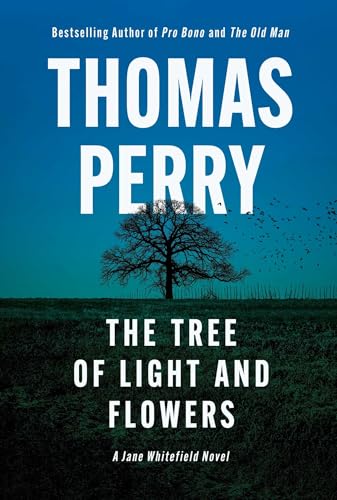
The Tree of Light and Shadows is the eleventh and final entry in the iconic Jane Whitefield series by Thomas Perry. My thanks go to NetGalley and The Mysterious Press for the review copy. This book is for sale now.
For those unfamiliar, Jane Whitefield is a Seneca Indian woman with a past avocation of helping people that need to disappear. The person in question might be a woman running from an abusive relationship; an innocent person that’s inadvertently run afoul of the mafia or some other dangerous group or individual; or someone that has been wrongfully convicted of a crime. Jane combines her Native tracking skills with modern methods of blending in or hiding away. However, in recent years she’s given it up, eschewing the danger for a normal life with her husband, who is a physician, and their baby girl, May in Amherst, New York.
However, the universe has other plans for her right now. Clare, a young Indian girl who has stabbed her rapist, has learned that she is wanted for murder. The dead man was Caucasian, and he moved in powerful circles. Knowing she is unlikely to get a fair shake in an Oklahoma courtroom, she heads for New York to find the distant relative that she’s heard will help people like her.
At the same time, a Russian woman named Magda has been hired by someone with a vendetta to find and kill Jane.
The dual storylines are deftly handled, which doesn’t surprise me, since our author is Thomas Perry. But there is one misstep that happens early on that niggles at me for the rest of the book. When Clare finds Jane, Jane decides the girl is too young to be established on her own, so she tells her husband that she wants Clare to remain with them. Clare will go to school and help with the baby. And then—here it comes—she runs out to do errands and leaves the baby with Clare! Would someone as seasoned and astute as Jane leave her infant daughter in the care of someone that might be attacked by people from her past, and do so before the girl has been in her home for even 48 hours? I find this so jarring that I am unable to entirely forget about it for the duration of the novel.
Nevertheless, the book holds my interest, and I look forward to my session reading it each day. When the conclusion is near, I can’t walk away from it until I see how it ends. This doesn’t happen often. I am lucky enough to have been given access to both the audio and digital review copies. I haven’t been able to learn who the narrator is, but whoever he is, he’s good.
I just read of Perry’s sudden death while writing this review. He was such a force within the world of mystery writers that I can hardly believe it. While this book wasn’t the best thing he ever wrote, it is still quite good.
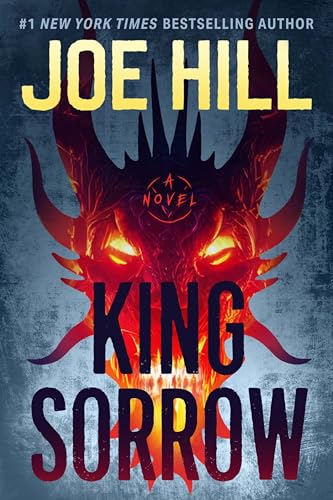
Arthur Oakes is in a jam. He is a student at Rackham College in Maine, and to make ends meet, he has a work-study position in the library’s rare books collection. But he finds himself unexpectedly being blackmailed into stealing books from that very place, a nightmare of epic proportions; the solution proves to be an even greater nightmare. He and his friends summon a dragon to get rid of the blackmailers, but now the dragon won’t go away.
My thanks go to NetGalley and William Morrow for the review copy. This outstanding tome is for sale now.
This author has no doubt learned to take comparisons between his writing and that of his mega-famous father, Stephen King, in stride. My own impression from reading both is reaffirmed here: he’s every bit as good and perhaps, at times, better. His father has mellowed in his old age, and he’s become reluctant to kill his most sympathetic characters. Hill, however, has no such compunctions. It increases the suspense to know, while reading, that he actually might do that.
Arthur has become involved with a townie, Gwen Underfoot, whose family has cleaned for the family of his friend, student Colin Wren, for generations. Add in some other friends, Alison Shiner and the twins, Donna and Donovan—clever of Hill to insert some D&D into a dragon story—and we have a cabal.
One of the earliest points of interest for me is that nobody in this circle of friends seems to doubt for a moment that the effort to summon a dragon will be successful. I had expected self-conscious eyerolling, but their approach is well researched and oddly businesslike. King Sorrow arrives with a vengeance, and he does not disappoint! The saga that unspools from there is an epic one, over 800 pages, so those that like to hurry through short novels will need to steer clear or adjust their thinking. As for me, never at any point did I see anything that resembled padding. There is never a slow moment, and while at the outset I made a point not to read this story too close to bedtime, lest it affect my dreams, once I reached the story’s climax there could be no stopping till the journey was completed.
I don’t read a lot of horror these days; most grandmas don’t. But when I make an exception, I want it to be damn good, and this book qualifies. Highly recommended to those that appreciate things that go bump in the night, and especially dragons.
Sharp Force is the 29th mystery in the Kay Scarpetta series, and it’s a humdinger. My thanks go to NetGalley, Grand Central Publishing, and Highbridge Audio for the invitation to read and review; this book will be available to the public October 7, 2025.
In writing this wildly successful series, author Patricia Cornwell goes deep into character, which is the best way to write a long running series. There are, after all, only so many ways to kill someone, and only so many reasons for doing so. One can add strange variations that raise questions, and indeed, Cornwell does, but the thing that keeps me on the edge of my seat is not only identifying and stopping the killer in question, but also making sure that Kay and her family are also safe. I’ve been following these folks for the whole series, and knowing that Benton, Marino, Lucy, and even Dorothy, Kay’s obnoxious sister who’s married to Marino are safe. I even worry about the cat, and this time around, we have reason to do so. (For those with triggers: no animal cruelty is involved in this book.) Conversely, there are also long running nemeses such as Dana Diletti, the journalist that will ruin the progress of an investigation in order to gain a scoop, and Maggie, the obnoxious secretary whom Kay fired for cause, but who is still working in an adjacent position, spying for friends in high places. Round all of these off with the disturbing, fascinating Janet, an AI entity developed by Kay’s badass niece, Lucy, a tech genius whose late lover, Janet, is the model for the AI. Janet—the artificial one, since the flesh and blood one was killed several books back—knows too much, and though she is helpful at times, she also has a tendency to stir up trouble within the family.
When all of these characters are stirred into Cornwell’s cauldron, the trite, often obnoxious tropes one runs into aren’t needed or used here, a welcome relief. Kay isn’t going to be knocked over the head and kidnapped; she doesn’t have an alcohol problem and the constant itch that goes with it; she hasn’t been framed and called upon to exonerate herself. (Some of these appeared early in the series, but have been blessedly absent for a good long while.)
There are a couple of recurring features that I would like to see the author avoid. These appear at the very beginning, so the reader has a long time to get over them: for example, why does there always have to be a big storm on the way just as the book opens? And when the narrative commences with Kay and Benton packing to spend Christmas in London on vacation, I roll my eyes and say, “No, we already know something will prevent this trip from taking place. Unpack your suitcases, kiddies, you never get to go anywhere.” And once again, the murder victim is someone Kay knows. These are small issues and rendered smaller by their appearance early, so I can quickly recover from my annoyance, but honestly, Cornwell has enough skill to dodge these next time, and she should.
I was fortunate enough to have both the digital and audio versions of this novel. Reader January LaVoy, one of my favorites, does a fine job.
The high rating I give this story, despite the opening irritants, is based on how I feel as I’m reading. I read anywhere from six to ten books at a time, located in various forms and on various devices, and while I am reading this one, I don’t have much interest in the others, although some of them are quite good. I cannot deny a strong rating to a book when I itch to return to it, as I surely do; then too, the ending is always important in a novel, and all the more so in a mystery, and this ending is terrific!
One side note: the Scarpetta books form the basis for a new series coming out soon, starring Nicole Kidman—a personal favorite—in the title role. I’m on pins and needles waiting for it!
It’s not just every day that I run across a five-star slasher novel, but author Philip Fracassi hasn’t written just any slasher novel, either. The Autumn Springs Retirement Home Massacre is one of this autumn’s most agreeable surprises. My thanks go to NetGalley, Macmillan Audio, and Tor for the review copies; this book will be available to the public September 30, 2025.
When a friend recommended it, she said it was funny and also different from her expectations. I agree on both counts. I was anticipating a book with plenty of old-folks barbs, sort of like the satirical carol, “Grandma Got Run Over by a Reindeer.” I considered whether I was up for it, given that I am a grandma myself, and decided my sense of humor hadn’t aged out. Sure, let’s give it a go.
Instead, though the book is indeed darkly funny in places, it also has aspects I didn’t anticipate. How many humorous slasher stories have character development, for instance? How many have genuinely poignant moments? And finally, on a more traditional yardstick, I find myself completely surprised by the solution.
Our protagonist is Rose Dubois, a 70-year-old retired school teacher. She buys a unit in the retirement community, not because she’s too decrepit to remember her medications or because she needs constant monitoring, but because she is ready to live in a smaller home near other people her own age. Her daughter has been urging her to come live with her instead, but Rose has friends here. She likes her little place, and she values her independence. She doesn’t want to go anywhere else.
Then her pals begin dying. The first is her bestie, and it stings, but also raises questions. The death—without giving anything away—seems out of character. But surprises happen, and they’re not all nice ones, so she and Angela’s other friends grumble, but move on.
But as the title suggests, there’s another. And another. Where will it stop? Rose and her remaining friends vow to stop it themselves, since the local cops and the home’s administrators don’t seem terribly concerned.
The story also raises the issue, a very real one, of the public’s lack of concern for the elderly. Hey, old people die. That’s what we do! And moreover, before we go, older folks become nearly invisible. The author’s moving note in the afterword explains why he took the approach he did.
Not long after I began reading, I was given access to the audio version, narrated by one of my favorites, January LaVoy. Although the print version is delightful, I give a slight edge to the audio because its format, which is mostly linear, lends itself well to this medium, and also because LaVoy always brings something extra to her narration.
Highly recommended to all that enjoy mysteries and a little gallows humor.
“One thing you can be certain of, boy. Things change. Even for those such as us.”
In 2018, I read a book by a promising local author titled Smoke City. It was complex and kept me on my toes, and all told, it was a good novel. Since I enjoyed it, the small publisher he was working with sent me another of his books, The Mercy of the Tide. I liked it, too.
Fast forward. I received a galley this year by the same author, but he was no longer working with the itty-bitty press. No, he was published by Random House. This made me sit up and take notice! My thanks go to NetGalley and Random House for the invitation to read and review Coffin Moon, the scariest straight-up horror novel you’re likely to find on the shelves this year. It will be available to the public September 9, 2025.
The premise is this: our protagonist, Duane Minor, is back from Vietnam. The year is 1975; the place, Portland, Oregon. His wife Heidi is living in an apartment over the bar her parents own, and Duane goes to work for them. Heidi’s 13-year-old niece, Julia, comes to join them as well after her mother is sent to prison. Duane is a bit shaky, following his tour of duty, but he’s sober, has pulled himself together, and things are going pretty well. That is, until the vampire takes over the bar.
That’s all you need to know of the plot to get started. In fact, I don’t even recommend reading the promotional blurb, because it’s better if you come to it on your own. What I will say is that this is not just any horror novel. There is more depth to it than you typically see, philosophical questions inextricably wound into the decisions that Duane and his niece must make. There’s also far more character development than I generally see in this genre. Finally, the word smithery Rosson brings to it makes this book grittier, more heart-rending, and far more thought provoking than other books of its ilk. Mr. Rosson was a good author before, but the brilliance of his prose has surged since his early work.
As I get older, I find I only have enough fortitude to read one or two horror novels each year; the rest of the time, I reach for other genres. If you are also an infrequent reader of horror, I strongly urge you to make this story a priority. It’s the sort of novel that stays with you long after the last page is turned.
System Collapse is the seventh book in Martha Wells’s acclaimed Murderbot Diaries series, and it’s a humdinger. Fans have been waiting for this one, and they will not be disappointed. My thanks go to NetGalley and Tor Publishing for the review copy. This book is for sale now.
If you are one such fan, I’ve already told you what you need to know; for the uninitiated, I’ll continue. I am a reluctant science fiction reader. I generally avoid anything that involves complex world building or a new vocabulary extensive enough to require a glossary. I absolutely don’t read science fiction series anymore, because I am not that dedicated. As we age, our brains become less flexible, and so whereas I loved reading a handful of excellent but rather intricate series when I was thirty, I’m just not up for it in my retirement years. I include this information because I know that a good number of my readers are also at or near retirement age, and may be similarly reluctant. So, first: you can do this, and it will be painless.
I was finally persuaded to try this series—not for review, merely as an audiobook from the library, which is about as low risk as it gets—when readers from a number of unrelated places in my life all recommended it. I saw good things from a couple of my Goodreads friends online. How nice, I thought, but I’ll pass. Next came my children, my eldest and my youngest, both grown, of course. Their rabid enthusiasm cracked my resolve a tiny bit, but I thought, maybe later. The final straw came when a couple of lifelong friends came to visit from out of state last spring. They were embarking on a road trip around the Pacific Northwestern USA, concluding their stay here in Seattle, and they, too, were wildly enthusiastic—and one of them doesn’t read for pleasure much at all! They listened to the audiobooks of the entire series up through the sixth, which is what was available at the time, and heartily recommended it.
Well, I thought. I could check the library. I could probably listen to the first one while watering the plants, and if I don’t like it, I’ll just send it on back. But of course, I didn’t send it back; I checked out the rest of the series, and friend, if you have to stand around for thirty or forty minutes daily with a hose in your hand, this is the way to do it.
The Murderbot is a being that is part machine, part human, and the term for this within the fictional world it inhabits is “sec unit,” because it has been invented for the security of the human beings inside the various spacecraft that are flying around out there, and also partly for the security of the ship also; but as we learn, the ship can sometimes take care of itself.
“Murderbot” is the specific name that our protagonist has chosen. And the main character is indeed about ninety percent of what’s important here. We don’t need a host of invented words. There are a bazillion other characters, and no effort is made to introduce them to us gradually, but it doesn’t matter. Just let it flow over you and at some point, the most important characters will click in.
This seventh installment in the series is the first time that I have read it with my eyes. I wasn’t sure how this would go, since voice actor Kevin R. Free is so adept at reading the series that I had begun to equate his voice with the character; I needn’t have worried. In fact, I find that I prefer reading it this way, because the internal monologue is immense, and it’s much easier to tell when the character’s ruminations have ended and the action resumes when I can see the (many, many) parentheses. Also, the humor here is often sly, and when listening to the story, I don’t get a pause that provides me with time to consider what’s been said; we’re off and running, and if I don’t want to miss anything, I have to forget all about that little witticism and move forward. Reading by sight allows some reflection.
The series is drop dead funny, and it is also timely, as AI makes more inroads toward humanity of its own, raising all sorts of ethical questions for the future.
For any fans of the series that are still reading, despite having been dismissed at the start of this review: my favorite character, apart from the protagonist, is Art, the ship that is also Murderbot’s beloved friend. Murderbot’s sarcasm is matchless, except when Art is around. matching snark for snark with Murderbot as it does here, and foreshadowing suggests that when #8 is written and available, the same will be true.
And I cannot wait for the next in the series. Highly recommended!