Prairie Fires, by Caroline Fraser

prairiethe_Are the classic “Little House” books memoir or historical fiction, and were they written by Laura or by her daughter? If you’re confused, you’re not alone. In this epic, absorbing biography of her great-grandmother, Fraser tells us. Between her congenial narrative and careful, detailed documentation, this author has created a masterpiece. Lucky me, I read it free and early thanks to Net Galley and Henry Holt Publishers. This book is now for sale.
Laura’s early life was considerably harder than the sepia-toned, heartwarming stories with which she recounts it. Little children could not stand to hear the grueling poverty and crushing losses her family sustained.


“Her autobiographical novels were not only fictionalized but brilliantly edited, in a profound act of American myth-making and self-transformation. As unpublished manuscripts, letters, and documents have come to light, we have begun to apprehend the scope of her life, a story that needs to be told, in its historical context, as she lived it. That tale is different from the one she wrote. It is an adult story of poverty, struggle, and reinvention—a great American drama in three acts…Showing American children how to be poor without shame, she herself grew rich.”

Wilder was a legend unto herself, a fierce, strong woman that could survive anything, anything, and everything. Her story recounts not only personal hardships, but the wide sweeping history that she lived through, from the Westward movement and Manifest Destiny to the suffrage movement, the Dust Bowl, and the Great Depression, as well as the elephant in the room: Indian removal and genocide.

The book, some 600-plus pages, recounts not only Wilder’s story, but that of her daughter, Rose Ingalls Wilder, who was, frankly, a real piece of work. Their lives were so intensely intertwined that to do this any other way would render Wilder’s story incomplete.  And I appreciate the scholarly objectivity with which Fraser treats her subject; it’s not without warmth, but she is clearly not manipulating facts, as some authors do when writing about famous relatives. PrairieFires

And although I previously named a different title as the go-to biography of 2017, I have to recognize that Fraser’s book is a contender.  Highly recommended.

The Girl in the Tower, by Katherine Arden*****

TheGirlintheTowerOh hey now…do you hear bells?

There are plenty of reasons to read this luminous, intimate, magical novel, the second in the Winternight Trilogy. You can read it for its badass female warrior, an anomaly in ancient Russia; you can read it for its impressive use of figurative language and unmatchable word-smithery; or you can read it because you love excellent fiction. The main thing is that you have to read it. I was overjoyed to be invited to read it in advance by Atria Books in exchange for this honest review; thanks also go to Net Galley for the digital copy. The book is available to the public tomorrow, December 5, 2017.

Vasya is no ordinary young woman. She sees and hears things few others do. Take, for example, the domovoi that guard the home; the priests discourage belief in such creatures, but they’re right there. She can see them. Then there’s the matter of her extraordinary horse, Solovey, who is nobody’s property and nobody’s pet, but who makes a magnificent friend and ally. And then of course there is the Frost Demon, a mentor and intimate acquaintance with whom she has a complicated relationship. But these are only parts of her story. The whole of it is pure spun magic that no review can adequately describe.

In ancient Russia, there are three kinds of women: some are wives; some are nuns; and some are dead. Vasya is determined to be none of these. Everyone that cares about her tries to explain how the world works so that she can make her peace with it. Her father is dead now, and so her brother, who is a priest, and her elder sister Olga both implore her to be reasonable. And even the Frost Demon wants her to face the facts. He tells her:

“Having the world as you wish—that is not for the young,” he added. “They want too much.”

Nevertheless, Vasya sets out into the winter woodlands with Solovey; she’s dressed as a man for the sake of safety. She learns that bandits have kidnapped the girls of a village that lies in her path, and everywhere she sees the depredations, the burned homes and ruined fortresses that have been laid waste by the Mongol invaders that have preceded her. She vows to rescue the girls and to seek vengeance, and as one might expect, she brings down a world of ruin and pain upon herself in the process.

A character like Vasya comes along perhaps once in a generation. Together with the first story in this trilogy, The Bear and the Nightingale, it has the makings of a classic. My one small wish is not to see it become a romance rather than what it is now—brilliant historical fiction and deeply moving fantasy. At the same time, wherever Arden takes the third volume of her trilogy, I know she can be counted on to do it better than anyone else.

Can this book stand on its own if the first title isn’t available? Arden ensures that the reader has the basic information necessary to jump into the story, and yet I urge readers to get both books if at all possible. To disregard the first in the series is to cheat oneself.

This reviewer seldom keeps review copies on the shelves here at home. There are too many books and never enough space. This title (and the one before it) is an exception to this rule; I will love this series until I die.

You have to read this book.

Gods in Alabama, by Joshilyn Jackson*****

godsinalabamaThis book was just what the doctor ordered. Whenever I find myself steeped in too much important-yet-grim literature, I have a handful of go-to authors that are guaranteed to leave me feeling better about the world. Jackson is one of them. I bought my copy of this book used via Powell’s City of Books, online using the gift certificate they bestow on reviewers from time to time. I recently won another one and have ordered some more books by this writer to brighten the winter to come.

Arlene had vowed never to return to her family in Alabama. Dark things have been done there, and she did some of them herself. Let’s examine, for instance, the murder of Jim Beverly. Arlene promised God that if he let her get out of the state after it occurred, she would never return, and despite her family’s hurt inquiries, she never has. Now things are different, though. A visitor from her hometown has come to her apartment asking about Jim. In addition, Arlene’s boyfriend Burr, who is African-American, has told her that if she won’t introduce him to her people, regardless of what they are like or how they will treat him, he will leave her. And so Arlene is forced to break her vow with the Almighty and head south.

Arlene’s family is unforgettable; Aunt Flo, who raised Arlene after her mother’s breakdown, is one of the finest strong female characters of all time. I have read several books since I read this one, and yet Arlene and Flo are still riding around in my head. That’s what excellent literature does.

As to Jim Beverly and Arlene’s vow, there’s more to all of it than meets the eye, and the ending is so surprising yet so completely believable that I can only roll my eyes in admiration. Highly recommended to those that love excellent fiction.

Lola’s House, by M. Evelina Galang***-****

LolasHouseDuring World War II, the Japanese Imperial Army forced over 400,000 women into sexual slavery; though the Korean comfort women have been recognized for a long time, the survivors in the Philippines lived with the trauma and appalling social stigmatization for decades, unheard. Recently 173 of them, now very elderly, filed suit against the Japanese government. This collection includes interviews with 16 Filipina women whose lives were ruined by this atrocity. Thanks go to Net Galley and Northwestern University Press for the DRC, which I received early and free in exchange for this honest review. The collection is for sale now.

This is a rough read, hard to push through for the very thing that makes it valuable: it tells the women’s experiences in their own words. And they want to be heard. For decades, nobody, including their own families, has been willing to listen to them. After experiencing cruel, sadistic torture, they were greeted, upon the army’s departure, as social pariahs. Their countrymen let them know that nobody wants anything to do with a woman that’s been touched, penetrated, harmed in many unspeakable ways by the Japanese. They were called “Japanese leftovers.” Thus, their nightmare at the hands of the enemy was worsened by a subsequent nightmare at the hands of those they thought would console them.

And so as you can imagine, it’s not an enjoyable book. It isn’t intended to be.

Galang is also Filipina, and she weaves her own story in with that of her subjects. I would have preferred that she restrict herself to the topic; whereas including her own memoir may be cathartic, it also slows the pace. There are also snippets of untranslated Tagalog, and although this may resonate for those that are bilingual, context didn’t make the passages clear much of the time, and so I was left with the choice to either run to my desktop, type in the passages, translate them and return to the text, or just skip them and read on. It didn’t take me long to decide on the latter.

So as a general read for the lover of history, I can’t recommend this book, but for the researcher, it’s a gold mine. There is information here that you won’t find anywhere else. There are primary documents end to end here. I can imagine any number of thesis topics for which this work would be pivotal.

For the researcher, this is a four star read.

The Unquiet Grave, by Sharyn McCrumb*****

theunquietgraveVoice, voice, voice; nobody writes like Sharyn McCrumb. Here her dry, dark humor combines with her expertise in Appalachian culture and above all, her deep respect for the working poor, and the result is a masterpiece of an historical mystery. Thanks to Net galley for the DRC, and to Atria for sending a hard copy galley and a finished copy of this excellent novel. However, had I paid full freight, I’d have come away happy. This book will be available to the public September 12, 2017.

Based upon the legend of the Greenbrier Ghost, our story is set in West Virginia in 1897. Zola Heaster is swept away by the handsome young blacksmith that comes to her tiny Appalachian farming community. Her story is told to us primarily in a first person narrative by her mother, Mary Jane. Magnetic physical attraction overwhelms any common sense Zona may possess—which isn’t much—so when the handsome stranger comes along, Zona tumbles:

“Zona was well nigh smirking at him—cat-in-the-cream-jug smug, she was. Well, Mr. Shue—the name fits the trade, I see—I am Miss Zona Heaster, a visitor to my cousin’s house, here. How do…Well before Edward ‘Call me Trout’ Shue came ambling along, with his possum grin and his storybook profile, we’d had trouble with Zona.”

Before we can draw breath, Zona is pregnant. It isn’t the first time, either, though the first was kept quiet, settled out of the area. As her mother wonders whether Trout will want to marry her, Zona brags,

“’He’d be lucky to have me.’ 
“’Well, Zona, it seems that he already has.’”

Mary Jane doesn’t like her daughter’s suitor, and a number of small but troubling things make her reluctant to see this wedding take place, even given the shotgun-wedding circumstances. We are disquieted, not by huge monstrous overt acts by Shue, but by the small hints that provide a deeper suspicion, a sense of foreboding. Part of McCrumb’s genius is in knowing when less is more.

Ultimately, Zona marries and moves away, and is little heard from. Too little. And here is the mother’s dilemma that most of us will recognize: how much should a mother pry? Will it make things better to follow our nose to the source of trouble; can we help? Or will our efforts only antagonize one or both of the newlyweds? And I love Zona’s father, the laconic Jacob who tells his wife that Zona has made the choice to marry, and she’s made the choice to stay there, so “Let her go, Mary Jane.”

But it’s a terrible mistake.

A secondary thread alternates with this one. The year is 1930; attorney James P.D. Gardner is consigned to a segregated insane asylum following a suicide attempt. His doctor is the young James Boozer, who has decided to try the new technique that involves talking to one’s patients. This device works wonderfully here because it provides Gardner the opportunity to discuss a particularly interesting case he tried many years prior, one that involved defending a white man accused of murdering his wife. The conversation flows organically, rather than as a monologue shoehorned into the prose. I am surprised at first to see McCrumb write dialogue for African-American men; I don’t think she has done this before, although I can’t swear to this.( I have been reading her work since the 90s and may have forgotten a few things along the way.) The dialogue between Gardner and Boozer is dignified and natural, and this is a relief; those that have read my reviews know that there have been others that failed in this regard. And just as the discussion starts to drone—intentional, since one of the two men yawns just at the moment I do—everything wakes up, and we learn about the trial of Trout Shue from a different vantage point.

Every aspect of this novel is done with the authority and mastery of Appalachian fiction for which McCrumb is legendary. The dialect is so resonant that I find myself using it in writing, speech, and even thought—just tiny snippets here and there—and then laughing at myself. And I cannot help wondering how much of it stewed its way into McCrumb’s own conversations while she was writing. You may find it in yours.

The result here is spellbinding, and the use of Appalachian legend, herbal medicine, and folklore makes it all the more mesmerizing. Again, skill and experience tell here. How many novels have I read in which an author’s research is shoehorned in to such a degree that it hijacks the plot? Not so here. The cultural tidbits are an integral part of Mary Jane’s personality, and there’s no teasing them apart. Instead of distracting as it might in less capable hands, the folklore develops character and setting, and ultimately contributes to the plot, when Zona’s ghost returns to let Mary Jane know that she has been murdered.

This is no-can-miss fiction, strongly recommended to those with a solid command of the English language and a love of great literature.

What I’m Reading

I’ve been experimenting with ways to share what is coming up next. Usually I put this on a different page, but then it also tends not to get seen, likely due to the absence of share buttons. Let me know what you think. Is it better to post it separately, or do you like it here?


Here are books I’ve finished reading, and as soon as a sane moment presents itself in my uncharacteristically busy domicile, you will see them reviewed here:

 This is what I am reading now; all are good, but some are outstanding. [Imaginary drum roll goes here.]

The Price of My Soul, by Bernadette Devlin*****

ThePriceofMySoulDevlin write this, her autobiography, when she was all of 23 years old. Had it been anyone else I would have considered it ridiculous, a juvenile pretention, but Bernadette Devlin was one of the primary fighters for Irish freedom during the tumultuous 1960s, ‘70s, and ‘80s, and given how events played out, it is likely that she wrote this while fully anticipating that she’d be killed in the struggle fairly early on. Goodness knows, the British cops tried. Here’s a bit of background information from Wikipedia:
 On 16 January 1981 she and her husband were shot by members of the Ulster Freedom Fighters, who broke into their home near CoalislandCounty Tyrone. The gunmen shot Devlin fourteen times in front of her children. British soldiers were watching the McAliskey home at the time, but failed to prevent the assassination attempt, indeed it has been claimed that Devlin’s assassination was ordered by British authorities and that collusion was a factor. An army patrol of the 3rd Battalion, The Parachute Regiment, entered the house and waited for half an hour. Bernadette Devlin McAliskey has claimed they were waiting for the couple to die. Another group of soldiers then arrived and transported her by helicopter to a nearby hospital. The paramilitaries had torn out the telephone and while the wounded couple were being given first aid by the newly arrived troops, a soldier ran to a neighbour’s house, commandeered a car, and drove to the home of a councillor to telephone for help. The couple were taken by helicopter to hospital in nearby Dungannon for emergency treatment and then to the Musgrave Park Hospital, Military Wing, in Belfast, under intensive care.

 Soon after her recovery, the author-activist went on a speaking tour, and this reviewer was able to hear her talk when she came to the University of Toledo in Toledo, Ohio.  Her intelligence, eloquence, and fierce, courageous nationalism left me spellbound. And yet, it was only recently that I learned she’d written a memoir over a decade earlier. I was even more amazed to find that it was available for sale, albeit used and fairly banged up; all praise to the internet. And so this time, instead of heaping praise upon the publishers, I will thank my youngest son for securing a copy for me at Christmas. It was worth the wait.

Devlin was orphaned, along with her sisters and brothers, when she was still a teenager. She and her siblings had a conversation and decided that they would raise themselves, rather than be parceled out to relatives and neighbors, broken up like pieces of a candy bar to be distributed willy-nilly by the church. But her parents left her a legacy, one that said not to let anyone shove a Devlin around. One of my favorite moments in her engaging narrative is early on, when her mother is being attended by a physician for a fallen arch in one foot. The doctor’s solution is to tightly bind it in hopes it will grow back to its proper configuration, but instead it becomes desperately deformed. One day when the doctor is rebandaging it, her mother complains of pain, and the doctor replies that there is no real pain; he says her mother is merely neurotic. In response, her mother raises her good foot and kicks the man across the room.

A woman after my own heart.

But the best passages, as the reader might expect, are those detailing the struggle for civil rights in Northern Ireland, and in particular the struggle based on social class regardless of religion. She tells of the horrific events of Bloody Sunday, when a peaceful parade including small children and babies in their strollers is gunned down by cops. Devlin speaks of the “evil delight” she sees on the faces of violent cops as they beat people down at an earlier demonstration.

There are lessons to be learned here, and now is the time to learn them.

Remarkably enough, there are still copies of this historical treasure for sale, used. Anyone that is interested in the Irish freedom struggle; cop violence; or Irish history should find a copy now, while you can still get them cheaply.

Jane Crow, by Rosalind Rosenberg****

JaneCrowPauli Murray is the person that coined the term “Jane Crow”, and was the first to legally address the twin oppressions of color and gender. I had seen her name mentioned in many places, but this is the first time I’ve read her story. Thank you to Net Galley and Oxford University Press for the opportunity to read it free in exchange for this honest review. This biography is for sale now.
Murray was born in North Carolina and was a labor activist during the turbulent 1930s. She was academically gifted and hardworking, but tormented by the issue of gender. 100 years ago, in the time and place into which fate dropped her, there was no recognition of trans people, and so her sense of herself (the pronoun she used) was that surely there was some unseen physical aspect to her body that must be male. She searched high and low for a surgeon that would perform exploratory surgery to discover whether she had an undescended testicle or some other material explanation to explain why she was convinced that she was actually male. It hurts to think about it. Those born after the early-to-mid-20th century cannot comprehend how the suggestion that gender could be binary was seen, and Murray was a devout Christian as well, and became an ordained Episcopal priest. By the time trans people gained respect from a significant percentage of Americans, Murray was no longer here.

Despite the misery and confusion that was inherent in such a life, Murray was prolific. She was declined a place at the University of North Carolina because of her race, and later denied a place at Harvard Law because of her gender. She graduated at the top of her class at Howard Law, the only woman in her class. Later she would be largely responsible for inclusion of the word “gender” in the title VII in 1964. Those of us that have benefited from that law—and there are a lot of us—tip our hats to her memory in gratitude.

Rosenberg has done a fine job in telling us about Murray. Her documentation is flawless and her narrative clear. At times—particularly in the beginning, before Murray’s career really catches fire—it’s a trifle dry, but I would prefer a clear, scholarly, linear narrative such as this one, over an exciting but sensationalized, less well documented telling any day of the week.

Those interested in the American Civil Rights movement and the history of the women’s rights movement in the USA should get this book and read it. Even if used primarily as a reference tool, it’s an indispensable resource, particularly to those with an interest in legal matters relating to discrimination and equity.

We Are Never Meeting in Real Life, by Samantha Irby*****

wearenevermeetingGet out your plastic and go use the restroom, because this book will leave you holding your sides. Samantha Irby mines what ought to be old material but isn’t, at least not by the time she is done with it, and her edgy, plain-truth humor may leave you breathless by the time the last page is turned. My thanks go to Net Galley and Knopf Doubleday for the DRC, which I received free and early in exchange for this honest review. This book has just been released and is available for purchase.

Much of the base level subject matter is eternal and well worn: needing to use the bathroom while stuck in traffic; dating; racism; attempting to lose weight. But Irby has a fresh take on everything. She refers to herself as “old”, and since at 36 she is the age of this blogger’s eldest child, I suspect that I am not her target audience. But so much of what she says is eternal, and her take on current social concerns such as cop violence and the horror of stumbling upon a bunch of white people in the hinterland performing a Civil War reenactment complete with Confederate flags is welcome and resonant. The thread in which she voices the horror of being away from a major urban center is one I share. I have not laughed at potty humor since I was twelve, but the essay containing the traffic jam bathroom emergency on the way home from the dorm made me laugh hard enough to shake the bed, and my husband—a silver-haired Japanese gentleman old enough for Social Security—laughed hard enough that he was doubled over. The passage where she discusses having squandered money on things she doesn’t need just to prove she can do it is just one instance where I laugh because I am surprised. What writer ever admits this? Irby does.

Other aspects of this wonderful collection of essays were more educational than resonant, but also good to read. Can Black women admit they have mental health issues and still be Black?

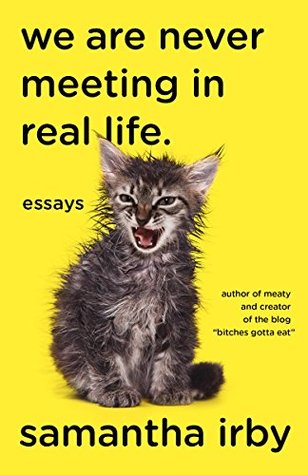
Her cover model represents the cat from hell, Helen Keller:

“’I know where they keep the euthanasia solution,’ I whispered into the downy fur on top of her head.”

Every book blogger knows the pressured feeling that comes with scooping up a galley right before publication. When I begin the book, all I want is to read it fast so I can review it in a timely manner; yet by the time I turn the final page, I am disappointed that we are done here.

Highly recommended to strong women with an offbeat sense of humor, and those that love them.

Dorothy Day: The World Will Be Saved By Beauty, by Kate Hennessy***

dorothydayDorothy Day is an interesting historical figure, the woman that founded The Catholic Worker, which was initially a combined newspaper, homeless shelter, and soup kitchen. I once subscribed to The Catholic Worker, and since it cost one penny per issue, you couldn’t beat the price. I saw this biography available and snapped it up from Net Galley; thanks go to them and Scribner, who provided me with a DRC in exchange for an honest review. This title was published in late January and is now available for purchase.

I always had a difficult time getting a handle on what The Catholic Worker stood for. The name suggests radicalism, and indeed, Day was red-baited during the McCarthy era. Day was a Catholic convert and a strong believer in sharing everything that she had with those that had nothing. She worked tirelessly and selflessly, and despite often living an impoverished existence somehow made it into her eighties before she died, an iconic crusader who became prominent when almost no women did so independently—though she was no feminist, and believed that wives should submit to husbands. Since her demise, speculation has arisen as to whether she might be canonized.

What was that huge crash? Was it a marble statue being knocked the hell off its pedestal? Hennessy takes on the life and deeds of her famous grandmother with both frankness and affection. In the end, I came away liking Day a good deal less than I had when I knew little about her. Her tireless effort on behalf of the poor included anything and everything her very young daughter had in this world, and at one point she remarked that she felt unable to ask others to embrace a life of poverty if her child wasn’t also a part of that. It was a different time, one with no Children’s Protective Service to come swooping down and note that the child was sleeping in an unheated building in the midst of frigid winter; that there was no running water, since the building was a squat; that the only food that day was a single bowl of thin soup and perhaps a little hard bread donated from the day-old stores of local bakeries; that even small, personal treasures and clothing given the child by other relatives and friends would either be stolen by homeless denizens or even given away by her mother, a woman with the maternal instincts of an alley cat. Day did a lot of good for a lot of people, and no one can say she did it for her own material well being, but she more or less ruined her daughter’s life, and even when grown, Tamar’s painful social anxiety and panic attacks derailed her efforts to build a normal life for herself.

Nevertheless, the immense contribution that Day made at a time when the only homeless shelters were ones with a lot of rules and sometimes religious requirements cannot be overlooked. She is said to have had a commanding presence, endless energy (and the mood swings that accompany such energy in some people), and a mesmerizing speaking voice. Day’s physician also treated the great Cesar Chavez, and reflected that their personalities were a lot alike.

I confess I was frustrated in reading this memoir, because I really just wanted the ideas behind the Catholic Worker laid out for me along with the organizational structure. Was the whole thing just whatever Day said it was at the moment, or was there democratic decision making? I never really found out, although I gained a sense that the chaotic events shown in the memoir reflected an unarticulated organizational chaos as well. This is a thing that sometimes happens with religious organizations; the material underpinnings are tossed up in the air for supernatural intervention, and the next thing they know, there’s an ugly letter from the IRS.

Only about half of this memoir was actually about Day; my sense was that the author did a lot of genealogical research and then decided to publish the result. The first twenty percent of the book is not only about Day’s various romantic entanglements; a significant portion of the text is mini-biographies of those men, and frankly, I wasn’t interested in them. I wanted to know about Day. Later I would be frustrated when long passages would be devoted to other relatives and their lives. Inclusion of daughter Tamar was essential, because Dorothy and Tamar were very close all their lives and shared a lot, and so in some ways to write about one was to tell about the other. But I didn’t need to know about Day’s in-laws, her many and several grandchildren, and so on. I just wanted to cut to the chase, but given the nature of the topic, also didn’t want to read Day’s own writing, which has a religious bias that doesn’t interest me.

Those with a keen interest in Dorothy Day and the Catholic Worker may want to read this, because not many books are available that discuss her life and work. On the other hand, I don’t advise paying full cover price. Get it free or at a deep discount, unless you are possessed of insatiable curiosity and deep pockets.