Caste, by Isabel Wilkerson*****

Isabel Wilkerson is the author of the groundbreaking, bestselling Pulitzer winner, The Warmth of Other Suns, and when I read it, I understood that from then forward, I would read anything Wilkerson published. Here it is, and you must read it. You may want to put on a pair of oven mitts when you do, because it is hot enough to scorch your fingertips; Wilkerson doesn’t sugarcoat the truth. My thanks go to Net Galley and Random House for the review copy. It’s been perched in the top ten of every bestseller list since its August release, and you don’t want to miss out on it.

Wilkerson’s thesis is that Black people in the U.S. occupy, and have always occupied, the lowest position within our social and economic ranks; social class is changeable, but caste is fixed. She compares their positions to the Dalit, better known as the Untouchables, the lowest rung of the lowest caste in India, and to Jews during the Holocaust. If this seems like overkill to you, get this book and read it carefully. This writer is relentless when she seeks to prove a point. She documents, documents, and documents again. She turns all the stones, and nothing is left.

Her evidence is organized by eight key commonalities, which she refers to as “Pillars” of caste. These are aspects of society that are unchanging and that define the positions of those born into them. (She recognizes that there are other races in the US that suffer, but places Black people at the bottom of the order, and so this is where her focus is.) The more I read, the more convinced I am. This is not metaphor or hyperbole. These are literal truths, and by the time she is done, I am convinced that the US is guiltier than Germany, because Germany turned it around, whereas the US is still in denial.

The Warmth of Other Suns is absorbing and easy to read, its style near to narrative nonfiction. In contrast, Caste is brutally frank. Though Wilkerson salts her narrative with relatively minor personal vignettes, they don’t make it easier to read; if anything, they make it hurt worse. (The airline attendant that does his level best to send her to the back of the plane, even though she has a first class ticket; the plumber that assumes she is hired help rather than the homeowner; the man attending the conference at which she is to speak that asks her to freshen his drink…)

I find this material so painful that I realize I am avoiding my review copy in favor of gentler reads, and then I know I have to step it up. This is too important; there’s been too much rug-sweeping in this nation already, and we won’t change if we don’t recognize the reality in which we live. I resolve to read one chapter a day. One chapter, and then I can move to more congenial literature. By the time I reach the end notes, I feel as if I have witnessed a natural disaster, a typhoon perhaps, or an immense, life-ruining earthquake. I’ve never run from books about race in the United States, but having the truth condensed and presented as it is here has to change the way we think. African-American readers likely won’t be much surprised, and many may feel vindicated in the resentments that have built over the years. But I cannot imagine anyone reading this book and then forgetting what’s in it.

Black lives matter, my friends. They matter just as much as anyone else’s. If you are more concerned about broken windows than about generation after generation of Americans whose potential has been stunted and whose contributions have been minimized, then you need this book. If you know that what’s been happening to men and women of color in the USA is dead wrong but you have difficulty forming cogent arguments when you talk with others, you need this book. If you speak and read English and you have a pulse, you need this book. What more does it take?  Information is the root of social change. Here it is.

A Long Petal of the Sea, by Isabel Allende*****

Allende has long been one of the writers I admire most, one of the few novelists to gain permanent space on my bookshelves. Her stories are distinguished by her devotion to social justice issues, particularly in Latin America, and to feminism. She’s known in particular for her use of magical realism, which I confess makes me a little crazy when she imbeds it in her nonfiction titles, and also her wry, sometimes subtle humor. Much of what she writes is historical fiction, as it is here, and she is a stickler for accuracy. Her research is flawless. She has prestigious awards from all over the world. Literature teachers love her.

My thanks go to Net Galley and Random House Ballantine for the review copy. This book is for sale now.

In A Long Petal of the Sea, she takes on a particularly ambitious task, creating a fictional family and charting its course from Spain following the failure of the Spanish Revolution, to Chile, to other points in Latin America, and then back to Spain once more. There are a lot of characters to keep track of, with different threads for each that separate, then braid together again and so on. There are at least three generations here, but primarily the story is Roser’s.

It’s a well written story, though it is also the sort of literary fiction that takes a fair amount of stamina. If you’re in search of a beach read, this isn’t it. I confess I didn’t enjoy it as much as I often enjoy Allende’s work, but I also believe it’s unfair to judge an author solely by what they have already written. If this was the first book by this author that I had ever read, I would give it five stars, and so that is what I’ve done.

My one disappointment is that we don’t learn more about the Spanish Revolution and the Spanish Civil War. This is an event that’s very difficult to find in quality historical fiction and literary fiction, at least in English, and I was excited when I saw this book was based on it. Then by the 25% mark, we’re out of Spain and it leaves me sad, because I wanted to know more about that period and place.  I also missed the usual Allende humor, which she uses in other books to break up tense passages and shoot down sexist behavior in her characters; her last book, In the Midst of Winter, made me laugh out loud more than once. That humor is in short supply here. The feminist moxie, however, is in splendid form, and the class and internationalist perspectives that I treasure are alive and well.

A book should be judged on its own merits, and I’ve done that, but I want to add a shout out to an iconic writer who’s still publishing brilliant, ambitious books at the age of 78. My own goals for that age, should I be fortunate enough to see it: I’d like to be breathing; to be able to see and hear most of what’s around me; and I’d like to not be completely crazy. Publishing great literature? Perhaps not. I am delighted that Allende can do this, and I hope she has more stories in the works.

A note on the audio version: I supplemented my review copy with an audiobook I found at Seattle Bibliocommons. It’s an approachable way to get through a complex, multifaceted story, but I don’t like the way the reader voices the elderly male character. The harsh, guttural-sounding tones are too near to a stereotype. Happily, the story is mostly Roser’s, but the unfortunate noise pops in fairly regularly all the way through, and it makes for a less enjoyable listen. For those with the time and inclination for the print version, it may be your better choice.

For those that love epic historical fiction, I recommend this book to you, although if you haven’t read Allende, also consider some of her early work.

A Good Neighborhood, by Therese Anne Fowler*****

Therese Anne Fowler is a complete badass. I have never read her before, but you can bet your bottom dollar that I’ll read her next book. My thanks go to Net Galley and St. Martin’s Press for the review copy. You can buy this book now, and you should.

I don’t usually begin by discussing the narrative voice, but I’m doing it this time because it’s one of the most impressive aspects of this novel. The story is told in the second person, but the point of view shifts seamlessly from that of the neighbors that are friends with a key character—I’ll get there in a minute—to an omniscient narrative, and I never catch the shift; by the time I realize a change has taken place, we’ve been there awhile. So, one minute, the narrative will say things like “All of us thought…” and “Everyone knew…” but later, we’ll be told what a protagonist is thinking. This is a risky way to write, and she’s carried it off so well that I can only bow in awe.

The story is, to some extent, a modern day Romeo and Juliet. It’s a tragedy, and we’re told this at the outset. The neighborhood in question is Oak Knoll, an old, established one in North Carolina. Valerie Alston-Holt is a forestry professor with a deep dedication to the environment; her son Xavier is gifted. Xavier’s father was Caucasian, but died when the boy was small, so it is just the two of them, mother and son. The new folks next door, the Whitmans, are a blended family. Julia, the mother, was living a hardscrabble life as a single parent with her daughter, Juniper, when the wealthy, charismatic Brad Whitman, who was her boss, married her. They have a small daughter together, but Brad has also adopted Juniper so that they can be a real family. Julia can hardly believe her good fortune. Her standard of living has risen beyond anything she ever dreamed.

The tension is there from the start. The Whitman home is out of character in comparison to the neighborhood, a garish, over-the-top McMansion built on a large lot created by tearing down the existing home that had been there. And the outcome of the construction is that a tree—a beloved tree—on the Alston-Holt property next door—is now dying.  The forestry professor sees an attorney, and the battle is joined.

Despite the tension between the adults, Xavier and Juniper are drawn to one another. They are teenagers, upperclassmen in high school, and they’re both squeaky clean kids, serious students. Neither has been in a serious relationship before. As we see their romance blossom, the narrator reminds us that this won’t end well.

I began this novel using my review copy, and although I could see it was going to be good, I was falling behind my reading for unrelated reasons. I scooped up the audio version from Seattle Bibliocommons, and so I can tell you that the reader does a wonderful job, and the story is well suited to this medium.

Fowler is an experienced writer, and it shows. There are several lazy stereotypes she deftly avoids. The Alston-Holts are middle class, not struggling financially. (Here I think of the new book, Caste, by Isabel Wilkerson, who reminds us that only one in five African-American families is poor.) Brad Whitman, who is a complete horse’s ass, is a charismatic Christian, but he is not a preacher, he’s a businessman.

Of course this story has a great deal to say about race and wealth, and how society empowers us according to these parameters. But because the characters are so intimately developed, so brilliantly fleshed out, the message integral to the story never feels like a manifesto. And reader, I’ll tell you, I’m a tough old granny who rarely is undone by a sad story, but I grew a little misty at the end of this one, and I thought about it for quite awhile afterward.

Highly recommended in whatever form you enjoy.

Africaville, by Jeffrey Colvin****

Narrated by Robin Miles

My thanks go to Net Galley and HarperCollins for the review copy; after publication, I used an audio book to finish it, thanks to Seattle Bibliocommons. It’s available to the public now.

There are two reasons I was drawn to this story. The first is the setting, which is primarily in Nova Scotia’s Black community. I have never read or heard a story set there, and so I was intrigued. There’s also a Civil Rights Movement tie-in, and for me, that sealed the deal.

The book starts out as a rough read, involving dead babies and “bad luck” babies that weren’t dead but needed killing. I was so horrified that I had to restart the book several times to get past it. Now that I have, I can assure you that once you’re past the introduction, that’s it. The dead babies are done. I’m not sure I would have lead off with this aspect, because I’m probably not the only reader to pick the book up and put it down fast. In fact, had I not owed a review, I would not have returned to it. I’m glad I did.

The story itself is ambitious, covering three generations of a family there. At the outset we have Kath Ella, who has ambition, but also a mischievous streak. I find this character interesting, but there are times when I don’t understand her motivation. The story is told in the third person and not all of her thoughts are shared with us, and so there are times when I’m left scratching my head. When the end of the book arrives, I’m still wondering.

Kath’s son and grandson comprise the second and third parts of the story; apparently the term used back then for passing as Caucasian was called “crowing,” and we see some of that. There are too-brief passages involving the Civil Rights Movement against Jim Crow in the Southern U.S., and I am disappointed not to see more about this or have the characters involved more deeply. What I do see of it is the surface information that most readers will already know.

Toward the end there’s a subplot involving getting an elderly relative out of prison, and I like this aspect of it, in particular the dialogue with the old woman.

The setting is resonantly described throughout.

All told, this is a solid work and a fine debut. I look forward to seeing whatever else Colvin has to offer. As to format, although Miles does a lovely job reading, something of the triptych is necessarily lost when we don’t see the sections unfold. For those that can go either way, I recommend the print version.

In the Neighborhood of True, by Susan Kaplan Carlton*****

“Shalom, y’all.”

Ruth Robb was born and raised in New York City, but following her father’s sudden death, she moves with her mother and sisters to Atlanta, where her mother’s family lives. The year is 1958. Almost immediately she is faced with a critical choice: should she quietly avoid mentioning her Jewish roots and allow her peers to make assumptions based on her grandparents’ standing in their Protestant church, or should she risk her newfound popularity with candor? My thanks go to Algonquin Books and Net Galley for inviting me to read and review. This book is for sale now.

The family has barely begun to grieve their loss. Everything is tossed into boxes and they leave New York, soon to be embraced by Ruth’s loving grandparents. Their new home, however, is almost too good to be true:  the house is large and luxurious, with a pool; her grandparents are generous and solicitous; their deep roots in the community make for nearly instant acceptance among the girls’ peers. But Ruth’s grandmother, called “Fontaine” within the family, has plans for Ruth and her younger sister, Nattie. They are enrolled in an elite Christian school, and Ruth is sent to private lessons for a “pre-debutante.” There’s a little pink book that serves as a grooming and etiquette guide, and it is specific and proscribed.

What isn’t in the pink book is the synagogue. Fontaine immediately informs the girls that they are, after all, “Half Christian,” but their mother quickly reminds her mother that she is a convert, and the girls are Jewish, period.

The characters are so resonant and believable that I find myself reflecting on the amount of stress that the girls, Ruth in particular, are experiencing. First, they must leave all of their friends, and the culture in which they’ve been raised, behind; their father is gone forever; and now there’s this tension between their loving grandmother, who provides them with everything, and their mother. This is not a dramatic conflict; but it shimmers under the surface constantly. They are a loving family, and they’re civilized. Yet Ruth is torn. But her nearly instant popularity galvanizes her, and she decides not to decide, by skating around questions of church and religion. After awhile her evasions become deception. Her mother is a discreet but unmovable force, with a sort of Jiminy Cricket demeanor: don’t forget who you are, Ruth. When are you going to tell your friends? What do they think you are doing on the weekend? The ante is upped when Ruth falls in love with Davis, who’s a big man on campus.

Things come to a head when the local synagogue is vandalized.

Carlton’s author blurb says that she had a similar experience, although she wasn’t the teenager, she was the mom. No doubt this is responsible for some of the story’s authenticity, but much of the compelling narrative has to be chalked up to excellent writing. There’s never a stereotype, and I never felt I was being lectured. Instead I am absorbed. What the heck is Ruth going to do? And though I am unfamiliar with Atlanta, there are several times when colloquial expressions that have fallen out of use pop into the story, expressions I recall from my early childhood in the 1960s. But the author never leans on pop cultural references; rather, they drop in naturally. It’s smooth as glass.

Sexual references tend toward the general; there is sex included, but not much detail. I include this information for teachers and parents considering including it in their libraries. If in doubt, read it before you present it to the young people in your life.

Since retiring from teaching language arts to adolescents, I have generally avoided reading young adult novels. I’ve been there and done that. But there’s an exception to everything, and I am glad I was given the chance to read this one. Highly recommended.

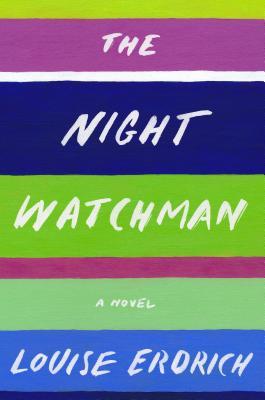
The Night Watchman, by Louise Erdrich*****

I cannot believe it has taken me this long to read the legendary novelist, Louise Erdrich. I had my reasons—wrong ones, as it turns out—and I am grateful to Net Galley and HarperCollins for the review copy, and thus helping me pull my head out of…the place where it was. This excellent novel is for sale now.

Let me explain, first off. Many years ago, I enrolled in an alternative graduate program that emphasized respect for all cultures and races, and which required, as a graduation requirement, attendance at a full day seminar listening to a locally famous Native storyteller.  The story was delivered in a monotone, with a good deal of repetition and no effort at summarization. So, after dutifully suffering through 6 hours of it on one of the hottest days of summer, I pledged to myself that I’d never go through that again.

Twice, good friends have urged me to read Erdrich’s novels, but I was also told she was an American Indian storyteller whose heritage formed a central theme in her writing. My eyes glazed over, and I vowed to give it a miss. When The Night Watchman drew early raves, I realized that my assumptions about Erdrich might be in error, and I hustled back to Net Galley to see if I might still score a galley. It’s a lesson well learned.

The year is 1953, and the place is the Turtle Mountain reservation in North Dakota. Patrice Paranteau has finished school, but she doesn’t want to get married. She has seen her friends do so and turn into old women overnight, shivering as they hang the wash to freeze dry in winter, and collecting snow to melt so that their children can take a bath. No thanks. Instead,

I cannot believe it has taken me this long to read the legendary novelist, Louise Erdrich. I had my reasons—wrong ones, as it turns out—and I am grateful to Net Galley and HarperCollins for the review copy, and thus helping me pull my head out of…the place where it was. This excellent novel is for sale now.

Let me explain, first off. Many years ago, I enrolled in an alternative graduate program that emphasized respect for all cultures and races, and which required, as a graduation requirement, attendance at a full day seminar listening to a locally famous Native storyteller.  The story was delivered in a monotone, with a good deal of repetition and no effort at summarization. So, after dutifully suffering through 6 hours of it on one of the hottest days of summer, I pledged to myself that I’d never go through that again.

Twice, good friends have urged me to read Erdrich’s novels, but I was also told she was an American Indian storyteller whose heritage formed a central theme in her writing. My eyes glazed over, and I vowed to give it a miss. When The Night Watchman drew early raves, I realized that my assumptions about Erdrich might be in error, and I hustled back to Net Galley to see if I might still score a galley. It’s a lesson well learned.

The year is 1953, and the place is the Turtle Mountain reservation in North Dakota. Patrice Paranteau has finished school, but she doesn’t want to get married. She has seen her friends do so and turn into old women overnight, shivering as they hang the wash to freeze dry in winter, and collecting snow to melt so that her children can take a bath. No thanks. Instead,

“She was the first person in the family to have a job. Not a trapping, hunting, or berry-gathering job, but a white people job. In the next town. Her mother said nothing but implied that she was grateful. Pokey had this year’s school shoes. Vera had a plaid dress, a Toni home permanent, white anklets, for her trip to Minneapolis. And Patrice was putting a bit of every paycheck away in order to follow Vera, who had maybe disappeared.”

The point of view shifts between Patrice; a local boy turned boxer, Wood Mountain; Haystack Barnes, the white math teacher and boxing coach; and Thomas, Patrice’s uncle, who is the night watchman at the jewel bearing plant. Thomas is modeled after Erdrich’s grandfather, and the author’s notes at the end mention that his struggle to save the Chippewa land made writing this book an emotional experience.  

As the story opens, Patrice is preparing to track down her sister, who is rumored to have had a baby in Minneapolis, and Thomas is organizing a group of Chippewa to attend the hearings in Washington, D.C. The Feds have sent a letter to the tribe suggesting that since they were clearly successful, they would surely no longer require government aid or protection. Their land would be absorbed by the U.S. government and then sold to private buyers; its current residents would be relocated to cities where they could get work. And it’s a measure of exactly how clueless the average American was about the Chippewas’ plight that Barnes, who lived and worked among them, said, “I don’t understand why it’s so bad. It sounds like you get to be regular Americans.”

There are other points of view as well; the most memorable are the Mormon missionaries that have drawn the short straw and been sent to minister to the “Lamanites.” This religion holds that the inferiority of American Indians is revealed holy truth; only by converting can they be salvaged, and when that happens, the new converts will slowly become whiter. Our two missionaries dislike each other profoundly, which is unfortunate since they may only separate from one another to use the toilet. When the main story becomes intense and at times, very sad, in will pop the missionaries and before I know it, I am laughing out loud.  In addition, I admire the way the strong female characters are developed.

There are three primary threads to follow: what Patrice decides to do with her future; whether Vera will be found; and whether the Chippewa of Turtle Mountain will lose their land. All are handled with the mastery one might expect from an iconic author.

Don’t be the idiot that I was. Get this book and read it now.

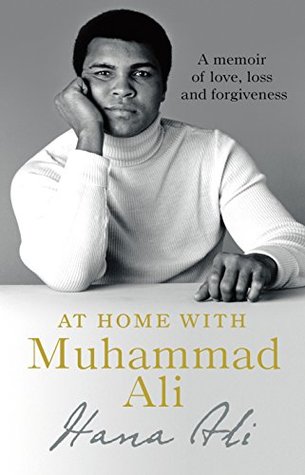
At Home With Muhammad Ali, by Hana Ali*****

Muhammad Ali is the sort of larger-than-life historical figure that nobody forgets. I was offered an opportunity to read and review this biography written by his daughter, Hana, and I jumped at the chance. Her recollections are bolstered by the vast archives that her father intentionally left, cassette tapes of every phone conversation that took place from his home, along with letters, photographs, and journal entries. Ali knew he was making history, and so he consciously left copious documentation behind. This wonderful book strikes the perfect balance, deeply affectionate and intimate, emotionally honest, yet never prurient or mawkish. My thanks go to the author for the beautiful hardcover copy, and for this opportunity.

A note before I continue: usually when I review a book, I refer to the author by his or her last name. In this case, however, the last name is shared by author and subject, and so when I use the name ‘Ali,’ I refer to the boxer, whereas I refer to his daughter and biographer by her first name.

I grew up in the 1960s and 1970s. I didn’t watch boxing, which my mother considered a nasty, violent sport; I was inclined to agree with her, and so when Dad turned on a boxing match on television, she and I beat a hasty retreat. However, it was impossible to miss my father’s agitated shouts at the TV whenever Ali was on it. Ali’s brash confidence, his refusal to humbly look at the floor while talking to white interviewers, his fervent proselytizing on behalf of the Muslim faith frightened a lot of Caucasians, particularly those who, like my family, lived a life that never intersected with people of races different from our own. But my father wasn’t just afraid of Ali; he was angry. How dare he! On television! He called him a clown; he called him an idiot. There was a lot of that going around at the time, as the Civil Rights Movement strove to change the racial contours of American society, not only in the Jim Crow South, but across the nation.

Many years later, when I began studying education in preparation for teaching public school, in particular language arts, American history and civics, one of the most critical parts of my own graduate school curriculum had to do with serving children from underserved racial and ethnic groups, and part of that was in holding up positive role models to foster self-esteem in every child. My classmates raised the name of Muhammad Ali, and I could see that they were right; say that name around any Black child, especially a little boy, and watch his chin raise perceptibly, his spine straighten, and a gleam come to his eyes. This is what interested me about Ali, not his athletic record, but his principled stand in regard to Civil Rights issues, and his assertion that Black men in America should walk tall.

As I began reading Hana’s glowing tribute to her daddy, I began to wonder more about his boxing career. Ali began boxing at age twelve! There’s a practice you won’t see today; but Louisville, Kentucky during the post-war boom was a much different place than anywhere in America today. By the time he was old enough to shave, he was already accomplished at his sport. And the more I read, the more convinced I was that I should not review this biography without watching some boxing. I went to YouTube over and over, and I watched Ali with Sonny Liston, with Joe Frazier, with George Foreman. I learned a lot about the sport, including the fact that it’s not really all that violent, and it involves just as much skill as other team sports. And also: that man was talented, and he was so damn smart.

And this is the side of Ali that the public never really saw. Who knew that he preferred brainy women with independent ideas? In the 1960s, this was a rare thing among men. Who knew that he wouldn’t let anyone, whether family or staff, raise a hand to his children? Nonviolent parenting all the way. There wasn’t much of that around back then, either. Part of his indulgent nature was due to his faith, but part of it was a deep fear that some hateful person would try to hurt him by kidnapping his daughters. Given the way Hana describes her childhood self, it might have become a Ransom of Red Chief situation. Among the mountains of documentation Ali saved is a hefty collection of letters sent home by preschools and schools decrying Hana’s scrappy behavior. Here’s one of my favorite excerpts from the recordings she shares:

“’Hana, say ‘I’m a good girl.’

“’I’m a good girrrrl.’

“’Say ‘I’m a pretty girrrrl.’

“’I’m a pretty girrrrl.’

“Say ‘I won’t bite the boys no more.’

“’I won’t bite the boys no more.’

“’Say ‘I won’t scratch the boys no more.’

“’I won’t scratch the boys no more.’”

Hana recalls him as a gentle father who remained available to his children despite his busy career; each day began with her careening down the stairs to find him in his den, where he might be having a phone conversation with one of many American celebrities as well as world leaders. He spoke with Brezhnev, Ghaddafi (who wanted to contribute to the war chest of a Black American presidential candidate), and Deng Xiao Peng, who wanted Ali to train Chinese boxers. He offered his services to President Jimmy Carter in the 1980s, hoping he might use his religion as a connection to the Iranians holding American citizens hostage.

In another section she recounts the time he happened by a police cordon. A man was out on a ledge of a skyscraper, threatening to jump; Ali persuaded the cops to let him get past the cordon and speak to the man. There are photographs of him holding the would-be jumper in his arms after he was rescued.

Whereas other public figures often bemoan their lack of privacy, Ali loved being famous, and he loved his fans. Sometimes he left home just to go out and find some of them and talk to them. It’s refreshing.

Yet Ali wouldn’t have been an easy man to be married to. Part of this dovetails with his generosity; he often tooled around in his Rolls Royce when he wasn’t training or working, and when he saw homeless people he’d load them into his car, bring them home, and put them in a guest room until he could arrange a lovely hotel suite for each of them. It’s a sweet gesture, but although Hana doesn’t mention how her mother reacted to it, I can tell you right now that for me, that would get old fast, coming home and not knowing how many strangers had taken up residence. And whereas Ali had more respect for the women in his life than most men did back then, his marriages were clearly never intended to be equal relationships.

But his relationship with Hana was an idyllic one, and this shows in the many engaging photographs that punctuate the text, one after another in which she and her father pose using identical body language, some of which are pretty funny. She also speaks with the pain she feels, even today, of her parents’ divorce, which she is convinced was primarily due to a misunderstanding.

There’s a great deal here about Ali’s religion; there’s really no way to tell his story without it, since it motivated nearly everything he did. There are places where I am ready to be done with it; but just when it threatens to slacken the pace of the narrative, Hana wisely segues on to other topics.

To remember Ali is to remember the virulence of the overt racism of twentieth century America. The way that the media played up every violent thing any Black man or boy did; the stereotypes involving the jungle, and the unpredictability of Ali’s personality, all served to underscore the false notion of hidden menace deep within the man. Ali is the first Black man I ever saw on television that didn’t keep his eyes down when talking to reporters, and who didn’t downplay his own strength. He scared a lot of Caucasian people half to death, merely by being successful, strong, and confident.

But Hana doesn’t dwell on any of the negative publicity; instead, she shows us who he really was. Ali loved to write poetry, for example, and he loved to read. He had never gained strong skills in spelling or grammar, so some of what he produced came out looking a little rough, and yet its merit is undeniable. What a voice! Who knew that a fun day out with his daughters often meant a trip to Barnes Noble to load up on good books?

The book’s ending is perhaps the most poignant of all. Hana recalls her father, an old man in his seventies, weakened by Parkinson’s, viewing footage of himself after the Foreman fight:

 “I wrestled with an alligator, and tussled with a whale. I handcuffed lightning and threw thunder in jail. Just last week I murdered a rock, injured a stone, and hospitalized a brick! I’m so mean I make medicine sick!”

Watching himself he muses, “Man, I was something!”

I defy you to finish this book without a lump in your throat or misty vision, as Hana tells us, “Sometimes I still feel like that five-year-old girl roaming the halls of a mansion, waiting for her daddy to come home.”

Highly recommended.

Dead Land, by Sara Paretsky*****

Detective Vic Warshawski was born in 1982, a time when a woman advocating for herself, or another woman, or women on the whole were few and far between. Such a woman often spoke softly, hesitantly, and to reassure the listener that she wasn’t stark raving mad, she might begin by saying, “I’m not a feminist or anything, but…” And so for the lonely few of us that were uncloseted, audacious feminists, this bold, brazen, unapologetic character was inspirational. Vic is fictional, but Paretsky is not. It was leading lights such as hers that made me feel less alone. I have loved her from then, to now.

Paretsky is no longer a young woman. I know this because I am a grandmother myself, and she is older than I am. For her readers that wonder if she’s still got it, I have great news. She’s better than ever.

By now I should have thanked William Morrow, Net Galley, and Edelweiss Books for the review copies. You can get this book April 21, 2020.

Victoria’s young goddaughter, Bernie Fouchard appears in an earlier story, and now she returns. Bernie’s youthful passion and impetuous disposition counter Vic’s experience and more measured responses. I liked Bernie when she was introduced, and am glad she is back. Chicago’s shady politicians are about to quietly sell a prime chunk of the city’s park lands to developers; the corrupt nature of the deal makes it essential that the whole thing be done fast and with as little publicity or public input as possible. Bernie and a handful of others learn of it, and they protest at a meeting at which the city fathers had hoped to slide this oily project through. There are arrests, and soon afterward, Bernie’s boyfriend is murdered.  

At the same time, Bernie tries to help a homeless singer named Lydia Zamir. Zamir is brilliant and was once very famous, but everything crumbled around the time that her lover was shot and killed; she’s been living under a bridge, filthy, disoriented, playing her music on a child’s toy piano. Now Lydia is missing. Lydia’s champion has been a man named Coop, and Coop is missing too. Before pulling a bunker, Coop deposits his dog outside Vic’s apartment, earning her the enmity of neighbors that are already up in arms over the barking of Vic’s own dogs when she is gone. Now Vic has every reason to help find Coop, Lydia, and the murderer. At the same time the reader must wonder how the sleazy deal, the murder, and the disappearances are connected. The pacing is urgent and my interest never flags; the haunting mental image of Lydia and her small, battered piano tug at my social conscience, all the more so as the world is hurtled into quarantine.

Long-running characters Lottie and Max, who are like parents to Vic, and newspaperman Murray, a close friend of Vic’s, return here, and I love them all. No doubt this colors my response as well. I have known these characters longer than my husband of thirty years; at one point I realized that somewhere along the line, I had separated the other books I was reading (some of them quite good) from this one. I had my books-to-read category, but I had mentally shifted this story into the same category as my family business. I should check on my sister, who’s been ill; I wanted to set a lunch date with one of my kids; and I should check and see whether Vic is having any luck finding…oh hey. Wait a minute.

Can you read this story as a stand-alone? You sure can. However, this bad-ass, hardboiled Chicago detective is an addictive character; once you’ve read it, you’re going to want to go back and get the other 21 in the series. I swear it. You probably won’t experience the nostalgia that I do, but a damn good read is a damn good read, any way you slice it.

Highly recommended.

Pride of Eden, by Taylor Brown*****

Taylor Brown is quickly becoming one of my favorite novelists. His 2018 book, Gods of Howl Mountain is one of my ten best loved books among the 1,300 I have reviewed since 2012, so I have been waiting for this book, and it does not disappoint. My undying thanks go to Net Galley and St. Martin’s Press for the invitation to read and review. This book is for sale today.

Pride of Eden is a wildlife sanctuary in Georgia, owned and run by a Vietnam vet named Anse. Anse has PTSD related to his service, and his most searing memory is of the loss of a service dog that sacrificed its life to prevent a soldier from being killed by an explosive device. Anse is a complicated character with a possible death wish, but this aspect of his character is never overplayed, and after a haunting, visceral passage at the beginning, it becomes a subtle quality that runs beneath the surface, as it likely would in real life.

Anse accepts animals of all sorts; some come from illegal private zoos, or from private owners that are surprised that their adorable lion cub has grown up to be a wild animal. But secretly, he is also a vigilante. When he sees an animal in need of rescue whose owner plans to keep it—or sell its dead body for parts—he creeps in at night and liberates it.

Tyler is the preserve’s veterinarian, a buff no-nonsense woman who is also Anse’s girlfriend. My favorite passage involving Tyler is when a man comes to see Anse, and Anse is in a mood and wants Tyler to get rid of the guy. Tyler pushes back; it might be important, and the man has traveled a long way to see him. Anse grudgingly tells her to “Send him in,” and Tyler fires back that she is “not your fucking secretary, Anse.” At the outset of the story, Tyler does not know that Anse does not acquire all of his animals legally.

The third main character is Malaya, who comes to the sanctuary looking for work:

  “What do you want to do?” he asked.

   “Anything.”

    “What are your qualifications?”

“Third infantry, two tours in Iraq. Honorable discharge. Then I contracted in South Africa, tracking ivory and rhino poachers.”

“You catch any of them?”

She uncrossed her arms, buried her hands in the pockets of her shorts. Anse could see her knuckles ridged hard against the denim. “Yes,” she said.

Malaya is complex as well. But I love Malaya not only for her meaty internal monologue, but for the things she isn’t. Most male authors (and some female ones too) wouldn’t be able to resist these tired elements, and once again I admire Brown’s respect for women, which shows vibrantly in the way he frames his characters. Malaya is not romantically interested in Anse, nor does she try to mother him. Malaya and Tyler are not jealous of one another, and they do not compete. Both characters are buff and intelligent, and at no time do they have to be rescued by men. As a result, I could appreciate this story as it unfolded without the distraction of stereotypes or overused, sexist plot devices. Neither female character is motivated by sexual assaults in her past.  

The other two characters are Horn, another damaged vigilante that collects wild animals, and Lope, Anse’s driver, who helps him move large animals.

This is not an easy read. It will attract Brown’s fans, of course, and also animal lovers; yet those same animal lovers have to wade through an awful lot of sorrow, as the story is rife with tales of animal abuse. Brown’s purpose, apart from writing outstanding fiction, is likely to raise awareness of poachers that kill endangered animals for profit, and of private game reserves that send semi-tame animals to an enclosure so that wealthy ass hats can bag some big game, take that animal’s head home to hang in the den.

 Yet there’s nothing at all here that is included to be prurient or sensationalistic; every word has a purpose, either to develop a character or drive the plot forward, or both.

My emotions run the full gamut as I am reading, and this is a sign of excellent literature. I laugh out loud a couple of times; at others, the prose is so painful that I have to walk away for awhile and then come back. But I am never sorry to be reading it. The ending is so deeply satisfying that I want to high-five someone, but alas, I am reading it alone.

Once again, Brown’s novel is destined to be one of the year’s best reads. I highly recommend it.

Fight of the Century, by Michael Chabon et al*****

In celebration of the 100th anniversary of the American Civil Liberties Union, a large cross section of the finest writers alive have written essays, each about one landmark case. Chabon and his co-editor, Ayelet Waldman, contributed their advance to the organization, and all of the contributing authors did so free of charge. As for this reviewer, I’d have been interested in an ACLU publication, even if I hadn’t heard of the writers involved; and I’d have been interested in anything written by Chabon, even if the story or topic wasn’t in my lane. As it is, I count myself beyond lucky to have scored a review copy courtesy of Net Galley and Simon and Schuster. It’s for sale now.

This is the sort of book that invites skipping around, either according to subject, or according to the authors you love best. Because of this, I recommend buying it in paper rather than digitally, because flipping around out of order in digital format is a pain in the butt. Also, this is the sort of classical reference material that you’d want on your shelf. In fact, I want a physical copy for myself.

I haven’t read all of the entries, but I’ve read enough of them to recommend it to you. The cases discussed are meaty and interesting, and they aren’t the standard fodder that shows up in every undergraduate course on Constitutional law. Each entry is succinct, and the writers refrain from self-promotion. The entries I appreciate most so far are by Jesmyn Ward, who discusses the use of anti-loitering laws to transform free Black boys and men into slave laborers; Timothy Egan, who details a 1962 decision regarding the right to receive Communist literature in the U.S. mail; and Louse Erdrich, who discusses digital snooping and surveillance used against the Dakota Pipeline protesters in 2016. I know there are many more I want to read, but I am posting this now so that you can get a copy while it’s in the stores.

Here’s your chance. You can get an outstanding addition to your home library while contributing to a worthwhile organization whose work is more crucial now than ever. Highly recommended.