The Autobiography of Mother Jones, by Mary Harris Jones*****

Note: I wrote this review before I began this blog, and I was shocked when I found I had somehow not included it here. There’s no disclosure regarding a review copy, because I didn’t get one. I bought this book and paid full cover price, and I will keep it until it is pried from my cold, dead hands.

Mother Jones has been called “the most dangerous woman in America”. Some refer to her as an anarchist, but in her autobiography, she denounces anarchism, though allows that these folks have their hearts in the right place. She has been called a syndicalist (which is probably closer to the truth), but the fact is that she was motivated by what she saw right there on the ground in front of her. When the Russian Revolution unfolded, she was by her own account past 90, and by the account of another biographer, in her mid-80’s, so either way, she was very, very elderly, yet she championed its achievement at the Pan-American labor conference held in Mexico:

“…a new day, a day when workers of the world would know no other boundaries than those between the exploiter and the exploited. Soviet Russia, I said, had dared to challenge the old order, had handed the earth over to those who toiled upon it, and the capitalists were quaking in their scab-made shoes.”

Jones’ career as a political organizer began shortly after she turned 30. She was a married woman, her husband an iron worker, and she stayed home with their four small children. “Yellow fever” (which I think is malaria) came and killed her whole family, and then as if that wasn’t enough, the great Chicago fire swept away her home and all her possessions.

Some would have turned to suicide. Some would have gone looking for an elderly widower to marry. Some would have gone off to find distant relatives and live with them as little more than domestic servants.

Jones reinvented herself and gave the next fifty-plus years of her life to making the world a better place.

Still clad in a widow’s black garments, she put her hair up in a chaste bun and left Mary Harris Jones behind. From this time forward, she would be “Mother Jones”. Think of it! The cinders from the American Civil War were barely cold, and women had no position in American political life, including the labor unions. Yet by becoming a mother to workers everywhere, including the women and small children laboring in mines and textile mills, she became a force to be reckoned with. It was a brilliant piece of theater, entirely sincere in its intention and in many cases successful. She was one of the most ardent champions of the 8 hour day:

“The person who believed in an eight-hour working day was an enemy of his country,a traitor, an anarchist…Feeling was bitter. The city [Chicago] was divided into two angry camps. The working people on one side–hungry, cold, jobless, fighting gunmen and policemen with their bare hands. On the other side the employers, knowing neither hunger or cold, supported by the newspapers, by the police, by all the power of the great state itself.”

When Mother speaks, people feel they should listen, and if she speaks in their better interests, they listen harder. And in the early days, at least, the boss’s goons and the local law thought twice about putting a hand on Mother. It wasn’t nice!

Later, as her impact on their wallets hardened their resolve, they would deal with her less gently. She didn’t care. She spent nights in jail when she could have left town instead. Sometimes she traveled into a coal mining enclave where every bit of property besides the public roads was owned by the mine owners. Even homes that had been rented to miners were closed to her, as was made clear enough to break almost anyone’s heart. She describes a mining family that held a union meeting at which she was present in the coal fields of Arnot, Pennsylvania. The following day the company fires and evicts the family, and “they gathered up all their earthly belongings, which weren’t much…and the sight of that wagon with the holy pictures and the sticks of furniture and the children” made the local miners so angry that they decided to strike and refuse to go back to work till their union was recognized.

The quote most well known that shows up on tee shirts, posters, and coffee mugs among the liberal and radical milieu today is knocked clean out of context, in my view. “Pray for the dead and fight like hell for the living” was delivered in order to get working men out of the local church, where the priest was trying to cool down the heat and persuade the coal miners to wait for a reward in heaven. “Your organization is not a praying institution,” she reminded them, “It’s a fighting institution!” She tells them to leave the church and meet in the local school, which their own tax dollars had bought. And she later tells other miners that striking is done to provide “a little bit of heaven before you die.”

From Chicago to the coal fields of West Virginia, from New Mexico to Pennsylvania, she was found among railroad men and their families, machinists, textile workers, and above all, miners. She had no use at all for union officialdom, and though she occasionally praised a senator or governor who saw the light of day and called off the hounds of vengeance so that unions could be organized and the workers represented, more often than not she saw them as perfidious and untrustworthy.

When Eugene Debs became a candidate for U.S. president, she embraced his campaign, though she stayed among the workers, which I think was the correct thing to do. But when Debs comes to speak to coal miners and the union officialdom wants to meet his train quietly with a few representatives, Jones proposes all the union members go to greet him. They stampede down to the train, leap over the railings, and lift Debs onto their shoulders, she says, shouting, “Debs is here! Debs is here!”

I could have been finished with this slender volume quite quickly if I hadn’t been making notes (most of which, as usual, I cannot fit into my review, but then I should leave you some choice tidbits to find for yourself, and there are still many of them!) The chapters are brief, and so the book can be read just a few minutes at a time. And the introduction is written by one no less auspicious than Clarence Darrow himself.

You may look at the price and wonder whether you should pay that price for this slender little volume. The answer is, oh hell yes. Please remember that the words of the woman herself are worth twice as many from some armchair hack who wants to pick it apart and wonder whether she was really 83 or 85 at such-and-such moment? Spare yourself the blather and go straight to the primary source. It’s worth double the cover price!

The Four Winds, by Kristin Hannah****-*****

“‘My grandfather was a Texas Ranger. He used to tell me that courage was a lie. It was just fear that you ignored.’ She looked at him. ‘Well, I’m scared.’

‘We’re all scared,’ he said.”

Kristin Hannah’s electrifying new novel, The Four Winds, is set during the Great Depression in the American Dust Bowl and California. It’s a story about courage, and about the ways that love can transform us. My thanks go to Net Galley and St. Martin’s Press for the invitation to review. It’s for sale now.

Elsa is born into a wealthy family, but this doesn’t do her much good. She is tall, ungainly, and considered homely by her parents, a contrast to her two younger, more adorable sisters. She was very ill when younger, and the family liked having her tucked away in her room so much that they would like her to remain there. When company comes over, it is suggested that she go “rest.” Affection and kindness are denied her entirely.

One day, in a fit of unheard-of rebellion, she buys herself a silk dress and sneaks out to a speakeasy. There she meets Rafe, and before long she is rolling in the hay. When the morning sickness comes upon her, her furious father drives her to the Martinelli farm, (“Italians, no less!”) and she is unceremoniously dumped there. The baby is a Martinelli, he tells them, and it—and its mother—are your problem now.

Rose and Tony Martinelli are not affluent like Elsa’s parents; she learns to haul water and do farm chores, and she learns how to make delicious, cheap food the Italian way. But her father’s abandonment is a blessing in disguise, because the Martinellis are good people. She is happy there with them. She marries Rafe, and she bears two children. But the land has been over-farmed, and soon the dust storms come and destroy nearly everything they have built:

Past the outhouse, a murky, urine-yellow haze burnished the sky. Wind picked up, barreled across the farm from the south. A board flew off the chicken coop and cracked into the side of the house. Rafe and Tony came running out of the barn. The cows mooed angrily and pushed into each other, pointing their bony butts into the dust storm.

The door opened. Rose yanked her to her feet, pulled her into the rattling, howling house.

Elsa and Rose ran from window to window, securing the newspaper and rag coverings over the glass and sills. Dust rained down from the ceilings, wafted from infinitesimal cracks in the window frames and walls. The candles on the makeshift altar blew out. Centipedes crawled out from the walls, hundreds of them, slithered across the floor, looking for somewhere to hide.

A blast of wind hit the house, so hard it seemed the roof would be torn off. And the noise. It was like a locomotive bearing down on them, engines grinding. The house shuddered as if breathing too hard; a banshee wind howled, mad as hell.

Friends, this isn’t even the climax. This is sixteen percent of the way into the story. And misery and tribulation continue to rain down on this poor little family and thousands more like them. The crops die, and the livestock that doesn’t starve is killed by breathing dust. Children, including Elsa’s little boy, fall ill with dust pneumonia; no matter how hard they try to prevent it, so much dust is in the atmosphere that it makes its way into the lungs, and so the youngest and oldest are soon in trouble.

The first half of this novel is a rough read. There’s sorrow, and suffering, and loss, and grief, and I find myself eyeing the page numbers and thinking to myself that if this were written by anybody else, and if I didn’t owe a review, I probably wouldn’t finish it, because who wants an entire story of this? But at about the halfway mark, things begin to change.

By now, Rafe has hit the bricks. Never a man of character or great resolve, he sneaks off into the night, leaving the three remaining adults to care for the children and the farm. And it is now that change takes place. Without Rafe to anchor the family as is traditional during this period, Elsa is left to make the decisions about her children’s futures, and in doing so, she changes.

Hannah portrays the Depression era American West vividly and accurately, and this is when the story grows legs. The plight of agricultural workers is likewise dealt with in clear, immediate detail. My one quibble, and it is the source of the missing half star in my rating, is her inexpert portrayal of Communism, which plays more than a passing role in the last thirty percent of the story. The first time I saw farmworkers’ struggles as “shutting down the means of production,” I cleared my throat, but I told myself it was possibly a typo that might be edited out in the finished version. The next two times I saw it, I started making notes. This is not a technical error; this is a dumb-butt error (trying to elude the censors here) that should have been caught on the first pass, and because it appears when the climax ramps up, it is a distraction that interferes with the flow of the narrative.

Nevertheless, this is a well-written novel, set during an interesting time period. Particularly arresting is the development of the relationship between Elsa and her adolescent daughter, Lareda, whose point of view is shared alternately with Elsa’s.  Setting, character, and plot work together seamlessly to enforce one another and move the story forward, yet if I had to hang my hat on one laudable aspect of this book, it would be character development.

I strongly recommend this novel to you.  

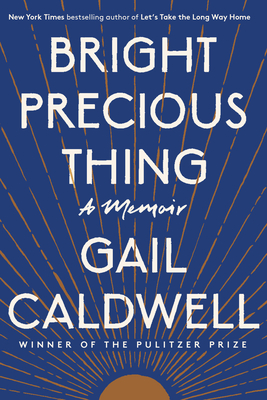
Bright Precious Thing, by Gail Caldwell*****

My thanks go to Net Galley and Random House for the invitation to read and review. This book is for sale now.

Gail Caldwell was the chief book reviewer for The Boston Globe, and she won the Pulitzer for Criticism. Once I began reading this luminous memoir, I could see that level of quality in her prose. She writes about her childhood in Texas, and about her travels and experiences growing up in the mid-twentieth century. More than anything, this is a feminist memoir, a chance to see how far we have come through a personal lens.

I missed the publication day here, and so I hunted down the audio version to supplement my reading. The author narrates her own work, and so it conveys the feeling that I am sitting by the fire with a dear friend, hearing about the challenges she’s faced as a single woman. Female readers will recognize the sensation: you start talking with a woman that you don’t really know, and before you know it you are talking and listening as if you’ve known one another for ages. That’s the essence of this book. In fact, I listened to it in the evening while preparing dinner, because I knew I’d be left alone during that time, and frankly, I didn’t want anybody to come barreling into the middle of my time with Gail. There’s a sense of intimacy that makes me feel a bit protective when I listen to it. Later, I go over what I’ve read and nod. Yes. Oh, yes, I remember that.

The title works in a number of ways. The darling little neighbor girl that becomes part of the family Gail chooses, bookends the memoir, coming in at the start as a very young person and ending it as an adolescent. But there’s more to it than that; life is a bright precious thing, and though she never says it overtly, I recognize that each woman is a bright precious thing as well.

I am a grandmother myself, but Gail is about the age to be my older sister. Women like Gail gave women like me a guiding light during our coming-of-age years. Our mothers were often resigned to their status as second class citizens, and ready to accept that there were things that women should probably not even try to do, and they couldn’t help transmitting their fears and reticence to us. It is women like Marge Piercy, Gloria Steinem, Wilma Mankiller, and yes, Gail Caldwell that provided us with a beacon, a way forward through the ocean of “no” to the bright shores of “yes,” that gave us courage to be insistent, even when we knew some would label us pushy broads, or worse. We needed role models badly, and they stepped up. They’re still doing it.

The calm, warm tone that came through this audio book, right during the turbulent period after the November election, was an absolute balm.   Sometimes I would be shaken by the things I saw in the national news, and then I would head for my kitchen (perhaps an ironic place to receive a feminist memoir, but it worked for me,) and once I had had my time with Gail, I knew I’d be all right.

Highly recommended to women, and to those that love us.

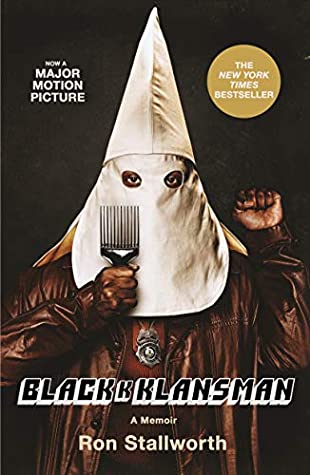
Black Klansman, by Ron Stallworth****

I was intrigued when I saw this book, and so I checked out the audio version, which the author reads himself, from Seattle Bibliocommons. It is one of a kind.

My first question, upon seeing the premise, is since when the FBI has any interest in busting the Klan or other White Supremacist organizations. Generally they chase activists on the left, and give those on the ultra-right a pat on the head and a cookie. This is addressed in short order, as the author explains it is his own idea. He initiates it when he learns how easy it is to join the Klan, and once he has access, his bosses agree to let him pursue it. And understand this: he is the only Black FBI agent in Colorado, and there is at least a wee bit of pressure on the Feds to increase their diversity just a wee. So for a brief and shining time, Stallworth is permitted to chase this lead.

The way Stallworth is able to join is that his membership interview is a phone call. At this time, there aren’t a lot of Klan members in the Rockies, and they’re spread thin. When the occasion arises for him to show up in person, he sends another agent, then takes over again on phone and through the US mail. (Heaven knows how this would shake out today; this would be difficult on Zoom.)

The memoir is important to write, because just as he is closing in hard on illegal activity that might result in arrests, he is called off by the brass, and he’s ordered to destroy every speck of research and evidence he’s compiled. Without this memoir, nobody would ever know it even happened. What a crock. What a bitter pill. I feel sick for him.

The audio is delivered in a wheezy, laconic narrative that sounds a lot like an old man sitting on his front porch telling the neighbors about his proudest exploits. It works for me.

Highly recommended.

Love and Other Crimes, by Sara Paretsky*****

Sara Paretsky is a venerable author, one who—along with the late, great Sue Grafton—reframed the role of women in detective fiction nearly forty years ago. When I saw this collection available for review on Edelweiss, I jumped on it. It’s for sale now, and you should get it and read it—although there’s a caveat coming up that should be considered first.

Sometimes when a favorite writer releases a book of short stories, I find that I’ve already read a lot of them in one form or another. This time, nearly every story is new to me. One forms the basis of a full length book that I read a long time ago and have forgotten much of. Another is a reworked version of the short story “Wildcat,” which I purchased a short time ago. These are the only duplicate stories I can detect, and I am a voracious reader where this author is concerned.  Some of her work was included in Sisters in Crime anthologies, but I haven’t seen them. Not all of them feature the iconic V.I. Warshawski. The signature elements that include social justice issues such as women’s rights, immigration, racism, and the homeless are here in abundance, as one might hope.

My favorite selection is the second, “Miss Bianca,” a mystery in which a little girl saves a research rat and ultimately uncovers a dangerous conspiracy. Paretsky gets the tone of the child’s voice just right, making her bright within the bounds of what a child that age is capable of, and registering the thought processes and perceptions of her protagonist flawlessly.

There’s an historical mystery that involves a Sherlock Holmes retelling, and like all of that ilk, it bored the snot out of me, a first where this writer is concerned. I abandoned it halfway through. The five star rating is unchanged, because the reader can skip this story and still get her money’s worth and then some; also, I am aware that not everyone is as averse to this type of writing as I am.

Another story is set during the late 1960s, and the Civil Rights Movement is center stage. In order to convey the horror of the backlash by some Caucasian Chicagoans during this tumultuous period, the *N* word is included several times. I used the audio version of this book for some of the stories, including this one, and I feel as if it should have a warning sticker of some sort because hearing that word shouted angrily sent a cold finger right up my spine, and I don’t like to think of other readers, especially Black readers, listening to it within the hearing of their children. I don’t deduct anything from my rating, because the author includes a note about its use and her reasons for it at the end of the story; in fact, there is an author’s note at the end of many of these that makes the story more satisfying. But you should know that this word is there, so be ready for it.

When all is said and done, there are few authors that can deliver the way Paretsky can. With the considerations above included, I highly recommend this collection to you.

One to Watch, by Kate Stayman-London*****

I’m not usually a romance reader, but when I saw the plus-sized woman on the cover of this novel, I was mesmerized. My thanks go to Net Galley and Random House for the review copy. This book is for sale now.

The premise is that Bea Schumacher, a successful plus-sized fashion blogger, is invited to be the subject of a season of Main Squeeze, which is a fictional reality show on the lines of The Bachelorette. I have been yearning for a proud, plus-sized protagonist since I read a novel last summer featuring a main character that used to be quite large. I didn’t want a protagonist that had a history of being big as her private, shameful secret. I wanted a protag that is plus-sized right now and fine with it. So I wasn’t drawn in by genre or the tie to reality television; I was hooked by the protagonist’s size.

Bea has never had a serious romantic relationship, and has just had her heart stomped on hard by a lifelong male friend. Bea had seen—or thought she had seen—their friendship evolving into something more, and after one magic night, she was sure her dreams had come true. Then the man of her dreams took off running and quit taking her calls. It would shake any woman.

But Bea has established herself as a serious force in social media, and a major reality program has come knocking. Isn’t it about time to have a plus-sized Bachelorette—er, Main Squeeze? With plus-sized courage, Bea throws her hat into the ring, but she also reminds herself that this is surely not the way to find real and lasting love; she is doing this to build her brand, and when it’s over, she’ll go back to her blog with lots of new followers. The only problem is that the audience is not so stupid that they can’t see what she’s doing. Ratings drop like a rock because Bea is obviously phoning it in, and the program director lets her know that she either needs to engage emotionally, or act like she’s doing so. No actor, Bea cracks open the door to her heart.

The readers most likely to enjoy this book are plus-sized women, and I have to tell you, there are some ugly remarks made by members of the public that are especially hard to read. It’s nothing we haven’t seen before, ladies, but it still hurts every stinking time. So there’s that.

But when all is said and done, I like this book a lot. Yes, it’s a light read in most ways; I don’t rate novels on the seriousness of their content, but rather on whether they represent the best of their genre. This book is a beach read perhaps, or a light romance, but the meaty social issues that are woven into it make it more-than. In the end I found it uplifting, and in this difficult year, that’s the kind of read I’m looking for.

A note on the audio version. Since I missed the pub date, I procured a copy of the audio version at Seattle Bibliocommons, and then immediately knew two things: first, that I HAD to read this book right away, not for the author or publisher, but for myself; and second, that this book is absolutely not suited to the audio format. It’s not the narrator’s fault; the text is liberally sprinkled with social media posts and parts of TV dialogue, and when read aloud it sounds artificial and disjointed. I promptly sent the audio version back and moved the digital galley to the top of my queue. If you read it, read it. It’s no good as an audio book.

That said, this book makes my plus-sized heart sing, and if you can use some of that, get this book. You’ll be glad you did.

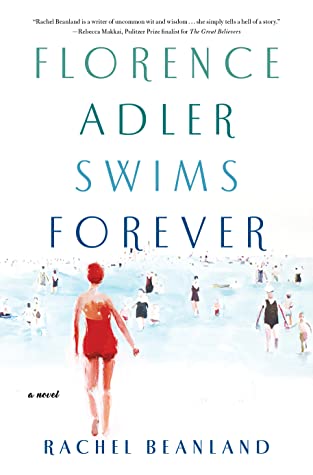
Florence Adler Swims Forever*****

It’s hard to believe that Florence Adler Swims Forever is a debut novel. Rachel Beanland has stormed our literary beaches, and I hope she does it forever. Big thanks go to Net Galley and Simon and Schuster for the review copy. This book is for sale now.

The title character dies almost immediately, which is a bit unusual all by itself. The central storyline centers on Fannie, Florence’s sister, who is in the midst of a dangerous pregnancy. She’s already had one premature baby that died at 3 weeks, and so this one Is being closely monitored. Because of this, the family closes rank in order to prevent Fannie from knowing that Florence has died until after the baby’s birth, lest she miscarry. However, Fannie isn’t the main character; the point of view shifts between the present and the past, from one family member to another, eight all told, in fairly even fashion.

My first reaction to this premise—keeping her sister’s death from Fannie for what, two months—is that it’s far-fetched to think such a plan could succeed. But as the story unfolds, I realize that information was not a constant presence during the late 1930s, as it is now. There was no television yet; a radio was desirable, but not everyone had one. Fannie asks for a radio for her hospital room, but she’s told they’re all in use. Too bad, hon. Newspapers and magazines were explicitly forbidden for visitors to bring in; the lack of news is explained in general terms as “doctor’s orders,” and back then, doctors were like little gods. If “Doctor” said to jump, everyone, the patient most of all, leapt without question. And then I see the author’s note at the end, that this story is based on an actual event from her family’s history! It blows me away.

Besides Fannie and Florence, we have the parents, Joseph and Esther, who have a meaty, complicated relationship; Fannie’s husband Isaac, who is an asshole; Fannie and Isaac’s daughter, Gussie, who is seven; Florence’s swim coach, Stuart; and Anna, a German houseguest whose presence creates all sorts of conflict among the other characters. Anna’s urgent need to help her parents immigrate before terrible things happen to them is the story’s main link to the war. All characters except Stuart are Jewish.

Because I missed the publication date but was eager to dive into this galley, I supplemented my digital copy with an audiobook from Seattle Bibliocommons. This is a wonderful way to read, because when something seems unclear to me, I can switch versions, and in the end, I feel well grounded. The audio version is read by eight different performers, and the result is magnificent.

Read it in print, or listen to the audio; you really can’t go wrong. The main thing is that you have to read this book. As for me, I’ll have a finger to the wind, because I can’t wait to see what Beanland writes next.

Caste, by Isabel Wilkerson*****

Isabel Wilkerson is the author of the groundbreaking, bestselling Pulitzer winner, The Warmth of Other Suns, and when I read it, I understood that from then forward, I would read anything Wilkerson published. Here it is, and you must read it. You may want to put on a pair of oven mitts when you do, because it is hot enough to scorch your fingertips; Wilkerson doesn’t sugarcoat the truth. My thanks go to Net Galley and Random House for the review copy. It’s been perched in the top ten of every bestseller list since its August release, and you don’t want to miss out on it.

Wilkerson’s thesis is that Black people in the U.S. occupy, and have always occupied, the lowest position within our social and economic ranks; social class is changeable, but caste is fixed. She compares their positions to the Dalit, better known as the Untouchables, the lowest rung of the lowest caste in India, and to Jews during the Holocaust. If this seems like overkill to you, get this book and read it carefully. This writer is relentless when she seeks to prove a point. She documents, documents, and documents again. She turns all the stones, and nothing is left.

Her evidence is organized by eight key commonalities, which she refers to as “Pillars” of caste. These are aspects of society that are unchanging and that define the positions of those born into them. (She recognizes that there are other races in the US that suffer, but places Black people at the bottom of the order, and so this is where her focus is.) The more I read, the more convinced I am. This is not metaphor or hyperbole. These are literal truths, and by the time she is done, I am convinced that the US is guiltier than Germany, because Germany turned it around, whereas the US is still in denial.

The Warmth of Other Suns is absorbing and easy to read, its style near to narrative nonfiction. In contrast, Caste is brutally frank. Though Wilkerson salts her narrative with relatively minor personal vignettes, they don’t make it easier to read; if anything, they make it hurt worse. (The airline attendant that does his level best to send her to the back of the plane, even though she has a first class ticket; the plumber that assumes she is hired help rather than the homeowner; the man attending the conference at which she is to speak that asks her to freshen his drink…)

I find this material so painful that I realize I am avoiding my review copy in favor of gentler reads, and then I know I have to step it up. This is too important; there’s been too much rug-sweeping in this nation already, and we won’t change if we don’t recognize the reality in which we live. I resolve to read one chapter a day. One chapter, and then I can move to more congenial literature. By the time I reach the end notes, I feel as if I have witnessed a natural disaster, a typhoon perhaps, or an immense, life-ruining earthquake. I’ve never run from books about race in the United States, but having the truth condensed and presented as it is here has to change the way we think. African-American readers likely won’t be much surprised, and many may feel vindicated in the resentments that have built over the years. But I cannot imagine anyone reading this book and then forgetting what’s in it.

Black lives matter, my friends. They matter just as much as anyone else’s. If you are more concerned about broken windows than about generation after generation of Americans whose potential has been stunted and whose contributions have been minimized, then you need this book. If you know that what’s been happening to men and women of color in the USA is dead wrong but you have difficulty forming cogent arguments when you talk with others, you need this book. If you speak and read English and you have a pulse, you need this book. What more does it take?  Information is the root of social change. Here it is.

A Long Petal of the Sea, by Isabel Allende*****

Allende has long been one of the writers I admire most, one of the few novelists to gain permanent space on my bookshelves. Her stories are distinguished by her devotion to social justice issues, particularly in Latin America, and to feminism. She’s known in particular for her use of magical realism, which I confess makes me a little crazy when she imbeds it in her nonfiction titles, and also her wry, sometimes subtle humor. Much of what she writes is historical fiction, as it is here, and she is a stickler for accuracy. Her research is flawless. She has prestigious awards from all over the world. Literature teachers love her.

My thanks go to Net Galley and Random House Ballantine for the review copy. This book is for sale now.

In A Long Petal of the Sea, she takes on a particularly ambitious task, creating a fictional family and charting its course from Spain following the failure of the Spanish Revolution, to Chile, to other points in Latin America, and then back to Spain once more. There are a lot of characters to keep track of, with different threads for each that separate, then braid together again and so on. There are at least three generations here, but primarily the story is Roser’s.

It’s a well written story, though it is also the sort of literary fiction that takes a fair amount of stamina. If you’re in search of a beach read, this isn’t it. I confess I didn’t enjoy it as much as I often enjoy Allende’s work, but I also believe it’s unfair to judge an author solely by what they have already written. If this was the first book by this author that I had ever read, I would give it five stars, and so that is what I’ve done.

My one disappointment is that we don’t learn more about the Spanish Revolution and the Spanish Civil War. This is an event that’s very difficult to find in quality historical fiction and literary fiction, at least in English, and I was excited when I saw this book was based on it. Then by the 25% mark, we’re out of Spain and it leaves me sad, because I wanted to know more about that period and place.  I also missed the usual Allende humor, which she uses in other books to break up tense passages and shoot down sexist behavior in her characters; her last book, In the Midst of Winter, made me laugh out loud more than once. That humor is in short supply here. The feminist moxie, however, is in splendid form, and the class and internationalist perspectives that I treasure are alive and well.

A book should be judged on its own merits, and I’ve done that, but I want to add a shout out to an iconic writer who’s still publishing brilliant, ambitious books at the age of 78. My own goals for that age, should I be fortunate enough to see it: I’d like to be breathing; to be able to see and hear most of what’s around me; and I’d like to not be completely crazy. Publishing great literature? Perhaps not. I am delighted that Allende can do this, and I hope she has more stories in the works.

A note on the audio version: I supplemented my review copy with an audiobook I found at Seattle Bibliocommons. It’s an approachable way to get through a complex, multifaceted story, but I don’t like the way the reader voices the elderly male character. The harsh, guttural-sounding tones are too near to a stereotype. Happily, the story is mostly Roser’s, but the unfortunate noise pops in fairly regularly all the way through, and it makes for a less enjoyable listen. For those with the time and inclination for the print version, it may be your better choice.

For those that love epic historical fiction, I recommend this book to you, although if you haven’t read Allende, also consider some of her early work.

A Good Neighborhood, by Therese Anne Fowler*****

Therese Anne Fowler is a complete badass. I have never read her before, but you can bet your bottom dollar that I’ll read her next book. My thanks go to Net Galley and St. Martin’s Press for the review copy. You can buy this book now, and you should.

I don’t usually begin by discussing the narrative voice, but I’m doing it this time because it’s one of the most impressive aspects of this novel. The story is told in the second person, but the point of view shifts seamlessly from that of the neighbors that are friends with a key character—I’ll get there in a minute—to an omniscient narrative, and I never catch the shift; by the time I realize a change has taken place, we’ve been there awhile. So, one minute, the narrative will say things like “All of us thought…” and “Everyone knew…” but later, we’ll be told what a protagonist is thinking. This is a risky way to write, and she’s carried it off so well that I can only bow in awe.

The story is, to some extent, a modern day Romeo and Juliet. It’s a tragedy, and we’re told this at the outset. The neighborhood in question is Oak Knoll, an old, established one in North Carolina. Valerie Alston-Holt is a forestry professor with a deep dedication to the environment; her son Xavier is gifted. Xavier’s father was Caucasian, but died when the boy was small, so it is just the two of them, mother and son. The new folks next door, the Whitmans, are a blended family. Julia, the mother, was living a hardscrabble life as a single parent with her daughter, Juniper, when the wealthy, charismatic Brad Whitman, who was her boss, married her. They have a small daughter together, but Brad has also adopted Juniper so that they can be a real family. Julia can hardly believe her good fortune. Her standard of living has risen beyond anything she ever dreamed.

The tension is there from the start. The Whitman home is out of character in comparison to the neighborhood, a garish, over-the-top McMansion built on a large lot created by tearing down the existing home that had been there. And the outcome of the construction is that a tree—a beloved tree—on the Alston-Holt property next door—is now dying.  The forestry professor sees an attorney, and the battle is joined.

Despite the tension between the adults, Xavier and Juniper are drawn to one another. They are teenagers, upperclassmen in high school, and they’re both squeaky clean kids, serious students. Neither has been in a serious relationship before. As we see their romance blossom, the narrator reminds us that this won’t end well.

I began this novel using my review copy, and although I could see it was going to be good, I was falling behind my reading for unrelated reasons. I scooped up the audio version from Seattle Bibliocommons, and so I can tell you that the reader does a wonderful job, and the story is well suited to this medium.

Fowler is an experienced writer, and it shows. There are several lazy stereotypes she deftly avoids. The Alston-Holts are middle class, not struggling financially. (Here I think of the new book, Caste, by Isabel Wilkerson, who reminds us that only one in five African-American families is poor.) Brad Whitman, who is a complete horse’s ass, is a charismatic Christian, but he is not a preacher, he’s a businessman.

Of course this story has a great deal to say about race and wealth, and how society empowers us according to these parameters. But because the characters are so intimately developed, so brilliantly fleshed out, the message integral to the story never feels like a manifesto. And reader, I’ll tell you, I’m a tough old granny who rarely is undone by a sad story, but I grew a little misty at the end of this one, and I thought about it for quite awhile afterward.

Highly recommended in whatever form you enjoy.