
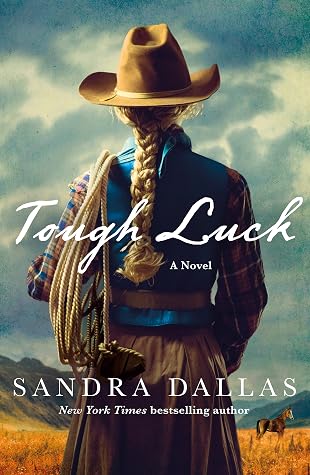
Tough Luck, by Sandra Dallas****

Tough Luck, a novel by Sandra Dallas, is the story of two almost-orphans, Haidie and her younger brother, Boots, that set out on a journey from Oklahoma to Colorado in search of their father. He’d left to find work some four years prior, planning to either send for them, along with their mother and older brother, Cheet; but Ma has died, and Cheet—the scoundrel—sells the farm, dumps his siblings in an orphanage, and takes off with the money. After escaping the orphanage, which is grim and abusive, Haidie is determined that she and her younger brother will make their way to Colorado and find their father.

My thanks go to NetGalley and St. Martin’s Press for the invitation to read and review. I’m over a full year late in doing so, a fact I’m not proud of, but despite my lateness, I have enjoyed this read, and I believe others that enjoy quality historical fiction will enjoy it as well.

Any author that writes historical fiction in the first person with a child as the protagonist has their work cut out for them. The ones that earn my scorn are those that make their main character so precocious that they speak as if they were an adult. This is, of course, complete nonsense, since brilliant children are still children; I am delighted to say that Dallas doesn’t use this cheap, ineffective device. Haidie is a bright child and most of her decisions are good ones, but she’s no Einstein, and she doesn’t talk like one. Having brother Boots along is important because it provides an opportunity for dialogue.

I do love American history, and so I am also waiting for Dallas to play fast and loose with historical fact. Instead, she is dead accurate, and despite the tall job she’s given herself, sending a couple of children across the plains and into the Rockies without an adult escort in the time before there were highways or readily available maps to follow, she nevertheless makes the story credible. I believe Haidie completely, and I believe the various villains and thieves, as well as the more decent people that she runs across during her journey. The settings are well rendered, too.

Because I fell behind in my reading, I checked out the audio book at my local library. Narrator Mia Hutchinson-Shaw does a fine job in bringing these characters to life.

This is an entertaining read, despite the sorrow and deprivation with which it begins, and I recommend it to those that love the genre.

Another Kind of Eden, by James Lee Burke****

James Lee Burke is a living legend, a novelist who’s won just about every prize there is, and whose published work has spanned more than fifty years.  My thanks go to Net Galley and Simon and Schuster for the invitation to read and review. This book is for sale now.

Another Kind of Eden is a prequel to Burke’s Holland family trilogy. The time is the 1960s, and protagonist Aaron Holland Broussard is in Colorado working a summer job. He falls in love with a waitress named JoAnne, but there are obstacles to their happiness everywhere he looks. There’s a charismatic professor that won’t leave her alone, a bus full of drugged-out young people that have fallen under his influence, and of course, there’s corruption among the local wealthy residents, which is a signature feature in Burke’s work. Aaron is a Vietnam veteran, and he has residual guilt and grief that get in his way as well. He’s got some sort of an associative disorder, though I am not sure that’s the term used; at any rate, he blacks out parts of his life and cannot remember them. He also has anger issues, and he melts down from time to time; there’s an incident involving a gun that he forces a man to point at him that I will never get entirely out of my head, and kind of wish I hadn’t read.

I had a hard time rating this novel. If I stack it up against the author’s other titles, it is a disappointment; a lot of the plot elements and other devices feel recycled from his other work, dressed up a bit differently. But if I pretend that this is written by some unknown author, then I have to admit it’s not badly written at all. By the standards of Burke’s other work, it’s a three star book; compared to most other writers, it’s somewhere on the continuum between four and five. Since I have to come up with something, I decided to call it four stars.

All that being said, if you have never read anything by this luminary, I advise you to start with one of his earlier books–almost any of them, actually.

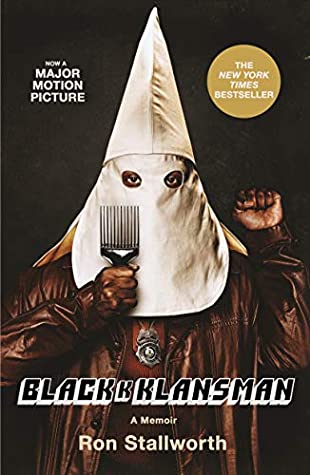
Black Klansman, by Ron Stallworth****

I was intrigued when I saw this book, and so I checked out the audio version, which the author reads himself, from Seattle Bibliocommons. It is one of a kind.

My first question, upon seeing the premise, is since when the FBI has any interest in busting the Klan or other White Supremacist organizations. Generally they chase activists on the left, and give those on the ultra-right a pat on the head and a cookie. This is addressed in short order, as the author explains it is his own idea. He initiates it when he learns how easy it is to join the Klan, and once he has access, his bosses agree to let him pursue it. And understand this: he is the only Black FBI agent in Colorado, and there is at least a wee bit of pressure on the Feds to increase their diversity just a wee. So for a brief and shining time, Stallworth is permitted to chase this lead.

The way Stallworth is able to join is that his membership interview is a phone call. At this time, there aren’t a lot of Klan members in the Rockies, and they’re spread thin. When the occasion arises for him to show up in person, he sends another agent, then takes over again on phone and through the US mail. (Heaven knows how this would shake out today; this would be difficult on Zoom.)

The memoir is important to write, because just as he is closing in hard on illegal activity that might result in arrests, he is called off by the brass, and he’s ordered to destroy every speck of research and evidence he’s compiled. Without this memoir, nobody would ever know it even happened. What a crock. What a bitter pill. I feel sick for him.

The audio is delivered in a wheezy, laconic narrative that sounds a lot like an old man sitting on his front porch telling the neighbors about his proudest exploits. It works for me.

Highly recommended.