
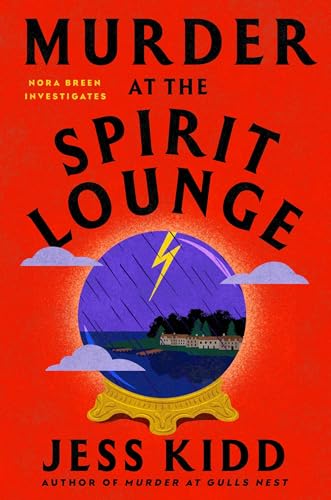
Murder at the Spirit Lounge*****

I would follow Jess Kidd anywhere! Murder at the Spirit Lounge is her sixth release in the U.S., and the second book in the Nora Breen series. My thanks go to NetGalley and Atria Books for the invitation to read and review; this engaging little mystery will be available to the North American public on June 16, 2026.
The time period is the late 1940s. We join Nora, a former nun who left the convent in order to find the whereabouts of the young nun that she mentored, and who had then left the order and disappeared. Her mission accomplished, Nora is still living in the rooming house, a cheap place that has terrible food and a grouchy proprietor, in a little seaside village called Gore-On-Sea. Nora left the convent with very little money and few possessions, and now she has even less money. In search of work, she finds a position at the local newspaper, working for an editor named Miss Hartigan:

Nora, having braved the smell of damp and mice to climb the narrow stairs of the Herald offices, finds the editor hunched over her ancient typewriter like a toad with a fly. Surrounded by empty booze bottles, stacks of back-copies. She turns a bull’s eye on Nora, who is reminded, curiously, of her former mother superior at High Dallow monastery. Perhaps it’s the same air of combative ruthlessness. Neither woman, in Nora’s estimation, would suffer fools gladly.

But Breen is soon sidetracked by a murder that occurs during a séance at the Spirit Lounge, and the medium is the victim—that is, the first victim. Since Nora has trained and worked as a nurse during her earlier life, she is summoned to the scene, and soon we’re off on another investigation. Inspector Rideout, the local man in charge of law enforcement, appears to be on the killer’s list, and as he and Nora have formed a warm friendship, she cannot allow that to happen!

Jess Kidd’s voice shines through here, and I love it. I would have liked to see more of the wit she’s displayed in some of her other novels, because she’s made me laugh out loud, but instead, we see greater depth of character development, and that’s crucial, particularly in a series. I wholeheartedly recommend this book, and this series, to those that love the genre. It can certainly be read as a stand-alone mystery, but once you’ve done that, you’ll want to scoop up the first as well.

Love and Other Crimes, by Sara Paretsky*****

Sara Paretsky is a venerable author, one who—along with the late, great Sue Grafton—reframed the role of women in detective fiction nearly forty years ago. When I saw this collection available for review on Edelweiss, I jumped on it. It’s for sale now, and you should get it and read it—although there’s a caveat coming up that should be considered first.

Sometimes when a favorite writer releases a book of short stories, I find that I’ve already read a lot of them in one form or another. This time, nearly every story is new to me. One forms the basis of a full length book that I read a long time ago and have forgotten much of. Another is a reworked version of the short story “Wildcat,” which I purchased a short time ago. These are the only duplicate stories I can detect, and I am a voracious reader where this author is concerned.  Some of her work was included in Sisters in Crime anthologies, but I haven’t seen them. Not all of them feature the iconic V.I. Warshawski. The signature elements that include social justice issues such as women’s rights, immigration, racism, and the homeless are here in abundance, as one might hope.

My favorite selection is the second, “Miss Bianca,” a mystery in which a little girl saves a research rat and ultimately uncovers a dangerous conspiracy. Paretsky gets the tone of the child’s voice just right, making her bright within the bounds of what a child that age is capable of, and registering the thought processes and perceptions of her protagonist flawlessly.

There’s an historical mystery that involves a Sherlock Holmes retelling, and like all of that ilk, it bored the snot out of me, a first where this writer is concerned. I abandoned it halfway through. The five star rating is unchanged, because the reader can skip this story and still get her money’s worth and then some; also, I am aware that not everyone is as averse to this type of writing as I am.

Another story is set during the late 1960s, and the Civil Rights Movement is center stage. In order to convey the horror of the backlash by some Caucasian Chicagoans during this tumultuous period, the *N* word is included several times. I used the audio version of this book for some of the stories, including this one, and I feel as if it should have a warning sticker of some sort because hearing that word shouted angrily sent a cold finger right up my spine, and I don’t like to think of other readers, especially Black readers, listening to it within the hearing of their children. I don’t deduct anything from my rating, because the author includes a note about its use and her reasons for it at the end of the story; in fact, there is an author’s note at the end of many of these that makes the story more satisfying. But you should know that this word is there, so be ready for it.

When all is said and done, there are few authors that can deliver the way Paretsky can. With the considerations above included, I highly recommend this collection to you.