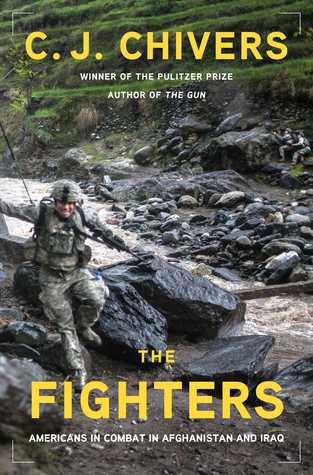
The Fighters, by C.J. Chivers*****

TheFightersChivers is a senior editor at The New York Times, and has won the Pulitzer for journalism. This meaty but readable book is the culmination of his years covering the U.S. wars in Iraq and Afghanistan. It is not the creation of a man parked in a library behind his laptop; he has personally gone to Iraq, Afghanistan, Syria, Ukraine, and Libya, and has either accompanied the people he writes about or retraced their footsteps. He covers the lives of six servicemen in the lower and middle ranks of the armed forces, and so he primarily uses eye witness reporting and interviews, in addition to American military data. I read it free courtesy of Net Galley and Simon and Schuster in exchange for my honest review. The Fighters will most likely be regarded in future years as the go-to book for those that want to know more about this war and the people whose lives were changed by it—including many of those whose homeland is or has been part of the war zone.

Chivers sees a tremendous amount of waste and foolhardy disregard for human lives on the part of the Pentagon, and he makes an undeniable case for it. After reading it I came away convinced that he did not begin his project with an axe to grind and seek out the particular facts that would support the reality he wanted to present, but rather that over the many years since the towers fell in 2001, the things that he has seen and heard all point remorselessly toward the same conclusion. In point of fact, there are two places in my reading notes where I marked, without hyperbole, the similarity between the true information provided here and what I might expect to read in The Onion.

Take, for example, the Afghan allies that are integrated into U.S. forces. The U.S. provides them with guns, but as far as anyone can see, it is strictly for the purpose of the Pentagon’s public relations campaign. Afghan soldiers in U.S. units don’t fire those guns. They hold them. They don’t aim; they don’t look at whoever is giving instructions nor at the translator. (They sure as fuck don’t salute.) In a protracted firefight, an American will eventually run out of ammunition and trade their empty weapon for one of those they hold, if the Afghan has not disappeared and taken the gun with him. And at night, the night watch exists in large part to ensure that if the Afghan soldiers choose to make themselves scarce overnight, they won’t take a bunch of munitions and hand them off to the Taliban.

But since the American public is increasingly impatient with the duration and loss incurred by this war, those guys have to be kept around like untrustworthy mascots in order to maintain the illusion that Afghan forces will be taking the place of U.S. troops soon. Timelines get pushed back, but nothing significantly changes. The drums beat on.

Thoughtless and ham-handed decisions by the top brass increase the resentment of civilians that live near the bases, people living in miserable poverty in sometimes directly across the street, with expensive machinery and plenitude of supplies the locals will probably never have. Meanwhile, troops are sent into circumstances that are bound to be fatal and also fail in their military objectives.

It makes you want to sit down and cry.

However, most of the narrative is not carnage and defeat. Who would read it if it were? Chivers instead does a fine job of painting the individual lives of the Americans he follows, and so most of the story reads almost like good fiction, and rather than being swathed in constant despair or endless statistics, I was instead deeply absorbed. Who knew it would be so interesting?

Those that are curious about the war in the Middle East, the first U.S. war in generations to see reporters banned from providing live footage or photographing flag-covered caskets sent home, could hardly find better material to read. This is on-the-ground coverage at its finest. If you want to read just one book about the U.S. conflicts in Iraq and Afghanistan, this should be it.

PBS published an interview with Chivers, and you can see some of the people whose experiences form the narrative, too:


Frederick Douglass: Prophet of Freedom, by David W. Blight**-***

frederickdouglassprophetThanks go to Net Galley and Simon and Schuster for the DRC, which I received free in exchange for this honest review.

Douglass is a key figure in American history, and Blight has made his career largely through his expertise on Douglass’s life. I expected to be impressed here, and indeed, the endnotes are meticulous and I would be amazed if there was a single error anywhere in this work. But aspects of the biography rub me the wrong way, and ultimately, I realized that the best way around this is to go back and read Douglass’s own autobiographies again.

Whether we read what Douglass tells us, or what Blight (or any credible biographer) has to say, there are two impediments that stop me short, and because I have never been required to start at the beginning and end at the end to complete a scholastic or professional assignment, I tend to read the beginning; recoil; abandon; and then return in an undisciplined, skipping-around manner that is uncharacteristic of my usual methods.

First we have the Christian aspect. Douglass was tremendously devout, and during his time it was much more common to discuss religion publicly and even in daily conversations, sometimes at length. It repels me. So that’s my first problem. It’s not Blight’s problem, but it’s one I have to deal with.

The second problem—again, not Blight’s, and it’s inherent in reading about Douglass—is that slavery was horrible. Douglass actually had a slightly better life than most of his peers, gaining an education and living in the master’s house, but it was nevertheless traumatic. It is unavoidable to see what he endured and not reflect on exactly how hellish life was for the four million that endured life in this dehumanizing, degrading system. After I read a certain amount of it, I feel as if I need to take a long shower to wash away the stain.

As for Blight’s book, there are some good moments here, and I learned some things. Who helped Douglass on his road to freedom? Free Black people did. Who knew that there were vastly more free Black folks in Maryland than there were slaves? The textbooks and other materials used to teach adolescents about slavery and the American Civil War overemphasize, to a degree amounting to deception, the participation of kindly white people, largely Quakers, and provide only a fleeting glimpse of the occasional African-American.

But I find that the eloquent passages that I highlight as I read this are not Blight’s words, but quotations from Douglass himself.

Meanwhile, the obstacles to appreciating this book are consistent and irritating. Blight makes much of inconsistencies in Douglass’s three autobiographies, and when he refers to the differences there is a superior, smirking quality to his prose that doesn’t sit well. I wouldn’t like it coming from any writer, but when the writer is a Caucasian, it adds an extra layer of insult. No matter how long Blight publishes, no matter his standing in the Ivy League, he will never be fit to polish Douglass’s boots. If he once knew it, I suspect he has forgotten it. So that’s a problem, and it’s hard to read around it.

The other issue, a more common one, is the tendency to guess at what is not known. This makes me crazy. The narrative will flow along in a readable, linear fashion, and then I start seeing the speculation, which is barely visible. Might have. Must have. Likely. It makes me want to scream. If you don’t know, Professor Blight, either don’t put it in, or address the unknown in a separate paragraph explicitly addressing the possibilities. Weed out the unimportant guesses and deal with the more critical ones head on. When these inferences are salted randomly into the text, we come away with tangled notions. Apart from the key events in his life, which of the finer details were fact, and which were surmise?

Excuse me. I need to find a nice brick wall so I can slam my forehead against it.

So there it is. For all I know, Blight may gain half a dozen prestigious awards from this work; it wouldn’t be the first time a book I’ve complained about went on to garner fame and glory. But I call them like I see them, and what I see is that it’s a better plan to read what Douglass says about himself, even though Blight appears to consider himself a more reliable resource than his subject.

If you want this thing, you can have it October 2, 2018.

Dagger John, by John Louhery ***-****

DaggerJohn I received a review copy of this book from Net Galley and Three Hills Publishing, which is affiliated with Cornell University, free of charge. This book is now for sale.

Since retirement, I have often taken my reading outside of my comfort zone, and at times I’ve been rewarded. I took a chance in requesting this biography because I have a peripheral interest in church history, and American history and Irish history are more direct interests. However, in this case there is too much assumed knowledge to be readily accessible to an acolyte of the region. My only trip to New York was a weekend tourist jaunt, and I have never been to the church in question.  However, I am drawn to the resistance he put forth during the “Know Nothing” period of anti-immigrant sentiment, and now is certainly the time to receive such a cautionary tale.

The claim that this man “made” Irish America seems overstated to me.

That’s not to say that it won’t interest you. The documentation is as unimpeachable as one would expect from a highly regarded university, and scholars with a specialized area of interest will likely find this a treasure because it is so specific. A niche audience may rate this title as four stars; I find it too dry a read to imagine five. But it isn’t intended to be a popular read but a scholarly one.

A solid niche read for those with interests that are aligned with the author’s.

The Black and the Blue, by Matthew Horace*****

theblackandtheblue“Even as a federal agent, I have been on surveillance or supporting an operation and have had an officer approach me and say that the neighbors called about a “suspicious” vehicle, which meant it was a black guy driving a car. I’ve been the man in that suspicious vehicle.”

Matthew Horace worked as a cop at the federal, state, and local level for 28 years, and he is plenty sick of the “toxic brotherhood.” The quote above refers to an incident that occurred in Mill Creek, a (very white) suburb outside Seattle, Washington where I live, but it’s not just here; it’s everywhere in the US. Specifically, he tells us about cities where some of the most notorious cop violence has created resistance such as New Orleans, Chicago, Baltimore, and Ferguson.

There are essays provided by police chiefs from some of these places as well as from Kathleen O’Toole, who was chief here in Seattle; O’Toole’s prose reek of electioneering, the sort of style that speaks for itself. Many of these contributors contradict Horace’s own assertion that the problem is endemic, and is absolutely not a case of a few bad apples. More than one of these essays hold the fascination I’d feel if forced to watch a rattlesnake before it strikes; the sanctimony, the grandiose claims of justice supposedly served. The most interesting of them all is from an African-American police chief in Chicago, whose personal stories of her family members having been abused—including her sons—stand diametrically opposed to what she does for a living, and yet she maintains her tightrope walk, determined to make a difference where only the smallest, if any, seems likely.

By now I should have thanked Net Galley and Hachette Books for the review copy, which I received free and early. This excellent book is available to the public Tuesday, August 7, 2018.

There has been a flurry of books published about this subject since it became national news. More than anything, the internet and cellular phones have stripped the gatekeeping capacity of the major news outlets; cops that were able to beat and even kill people and lie about it later are being outed left and right. Even I, who am an old lefty and have never really believed cops were there to protect ordinary people, am shocked by much of what’s been revealed. I wondered, as I began reading, whether Horace could add to what’s already been said and shown. What could he add to the body of information provided by Ta-Nehisi Coates, Angela Davis, and Matt Taibbi? (Many years ago, Norm Stamper, former Seattle police chief, also wrote an expose that included a chapter on why cops beat Black men.)

As it happens, Horace has a lot of information that I hadn’t read, and it isn’t just a matter of fine detail. For example, who knew that in New Orleans, cops were not merely accepting graft, but actively robbing Black-owned businesses, guns drawn, and making off with their cash and other valuables? It’s the sort of thing that lives in your head for a long time after you read it; but then again, it should be.

The sourcing is impeccable.

Those with an interest in Black Lives Matter, in civil rights in general, or with an interest in race issues within the so-called criminal justice system in America should get this book, for full price if necessary, and read it. Read the whole thing. So much of our future depends on how we respond.

A Brotherhood of Spies, by Monte Reel****

BrotherhoodSpies3.5 stars rounded up. Thanks go to Net Galley and Doubleday for the DRC, which I received free and early in exchange for this honest review.
The story begins with a US spy plane being shot down over Soviet (Russian) airspace in 1960. This is embarrassing. Eisenhower’s people decide to make something up; after all, nobody survives an airplane crash over dry land. Moreover, the pilot was provided with a cyanide capsule—James Bond style—so even if he survived, he must be dead; likewise, the plane was likely blown to bits, with not much left for the Soviet investigators to learn.

Let’s say it was a weather plane. It wandered off course, and those mean Soviets shot it down.

But oh dear, this is even more embarrassing: the pilot lived, and he didn’t feel like taking the poison pill. Would you?  So the Russians know what he was flying, and they know who he is. They’re telling the world.

Just reading the teaser for this book, I was hooked. But just as a brilliant writer can take dross and make a good tale of it, so can an indifferent one take compelling information and make it into a snooze. For me, this was not an entertaining read. I had agreed to write about it, so I had to read it, and it felt like work.

I want to be fair here: there are people that will read this book and like it. There’s a lot of technical information about the spy plane, and about many other spy planes, some of which were never built. Apart from the truly bizarre one that was supposed to be landed on its belly (no landing gear), or the ridiculous idea of a nuclear powered plane, I found my attention drifting during these descriptions. But I am not interested in aviation, and if you are, you may like this.

The other aspect that causes my attention to wander is the history 101 aspect of it. I’m a retired history teacher. I don’t need an author to walk me through the Cuban Missile Crisis or the Bay of Pigs. However, I note that other reviewers came to this work with no knowledge of either, and they are delighted to be clued in. For newbies, count this as a win.

Finally, I have to credit the source work. Reel didn’t take the easy way out. His end notes are first rate.

For those that are relatively new to this chapter of American history, this may be a compelling read. For those interested in the history of American aviation, it is recommended. For those that are well read in the field, maybe not.

This book is now for sale.

The Lost Indictment of Robert E. Lee, by John Reeves*****

LostIndictmentRobtELeeI’ve never understood why so many Americans revere the memory of Robert E. Lee, the general that turned Lincoln away at the outbreak of the American Civil War and instead commanded the treasonous Army of Northern Virginia. When I saw this title, I leapt at the chance to read and review it. Thanks go to Net Galley and Rowman and Littlefield Publishers for the DRC. The book will be available to the public June 1, 2018.

Before reading this book I wasn’t even aware that an indictment had ever been issued. This is particularly odd given that a good part of my teaching career involved teaching American history and government. I even wondered, before opening it, whether this indictment would be metaphor; no indeed. Reeves did a lot of digging in order to write this book, and that’s what makes it worth having. His sources are ones that I cannot find myself through a quick Google search or a trip to the library or bookstore. Reeves  uses sources that require traveling hither and yon in order to access special collections that libraries won’t check out to anybody ever, that’s proof that this writer had done the legwork.

Back to the indictment. Following the end of the war and the death of Lincoln, the North—contrary to mythological retellings—clamored for retribution. Let’s all be brothers and have peace? Oh hell no. Who had not lost a brother, a son, a husband to this terrible conflict? And President Andrew Johnson, working hand-in-glove with the passionate abolitionist, Judge Underwood, set out to “make treason odious.” At a bare minimum, Lee, Jefferson Davis, and the members of the Confederate cabinet most closely linked to the war itself needed a day in court. Afterward, they needed to either hang, or rot in prison for a goodly while. So the thinking went.

As usual, the devil was in the details. Why is it so difficult for government to move swiftly? A lot of terrible decisions were made here, the most noteworthy being to try these men in a civilian court rather than in a military tribunal. Too late they realized that Lee must then be tried by a jury of his peers in Virginia. This would have been disastrous, since Lee was regarded by most Caucasian Virginians as a hero, much the way we now look at Lincoln. After all, when the war broke out, most antiwar or antislavery advocates had to move North in fear of their physical safety, and only the diehard Dixie whistlers remained, so a fair and impartial jury in Virginia was a nonstarter. What could possibly be worse than letting Lee off scot-free? What would be worse would be for him to be exonerated.

Added into the stew was a heap of political scandal and the unraveling of Johnson’s presidency, and the tarnishing of Underwood’s reputation, a man controversial from the get-go.  At the end of the day they were too busy salvaging themselves to bring these men to justice.

I find some measure of comfort in the knowledge that Arlington, the huge, fancy estate that had been passed down to Lee’s wife and of which he never stopped bragging, as if property ownership and family history made his family American royalty, was expropriated by the Union, and its extensive grounds became Arlington National Cemetery. After Lee’s death, there was considerable talk among the public suggesting that the widow Lee should get her old house back; however, she overstepped when imperiously telling Congress that she also wanted the remains of all those poor boys dug up and interred some other place. There was almost nothing she could have said or done to lose the sympathy vote more quickly.

This excellent book is highly recommended to those that are interested in the American Civil War and its aftermath.

The Day Fidel Died, by Patrick Symmes*

thedayfidelThose that admire and stand in solidarity with the Cuban Revolution will not find any measure of satisfaction here.  When I read the promotional blurb, I noticed that this account was written by a Rolling Stone Magazine journalist, and that it was written soon after President Obama opened relations between the US and Cuba. I thank Net Galley for permitting me to read a review copy free of charge, but that cannot diminish my disappointment and irritation (thus one star) at the patronizing, reactionary vantage from which Symmes writes.

Has no one noticed that even the United Nations has recognized that Cuba is the only nation in Latin America and the Caribbean to eradicate malnutrition? And has nobody noticed that when Fidel died, the revolution didn’t die with him?

Most nations do not offer visiting heads of state a forum and opportunity to locate and meet with the disgruntled fringe citizens that might be open to overthrowing the government of the host nation. Symmes’ punch line here seemed to be that by Obama cutting his trip short, he was somehow making the Cuban Revolution ‘irrelevant’.

Do the other nations of Latin America and the Caribbean see it thus? Has Africa adopted this stance? I didn’t think so. It is only possible to see the Cuba in that light if one filters world news through the view of international business conglomerates and the U.S. government.  Happily, there are independent thinkers here that can appreciate the contributions made by Cuba in ending hunger and oppression in that country and making medical advances from which the whole world benefits.

This book is a waste of ink, and a waste of space in one’s digital library.

Eloquent Rage, by Brittney Cooper****

EloquentRageCooper has had enough, and who can blame her?
I received my copy of Cooper’s essays free and early, thanks to Net Galley and St. Martin’s Press. Her prose is clear, articulate, and full of fire.

Had I read my post-Trayvon civil rights titles in a different sequence, I might very well have called this a five star collection. However, I read Samantha Irby, Ta-Nehisi Coates, Angela Davis, and Matt Taibbi first, and so the bar was set somewhere in the stratosphere when I opened this galley. I wanted Cooper’s viewpoints to be accompanied by some hard facts, complete with citations. However, for those looking to have their world view clarified and their consciousness raised, Cooper’s collection is recommended.

Sadness is a White Bird, by Moriel Rothman-Zecher*****

“There’s nothing ‘not political’ in Palestine, habibi.”

SadnessisaJonathan grew up in the United States, but now his family is in Israel, the land of his mother’s birth. He’s visited Auschwitz where much of his family died, and he can’t wait to turn eighteen so that he can train to be an Israeli paratrooper. Enough with being ‘people of word’, he figures; he wants to be a Jewish warrior, the ‘people of the sword,’ and exact some payback.  A friendship with two Palestinian teenagers complicates his life in ways he didn’t expect. I received an advance review copy of this exquisitely rendered story free, courtesy of Net Galley and Atria Books in exchange for this honest review.

Twin siblings Laith and Nimreen are Palestinians, but long days at the beach and twilit evenings spent with Jonathan, getting high and telling ridiculous jokes, blur the social boundaries observed by most Jews, and by most Palestinians. With the absurd idealism peculiar to young people that haven’t run up hard against life’s limitations, Jonathan thinks that he can have both, that he can become an Israeli soldier and keep his friendships separate from his new career. His friends know better, but still they love him.

There’s only one way to tell a story like this one, and that’s as a tragedy; that’s exactly what Rothman-Zecher does, but he does it better than anyone else I can imagine.  This doomed friendship becomes more deeply intimate the closer the day comes when Jonathan must report for duty. Ultimately it becomes a bizarre love triangle in which our young protagonist has a sexual relationship with both of them—though fortunately not simultaneously.  For a good long while this lodges in my craw, and as the story continues, I am too revolted to focus. As brilliantly written as this story is, I was headed in the direction of a four star review in protest; that was true, anyway, until I recognized the allegory. Then I was over it.

Nimreen is a teenager too, but she lives with the partitioned state every damn day of her life. She knows that Jonathan can’t have it both ways, but she hopes against hope that he’ll change his mind, that he won’t go into the service. And as Jonathan and his friends try to do anything, go anywhere where there are other people, we see exactly how polarized this place has become. They can’t hitchhike together; there are so many places where either Jonathan isn’t safe, or Laith and Nimreen are not permitted. He goes through a checkpoint where, without his suspicious-looking friends, he would simply have been waved through, and he finds out what it’s like to have one’s homeland invaded.

Rothman-Zecher does a splendid job of depicting exactly how difficult this question is. If I ask myself, have Jews been systematically robbed of their possessions, their homes, and sometimes their lives across not just hundreds of years, but across centuries? I know the answer is yes. I knew it before, but this story drives it home in a way that is visceral. And do Jews deserve to have a home that nobody can ever, ever take from them again? Again, the answer is absolutely yes.

But then we look at the Palestinians, indigenous people living in the Third World at a bare subsistence level. Their homes are almost all they possess, and does anyone have the right to march in, evict them from this place and chase them away from their homes, their families, their livelihoods? Oh hell no, of course not.

In this epic story, Rothman-Zecher bridges the scholarly with the deeply personal, fulfilling a task that can only be achieved by excellent fiction. This searing debut has put this writer on the map definitively and marked him as a new voice in literature.

Highly recommended.

I Can’t Breathe, by Matt Taibbi*****

“Try to imagine a world where there isn’t a vast unspoken consensus that black men are inherently scary, and most of these police assaults would play in the media like spontaneous attacks of madness. Instead, they’re sold as battle scenes from an occupation story, where a quick trigger finger while patrolling the planet of a violent alien race is easy to understand.”

ICantBreathe
I received an advance review copy of I Can’t Breathe: A Killing On Bay Street, courtesy of Random House and Net Galley. I had expected this civil rights title to be a good read but also to be anticlimactic, coming out as it did just after publications by literary lions like Ta-Nehisi Coates and Angela Davis. I am surprised and gratified to see that Taibbi, a journalist for Rolling Stone, holds his own quite capably. The title is for sale, and if you care about justice and an end to cop violence in the US, then you should get it and read it.

Many readers will recognize the title, which constitutes Eric Gardner’s last words and became a rallying cry for protests that spanned the globe. Why would any cop, especially one not acting alone, find it necessary to put an elderly man, a large person but not a violent one, in a choke hold over what was, after all, a misdemeanor at most? Taibbi takes us down the terrible urban rabbit hole, deftly segueing from Garner’s story, the events that led up to his death and the legal and political fight that took place afterward, to the cop killings of others, and the bizarre, farcical prosecution that takes place in the unlikely event that a cop is ever charged with having unlawfully killed another person.

Though my own life is free from this type of harassment and though I benefit from White privilege and have done so since birth, I found it hard to breathe myself as I read Garner’s story, and the behind-the-scenes machinations that result in the maintenance of the status quo. And I trembled, and still do, for the Black men in my family.

I think many people over the age of 40 understand that the attacks we see publicized online, one by one, Black boys and men that have done either nothing wrong or committed a minor offense that most Caucasian people would never be stopped for, have been taking place for a very long time. What we didn’t have was proof; what we didn’t have was the long view that allows us to see into cities, rural areas, and small towns in America such as Ferguson, where Michael Brown was killed. And there’s one other thing: we didn’t have to look at it before if it wasn’t happening in our own community, our own neighborhood. Even those of us with racially mixed families didn’t see the scope of it. Some would prefer not to know.

Here’s Taibbi’s take on how it unspooled:

“The civil rights movement ended in a kind of negotiated compromise. Black Americans were granted legal equality, while white America was allowed to nurture and maintain an illusion of innocence, even as it continued to live in almost complete separation. Black America always saw the continuing schism, but white America has traditionally been free to ignore and be untroubled by it and to believe it had reached the “postracial” stage of its otherwise proud history. That was until cell phones and the internet came along. When the murder of Eric Garner hit the headlines, it at first seemed to lift the veil.”

Taibbi’s smooth narrative and expert pacing doesn’t make this any easy book to read; nothing can. If it’s easy, you’re not paying attention. But if we ignore Eric Gardner, Michael and Trayvon and Freddie and Sandra and all the rest, we are complicit in their deaths. Highly recommended, even at full jacket price.