The Crowded Hour, by Clay Risen*****

The Spanish-American War sparked the earliest fire of U.S. imperialism, and the eccentric rich man that pushed it forward, Theodore Roosevelt, was at its center. Risen provides a contemporary view of this badly managed chapter in American history, dispelling longstanding myths and examining the long term effect of the conflict on the U.S. military. My thanks go to Net Galley and Scribner for the review copy, which I read free in exchange for this honest review. This book is for sale now.
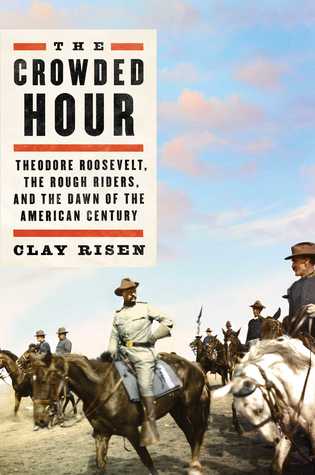
Roosevelt was challenged with a number of health problems as a youngster, but instead of embracing his sedentary, privileged existence, he embarked on a series of physically demanding adventures in order to strengthen his constitution and affirm his masculinity.

When Cuban nationalists sought independence from Spain, Teddy began campaigning for American intervention. Men of his generation was had not known the destruction of lives and property that touched every part of this nation during the American Civil War, and like most young people, they were unwilling to listen to their elders. Roosevelt believed that war was a splendid thing, and that in facing death, men were elevated to a higher level. He joined his voice to those in the press advocating military aid to Cuba, and after tapping every powerful connection his wealthy family could access, he was successful.

 His own unit—all volunteers—were dubbed the “Rough Riders.” Most had no military training of any kind; the mighty Union Army had been all but disbanded once the nation was reunited. Though they were promoted as cowboys, the rugged individuals of the Wild West, a goodly number hailed from Wall Street and Harvard. In addition to being able to fund their own wartime excursion, they were noteworthy in their riding capability.

There was no San Juan Hill. There was a series of them.

The American invasion of Cuba cast a spotlight on its unpreparedness. Transporting troops, beasts and equipment across the Atlantic was a debacle of the worst order. There weren’t even close to enough seaworthy vessels, and because of this, most of the so-called cowboys fought on foot the entire time; horses and mules were stuck back in Tampa waiting to sail. There wasn’t enough food, potable water, or appropriate clothing for most of the men; the wealthiest among them fared best, but there were many occasions when there wasn’t any food to be bought at any price. There had been no reconnaissance and so they went in blind; the heat and disease killed more Americans than the Spaniards did. Vultures and immense land crabs that measured 2 feet across and traveled by the thousands made short work of the dead when not buried immediately. American losses were nearly triple those of the Spanish, and when the war ended there were no hospitals or sanitation ready to receive the legions of sick and wounded when they returned from the Caribbean.  

Roosevelt used the occasion to point to the need for a standing army and U.S. readiness, and ultimately this was his one useful contribution. In other regards, the man was an ass hat. His bald-faced racism, though not unusual at the time, went over badly with the Cuban freedom fighters that were supposed to benefit from their presence. He crowed to his friends about how much he enjoyed shooting an enemy soldier from just a few feet away “like a jackrabbit,” and called his 45 days of combat the ultimate hunting trip. Mark Twain hated the guy, and it’s not hard to see why.

Risen has an engaging writing style, and he uses lots of well-chosen quotations. His research is excellent as are his sources. I would have liked to see more of a breakdown along the lines of social class and other demographics, but this war did not yield a rich archival treasury like the one that came from the Civil War, so this may not be possible.

All told, this history is a find. Right now it seems that every second historian on the planet is writing about World War II, whereas this cringeworthy but significant chapter of American history has been largely left by the wayside.  I highly recommend this book.
Waisted, by Randy Susan Meyers*****

Randy Susan Meyers wrote The Murderer’s Daughters and The Widow of Wall Street. Her new novel, Waisted is a fiercely feminist story that skewers the weight loss industry and a society that “treats fat people like out-of-control horrors” and the war against women with its “intersectionality of misogyny, fat shaming, [and] faux health concerns.”  Thanks go to Atria and Net Galley for the review copy. You should read this book.

Alice married Clancy when she was “break-up skinny,” not knowing that he isn’t attracted to any woman that isn’t thin. Daphne is tormented by her 108 pound mother, whose toxic monitoring and obsession with Daphne’s eating have nearly driven her daughter over the edge.  Alice and Daphne meet at Privation,  a live-in weight loss program in rural Vermont. They and five other women sign on because they are promised rapid weight loss free of charge, with the caveat that they must agree to be filmed 24 hours a day for a documentary. The program is not only extreme; it is cruel and dangerous.

“Welcome to hell, ladies, where we recognize that life is unfair, and you pay the price for every action you take…You’ve eaten your way through pain, through loss, through happiness, and just for the plain pleasure of crunching calories between your teeth. Not one of you knows how to live with privation. So you landed here. The last stop.”

The women don’t know that there are no doctors here, or that they are part of a nasty experiment to see what women will tolerate in order to become thinner, even when it is obvious that such a program cannot be sustained. Each time one or another of them considers decamping, there’s a weigh-in that shows them to be even lighter than they were earlier in the week, and with dreams of a new, sleek, lovable body ever nearer realization, they persevere.

The readers that will relate to this story best are also the ones that will have a hard time getting through the first half of it. Meyers drives home so many uncomfortable truths that overweight women like me have trained ourselves not to think about most of the time because they are painful. Do it anyway. It’s high time someone wrote this book.

Apart from its very real underpinnings, the story is far-fetched and features an unlikely outcome, but that doesn’t matter. A more nuanced or realistic version would fail to deliver the message in as brilliant a fashion.

This is urgent, angry, and at times darkly funny prose. It will be available Tuesday, May 21, 2019. Highly recommended.

Madame Fourcade’s Secret War, by Lynne Olson*****

“The memory of an elephant, the cleverness of a fox, the guile of a serpent, and the fierceness of a panther.”

Marie-Madeleine Fourcaude ran the largest spy network in France during World War II. Charismatic, organized, intelligent and completely fearless, she was possessed of such obvious leadership skills that even very traditional Frenchmen (and a few Brits as well) came to recognize and respect her authority and ability. I had never heard of her before this galley became available; thanks to go Net Galley and Random House. This book is for sale now. 

Fourcade was born into a wealthy family, and this fact almost kept me from reading this biography. Fortunately, others read it first and recommended it, and once I began reading I quickly caught onto the fact that no one without financial resources could have initiated and organized this network. At the outset, there was no government behind them and no funding other than what they could contribute themselves or scrounge up through the kinds of contacts that rich people have. There are a few fawning references to some of her associates—a princess here, a Duke there—that grate on my working class sensibilities, but they are fleeting. 

Fourcade’s organization ultimately would include men and women from all classes, from magnates and royals to small businessmen, train conductors, waitresses, postal clerks and so on. Some were couriers delivering information about Nazi troop placement and movement, U-boats and harbors and so forth, whereas others quietly eavesdropped as they went about their daily routines. Once they were able to network with the British, the organization became better supplied and funded, and it had an enormous impact on the fascist occupiers, which in turn drew more enemy attention to the resistance itself; among the greatest heroes were those that piloted the Lysander planes that delivered supplies and rescued members that were about to be captured. But not everyone was rescued; a great many were tortured, then killed. Fourcade herself was arrested twice, and both times escaped. 

If you had tried to write this woman’s story as fiction, critics would have said it lacked credibility. 

In reading about Fourcade, I learned a great deal more about the Resistance than I had previously known; in other nonfiction reading this aspect of the Allied effort was always on the edges and in the shadows, not unlike the spies themselves. In addition, I also came to understand that France was barely, barely even a member of the Alliance. The British bombed a ship to prevent fascists from seizing it, but they didn’t evacuate it first, and an entire ship full of French sailors were killed, leading a large segment of the French population to hate the British more than the Germans. Then too, there was a sizable chunk of the French government that welcomed the fascists. 

Revisionist histories will have us believe that the Nazis were opposed but that France was powerless to stop them, and for some that was true; yet the ugly truth is that it was the French themselves that incorporated anti-Semitism into their governmental structure before the Germans demanded it. Vichy cops had to take an oath “against Gaullist insurrection and Jewish leprosy.” When planning D-Day, U.S. President Franklin Roosevelt didn’t even want to include the French in the planning or even inform them that the Allies were invading. Let them find out the same way that the Germans would, he suggested to Churchill. But the British insisted on bringing in friendly French within the orbit of De Gaulle, not to mention those around a pompous, difficult general named Henri Gouroud, a hero from World War I who had to be more or less tricked into meeting with the Allies at the Rock of Gibraltar. The guy was a real piece of work, and some of the humorous passages that are included to lighten up an otherwise intense story focus on him.

I have never read Olson’s work before, but the author’s note says that she writes about “unsung heroes—individuals of courage and conscience who helped change their country and the world but who, for various reasons, have slipped into the shadows of history.” Now that I’ve read her work once, I will look for it in the future. 

Highly recommended to historians, feminists, and those that love a good spy story, too.

Say Nothing, by Patrick Radden Keefe*****

The Irish have fought against oppressive British rule for centuries, but for many the most interesting—and for some of us, emotionally charged—period is that known as The Troubles, which unfolded in 1969 as Irish youth, inspired by the Cuban Revolution and the Civil Rights movement in the United States, sought to carve out some rights for working people living in the North of Ireland and concluded in 1997 following the ceasefire agreement struck between Sinn Fein, which was then the political arm of the revolutionary Irish Republican Army, and the British government. Keefe’s intense, compelling narrative is the most readable that I’ve seen, and the revelations it holds affected me more deeply than any literature I’ve read since I began reviewing books five years ago. Thanks go to Net Galley and Doubleday for the review copy, which I read free and early. You can buy it tomorrow, February 26, 2019. 

The history unfolds in three sections and is bookended by the quest of Jean McConville’s family to find her body and if possible, to learn who killed her and why. It’s an interesting choice given the number of dead the conflict produced, many of whom have never been found and identified, but the mystery and the ambiguity of her activities—was she merely a mother of ten as her children say, or working quietly for the IRA, or a double agent working for the British—is emblematic of the tension and secrecy maintained on both sides. We begin with Jean’s abduction in the first section, titled “The Clear, Clean, Sheer Thing,” move on to the meatiest and most tragic part of the struggle, “Human Sacrifice,” in which young hunger strikers and many others die, and conclude with “A Reckoning,” in which the ceasefire is signed and many Irish people that were involved in the guerrilla war are held accountable—and as usual, the British are not. The entire thing is carefully documented. 

Keefe notes that during the 1980s there was a good deal of “ambient” support for the IRA in the US, and this I know to be true. I participated in fund raisers for humanitarian aid to the six counties during that time, and I attended a presentation by Bernadette Devlin, an iconic leader of the struggle who for some reason barely bears mention in this work. It’s my only complaint about the book. 

The middle section left me shaking an in tears. I had not read Brendan Hughes’s claim about the deaths of the hunger strikers and the role almost certainly played by Gerry Adams, and it was a week before I could pick the book up again. I am still raw from it. I can recall seeing headlines in 1981 when Bobby Sands died, and at the time I was a practicing Catholic. When I saw the news, I picked up the phone and requested a special mass be held for him at my parish in the Midwestern city where I lived then. The parish priest thought it was a lovely idea but he needed the approval of the bishop. The bishop squashed it like it was a bug. There’s a metaphor in there somewhere. 

The final section discusses The Belfast Project, a series of interviews done under the promise that they would not see the light of day until the subjects were dead and buried. The names of the interviewees were coded as a further layer of protection, and the whole thing was stored in the vaults of the Burns Library at Boston College, where it was believed that the British government would never lay hands on it. Never say never. 

This book is a masterpiece. The writer is a journalist on the staff of The New Yorker, and this project took four years of steady effort by the author and his assistants, and a good deal of travel as well. The documentation is meticulous. Nevertheless, there are a number of details that are impossible to nail down, and the book’s title gives the reason for this. The only way to be sure a secret remains a secret is to keep your mouth shut, and that’s precisely what most of those involved in the struggle have done. A great many details that could doubtless condemn large numbers of working class Irish to lengthy prison sentences are buried with the bones of those that could have told. And although the author doesn’t explicitly say so, it’s obvious from the fate of the interview tapes that there is never any other guarantee of confidentiality; the code of silence still held to by the survivors of The Troubles has been all the protection that Irish participants have ever had. The vow to keep information private was decimated time and time again by the horrifying physical and psychological torture on the innocent and culpable alike by British jailers, none of whom will ever be brought to justice. 

Those that didn’t follow this fight in real time will likely not be as shattered by the things this book holds as I was. The author paints a vivid scenario—imagine coming home and noting that there’s a British soldier in uniform, gun drawn, in the rhododendrons in the front yard, for example—and peppers the account with well-chosen quotes. The slow deaths of Irish youth held in virtual dungeons are hard to read about, but then, war stories usually are. It’s fascinating stuff, though but necessarily material for bedtime, depending on your level of sensitivity. 

Highly recommended. 

The War Before the War, by Andrew Delbanco****

You may not have had the grades or the money to attend Columbia University, but you can read Professor Delbanco’s book anyway. It’s meaty and interesting, and it clears up some longstanding myths about slavery in the USA. My thanks go to Net Galley and Penguin Random House for the review copy; this book is for sale now. 

At the outset I find this work a little on the slow side, and I wonder if I am in for five hundred pages of drone. Not to worry. By the five percent mark the whole thing wakes up. Slavery from the time of the early European immigrants to the American Civil War is mapped out, and I found myself wishing I had read it before I taught social studies instead of during retirement. Sacred cows are slain and there’s plenty of information that is new to me. For example, I did not know that the number of runaway slaves was always a fairly small, economically of little consequence but powerful in its example. I didn’t know that Caucasian people were retaliated against sometimes by sending them into slavery; since one couldn’t tell a person with a tiny amount of African-American heritage from a white person, it was possible to lie about someone whose roots were entirely European and send them down south. And although I understood that the great Frederick Douglass was hugely influential, I hadn’t understood the power of the slave narrative as a genre: 

“When [slave narratives] were first published, they were weapons in a war just begun. Today they belong to a vast literature devoted to every aspect of the slave system–proof, in one sense, of how far we have come, but evidence, too, of the impassable gulf between the antebellum readers whom they shocked by revealing a hidden world .and current readers, for whom they are archival records of a world long gone. Consigned to college reading lists, the slave narratives, which were once urgent calls to action, now furnish occasions for competitive grieving in the safety of retrospect.”

It is painful to envision a roomful of young people flipping through their phones or napping during a lecture or discussion about this damning aspect of U.S. history that haunts us even today; and yet I know it happens, because I have seen it among the teenagers I have taught. I want to roar, “Where’s your sense of outrage?” And yet it’s there; but many that are activists against cop violence and other modern civil rights issues haven’t yet made the connection between the present and our national origins. So I feel this guy’s pain. 

For the interested reader of history, the narrative flows well and the documentation is thorough and beyond reproach. Delbanco has a sharp, perceptive sense of humor and this keeps the reader further engaged. 

I recommend this book as an essential addition to the home or classroom library of every history teacher and reader. 

Best History 2018

Image

Best Nonfiction 2018


theblackandtheblueThe Black and the Blue, by Matthew Horace*****

Best Feminist Fiction 2018

ASparkofLightA Spark of Light, by Jodi Picoult*****

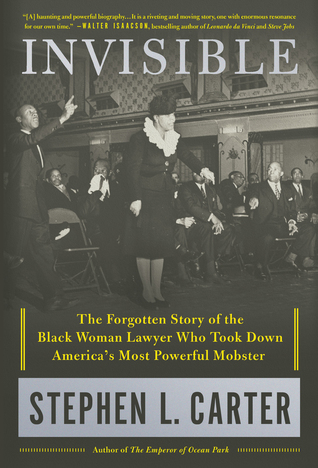
Invisible, by Stephen L. Carter****

InvisibleI received a review copy of this affectionate, well-documented biography free and early thanks to Net Galley and Henry Holt. This book is for sale now.
Eunice Hunton Carter was the author’s grandmother, and though her name is little known today, she was an exceptional woman, a scholar, political activist, and social diva that did extraordinary things during a time period when it was nearly impossible for women of color to rise professionally. Carter tells of her impact on what he calls “the darker nation” and in particular, of her role in taking down notorious gangster Lucky Luciano. She was largely invisible to the mainstream press; this was a time when Black people virtually never won acclaim, and women didn’t either, but it was she that devised the strategy that was needed to try to convict him.

The author is a Yale professor and has a number of successful books to his credit already. This biography is written with the professionalism one would expect; the tone is conversational and keeps the pages turning; transitions are buttery smooth; and the documentation is flawless and meticulous. Those interested in African-American history, or particularly in that of African-American women should read this book.

Carter was born into a well-to-do Atlanta family, leaders among the Negro petite-bourgeoisie. (The author uses the term “Negro” because it was the accepted, polite term during the period in which his grandmother lived.) However, the rise of terrorist groups like the Klan forced successful families of color out of the South, and so most of Eunice’s story takes place in New York City, and it is there that she became a famous woman.

Eunice was a die-hard Republican, and the author reminds us that in the early 1900s, it was still known as the party of Lincoln. Though she did not initially aspire to be politically active—a hat that her mother, Addie, already wore—she became involved in Dewey’s various campaigns after working with him in the prosecutor’s office.

The story is well documented and the voice is distinctive. Two things got in the way of my enjoyment of this biography. The first and technically most significant is focus. The author seems at times torn between his desire to write his grandmother’s biography and perhaps a desire to write about his entire family. I’ll be absorbed in the events that shape Eunice, but then her mother is mentioned—as is appropriate, since her mother is so influential in Eunice’s development—but then we’ll see more about her mother. More, more, more. Pages of Addie. When the author smoothly returns us to Eunice I sigh with relief, snuggle into my chair, and then a few pages later, there we are again. Numerous times I have typed into my reader’s notes, “Whose story is this, anyway?” Eventually I become so frustrated by Addie’s success in hijacking her daughter’s story that I stop making notes and highlight every transition, from Eunice to Addie, Addie, Addie, and ah, back to Eunice (and then to Addie again).

This irritating diversion, one that makes me feel as I am sitting in the parlor of some elderly, garrulous, lonely individual that has just poured me more lukewarm tea and picked up yet another photo album—Did I tell you about my cousin Rudy? Now there was a character, they say—mercifully abates about halfway into the story, as we move into the Luciano case. Here we are focused, and it’s a fascinating read. But during the last portion of the book, it is brother Alphaeus that needs editing down. Again, this brother has good reason to be here, since Eunice is convinced that her career suffers from his membership in the Communist Party USA; yet I feel as if a strong editor’s pen would be useful for this relative as well. Or better still: maybe let’s not read about Eunice. Maybe let’s have a biography of Alphaeus instead, since it is he that is driven to try to make the world a better place.

Because Eunice, it’s clear, is really out there for Eunice. The author makes no bones about this; yet his glee at her snobbery, social-climbing, and vast ostentatious displays of wealth is not inspirational.

When all is said and done, however, Eunice Hunton Carter deserves a place in history. Had she been born Caucasian and male, who knows? She might have become president, or at least governor of the state of New York. Her drive, talent, and energy seem to have been limitless.

As a read for general audiences, I’d say this is a 3.5 star read, rounded upward, but for those with a special interest in African-American history, or that are doing research for a more specific topic such as African-American women in politics or law, this is a must read.

The Tango War, by Mary Jo McConahay****

TheTangoWarI read my copy free and early, thanks to Net Galley and St. Martin’s Press. This book is for sale now.

This meaty little nugget is one of a kind. I had sworn off World War II, both fictional and historical, because so much information gets repeated; you can only read so much about the most visceral parts of this conflict before your worldview darkens. I am out of the classroom and had promised myself a chance to stop and smell the roses in my retirement years. But then there’s this.

Firstly, there’s nothing about the Holocaust to speak of here. That was a draw card, because I am done with that most searing of horrors for awhile. Instead, she writes about Latin America during the war—and I knew nothing, nothing, nothing about any of this. I was aware that there were some nations down there that are reputed to have flirted with the fascists, and even then, I wasn’t sure it that was the truth or a myth.

The book is broken down, not by relevant Latin American countries, but by subtopics, and this is both more analytical and more interesting than if she’d done it the obvious way. Who knew that there was a model city established inside of the Amazon in an effort to rope more employees—well, slaves—into harvesting rubber for the war? Who knew that vast amounts of South American petroleum ran the trucks and tanks that rolled over Europe? Perhaps most appallingly—who knew that Japanese expatriates and their families, born and raised in Peru and other locations in Latin America,  were kidnapped in a down-low deal between the US and the governments of the affected nations so that the US could intern them, then use them for prisoner swaps?

There are enough weird-but-true facts here to cross your eyes, and the author has her documentation at the ready.  A fifth star is denied because of what isn’t here; why portray United Fruit as upstanding patriots? Many of us know this corporation was a sinister entity with its roots tangled deeply in the CIA. Lots of Guatemalans have plenty to say about United Fruit.  More directly related here is the brief, friendly reference to Disney as a WWII patriot, and yet many of us know how warmly Uncle Walt regarded Hitler: the catch-phrase “Mauschwitz” says it all.  Partial truths make me wonder what else I am missing as I read this.

With that one caveat, this book is recommended to you. The citations are thorough and the text is written free of technical terms that might hamper a wide readership.  Read it critically, but do read it.