Bird Uncaged, by Marlon Peterson****

I’ve never felt so ambivalent about a Civil Rights memoir. I read this book free and early, thanks to Net Galley and Public Affairs. It’s for sale now.

At the outset, Peterson describes his early years as the son of Trinidadian immigrants living in Brooklyn. His family belongs to the Jehovah’s Witnesses, and so that is an angle I haven’t encountered before. He describes his brilliance as a student, and the glowing future that has been predicted for him, scholarships, fine schools, and a ticket to the top. It doesn’t happen that way, though. He is involved in a robbery that becomes a homicide, and he wants us to know none of it was his fault.

What?

This is what concerns me throughout most of the book. He describes the limitations on young Black men in America, the limitations of poverty; the racist assumptions; and the “toxic masculinity.” He is sexually assaulted as a youngster, and he considers that an element in his decision-making, the trauma of his past informing the crimes he commits later. He talks about this at length, but I’ll tell you what he doesn’t talk about much. He doesn’t talk much about the near-rape in which his was the pivotal role. He asks a “chick” out, and he and his friends are planning to “run a train” on her. But she is alarmed when she realizes that there are other men in the bedroom where they’re making out, and she gets away fast. He doesn’t recall her name, and he wants us to know he wasn’t that interested in her, anyway. She wasn’t “the pretty one,” she was the friend of the pretty one. And I keep wondering why he includes this if he feels so badly about what he and his homies nearly did to her. He pleads ignorance; he was a virgin. He just wanted to lose his virginity. He had believed she would welcome a roomful of men lining up to use her.

Uh huh.

There are also a good number of solid aspects to this memoir, most of them having to do with the dehumanizing American prison system. There’s not a lot that I haven’t seen before, but obviously, the system hasn’t been significantly altered as a result of the other memoirs that have seen publication, and so there’s a further need for stories like his. He speaks of how, while doing his time, after a visit from his mother, he kisses her on the cheek, and the guards swarm him to check the inside of his mouth before his mama is out the door. I’m guessing that after that farewell, the woman is out the door in a matter of seconds. What would it hurt to hold him there for 30 seconds, let the parent get out of the room, and then check him? It’s little things like this that increase the alienation felt by those that are incarcerated. Other countries don’t do it this way, and you have to wonder why the U.S. has to be so ugly about it. He leads a program and conducts protests while he’s inside, and is successful in making small changes. Other men learn from his work and are improved by it, and that’s something to be proud of.

But back to the robbery. He keeps reminding us that he was only nineteen years old, and I cannot, for the life of me, think why he considers this a mitigating circumstance. Ask a youth psychiatrist or counselor when men are at their most dangerous, and they will tell you that the teenage years are the worst, hands-down, because young men haven’t developed impulse control. And Peterson himself points out, later in the book, that when ex-cons get out of prison after spending a long time inside, they don’t go straight because they’re rehabilitated; they go straight because they’re older, and have outgrown that nonsense. It’s inconsistencies such as this one that weaken the narrative.

Toward the end, he pulls it together and claims responsibility, and he does so eloquently. But it makes me wonder why he didn’t go back and rewrite the earlier passages. Because there are a lot of red flags back there, things that those of us that have worked with at-risk youth know to listen and look for. For example, there are a lot of passive references to his crimes, things that “happened” rather than things that he did, or things that went differently than he expected; there’s an awful lot about his trauma, the environment, and allll the “toxic masculinity,” but thefts, robberies, and the homicide for which he was the lookout man but “didn’t even have a gun,” are given relatively little ink.

I’m carrying on quite a bit about this, but I have seen glowing reviews, and he’s gotten awards for this book, and nobody is talking about the red flags, and so I feel it’s important to mention them. The fact that the book ends with much more accountability is what’s kicked my rating up to four stars.

Read this book, but do it critically. There are lessons here that are intentional, and others that aren’t.
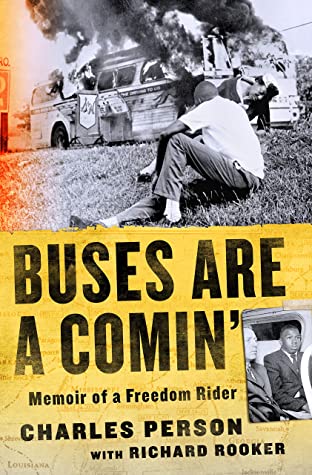
Buses Are a Comin’, by Charles Person and Richard Rooker*****

I’ve read my share of Civil Rights memoirs, and this is one of the best. My thanks go to Net Galley and St. Martin’s Press for the review copy. This book is for sale now.

Charles Person grew up in an all-Black Atlanta neighborhood in the 1950s and 60s. At the story’s outset, he describes how sleeping arrangements were juggled inside their two-room apartment, with four family members sleeping in the front room, and three, himself among them, back in the kitchen. Since everyone in the neighborhood had roughly the same economic standing, it didn’t occur to Person that his family might be considered poor. He was at the top of his class academically, college-bound. His family were faithful church goers, and his father worked two-plus jobs to provide the bare necessities, but they never went hungry. It was only later, when his neighborhood was featured on a news program addressing “Urban blight,” that he learned that the place he loved and called home was part of a “tenement.” The overall tone of his home life is set at the beginning, when he describes an incident from childhood. He and another child stole peaches off of a neighbor’s tree, and his mother marches them to the door, makes them confess—which meant looking the owner in the eye and using the word “stole,” rather than a softer euphemism—and pay for the fruit they ate. Thus we know there’s a definite moral compass here.

It isn’t until he’s grown that Person learns about racism. He gets his first job at a bowling alley, and he learns what parts of that place and the surrounding businesses he is allowed to access, and which are for whites only. Later, he insists on sending his test scores and application to a Georgia university, knowing his marks are excellent, but is notified by mail that the school will not admit Negro (the accepted term at the time) students. As the lunch counter sit-ins in North Carolina draw headlines, Person becomes part of a local student effort to end segregation at the lunch counters in their area. Person is thrown in jail, and when he is released a short time later, he is experienced, primed, and ready for more.

The story of Person’s life, and of the Freedom Rides, which make up most of the memoir, is riveting. It’s told in first person, in a you-are-there kind of narrative that drew me in. I listened to part of this story using the audio book that I borrowed from Seattle Bibliocommons, but although the reader generally does a serviceable job with the text, I recommend the print version. I winced when the reader mispronounced “mimeograph”; there are no mimes in there, honey. But mostly, there are a lot of freedom songs interspersing the story, as the riders sing in jail, sing in the bus, sing, sing, and sing some more, and I don’t know about you, but it sets my teeth on edge when in the audio version the lyrics are simply read, with or without rhythm. Many of these are well-known songs, and if I see the words on the page, I will hear the music in my head. Listening to someone recite the words in a bloodless, wooden recitation is just sad.

For anyone that misses the connection, Person draws the connection between the Freedom Rides and the struggle of the present:

“It is sixty years later, and politicians do the same today when the devalue and disrespect important African-American societal concerns by turning Black Lives Matter into All Lives Matter. Of course, all lives matter. No one argues against that, but changing the issue from “Black” to “All” steals the legitimacy of a vital concern that needs political attention and a political solution. The intentional and insidious shifting on an issue through language is a calculated move. It was by [Georgia Governor] Vandiver in 1960, and it is today. It avoids and insults at the same time.”

There is no better time to learn the lessons of the Civil Rights Movement of the mid-1900s, and apply them to the struggle against racist cop brutality in the present. If this subject makes you sit up a little straighter, you need this book. Of course, it’s also great reading for anyone that likes a good memoir, but even so, read it actively. There’s so much more work to be done.

How to Grill Vegetables, by Steven Raichlen****

Raichlen is the author of The Barbecue Bible, which won the Julia Child Cookbook Award. I won a copy of that excellent tome in a Goodreads First Reads drawing, and I’ve used it every summer since then. So when I noticed that his guide to vegetables on the grill was available, I leapt on it. My thanks go to Net Galley and Workman Publishing for the review copy. This book is for sale now.

Summer is the best time of the year to eat healthy foods, and yet when we attend a barbecue, often the only vegetable dish is the potato salad, and possibly an anemic tossed salad or plate of tomatoes. Raichlen proves that it doesn’t have to be that way. This nifty cookbook provides starters, entrees, and includes some ideas I’d never considered, like making bread or pizza on the grill. I made the green bean rafts (stuck together with skewers, cooked on the cooler part of the grill, liberally oiled) and the hobo packs. I think the latter is due for change to a more sensitive name, but Raichlen didn’t invent this category of food preparation, and we cannot hold him responsible for the term. As to the food inside the pack, it was delicious, and has made its way into the regular rotation for summer barbecues at my house.

The sad part here is that for those of us eating vegetables as part of a weight loss regimen, the benefits are limited. Again—not the author’s fault. It’s impossible to cook vegetables on high heat this way without adding a lot of fat into the mix. It’s a matter of physics, and there’s nothing we can do about it; if I surrendered rather easily to the need for gobs of olive oil, surely no one can fault me. I look forward to trying the recipe for Tuscan Edamame next.

One of the things I appreciate most about this author is that he doesn’t use his book as a sales tool. It burns me up when I purchase a cookbook, only to find that many of the writer’s recipes include some secret blend of flavorings that can only be obtained by ordering it from—you guessed it—the author. Raichlen doesn’t stoop to this practice, and his recipe calls for ingredients that are are readily available and reasonably affordable. My one complaint, and it’s a minor one, is that too many of these recipes call for me to do a great deal of kitchen prep, involving many dishes and sometimes a food processor, before venturing out to the barbecue. For me, the joy of barbecuing, apart from its delicious results, is to spare myself all that time in a hot kitchen (or a cool one that results in astronomical energy bills.) I don’t want to come back inside after a barbecue and have to contend with a mountain of bowls and pans that need washing. I like to keep it simple.  However, this can be done by picking and choosing which recipes to try.

Most of these recipes are not vegetarian in nature, so if that’s your wheelhouse, you will be happier looking elsewhere, assuming that someone somewhere has written such a book. I don’t need it, so I haven’t searched. But what you can make here is scrumptious.

I generally like reading digitally, but cookbooks are a pain in the butt to read on a phone or tablet, so for that reason, I suggest you buy this nifty cookbook on paper. Summer isn’t over yet, so get it now!

Blood and Treasure, by Tom Clavin*****

Daniel Boone’s story is legendary, but few of us know any of the particulars of his life and achievements, beyond the forging of the Cumberland Gap. When I saw this book, I leapt at the chance to read it. My thanks go to Net Galley and St. Martin’s Press for the review copy; this book is for sale now.

Boone’s life is often held up as a testament to what an individual can accomplish if he is hardworking and determined; yet though he was both of those things, this bit of lore is also partly myth. Boone is born into a well-to-do family, pioneers to be certain, but not ones forced to build fortunes from scratch. After parting ways with the Quakers in Pennsylvania, the family moves south.  Daniel is in love with the wilderness, and his physical strength, health, and stamina, combined with courage, resourcefulness, and a capacity to think on his feet make him a natural born explorer. He is an excellent hunter, and so he makes his living by selling animal pelts; also, it turns out that bears are delicious. (Sorry, Smokey.) But as others move westward, the game begins to dry up, and so he moves further westward than anybody else.

Boone is renowned as an Indian fighter, but the truth is complicated, and it’s political. There were a great many tribes involved, and often as not they were enemies with one another, at least in the beginning. In some cases, land was sold by a tribe that actually had no claim to it in the first place. This explodes the notion taught to us as children, that the Native peoples found the notion of selling land incomprehensible because of its sacredness; we see one tribe for whom this is true, but there were plenty of instances where a treaty was knowingly made, yet other factors also made it unenforceable. Most of all, Caucasian Americans failed to understand the lack of a top down decision-making structure within the tribes, and so often a chief or other leader would sign, but others within his tribe weren’t bound by his individual decision.

Then too, there’s the little matter of the American Revolution. Alliances are constantly made and broken, involving the British, French, Spanish, and Patriots. At one point, Boone loses his considerable acreage because his land is granted him by the Spanish, but the Louisiana Purchase renders his title null and void.

But it is the detailed recounting of Boone’s explorations (almost never alone, except in an emergency, so there goes the myth of the rugged individual) that makes this book fascinating. The scrapes he gets into, and how he gets out of them; the harrowing fates that befall those around him. He is captured and escapes multiple times.  And although the women in his life get little ink, my heart goes out to Rebecca, his wife, who is left alone with the younger children for months and months on end, often without any idea as to where his travels have taken him, and whether he’s coming back. There are so many ways to die out there, and it’s not like anyone can send her a telegram to let her know if everyone is killed. At one point, she gives him up for dead, and when he finally shows up, she is pregnant, and the baby cannot be his! She tells him that she believed herself a widow, and so she turned to his brother; Boone decides this is understandable, since that’s pretty much what widows are expected to do, and since his brother looks like him, it won’t be obvious to others that he isn’t the father.

Even more interesting, however, is his daughter, Jemima. Her strength and cunning in dangerous circumstances—particularly when she is kidnapped and plays a part in her own rescue—make me wish she had her own biography. Were gender roles not so restrictive, she would have made an outstanding lieutenant, and perhaps successor to her father.

I initially didn’t believe I could give this work a five star rating, because the sources provided aren’t well integrated, and Clavin has relied tremendously on one source, a biography written long ago by Draper. But after I read the endnotes, I realized that even if he had been merely rewriting Draper’s book for a modern audience, it would be a great service. The social and political perspectives dominant when Draper’s book was written would make most of us blanch today, particularly with regard to race and gender, and yet, Draper did a masterful job with research, extensively reviewing Boone’s family and others still living at the time. I came away convinced that Clavin knows his subject well, and though I taught American history and government for decades, I learned a great deal from this one nifty book.

Highly recommended.

The Soul of a Woman, by Isabel Allende*****

Isabel Allende has long been a guiding light for women, immigrants, and social justice activists. She is an old woman now, and her wisdom and word smithery have only grown deeper and wider. Thanks go to Net Galley and Random House Ballantine for the review copy. This book is for sale now.

There are four sections to this compact memoir, and overall, it is a memoir of Allende’s feminist philosophy and experiences. She also describes the trajectory of the feminist movement and the gains that have been made.  One of Allende’s most agreeable attributes is her candor, and she discusses her relationships with the men she has married with disarming frankness and humor. Her voice is like nobody else’s.

Generally speaking, I find it annoying when an author uses space in the book they’ve sold us to advertise a product or beg for funds, nonprofit or not; however, this time I wanted to stand up and cheer! Allende’s foundation exists to support women’s reproductive choices, and that includes abortion. Out of all the years I’ve blogged, over one thousand reviews I’ve scribed, and I have never seen abortion rights advocated so forcefully. I bow in admiration.

If I could have something more from this iconic writer, it would be an overall autobiography. She has written numerous memoirs, but all of them focus fairly narrowly on one particular aspect or time period. I would love to have her whole story in her own words.

Highly recommended.

Broken, by Jenny Lawson****-*****

4.5 stars, rounded up.

Jenny Lawson, AKA The Bloggess, has a new book out, and I do believe it’s my favorite. My thanks go to Net Galley and Henry Holt for the review copy. This book is for sale now.

Lawson bucks a somewhat disquieting trend, and I am so glad. The trend is to make the first three chapters—most likely what sells the book—sterling, and then fill the rest with mediocre, highly missable prose. In contrast, the earliest part of this memoir is good, but it’s not great. She starts slow and then builds toward most of her best material, leaving me smiling as the book concludes.

But let’s go back to the material at the start, which I find to be random in a way that yearns for the hand of a high profile editor. I’m throwing my hands up, wondering just why a professional writer would blather on like this. Can she write a coherent sentence, and then end it when it’s over? Of course, I continued reading and loved the essays in the middle, and as we draw near the end, she refers to the challenges she encounters in writing, citing her inclination to overwrite, and the resultant paragraphs that contain “a run-on sentence that would make an English teacher cut herself,” and I howled, because that’s it, exactly. Almost exactly, I mean; I was moaning, but I hadn’t reached for anything sharp.

What is it about depression and humor, and the connection between them? It’s hard to tease apart all of the components that make Lawson’s writing so compelling; to a certain extent, it’s alchemy of the human spirit, I suppose, combined with skill at self-expression. But there are other components much easier to spot. One is her disarming frankness; for example, she mentions that people, remarking on her twentieth wedding anniversary, ask about her secrets for a long and happy marriage, and she tells us that actually, not all of those years have been happy. There are good periods, and there are bad periods. And then she adds, not entirely jokingly, that part of the reason she is still married is that there are things in her marriage that she doesn’t write about.

But even more compelling is her level of perception, and her ability to understand the subtext of just about everything.

I’ll mention my favorite parts, but I am not giving up any more humorous quotes, because that’s a crappy thing to do to a humor writer. There’s a funny part having to do with shoes, and the kayaking trip from hell, which she dubs “Divorce Creek.” The chapter about Transcranial Magnetic Stimulation, which is a serious bit for the purpose of informing us, is interesting and may be of help to a number of readers. (However, the searing honesty about her suicidal impulses might actually be a trigger for a profoundly depressed reader.) And the infuriating experiences she has had dealing with insurance makes me want to throw things, but it is important that she includes them here.

If you’re a fan of The Bloggess’s writing, you have to get this book. If you are new to her work, you can dive into this memoir without reading her previous ones. Highly recommended.

Well-Read Black Girl, by Glory Edim, editor****

Ahem. Yes, I am in fact, over two years late with this review. I can explain.

My dog ate…no, wait. I got a flat tire when…oh. Yeah, that doesn’t work.

So now I have to tell the truth, having failed miserably, as I usually do, at lying. Here it is. About a month after I received the galley to this book, courtesy of Net Galley and Random House, national news and social media went into a virtual frenzy discussing cultural appropriation. And I froze. I started examining everything I did through that lens, and I may have gone overboard. I looked at this galley and I thought, I have no right to review this thing. And when I read the introduction anyway, I feel it even more so. Not written with me in mind, was it? Was this the literary equivalent of reading someone else’s mail? And so I did the easy thing, which was to shove it onto the back burner and read something else. Repeatedly.  

Several months later, it occurred to me that nobody would even have to know if I were to sneak it out of my files and just read the article by Jesmyn Ward, which was actually why I had originally requested it. Ward is on my read-anything list. I read it, and I liked it, and then I shuffled it back into the file. No harm done.

This spring, as the world tentatively emerges, one hopeful toe at a time, from the isolation imposed on all of us by the horrific pandemic, I realize what I should have known all along: that anybody can read anything, and form an opinion about it; and that since I was granted the galley, I actually owe a review. I straightened my spine, dusted myself off, and sat down to read it. There was no blinding light or thunder from the heavens. Nothing smote me. I read it, and I lived to tell the tale.

Most of the authors here are new to me; in addition to Ward, I also know Jacqueline Woodson’s work a bit, mostly from my years teaching language arts, when I used her YA book. Everyone here included in this compendium is a strong writer, and they are largely preaching to the choir, since the audience are also bibliophiles. But the common thread, the point they drive home—and rightly so—is the importance of finding literature about girls that look like themselves. They speak of it as empowerment and validation.

Back in the stone age, when this reviewer was enrolled in a teacher education program, we were likewise taught the importance of inclusive literature. It seemed so obvious to me, this obligation teachers surely have to make sure all of their students are represented in the books their students read, or have read to them. I figured it was a no-brainer. But when I arrived at my first teaching position in elementary school, (heaven help me and those children both,) I was shown the supply closet and there were the classroom book sets. The main characters were Caucasian boys; Caucasian boys and girls; fluffy woodland animals, mostly male; and more Caucasian boys. I sadly examined my battered Visa card and drove to the bookstore to order better books. And I was further amazed to learn, later, that my colleagues, all of whom were Caucasian, believed that the school’s book collection was terrific. Their students loved those books, and that included the children of color that made up approximately half of the population there, they told me.

Sure they did.

The essays in Well-Read Black Girl are a much-needed reminder that racism isn’t always overt; sometimes racism is exclusionary, unintentionally so. And what silences young voices, and what teaches children that books, and life in general, are not about them, worse than discovering that they are not important enough to be included in books?

When I moved to secondary education, where I belonged, I visited the book room there, and I found a set of books about African-American boys, but the message inherent was that they are constantly exposed to drugs and gangs, and it will be hard as heck not to be drawn in. And once again, I scratched my head. These Black kids, most of them were from middle class homes, or loving, well supervised working class homes. Drugs? Not so much. And what did these books teach their Caucasian classmates about Black people? I sighed and got back in the car, already apologizing silently to my Visa once more.

This collection of essays is important, not because of any particular brilliance in composition; they are well written, but not memorable for the writing itself. Instead, they are the key to understanding, from primary sources, why Black girls need books that depict Black girls and women in a positive light.

I’ve assigned four stars to this book for general audiences, but for teachers in training, it is five stars. Every teacher training program should include these essays as required reading. We have to read it until we get it right.

On the Plain of Snakes, by Paul Theroux****-*****

Paul Theroux has been a successful travel writer for a very long time, but he is new to me. Lucky me, I read this free, thanks to Net Galley and Houghton Mifflin Harcourt. It’s for sale now.

The first thing that took my notice was that this is a gutsy writer. Though he’s in his late seventies, he hops in his personal vehicle and motors south to Mexico, and then all over that nation independently, venturing into out-of-the-way spaces, mostly eschewing the usual tourist haunts that draw the spring break crowd from the US and other parts. Over and over again, locals explain to him that this road, or that, or the other is very dangerous right now; sometimes he revises his route; sometimes he takes the route but at a different time; and sometimes he goes anyway, but takes somebody with him. What he doesn’t do is go home early, or store his car somewhere and follow a tour guide around. I stand in awe.

Theroux approaches his journey as a researcher, rather than as a tourist advisor. He interviews countless individuals, even learning a little of one of the indigenous languages—in addition to Spanish– in order to communicate. I gave up trying to trace his route, instead just going with the narrative as it unspools.

I have to tell you, this is a tome. I might never have finished it had I relied exclusively on my review copy. I recognized it would be a hefty commitment to get through all of it, so once again, I turned to Seattle Bibliocommons for the audio version. I found it went much faster once I was able to do something else with my hands as I listened. Joseph Balderrama is a wonderful reader, and I quickly found myself absorbed into the journey, as if I were an unseen passenger.

Theroux takes us through the ordeal at the US/Mexico border, which was a nightmare during the time this was written, during the Trump administration. (If you have a MAGA cap in your closet, you may not enjoy this book.) He listens to Mexican citizens that live near enough to the border that they can actually see it from their homes, or from their workplaces. Some of them have lived in Mexico but worked in Texas for a long time, and the hardship they experience once the rules are changed is dreadful. And the insight I gain from listening to his interviews with people there about immigration to the US is most enlightening.

The most amazing thing to me is the way the cartels and the Mexican police force overlap, and in a number of places are exactly the same people! He describes multiple shakedowns by traffic cops while he is driving. It seems that the state pays its cops next to nothing, and so in order for them to support themselves, (particularly, we assume, those not being paid by cartels also,) they are permitted to stop anyone they believe has some money, and essentially intimidate them into a bribe. But it’s not complete chaos: once a driver has been shaken down, they are entitled to a receipt for the money they have had to forfeit so that another cop up the road cannot do the same thing.

The one tourist area Theroux passes through is Puerto Vallarta, which also happens to be the only place in Mexico that I have visited. About ten years lapsed between my visit—a very pleasant one—and Theroux’s, and I was saddened to learn how unsafe it has become, and how badly the locals, who were mostly middle class when I was there, have it now.

There are a number of fascinating passages, and I learned a lot. One village is awash with what sounds like a new sort of trans woman, (new to an American from Seattle, at least,) and another where the handmade sandals are finished with a jaw dropping method. There’s one very poor village where earthquakes occur so frequently that most of the homes are no longer standing, but many people won’t sleep indoors anyway for fear of being crushed to death. No aid from the Mexican government or any international body has ever reached them. Those people are on their own, and they are suffering.

Perhaps the sweetest parts have to do with the friendships that the writer forms with the people he meets there. I especially enjoyed reading the interviews with his new author and artist friends.

For those like myself that approach this with general interest, I’d call this a four star book. My stamina is greater than most, yet as much as I enjoyed it, it did feel a little bit lengthy. For those with a particular interest in the socioeconomic, cultural, and political realities of Mexico, it’s five stars, hands down.

Recommended to those with an interest in this field.

Race of Aces, by John R. Bruning****

What kind of nerve does it take to go up alone in a fighter plane and duel with an enemy? Race of Aces is an account of the best Allied fighters in the South Pacific during World War II. My thanks go to Net Galley and Hachette Books for the review copy. When I missed the publication date, I obtained a copy of the audio book from Seattle Bibliocommons. This proved to be a very good thing.

John R. Bruning does a fine job introducing each of the best fighters to us, and when he begins with a young man from Portland, Oregon, which is where I grew up, I was instantly engaged. There are five fighters whose stories are told here: Portlander Gerald Johnson, Richard Bong, Tommy McGuire, Neal Kearby, and Charles MacDonald. The framework for the story is a competition for a prize offered by the iconic pilot, Eddie Rickenbacker, who promised a bottle of excellent bourbon to the first pilot to break his record of 26 planes shot down. The men’s heroism—and sometimes recklessness—makes for a compelling narrative for readers of military history.

I begin by listening to the audiobook as I make dinner, following up later each day by going over the digital review copy. However, I soon discover that the detailed descriptions of noteworthy dogfights are impossible to envision unless I do both at the same time. Soon my routine is to listen to the passages in between battles, knowing that whatever I am doing, I’d better drop it and grab my tablet so I can follow along once the pilots take to the air. When I do this, I am rewarded with a clear mental movie of what is unfolding. Some of these fights are breathtaking in their intensity.

A flying ace is someone that shoots down five or more enemy planes. The vast majority of World War II flyers were competent and may at some point have shot down a plane or two, but the aces were few and far between. They were often working with substandard equipment—with the best American machinery reserved for the war in Europe. One noteworthy statistic caught my attention. “Fewer than 5 percent of combat fighter pilots achieved acehood, but they accounted for 47 percent of all the enemy planes knocked out of the sky.”  

Again and again, I read instances in which the Allied fighter pilot plays a game of chicken with his opponent, flying straight at the enemy plane; usually the enemy veers off at the last minute, and once in awhile it’s the Allied fighter. There’s one noteworthy instance when they fly so close that the American pilot’s wing knocks into the Japanese plane; they find a smear of green paint on it after he lands. And so I kept wondering, what if nobody blinks? Of course, my mindset is diametrically opposite that needed for warfare; I think like a teacher. Don’t run with scissors. Slow down. Watch where you’re going, young man. Don’t wave your pencil or you’ll put somebody’s eye out. These guys, on the other hand, were warriors:

“Carl held his course and refused to break first. Blev watched in horror as he flew straight into a Zero, the two planes exploding with all the violence of a 500-mile an hour collision.”

Despite short rations at times, missing mechanical tools and parts of planes, and a number of other challenges, these men crippled the Japanese air corps in this part of the world, and because of this, the five aces were particularly loathed by the Japanese pilots. One of them is shot down toward the end, and although he survives the crash, he is shot repeatedly after he goes down. It’s just as well that he’s dead by the time they get to him:

“After he fell to the jungle floor, the Japanese stripped everything off him, including his boots, watch, clothes, jacket, and dog tags. They left his naked body unburied, sprawled facedown at the base of the tree, his parachute still entangled in its branches like a canopy for his anonymous grave.”

It’s a weird sort of compliment.

The audiobook frees me to check details not provided in the book itself. There is a description of the different aircraft available to the men, and as I listen. I search for images of them and find some diagrams; there are parts of the craft mentioned and I have no idea what they are. Hopefully those that pick up the finished copy may find some photographs or illustrations, but I have none, so I run some searches.

Ultimately, I don’t care at all who wins the bottle of bourbon, and I have trouble remembering who is who, apart from Gerald Johnson. But that doesn’t bother me; I am not in this thing for individual biographies of the pilots, or because of the Rickenbacker contest. I want to know more about the World War II pilots, and the contest between the five men provides an excellent framework for that information.

The audiobook, while useful, does have some small glitches. The narrator should have taken the trouble to find out how to pronounce place names. The story begins in Oregon, and every time the word “Willamette” is used—Willamette Valley, Willamette River, and so on—the mispronunciation sets my teeth on edge. I catch myself snarling at the reader as if he is there in the room with me. His general manner while describing the military aspects of the book, which of course is most of it, has a documentary feel to it, and it works well, but now and then we veer into the private lives of the pilots, and when more sensitivity and nuance are called for, the reader is still using that clipped documentary voice you’d associate with a movie shown in your high school social studies class. Because of these things as well as the complexity of the fight scenes, I recommend the printed version over the audio. However, if you can swing it, the best way of all is to use them both simultaneously.

Nobody can dispute that Bruning knows his material, and copious research was done to produce this book, at least on the American side of it. It is a bit longer than it needs to be, and my own preference would be to edit it down a bit. Also, although the “J” word is only used in quotations, it shouldn’t be used at all. Those that squawk about authenticity should try inserting the “N” word, which was also freely used during this time period, into the quotes, just to test the assertion, and then it’s obvious that of course no reputable author should publish such a thing. Racist terms, no matter how common to the time described, have no place in any reputable history publication, and he should have worked around them.

With these caveats, I recommend this book to those that enjoy military history.

Girlhood, by Masuma Ahuja****

My thanks go to Net Galley and Algonquin for the review copy. This book becomes available to the public tomorrow, February 9, 2021.

From the beginning, it was plain to me that this would not just be another anthology. Every school library has books that include children from many places around the world, but this one is more diverse than most, and it conveys more of the girls’ own words. Included are girls from 31 countries, and most of them are people of color. The United States does not dominate the collection; there are two girls from the U.S. included, but they are not given anchor positions, and neither is from New York or California.

Each entry contains writing done by the girl herself, more extensive than anything else I have seen; I cannot tell whether some of them have been translated, or if all of them wrote in English originally. There are multiple photographs of each girl, her home, and the things that are important to her. Most are students; one is a mother herself. There are a variety of social classes, though none appears to be from a wealthy family. The girls that live at or near what we in the developed world would call the poverty level, do not speak about being poor, but about everyday life. My favorites are the Cambodian, Syrian, and Irish girls, but they’re all interesting. I am pleased to see several Black girls in the mix.

Though the collection is inclusive, none of the girls appears to be, or says she is, disabled in any way. I would like to see at least one such girl. But more concerning to me is that, although twenty percent of girls worldwide is obese, all of these girls in the anthology are either near the ideal weight, or on the thin side. Ahuja does not say how the girls were selected, but I can just about guarantee that the big girls that view this book will not see themselves. I hope future endeavors along these lines will correct this omission. Right now, the message large girls will have is that nobody wants to look at someone like themselves.

Nonetheless, this is one of the best such collections available today. It would be wonderful if there were a way to offer it in different languages and sell it in other countries, too. I recommend this book for middle and high school girls, and in particular to school libraries and humanities teachers.