
Chameleo: A Strange but True Story of Invisible Spies, Heroin Addiction, and Homeland Security, by Robert Guffey****


ChameleoastrangeChameleo is a twisted but true story of an addict who unwittingly becomes an experimental subject in a classified government research program, and the bizarre events that took place then and in the aftermath. My thanks go to the author, who provided me with a copy in exchange for an honest review.

Dion Fuller (not the person’s actual name) had been released from a psychiatric hospital in Southern California. He had procured some heroine and nodded off, permitting various equally marginal characters access to his home. Sometimes he was out of it and had no idea what was happening. It was likely during this time that the guy with the stolen classified documents and a couple dozen pairs of night-vision goggles belonging to the US government made his way into Dion’s apartment. The ensuing chaos proves once and for all that just because a person is crazy does not mean nobody is out to get them. Just ask Dion!

Guffey, the author, is a Cal State creative writing teacher who found himself involved in Dion’s situation. He had a free term at the same time that Dion, an old childhood friend, called for help. With a certain amount of necessary remove, he did his best to advise his friend while taking copious notes. Soon he became convinced that his old friend was not hallucinating.

“Imagine a ridiculous college fraternity with the resources of the entire black budget of the United States of America deciding to play one long prank on some faceless guy in San Diego. And imagine that the faceless guy is you.”

The author’s description of a malicious antic known as “Street Theater” in government circles reminded me of the dirty tricks that the Democratic Party played on the Nixon camp during the early 1960’s—cruising into town in advance, for example, and moving street signs around so that the Republicans would get lost and be late to a speaking engagement—which were later used in turn by Nixon’s Committee to Re-Elect the President in 1972. Dion hoped that leaving his home, which was located very near a Naval installation, would make it all stop, and it did. He left California and headed cross country, but every time he got close to a US military installation, a whole train of personnel would follow him once more, like a trail of ducklings after their mother, right out there in the middle of the freaking desert.

Guffey’s story, which includes the Masons, the Illuminati (note the cover), and assorted other conspiratorial ingredients that would ordinarily cause me to stay completely fucking clear of this whacked out tale, follows Dion as far north as Minnesota, then oh dear God, to Seattle where Guffey was staying. But just as it seems it can’t get any more strange and stressful, the whole thing becomes hilarious! Your humble reviewer sat and laughed out loud about two-thirds of the way into the story, and the lighter tone that marks the book until near the end is what prevents the whole thing from degenerating into a bottomless abyss.
My only quibble with this story—and it’s a small one—is that if we must read entire transcribed passages of conversations, then the persons involved in the conversation in question should all be named, with no pseudonyms involved, so that the reader can use that transcript as a primary document if they want or need to. If that can’t happen, then some of these conversations ought to be summarized or paraphrased, at least in places. But this shouldn’t keep you from getting a copy of this memoir and reading it.

In fact, those that question authority and wonder just how far the US government has strayed from its stated ideals will welcome this strange little book, which is just well documented enough to convince me that it’s entirely true.

It’s available for purchase now.

Bonnet Strings: An Amish Woman’s Ties to Two Worlds, by Saloma Miller Furlong*****

bonnetstringsA few years ago I read and reviewed this author’s first memoir, Why I Left the Amish. Her reasons were compelling, some of them inherent in the Amish tradition, others probably atypical of most Amish families, but all together they provided a powerful impetus, that little voice inside all but the dullest that cries out, “Man the life boats! Save yourself!” I understood, having read it, why Furlong would choose to bail, but I was left with other questions, mostly regarding a gap between the end of the book and the author’s biographical blurb. Happily, I heard from her a couple of months ago; she had written a sequel, and this is it. She volunteered kindly to send it in my direction for a chance to read and review, and it is just as riveting as the first.

The first volume dealt with the horrifying domestic abuse within her family, and the failure of the church to deal with it. Furlong wondered whether she might have remained Amish had she not dreaded her home life, or at least many aspects of it, so tremendously.

It also dealt with her independent nature and intellectual curiosity (my own terms, not hers). Why would the Amish so persistently seek to stamp out the desire of some of its own members to seek higher education, I had to wonder. Would they not want Amish nurses, professors, plumbers, electricians?

The e-mail I received from the author mentioned a PBS miniseries in which she was featured, The Amish followed by The Amish: Shunned. Once I finished reading Bonnet Strings, I decided to hold my review until I could view these productions, some four hours all told. Between what she tells us in this second memoir and what is said in the miniseries, I understand. Not that I know what it is like to be Amish; far from it. But I see now why they set such strict parameters in order to preserve their culture.

The metaphor the Amish use for the individual is that of a grain of wheat. The church is a loaf of bread, and one person can’t be in that loaf without crushing out their individual needs and desires. I have heard of other cultures abroad that take this approach—the Chinese come to mind—but for a quarter million such people to be here in the USA with its John Wayne culture of independence is remarkable indeed, and it is clear to me now that to permit its members to put even one toe into the world of freedom, independence, and yes, greater risk, is to invite its youth to leave and not return. But ninety percent of Amish children grow up to be Amish. They stay Amish. And I really think the twin practices of shunning those—even one’s own children or yikes, parents!—when they leave, combined with the standing offer of reconciliation upon return, is the powerful engine that sucks many of those that have departed back into the fold.

Furlong has been independent and living in Burlington, Vermont, has built new friendships and has a serious boyfriend, but she goes back to the Amish when they come for her. She recounts how it is almost as if a mental switch has been thrown, and she suddenly no longer feels she has a choice. Until I watched the documentaries to accompany the poignant and visceral material in her memoir, I thought this was crazy. But the combination of religion, family, and the fact that there is another language, that old German dialect spoken only by the Amish, weaves a powerful spell. It is as if a voice says, “We know you in a way no one else can.” Saloma goes back to live in her old home town once. Others go back multiple times before they are able to tear away. Actually, our author made a pretty good job of it compared to others that tear themselves away, and in the end is happier that she has returned once in order to put to rest her own doubts, her own questions about whether, once out of her father’s home, she could become a successful Amish woman.

Her memoir is punctuated with memories scribed by her husband, David Furlong, who was a part of her journey out into the world. He provides a different perspective, perhaps closer to what the reader might have seen.

In reading the memoir, it occurred to me that the practice of shunning creates selective breeding. If those that become independent are allowed to return to the community at will and be welcomed, allowed to mix and mingle, then before you know it, they would intermarry. And though science has still not teased apart the mystery of which qualities in us are inbred, and which are the result of how we are raised, the stunning level of passivity among those that remain in the community is remarkable. And it is those truly passive folk that have babies, babies, and more babies. I suspect that this is how they have managed to not only not die out, as those of us on the outside would have anticipated, but thrive and grow.

With a thoughtful memoir such as Bonnet Strings, I like to read the foreword and introduction, read the book, then go back and reread both of them again. The producer of the documentaries wrote the foreword, and she mentioned that Saloma has taken the time—some thirty years–to let her experiences gel. The memoir, therefore, is not written for a therapeutic purpose, but rather to provide an account, both of the strengths and tenacity within the Amish culture, and of the resilience required of those that simply cannot find a place within it.

Because there is no middle ground. There probably never will be.

This articulate, engaging memoir is available for purchase right now. This is a great way to spend your own holiday weekend, and it would also make a terrific gift. Fascinating!

Liar, by Rob Roberge*

liarApologies, dear reader; I hate having to pan a book. I only request galleys that I believe will be either good or great, but when I inadvertently find myself with a terrible book, I have to call it as I see it. I have another review about ready to post that will occupy this space soon.
I received this DRC free of charge from Crown Books and Net Galley in exchange for an honest review. To be honest, it is the second-worst galley I have ever read. (The very worst lacked punctuation and was unreadable.) I wondered how a book like this wound up with such a reputable publisher; an internet search tells me that he has written other books that were well received. But I can’t find any redeeming value here. I actually came out of it feeling as if I’d been played, and I read it free.

This memoir is billed as a testament of sorts to the writer’s mental illness. I have a relative who struggles with bipolar disorder, and I like the idea of educating the public and of advocating for greater support and funding for those struggling with mental illness and also addiction issues, which are another key part of this book (If it can be said to have parts at all). The two often go hand-in-hand, the mentally ill using alcohol and/or street drugs to self-medicate. So I was on board when I began reading. But soon, I found excuses to read other DRC’s instead. Today, I made myself finish this thing so I could write the review and move on.

Liar isn’t even really a memoir. Let’s start with the title; some of what is in the book is true, some of it is invented, and we don’t get to know which is which. As if that weren’t bad enough, random dark matters (the death of the last passenger pigeon is one) are dropped into the text in no particular order. In fact, the text itself is not linear. This is clearly intentional, with things that happened (or didn’t happen) from 1977 dropped in between what happened (or not) in 1995, or 1982, etc. to let us see how confused is the mind of the mentally ill individual. The whole book is a mishmash of horrors that may or may not have transpired, just as the stricken person’s mind may not always be able to discern the real from the imagined. But for that, we hardly need a whole book; one short chapter would do the trick. I wanted to believe it would prove to be an artistic and if hard to read, avante garde approach to bipolar disorder; by the end, my head hurt and I was pissed.

How can anyone charge money for this?

Part of the reason I wanted to read Roberge’s galley is because it is billed as “blackly comic and brutally frank”, but it isn’t comic, and it isn’t frank. I found two (very, very darkly) humorous moments roughly between the 15% and 20% mark and thought maybe this was where the story would get rolling. Not so much. Nothing else—and I mean nothing else—was amusing. If it had been billed more accurately as merely dark and brutal, I would not have gone anywhere near it, nor do I recommend it to you. If it were at least entirely truthful, however disorienting and disjointed its telling, I could say it shines a light on the mental health crisis in the U.S., but since some of it is just tossed in for the hell of it and didn’t occur, I can’t even, in good conscience, recommend it to those researching bipolar disorder. How could a researcher cite this book in an academic publication?

The only positive thing I can say about this shipwreck of a book, apart from its accurate punctuation, is that no matter how bad your own life looks right now, it probably looks better than this.

Simple Dreams: A Musical Memoir, by Linda Ronstadt***-****

simpledreamsI came of age just as Ronstadt’s career exploded. I was eighteen years old, headed down a winding staircase in the administrative building at Portland State University, when I first heard the song “Blue Bayou”. I was a music major at the time myself; her haunting vocals literally stopped me in my tracks. Fortunately, no one else wanted to use the staircase just then, because I could not move until the song was over. After it ended, I accosted fellow students going about their business, saying, “Excuse me”—pointing to the speakers through which music was piped into the common areas—“but who was that?” They looked at me like I was crazy. Who was who? What? They hadn’t been paying attention to the music.

Later, of course, I learned that the song was performed by Linda Ronstadt, and right away, I knew I had to have that platter. And when I saw that Ronstadt, by now a musical icon holding the record as the only female artist to have four consecutive platinum albums, had published a memoir, I knew I had to have that too. Sadly, I had barely begun collecting galleys and reading them to review, and I missed out. Happily, the Seattle Public Library came to my rescue. I got this book there, and I rate it 3.5 stars rounded up.

I finished reading the memoir about a week ago, and was impressed in some ways, ambivalent in others. What is it about musicians and other entertainers that makes their admirers want to gobble them up, body and soul? How much of her personal life is an entertainer morally obligated to share if she is publishing a memoir and wants the public to pony up what, in these times, is often the only disposable income a retired member of the Boomer generation may have in a given month?

Here’s what I came away with. Ronstadt tells us, right there in the title, that this is not going to be a prurient, tell-all bloodletting. She is giving us the history of her musical life, and that’s what she is giving us, period. And I think the unhappy reviews I have seen from many other reviewers, together with my own strange dissatisfaction when I turned the final page, comes not from her failure to give out personal information, but from her inconsistency in doing so.

As the memoir begins, she provides abundant personal details of her early life, filled with some really funny anecdotes. We see her born into a middle class, very musical family, with her sister turning to her brother and commenting on four-year-old sibling Linda: “I think we got a soprano here.” We read about her forming “mud huaraches” in the hot desert so as to go barefoot without burning her feet, and many, many anecdotes that have nothing, nothing, nothing at all to do with music. And so we bond with her, not just as a performer, but as a person, and we develop the expectation that we will at least hear the broad contours of her personal life and maybe some more fun anecdotes as her mainly-musical memoir progresses.

Before I go any further, I also have to say that she is a strong writer; no ghosts needed here. And her keen intelligence lights the pages as she takes us down her musical pathways.

Even in the 2000’s, women in the music industry have not reached parity with male performers; Ronstadt takes us back, back, back to the days of folk rock, and to a conversation she had with Janis Joplin at a venue where they would both be performing:

“Because of the phenomenal success of artists like the Rolling Stones and Bob Dylan,
earthy funk was God, and the female performers in the folk pop genre were genuinely
confused about how to present themselves. Did we want to be nurturing, stay-at-home
earth mothers who cooked and nursed babies, or did we want to be funky mamas
at the Troubador bar, our boot heels to be wandering an independent course
just like our male counterparts? We didn’t know.”

Those with a strong interest in vocal music—not just as listeners, but as individuals who have studied the craft—will find her memoir more satisfying than those that just enjoy tapping the steering wheel while her songs fill the family car. I had already noted the problems with phrasing in her early work, and was gratified as I read the progression of her training. I was, and am still, dumbstruck by the professional risks she took. She had an established career, and yet dared to venture into areas of music where no one was making money. She had a solid country rock pedigree, yet decided to record orchestral, old-school music with Nelson Riddle. She performed in Pirates of Penzance, and you can bet she knew the finer points of musicianship by then! She released mariachi music, and it sold like crazy.

But the book’s ending feels tremendously abrupt. I respected the way she referred briefly, toward the middle of the book, to her liaison with Californian governor Jerry Brown (“keeping regular company”), and the fact that she didn’t drag us through their affair seemed appropriately modest to me; the woman isn’t a name-dropper, and her own editors had to tell her to put more musicians and fewer horses into her memoir before publishing it.

But at the end, she mentions staying at home with her two small children and we have no clue where they came from. Did she marry? Did she adopt? We don’t need all of the most intimate ends and outs of her personal relationships or her decision to become a mother, but she could toss us a paragraph or two. Even had she handled these more personal aspects of her later life as she did her relationship with Brown, with a mention here and a segue there, the entire thing would have flowed better, leaving the reader more satisfied, and less likely to feel, in some odd way, cheated.

Should you pay the full jacket price for this memoir? I guess it depends how deep your pockets are, and how much you enjoy a conversation that is, more than anything, the history of Ronstadt’s musical career, and those she knew professionally as a side bar of sorts. There was a time in my own life when I thought nothing of stopping by my favorite bookstore and coming out loaded down with bags of books. I bought anything I wanted, as long as each selection was under a particular dollar amount. Some teachers went on ski vacations or cruises, I figured; some smoked and drank, spending great sums in that manner; and as for me, all I wanted was a decadent chocolate bar and a vast trove of paperbacks. It didn’t seem so much to ask, while I was earning a professional’s salary.

These days it’s different. My pockets are a lot lighter, and I have much greater access to books I don’t have to pay for. So for me, this was a splendid library find, but I think I would have been put out if I’d spent jacket price on the memoir that sort of peters out at the end, with no satisfying resolution.

In the end, this book is recommended for those with a strong interest in the professional development of Linda Ronstadt, and of the genre of country rock. Those looking for a more personal glimpse will likely have to wait for an unauthorized biography to pop up.

Unlocking Minds in Lockup: Prison Education Opens Doors, by Jan Walker*****

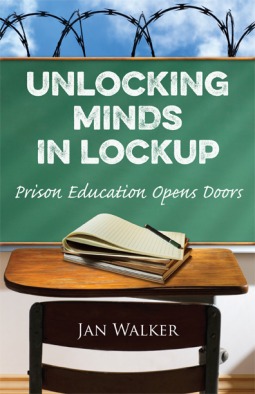
unlockingmindsinlockupJan Walker has spent a large part of her life developing and implementing educational programs, primarily parenting programs, for inmates, and the textbook she has written for these classes is used in prisons around the USA. This book is her account of her work with prisoners of both genders in Washington State. Most of her material addresses her work with serious offenders housed on McNeil Island, a place with a notorious reputation locally because it houses sex offenders. Thank you, Net Galley and Picata Press for allowing me to access the DRC. This book is hot off the presses, and you should read it.

The primary purpose of Walker’s memoir is to let us know that 95% of those currently incarcerated will be released to their families at some point in their lives. A small percentage have their parental rights terminated, and a small percentage are in prison–really and truly–for their whole lives. Almost everybody gets out, and almost everyone goes back to their family. Wasn’t it Robert Frost who wrote that “Home is the place that when you get there, they have to take you in?” And so it is with former inmates. They’re going back to those kids. It’s in everyone’s best interest that they know how to talk to them and how to treat them when they return, as well as while they are incarcerated. She points time and again–and there is so much information and so many anecdotes in between, that it’s a good idea to bring her point back to us–to the fact that most domestic abusers were themselves abused as kids. The only way to break the cycle is to teach inmates how to take responsibility for what they have done; and how to let their children know that they have made a mistake; that prison is the consequence; and that it is not the child’s fault.

Some of this may seem obvious to you, reader, but the woman knows a tremendous amount. And as a former educator in a low income middle school, I can personally attest to the way that children internalize the things that happen to them. Some of them regard themselves as responsible for their parents’ divorces; I’ve had those kids in my classrooms. And when my first husband died in a manner both sudden and tragic, our children didn’t just think it was their faults; they knew it. They were absolutely sure. It took years of therapy to pull them out of that dark place.

Inmates are frequently semi-literate, and literacy skills are crucial to the ability to think critically. So the community college classes that seem like an absurd perk for inmates to receive free of charge, the tab paid by the tax-paying public, are actually beneficial, not only to the inmates and the children that we hope will not repeat their mistakes; they also benefit society in the long run. Better readers are better thinkers; better thinkers make better choices, and they’re better parents in most cases.

Walker has seen and heard plenty of the ugly underbelly of serious offenders’ lives, attitudes, and habits. There was more than one moment when she questioned her personal safety when the prison was short-staffed and she was alone with her classes, no one to help even within range of a good holler. She chose not to wear the gear that guards have because she wanted to differentiate her own role in her students’ minds. The gamble paid off more often than not. But she knew there were some mean, tremendously hard people there. This isn’t about that.

So don’t think she is some namby-pamby bleeding-heart enabler, because she is far from it. We know that she has seen plenty of ugly more from the way she avoids telling us the most shocking material, rather than because she flings it at us (which she doesn’t). But the anecdotes she chooses to share–with names changed for the purpose of privacy, of course–underscore her talking points, and the work is also painstakingly documented. Do you read the sources and end notes in nonfiction? I do. That part of the book says a lot about whether a writer is just referencing other writers, writing up their own opinions, or speaking as an expert. Walker is an expert.

The book starts out dry. Fight your way through that initial fifteen percent; by the time you hit the twenty percent mark, you will be really glad you stuck to it. Although I recommend this outstanding work to everyone, I recommend it especially to public school teachers, particularly those that teach at high poverty schools with large numbers of children of color. I did that for twenty years, and I have seen how deeply affecting it is for children and adolescents to have a parent in prison. Some are ashamed; a lot of them are angry or confused. Some go for a visit that involves a stiff weekend commute, sleeping in the car, and then they fall asleep at their desks on Monday. But the ones that suffer most are those that were promised a visit they didn’t get; that were expecting their parent to be released, and then the parent wasn’t; and those that are convinced their parent is innocent.

And here, though you may roll your eyes, I have to address the one little nugget that ricochets inside my brain when Walker discusses teaching inmates to own what they did and tell their children that they made a mistake; prison is their consequence, it’s not your fault. I understand the rationale, because probably 99.9% of those incarcerated (primarily on McNeil Island, which is near Tacoma, Washington, about an hour from my Seattle home) are not only guilty of what they are in prison for having done, but more offenses for which they weren’t caught. It’s also true that there are no millionaires on death row, and anyone that has read Michelle Alexander’s study of the racial disparity in The New Jim Crow, or who has followed the data produced by the NAACP and other organizations centered on #BlackLivesMatter, knows that Caucasians serve hard time far less often than people of color that commit the same crimes.  But that does not mean that those that are there didn’t do the crime; they did….most of them.

At the same time, my mind kept going back to exceptional people–none of them on McNeil–that I am convinced are innocent. Should Leonard Peltier tell his children that he made a mistake, when he was framed? What about Mumia Abu Jamal? What about the lesser-known Mark Curtis, whose rape case was so clearly bogus that the local chapter of NOW endorsed his case? I know that in the last case, parole was denied over, and over, and over again because he refused to sit down and be rehabilitated for a crime he did not, did not, did not commit and would rot in prison for his entire life before he would crumble and confess to a lie just to get out of that place. He’s out now, but he sat through his whole sentence because he could not have parole by maintaining his innocence.

So although these cases are exceptions rather than rules, and I actually think Walker’s program is both strong and essential, it’s worth bearing in mind that once in awhile, someone that says they didn’t do it, really didn’t do it.

I have so many outstanding passages I flagged, so many poignant anecdotes, so much compelling evidence. I finished reading this book a week ago, but it is the really excellent ones like this that I have to mull over for awhile before I can write the review. I had 187 notes, and it was impossible to select some over others. I went back and reread them, and apart from a few paraphrased instances mentioned above, I think you’ll do better to read them in context, the way she wrote them.

The heartbreaking thing is that now that her classes and text have been adopted around the nation, they have been canceled at McNeil. Some wise ass somewhere decided that volunteers could be found to do this work. Sure, maybe once. Really sturdy do-gooders might last six months, even. But the work has to be done consistently, and you can’t fire a volunteer who phones in sick all the time, or just doesn’t show up, and those that are incarcerated need to develop a relationship with a single reliable professional instructor. I hope the Washington State legislature will reconsider this critical, valuable part of rehabilitation in our prisons. If we can’t raze those prisons to the ground, as the old folk song suggests, then let us at least make a difference for the children of those that are in them.

Highly recommended for all educators, for Civil Rights activists, and for anyone concerned about social justice. Actually, I recommend it to everyone. You can get it right now.

The Remarkable Rise of Eliza Jumel: A Story of Marriage and Money in the Early Republic***

theremarkableriseofelizajumelEliza was born in a brothel, but over the course of her lifetime became a very wealthy woman who took substantial joy in rubbing shoulders with the bourgeoisie in the USA, and in getting as close as she possibly could to the royal family in France. This scholarly biography is her story. Thank you to Net Galley and Chicago Review Press for the DRC. The book will be for sale November 1.
Eliza Bowen moved to New York at an early age and shed her last name and identity, realizing that socially and economically, she had nowhere to go but up. Her ambition was limitless, and her intentions entirely fixed upon her own well being. She married Stephan Jumel, a wealthy Frenchman living in the USA, and set to work spending his fortune. No home was too grand for her tastes, and once she had the place, she set to work making improvements beyond ordinary repairs and redecoration. Her husband trusted her business acumen sufficiently to put real estate in her name in some instances, and this was nearly unheard of during the period in which they lived.
When the Jacobins and Napoleon had been defeated and the Bourbons were back on the throne, Jumel wanted to go home and stay there. His wife had other plans. After his death, she married the notorious former vice-president Aaron Burr. The marriage was short-lived, and they divorced after only about a year of marriage.
The documentation and research Oppenheimer has done is excellent, once her story really gets rolling. The initial ten percent or so, during which Eliza’s predecessors and early life are covered, is almost entirely surmise, and so we constantly read “might have”, “probably”, and finally, “…we can only speculate.” Given the opportunity, I would edit that out completely. The story stands without it, and so it really is unnecessary filler. My recommendation to the reader is to skim up to the point where she meets and marries Jumel.
Eliza Jumel is not an appealing individual, and since the nature of Oppenheimer’s narrative is expository, she makes no excuses for Eliza’s avaricious and sometimes unprincipled behavior. The woman was more than a survivor; she was a predator. But Oppenheimer has been thorough in providing us with a picture of her climb, financially and socially, and she is meticulous both with details and documentation.
Jumel’s life story isn’t a particularly enjoyable read, but for particular aspects of research, mostly topics steeped in women’s history within the US, it is a very useful resource. Scholarly and well documented, students of women’s history in the US will benefit from it.

My Life on the Road, by Gloria Steinem*****


mylifeontheroadI’ve been thinking a lot about Steinem since the recent unfortunate episode on a TV talk show. I was heartsick. What woman gets past 80 without a single regrettable senior moment? But most of us will be fortunate enough to have a spouse, partner, adult child, or other companion who will take us aside and suggest we rethink what we’re doing or saying. “Mom, I’m getting a little worried. Can we check your meds? What do you think?”
But Steinem doesn’t have that sort of support system. The women that were closest to her for a long, long time are already dead.

So I republish this blog post asking you to think, not about the single magic moment, for which she later apologized, but instead, for all the amazing accomplishments and selfless deeds she has done on behalf of women, and for her willingness in a time when most of white America kept to itself, to learn at the feet of women of color.

Because this is her legacy; her real one.

Feminist heroes are everywhere, but if I had to name half a dozen women that were at the core of the feminist movement that followed closely on the heels of the Civil Rights movement and the movement to end the US war in Vietnam, Steinem’s name would be among them. In fact, hers might be the first name out of my mouth. It was she who coined the salutation “Ms”, and who founded Ms. Magazine. When I saw she had written a memoir, I knew I had to have it, and when Net Galley and Random House gave me the DRC, I was delighted. But this is one of the few books that if I’d had to, I’d have been willing to pay full jacket price in order to read. Heroes are thin on the ground these days, and we treasure those that still walk among us.

My reading records reflect over 300 biographies, autobiographies, and memoirs I’ve read, and I didn’t even start listing them until about 3 years ago, so who knows how many? The one thing I know to expect, when someone really famous sits down to tell us about her life, is that the ego will be there. It might be veiled, especially if the person is famous for writing as opposed to something else, or it might be big and bold. Once in awhile it’s been so bald-faced that I came away wishing I hadn’t read the book so I could go on liking the author. So for one of the most famous of living feminists, I was braced and ready.

And this icon’s ego isn’t there. I don’t mean she hides it well; I just don’t find it. And it appears as if large amounts of time spent among Native sisters in struggle—Wilma Mankiller foremost among them—taught her so much about focusing on the circle, rather than a table that has someone at its head, a big-boss type, that she let go of whatever ego she might have been thinking about building. For example, when she works as an organizer, she dreads public speaking, but looks forward to the place at which one part of the auditorium begins to answer the questions from another part, and she knows a circle has formed, one in which she becomes just another person present. I was blown away!

Steinem began her career in journalism, and she is one of the finest writers whose work I have read. For a brief time in years gone by, I dismissed her because of her sometimes-attachment to Democratic party candidates, but the sum of her contributions has been so much more that I missed the forest for the trees during that time of my life. Now I want to read everything she ever wrote.

Travel is a great metaphor, but it’s also a material fact for Steinem. She grew up with a father who was a traveling salesman, and unlike most such men, he took his family with him. For most of her childhood, there was no home, merely a series of stop-overs. This rootless existence would leave some children traumatized. Kids thrive on routine, and not all would be able to translate constant travel into a sense of the usual. But Steinem mostly remembers it as a positive attribute, and credits her parents for their capacity to question social norms during a time most Americans were madly conforming. The fact that she continued to live out of a suitcase once she was grown and on her own is the greatest testament of all to her upbringing, and to her response to it.

There are oh, so many stories, some of which made me laugh out loud, and others that made me think. You can go winnow those out for yourself. And of course, my favorites may not be yours.

But the one thing I can promise you is a really great read, one with depth, yet not difficult to access. It’s friendly and feels as if we are having coffee with an old, dear friend, right at the table with one another. A circular table.

You have to read this book. It will be for sale October 27.

Live From Death Row, by Mumia Abu-Jamal*****

livefromdeathrowMumia is a former Black Panther. The facts support his having been framed in the murder of the cop, a crime for which he was nearly executed.

Live from Death Row, written before his sentence was commuted, is not, however, a vehicle he uses to advocate for himself or plead his own case to the public. He has written other books I haven’t read, and I don’t know if he did that there.

Instead, here he uses his own situation to discuss the racism inherent both in the U.S. court system; he also talks about racism on death row.

The mandatory fresh-air time, prized and treasured by men who rarely see the clear blue sky, is an Apartheid one, at least in Supermax, RHU,SMU, and SHU (ultimate maximum security prisons, which he says have swelled since jailhouse overcrowding has made prisons tenser places and more people are tossed into “the hole”). The vast majority of prisoners are Black, though they are a minority of the population at large, and in the Pennsylvania prison he describes, 80% of those maximum security cases, those who wear Black skin, are crowded into a courtyard. They can’t see green grass or the outdoors, only four brick walls and way up there, blue sky. Why? And where are the other prisoners going?

The other prisoners (who are also maximum security) who are not Black have a SEPARATE courtyard, which is surrounded by chain=link fencing with razor-wire, but has the view. The 20% have the perk of a much less crowded space and the capacity to see Mother Earth during their treasured time outside prison walls.

As to the racist system that places Blacks on death row at such a startlingly high rate, he offers the following statistics and footnotes all of them like the scholar he was before being incarcerated, and continues to be behind prison walls. He uses a Georgia case because it is one which caused the Supreme Court to recognize the following facts:

*defendants charged w killing Caucasian victims are 4.3 times as likely to be sent to death row as those charged w/killing Blacks;

*the race of the victim determines whether or not a death penalty is returned;

*nearly 6 of 11 defendants who received the death penalty for killing Caucasians would not have received the death penalty if their victims had been Black;

*20 of every 34 defendants sentenced to death would not have been given the death sentence if their victims had not been Caucasian.

He continues to pound one damning fact upon another, and cites court cases to back them up; those above come from McClesky vs. Kemp (1987). If the case sounds old, I would argue that precedents are set by very old cases indeed, and of course, this book was published early into the 2000 decade. I doubt a more recent gathering of data would return more favorable information; in the case of jail overcrowding, I suspect the recession has made it worse.

A person would have to be hiding under a rock or in a coma not to be aware of the level of violence visited upon African-Americans by cops and vigilantes within the past year.

I applaud Mumia for using his well-known case to set the facts before us, rather than trying to build momentum to save himself. There was a considerable amount of public pressure NOT to execute him, and I do think that had to do with his sentence being commuted; as it was, my kids’ urban U.S. high school was “barely holding together”, according to a counselor I knew there, the day that Mumia’s case was turned away by the U.S. Supreme Court.

If you are interested in reading about social justice issues, this relatively slender volume holds an astounding amount of really critical information. I appreciate Mumia’s relentless effort to make the public, both in the US and internationally, aware of the atrocities that continue to visit Black prisoners in the USA, and it’s more relevant now than ever!

Being Nixon: A Man Divided, by Evan Thomas ****

beingnixonSuddenly, everyone is writing Nixon biographies; it’s a Watergate junkie’s dream come true! Here Thomas does his best to take us inside Nixon’s skin and tell us what motivated some of the decidedly strange things he did. It makes for highly engaging reading. 3.75 stars get rounded up to 4, along with my thanks to Net Galley and Random House for the DRC. This book is available for sale now.

When I signed on for this galley, I imagined that perhaps Thomas had a background in psychology or psychiatry and was going to take a stab at diagnosing a mental illness that might explain what in the world Nixon was thinking when he did the things he did; if he’d had different meds, would things have shaken out differently? But that isn’t what this book is about. Instead, it is a glimpse at Nixon’s life, including his early childhood and adolescence, postulating that childhood experiences may have shaped the politician Nixon became.

To this, I will admit that I said, “Psssh. Right. Whatever.”

Because it’s a plain and simple fact that many presidents had lives that were scarred by events as bad or worse than what Nixon experienced, and most of them still managed to do their jobs without coming within a hair’s breadth of impeachment. So I don’t buy that theory.

Nevertheless, there are so many interesting tidbits and stories in this memoir that even if the reader doesn’t buy the overall thesis, it’s a compelling read. The conversational narrative kept me rolling along, and every time I found an opinion I thought was baloney, I made a note of it and kept going. I would have continued reading even if I didn’t have an obligation to the publisher, because it really is fascinating stuff.

Imagine, for instance, a solitary candidate with a love for classical music, sitting all by himself in his hotel suite, with the 1812 Overture blasting away, with his arms furiously directing an unseen orchestra. Just one aide saw this, and Thomas ferreted the incident out and presented it here. I doubt you’ll find these tidbits anywhere else!

In addition, few other biographers have managed any insights into what went on in the Nixon residence. I often wondered about Pat, Tricia, and Julie. When he showed up to home, did he storm in and turn the coffee table over? Get quietly drunk? Blame his family for all his ills? Drawing heavily on the memoirs written by family members that I am unlikely to ever read, Thomas gives us a little voyeuristic peek behind the curtains, and I found it intriguing indeed.

When it comes to Watergate, Thomas holds Nixon responsible for what he did, for the greater part, but I rolled my eyes at the repeated claim that if he hadn’t been too shy to socialize with the staff, with the Washington socialites who invited him to dinners, and so forth, maybe he would not have become so isolated…if his childhood hadn’t been so poor, and if his father hadn’t kept him home from his Yale scholarship because there was no money for dorm fees…if…if…if…

I felt much more certain that the author’s research, which is mostly done via secondary sources and the Nixon family’s memoirs, including heavy use of Nixon’s own (RN), was based on fact when he dealt directly with Nixon’s personal life. Although various quotes by the Watergate conspirators were interesting, some are more believable than others. I found one fact in this bio that directly conflicts with that of biographer Tim Weiner, and it has to do with the choice of Spiro Agnew as a running mate. Thomas cites reasons personal and political; Weiner documents that the choice was bought and paid for by Greek financial interests. Here, I believe Weiner. It’s just one directly conflicting fact, but when I found it, just as a humble reviewer rather than as a researcher, it called other things into question, which is where ¼ star fell off this review.

The author thanks a number of people in his after-notes. I always read those, because you can pick up little things lost elsewhere. He especially thanks the man that told him to beware the various items found in the prodigious memoirs by “that old thespian”, Richard Nixon, who was a student actor before he went into politics. It was strong advice.

In perusing this biography, I realized two things. The first is that the reason Nixon had so little domestic policy, and the reason the country moved so smoothly without him during the tortuous period prior to his departure, is because he didn’t have much of a tool kit to start with. The author notes that although Nixon has gained a sinister reputation as an evil, sneaking genius, in fact there were areas in which he really wasn’t all that smart, and this was one of them. He focused on three things: foreign policy, in which he was better equipped to carry out the wishes of the bourgeoisie than most presidents have been; running for office again and when that was done, honing his legacy, about which enough has been said; and of course, revenge, revenge, revenge.

The second thing I realized is that the reason he was virtually cast out of office in a situation in which other presidents might have been able to pull their chestnuts out of the fire, had to do with the fact that he believed himself, as US president, to be more powerful than the ruling bourgeoisie. He misjudged the relationship of power between himself and those that rule us quietly, usually in an unseen way. In attempting to yank the broadcasting license of CBS as part of a personal vendetta against the owner of the Washington Post, he took on a sector of the ruling rich, and he made of himself an object lesson.

By my count, this was my twelfth Nixon biography, though I may have read and forgot about some others. It’s neither the best nor the worst, but for those fascinated with Nixon’s rise and fall, and with Watergate, it should go on the to-read list. It’s just too good to miss!

The President and the Apprentice: Eisenhower and Nixon, 1952-1961, by Irwin F. Gellman***

thepresidentandtheapprenticeGellman’s biography covers Nixon’s tenure as Vice President of the USA under President Dwight Eisenhower; he covers the election campaign beforehand as well as the famous “Checkers Speech”. Thank you to Net Galley and Yale University Press for the DRC, which I took in exchange for an honest review.

It is a little bit hard to be sure about this work, because the galley I got was so rough that it was difficult to judge its fluency. I settled on 3 stars rather than 4 stars because I saw some issues with organization, small tidbits that only marginally bore mentioning showed up in multiple chapters.

That said, it’s a good resource for anyone looking to study the Eisenhower administration or Nixon’s early years in government. I learned some things I didn’t know, and I have read my share (and maybe your share too!) of Nixon-related literature. Gellman has done a great job with research, and even offers pictures of primary documents, such as Ike’s notes during Nixon’s famous speech, at the end of the book.

I learned that the USA of that time period was a much more innocent one than that which we live in now. The Checkers Speech is one good example: now it is regarding laughingly as a mawkish bit of theater, but what is not widely publicized anymore is that the American public was asked to respond as to whether he should stay on the ticket, and they flooded the Republican headquarters and media centers with letters that supported him 350 to 1.

Now that it is known that he used public dollars for personal gain as president, I had rather assumed he had done the same during the funding crisis in question, but actually, back then he was guilty of nothing. The donations that were made were a travel fund, because the Nixons didn’t have the money to travel around the country campaigning. Donors pitched in for their air fare, cab fare, and hotels. There was no law regarding campaign spending limits back then; no law was violated.

As vice president, Nixon had more responsibilities, and occupied a position of greater trust, than most who occupied the same position. He was sent overseas, not only as a good will ambassador or ribbon cutter, but to do unpleasant, tricky things, like talking down the heads of state in South Korea and Taiwan. In addition, Ike never cared to do his own dirty work domestically, and so if someone needed to be officially taken apart, there was a good chance Nixon would be tapped for the job. He had an unstoppable work ethic and was unflinchingly loyal.

If Nixon’s vice presidency is of interest to you, get a copy of Gellman’s book. It goes up for sale in late November, so you can also consider it as a holiday gift if someone you know would appreciate it.