
Ain’t Nobody’s Fool, by Martha Ackmann****

Note: I ran this post in January of this year; under the circumstances, I thought I’d run it again.

“People don’t come to see me be me. They come to see me be them.”
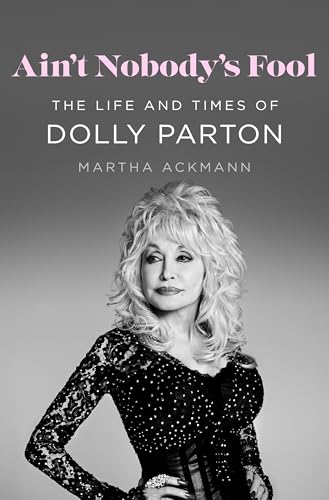
Ain’t Nobody’s Fool: the Life and Times of Dolly Parton, by Martha Ackman, is a fine biography of one of America’s most iconic musicians. My thanks go to NetGalley and St. Martin’s Press for the review copy. This book is for sale now.

Dolly began singing as a child, first informally, as children do, but she also understood very early on that this would be her life’s work. Most of her family was musically inclined, but she had a greater talent and a greater need to use it. She also had the right personality for the job; though her early years were filled with deprivation—the song “Coat of Many Colors” does actually describe an early childhood experience that marked her—she was also born with a sunny outlook and determination. For example, when she met the love of her life, Carl Dean, just as she was beginning to be heard on the local radio, she told him that though she loved him, she could not become a traditional wife to him. She would not have supper waiting when he finished work. She would not produce a houseful of children. These are the things that would prevent her from realizing her burning ambition. They were a trap. And happily, Carl—a private man that didn’t listen to country music so much as Led Zeppelin—told her that was just fine with him. He wasn’t going to tag along everywhere and be Mr. Dolly Parton, but they would make it work. And they did.

Fans of Dolly’s might have wondered, as I did, whether we would learn more about the rather mysterious Carl when reading this biography. We will not, apart from seeing Dolly’s philosophy where her marriage was concerned. Though in every other respect she has been open and accessible to the public, Dolly has followed her mother’s advice, that she should find just one thing about her life that she would not share with others, but keep for herself. For Dolly, that’s Carl. The man died last year, but she still keeps Carl, and her memories of their sixty years of marriage, to herself. And I don’t see how we can complain.

Whenever I read a galley, I highlight passages that I think might be suitable to include as quotes in my review. In this case, I highlighted 60! I can’t use them all, but this should give the reader a clue as to how readable this lovely biography is, and how saturated with quotes from Dolly, and from those that know and love her. From her early, sometimes tumultuous years working for and with Porter Wagoner, to the actors that she worked with in movies such as 9 to 5 and Steel Magnolias, to her own family members, it’s rich. Another fun fact: by doing some of her recordings in Tennessee, and by creating the massive theme park, Dollywood, she has come close to doubling the GDP of the state of Tennessee!

Many people may not be aware of Dolly’s intellect and savvy business skills. I have read so many musical memoirs and biographies of hugely talented, successful musicians that trusted others to take care of their business matters and accounting, only to discover too late that they’d been robbed. Perhaps my favorite anecdote in this biography is where early on, when she was only starting to be recognized, Colonel Parker, the man that ran Elvis’s career and gutted his finances, came to Dolly to express interest in one of her songs. Elvis wanted to sing “Islands in the Stream.” But he told her sweetly, Elvis is accustomed to receiving the publishing rights to any song he performs. And Dolly, also responding sweetly, told him how sorry she was, but she just didn’t believe in parting with her catalog. Many years later, after she and Kenny Rogers had gone more than platinum with that same song, she said that that song alone made her more than enough money to buy Graceland, at least hypothetically!

Serious fans and researchers will do well to augment their knowledge by reading at least one other biography, or Dolly’s own autobiography, My Life. Though author Ackman has a congenial writing style and has read a great deal about her subject, she has apparently never interviewed Parton herself. I combed through the documentation at the end of the book and found that out of the hundreds of end notes, there are just five references to a couple of interviews by the author with friends and family of Dolly’s. Sources for the book’s early chapters are sparse and not well integrated, relying almost exclusively on the autobiography.

Nevertheless, this is a greatly enjoyable read. I played Dolly’s music as I read, and though I am finished with it and am reading other things now, I still carry Dolly around with me.Serious fans and researchers will do well to augment their knowledge by reading at least one other biography, or Dolly’s own autobiography, My Life. Though author Ackman has a congenial writing style and has read a great deal about her subject, she has apparently never interviewed Parton herself. I combed through the documentation at the end of the book and found that out of the hundreds of end notes, there are just five references to a couple of interviews by the author with friends and family of Dolly’s. Sources for the book’s early chapters are sparse and not well integrated, relying almost exclusively on the autobiography.

Nevertheless, this is a greatly enjoyable read. I played Dolly’s music as I read, and though I am finished with it and am reading other things now, I still carry Dolly around with me.

Simple Dreams: A Musical Memoir, by Linda Ronstadt***-****

simpledreamsI came of age just as Ronstadt’s career exploded. I was eighteen years old, headed down a winding staircase in the administrative building at Portland State University, when I first heard the song “Blue Bayou”. I was a music major at the time myself; her haunting vocals literally stopped me in my tracks. Fortunately, no one else wanted to use the staircase just then, because I could not move until the song was over. After it ended, I accosted fellow students going about their business, saying, “Excuse me”—pointing to the speakers through which music was piped into the common areas—“but who was that?” They looked at me like I was crazy. Who was who? What? They hadn’t been paying attention to the music.

Later, of course, I learned that the song was performed by Linda Ronstadt, and right away, I knew I had to have that platter. And when I saw that Ronstadt, by now a musical icon holding the record as the only female artist to have four consecutive platinum albums, had published a memoir, I knew I had to have that too. Sadly, I had barely begun collecting galleys and reading them to review, and I missed out. Happily, the Seattle Public Library came to my rescue. I got this book there, and I rate it 3.5 stars rounded up.

I finished reading the memoir about a week ago, and was impressed in some ways, ambivalent in others. What is it about musicians and other entertainers that makes their admirers want to gobble them up, body and soul? How much of her personal life is an entertainer morally obligated to share if she is publishing a memoir and wants the public to pony up what, in these times, is often the only disposable income a retired member of the Boomer generation may have in a given month?

Here’s what I came away with. Ronstadt tells us, right there in the title, that this is not going to be a prurient, tell-all bloodletting. She is giving us the history of her musical life, and that’s what she is giving us, period. And I think the unhappy reviews I have seen from many other reviewers, together with my own strange dissatisfaction when I turned the final page, comes not from her failure to give out personal information, but from her inconsistency in doing so.

As the memoir begins, she provides abundant personal details of her early life, filled with some really funny anecdotes. We see her born into a middle class, very musical family, with her sister turning to her brother and commenting on four-year-old sibling Linda: “I think we got a soprano here.” We read about her forming “mud huaraches” in the hot desert so as to go barefoot without burning her feet, and many, many anecdotes that have nothing, nothing, nothing at all to do with music. And so we bond with her, not just as a performer, but as a person, and we develop the expectation that we will at least hear the broad contours of her personal life and maybe some more fun anecdotes as her mainly-musical memoir progresses.

Before I go any further, I also have to say that she is a strong writer; no ghosts needed here. And her keen intelligence lights the pages as she takes us down her musical pathways.

Even in the 2000’s, women in the music industry have not reached parity with male performers; Ronstadt takes us back, back, back to the days of folk rock, and to a conversation she had with Janis Joplin at a venue where they would both be performing:

“Because of the phenomenal success of artists like the Rolling Stones and Bob Dylan,
earthy funk was God, and the female performers in the folk pop genre were genuinely
confused about how to present themselves. Did we want to be nurturing, stay-at-home
earth mothers who cooked and nursed babies, or did we want to be funky mamas
at the Troubador bar, our boot heels to be wandering an independent course
just like our male counterparts? We didn’t know.”

Those with a strong interest in vocal music—not just as listeners, but as individuals who have studied the craft—will find her memoir more satisfying than those that just enjoy tapping the steering wheel while her songs fill the family car. I had already noted the problems with phrasing in her early work, and was gratified as I read the progression of her training. I was, and am still, dumbstruck by the professional risks she took. She had an established career, and yet dared to venture into areas of music where no one was making money. She had a solid country rock pedigree, yet decided to record orchestral, old-school music with Nelson Riddle. She performed in Pirates of Penzance, and you can bet she knew the finer points of musicianship by then! She released mariachi music, and it sold like crazy.

But the book’s ending feels tremendously abrupt. I respected the way she referred briefly, toward the middle of the book, to her liaison with Californian governor Jerry Brown (“keeping regular company”), and the fact that she didn’t drag us through their affair seemed appropriately modest to me; the woman isn’t a name-dropper, and her own editors had to tell her to put more musicians and fewer horses into her memoir before publishing it.

But at the end, she mentions staying at home with her two small children and we have no clue where they came from. Did she marry? Did she adopt? We don’t need all of the most intimate ends and outs of her personal relationships or her decision to become a mother, but she could toss us a paragraph or two. Even had she handled these more personal aspects of her later life as she did her relationship with Brown, with a mention here and a segue there, the entire thing would have flowed better, leaving the reader more satisfied, and less likely to feel, in some odd way, cheated.

Should you pay the full jacket price for this memoir? I guess it depends how deep your pockets are, and how much you enjoy a conversation that is, more than anything, the history of Ronstadt’s musical career, and those she knew professionally as a side bar of sorts. There was a time in my own life when I thought nothing of stopping by my favorite bookstore and coming out loaded down with bags of books. I bought anything I wanted, as long as each selection was under a particular dollar amount. Some teachers went on ski vacations or cruises, I figured; some smoked and drank, spending great sums in that manner; and as for me, all I wanted was a decadent chocolate bar and a vast trove of paperbacks. It didn’t seem so much to ask, while I was earning a professional’s salary.

These days it’s different. My pockets are a lot lighter, and I have much greater access to books I don’t have to pay for. So for me, this was a splendid library find, but I think I would have been put out if I’d spent jacket price on the memoir that sort of peters out at the end, with no satisfying resolution.

In the end, this book is recommended for those with a strong interest in the professional development of Linda Ronstadt, and of the genre of country rock. Those looking for a more personal glimpse will likely have to wait for an unauthorized biography to pop up.