
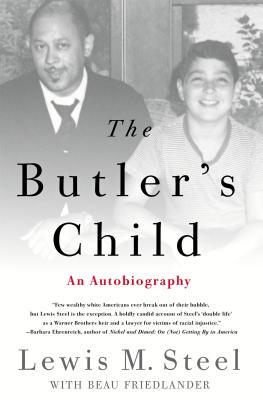
 Lewis M. Steel has a long, noteworthy career as a civil rights attorney. He was an observer during the Attica Prison riots; worked for the NAACP during the Civil Rights movement, and later defended boxer Hurricane Carter against a frame-up charge of murder. And I was permitted to read this story free and in advance, thanks to Net Galley and St. Martin’s Press in exchange for this honest review. I rate it 3.5 stars and round upwards; it is now available to the public.
When I first approached this title I expected to see what the life of a butler’s son was like. In fact, Steel’s social class is at the other end of the spectrum. An heir to the Warner Brothers fortune, he spent much of his time in the company of the family butler, and he was deeply affected by the emotional distance that this family servant, whom he had innocently regarded as a father figure, began to demonstrate as Steel grew older. Later, as an adult, he realized that this faithful retainer, an African-American man, surely had a family and life of his own that he went to visit on his two half-days off work, and he began to wonder what he might do to tear down the wall between the worlds of Caucasian families and Black folk. Ultimately he decided to become a civil rights attorney, and he credits the man that helped raise him as a key reason.
The NAACP of the Civil Rights era—the National Association for the Advancement of Colored People– was deeply immersed in litigation as a means to end segregation. Again and again, racist judges sat in court, north and south alike, and they told the NAACP to go to hell even when their evidence and research was baldly, plainly in the plaintiff’s favor. The NAACP continued to push litigation over mass action because of a strong conviction that if they could get a case heard by the Supreme Court, relatively liberal in many regards and headed by Chief Justice Warren, then surely justice would be done.
It didn’t shake out that way. Outraged over the way the nation’s highest court failed to provide equal protection to its Black citizens, Steel wrote an article for Time Magazine titled “Nine Men in Black Who Think White”, and was summarily fired from the NAACP, who still wanted to curry favor with that court. Many of his colleagues walked out of the NAACP offices in protest.
A common question among Caucasians that want to fight for the rights of people of color in the USA is what can we do? How can one use this white privilege that exists whether it should or not, to change US laws and society for the better? And this question is raised exponentially when one is an heir, a ruling class scion that can do a tremendous amount for the cause in which he believes.
This reviewer has a friend that found himself in this situation. The distant but only heir of a corset magnate’s fortune, he decided that the best way to seek justice was to walk his talk. Reserving a small percentage of the fortune for himself—which is still a tasty enough chunk to own a middle class home in Seattle, take a vacation abroad annually, and eat in restaurants instead of his own kitchen—he donated the vast majority of his personal wealth to the organization he thought best. He doesn’t live in an all white neighborhood; doesn’t have a household staff; and he does blue collar work on the railroad so that he can talk politics with other working people. Because to help people the most, one needs to be among them and facing similar circumstances to those they face. So he gets up at crazy o’clock in the morning, goes out and gets greasy and banged up with everybody else, and then he goes home and cleans his own house and mows his own grass. He gets that more people listen when you put your life where your mouth is, and he believes the future of the world lies with the working class.
So when Steel commences his hand wringing over how wealthy, how privileged he is and how bad he feels about it, I want to say, Cry me a river. Steel freely admits that he enjoys his lovely home that looks down on Central Park and allows him a lovely view of the Macy’s Parade every Thanksgiving. He enjoys the servants, and his neighborhood is all white. He sent his children to all white private schools even as he fought to integrate the public schools that he wouldn’t let his own children attend in any case.
At one point, Steel mentions that his therapist told him to stop whining, and I wanted that doctor here in the room so I could offer him a high five.
Now that I have addressed the elephant in the room, I have to say that Steel’s memoir, despite the wealthy liberal whining, is worth a read for those interested in Civil Rights history and in particular the part of it that has played out in the courtrooms. You don’t have to like the author to benefit from the treasure trove of information in the pages of this memoir. Steel has been involved in some landmark cases, and he is at his best when he talks about the cases he has taken and how they shook out.
Black lives DO matter, and those of us that think so need all the information available to fight that fight, and there are many worthwhile lessons that still apply right here, this book is worth your time and money regardless of whose memoir it is.
This book was released earlier this month, and is available for sale now.
 Isabella Leitner was a Holocaust survivor, and she scribed her memoir using brief entries similar to a diary in format. The length is just 120 pages, about the size of a novella. I was asked to read and review this memoir free of charge before it was released digitally. Thanks go to Net Galley and Open Road Integrated Media for the invitation. This title was just released, so it is available now for purchase.
 I decided to read and review this title because I anticipated that it would be, by and large, a depiction and critique of the American prison system and Homeland Security. As it happens, that is really only a small part of this memoir, which focuses more on the couple’s relationship and the way that addiction warps and undermines trust and affection. Nevertheless, I found it really compelling, and so thank you Net Galley and Random House Ballantine for the opportunity to read and review free and ahead of the public in exchange for this honest review. The memoir will be available to the public June 7, 2016.
 Bryan was a journalist and author during the mid-twentieth century, and Friendly Fire, which originally began as a story for the New Yorker and grew into something more, tells the story of the Mullen family and their response to the death of Michael, a clean-cut young man that answered his draft notice, dutifully served and was killed by friendly fire not long after he was sent to Vietnam. Thanks goes to Open Road Integrated Media and to Net Galley for the invitation to read and review. This is right up my alley and I found it compelling. It was published digitally May 10, 2016 and is now available for purchase.
 I loved this memoir. I read it in 2014 through the Goodreads First Reads program when I first began writing reviews, a few months before I began my blog. This is a memoir intended for general audiences, disarmingly funny and engaging. I recommend it to everyone.
 I read this memoir, one of the most important of our era, before I was writing reviews. I bought it in the hard cover edition, because I knew I would want it to last a long time and be available to my children and their children. It was worth every nickel. It’s lengthy and requires strong literacy skills and stamina, but if you care about social justice and are going to pull out all the stops for just one hefty volume in your lifetime, make it this one.
 Elie Metchnikoff is credited with several medical discoveries, some of which were found before Mother Russia was entirely ready to receive them. This interesting though technically challenging text is the story of his life, and especially of his scientific career and achievements. Thank you Net Galley and Chicago Review Press for the DRC, which I received in exchange for an honest review. This title will be available to the public April 1, 2016.
 Huge thanks go to Net Galley and University of California Press, who provided me with a DRC in exchange for an honest review. It has taken me some time to read and rate it because once I had the DRC for Volume 3, I decided I should hunt down volumes 1 and 2 and read those first. Now I am finally finished, and it was well worth the effort.
 What, another one? Yes friends, every time I find a noteworthy biography of Grant, it leads me to another. This is not a recent release; I found it on an annual pilgrimage to Powell’s City of Books in my old hometown, Portland, Oregon. I always swing through the American Civil War shelves of their history section, and I make a pass through the military history area as well. I found this treasure, originally published in 2001 when I was too busy to read much of anything. It was a finalist for the Pulitzer; A New York Times and American Library Association Notable Book; and Publishers Weekly Book of the Year. But in choosing a thick, meaty biography such as this one—it weighs in at 781 pages, of which 628 are text, and the rest end-notes and index—I always skip to the back of the book and skim the sources. If a writer quotes other secondary texts at length, I know I can skip the book in my hand and search instead for those the writer has quoted. But Smith quotes primary documents, dusty letters, memos, and military records for which I would have to load my wide self into the car and drive around the country to various libraries in out of the way places. Source material like Smith’s is promising, so I bought a gently used copy for my own collection and brought it on home. And unlike the DRC’s I so frequently read at a feverish pace in order to review them by a particular date, I took my time with this one, knowing that if I only read a few pages each day and then reflected on them before moving on, I would retain more.
 Paul Kalanithi was a promising young physician who had nearly finished completing ten years of training as a neurosurgeon when he was diagnosed with Stage IV lung cancer. His twin ambitions had been to become a neurosurgeon and to write. When he realized how little time was left of his too-brief life, he decided to spend his remaining time writing this book. Thank you, Net Galley and Random House Publishing House for the DRC. Dr. Kalanithi died in March 2015, but he left this luminous memoir behind as part of his legacy. It is available to the public January 19, 2016.
