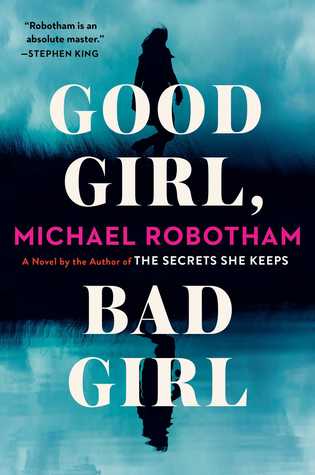
Good Girl, Bad Girl, by Michael Robotham****

I had never read this author’s work before, but went looking for it after reading raves about it from online friends. Thanks go to Net Galley and Scribner for the review copy, and to Seattle Bibliocommons for the audiobook that helped catch me up when I found I’d fallen behind. This book is for sale.
Evie Cormac–whose real name is unknown–is a patient in a children’s psych ward. She was found emaciated and filthy at the scene of a violent crime; it’s believed she was kept hostage, though she won’t deny it or confirm, or talk to anyone about it. Cyrus Haven, a psychologist that looks to become a recurring series protagonist, has his own tragic past. When Evie applies for emancipation, Cyrus offers to bring her home as a foster child until she can live alone. Everyone tells him it’s a crazy thing to do.

Meanwhile, a very different girl has been murdered. Jodie Sheehan had a golden future; a championship figure skater, she was locally famous and appeared destined for great things. Instead she was found murdered not far from home. Who the heck would do such a thing? Jodie had no enemies. Police are baffled.

Throughout this tautly written novel I found myself waiting for big reveals. What connection can there be between Evie and Jodie? Who is Evie really?

The thing I admire about this story is the restraint Robotham shows. A more formulaic writer would twist things around and then hit us with all sorts of deep though wildly unlikely ties between the two cases. He doesn’t do that. I expected the big dramatic scene in which Evie spills everything; he doesn’t write that scene. I’ve probably read a few too many novels of mystery and suspense lately, and I was in the mood to roll my eyes. That eye-roll had to wait for a different book and author, because I believed most of this story, and Robotham had shown excellent taste in keeping the reveals minimal.

Here’s the one thing that makes my eyebrows twitch; it’s the same issue I sometimes have with Jonathan Kellerman’s Alex Delaware books, which I  like a lot. Psychologists don’t race around conducting independent investigations, confronting possible perpetrators, and interviewing people t hat don’t want to talk to them. And sure as hell, psychologists don’t wear bulletproof vests.

But those of us that like these stories agree to suspend disbelief given half an excuse, because a psychologist’s ordinary job—interviewing truculent teens in an office, perhaps, or making hospital rounds—is not nearly as much fun to read about as is a psychologist-as-detective protagonist.  There were a couple of times toward the end where I made little frowny notes in my copy, but for the most part I was on board. Robotham takes us deep inside Cyrus’s head, and the more I felt I knew the character, the more I was able to believe the narrative.

Should you read this book? Sure, why not? It held my attention quite nicely, including during my loathsome hours on my exercise bike.  I would happily read this author’s work again.  Recommended to those that enjoy the genre.

The Broken Road, by Peggy Wallace Kennedy**

“I was perhaps Daddy’s most important legacy of all.”

Thanks go to Bloomsbury and Net Galley for the review copy, which I read free and early in exchange for this honest review.

I was a child during the Civil Rights era, and although I didn’t live in the American South, I recall news footage of Kennedy’s father, George Wallace, the man that the author rightly attributes as a harbinger of the Trump movement. Instead of “Make America Great Again,” Wallace urged his constituents—including the Klan, whom he openly welcomed to his campaign—to “Stand Up for America.” When the federal government signaled that it would enforce the segregation ban, Wallace made headlines around the world by literally standing in the door of the schoolhouse in order to turn the first Black student away from a public school in Alabama.  My own father was a redneck of the first order, but even he distanced himself from this extremist. Wallace ran for U.S. president but was defeated; upon returning to the governor’s mansion, he was shot and paralyzed from the waist down. By that time Malcolm X was dead and could not have told us that this was a case of chickens coming home to roost, and yet it may well have been.

Although the book’s summary suggests that Kennedy is vastly different from her father politically, her prose indicates that her true, bitterest grievances all center on his philandering betrayal of her sainted mother and his failure to be a strong provider and dedicated family man. She tells us that even in the 1960s, she felt his racist rhetoric was wrong, and so I waited for what I thought must surely come next: the moment she either confronted him or simply moved out of the house to another part of the country to restart her life in saner surroundings. None of this happened, as it turns out. She stayed in the governor’s mansion, thrilled by the relative affluence and privilege she regarded as her due following a tumultuous, sometimes impoverished childhood.

The title is taken from a Hemingway quote, and in her own story designated the location of her maternal grandparents, whose simple, homespun nurturance provided relief to her mother and herself when her father went on the road politicking and didn’t send money home for them to live off of. At the beginning of the book she uses the expression often enough to beat it to death, but once her father becomes governor she rarely speaks of these kind, gentle people. Toward the end, she parenthetically notes that her grandmother died at some point back in the middle of the book.

It’s interesting that although Lurleen Wallace was elected governor in order to circumvent what was at the time a state law against successive terms for her husband, the author says nothing at all about her mother’s civil rights policies. We see that she won the governorship in a landslide and was loved by all, and yet if her policies diverged much from George’s, that would have created screaming headlines. It’s just one of the many inconsistencies within this memoir.

The last several chapters are devoted to her father’s redemption politically, or so she asserts. He never hated African-Americans, she tells us, but only did and said those things in order to gain office. Later in life, he asked a handful of Civil Rights leaders for forgiveness and spoke in Black churches about his error. She follows this up by pointing to the large numbers of Black voters that returned him to the Capitol.

I find myself wondering a lot of things, and foremost among them is why anyone would consider a candidate that makes the cold-blooded decision to promote violent racism for the sake of gaining office to be morally superior to one holding the genuine belief in the inferiority of other races and ethnicities. Wallace, she tells us, didn’t sign onto the Klan’s program because of his convictions, but because of what they could do for him. And while the parallels she draws with Nixon are apt ones, the rationalization of her late father’s destructive, ethically bankrupt lifetime is chilling in its own way, but she underplays this aspect of his career.

Her “daddy” lived long enough to appoint her 26-year-old attorney husband to the state bench.

The second star here is reluctantly provided because she does some very nice things at the outset with regard to her description of time and place in the life of poor white folks in mid-twentieth century rural Alabama.  If you’re looking for a silver lining to this wretched work, there it is. It’s all I can find.

I would place this book in the child-revenge category along with Christina Crawford, Patti (Reagan) Davis, and Carrie Fisher.  Read it if you want to wallow, but when you’re finished, you will likely want to shower and gargle.

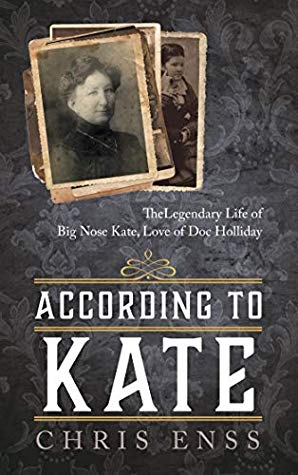
According to Kate, by Chris Enss***

Kate Elder, better known as Big Nose Kate, was a colorful character in the mercurial Wild West. Together with her paramour—possibly her husband—Doc Holliday, she shot, swindled and burned her way through Kansas, New Mexico, Texas and other parts of the American Southwest. My thanks go to Net Galley and Two Dot Publishing for the review copy. This book is for sale now.

Enss is a capable writer, and I enjoy seeing women about whom little has been written brought to the foreground. Enss amassed a fair amount of material on her subject, but some of it was contradictory, and the greatest contradictor of all was Kate herself, who decided to tell her own life story when she was too old to recall everything properly. Enss tells the reader in the title and introduction that she is telling Kate’s story from the subject’s point of view, and she adds numerous footnotes explaining  conflicting information throughout the narrative.

I read things I had never known before about this time and place, and general historical knowledge is where Enss shines best. For example, a ‘soiled dove’ was allowed to own real estate, whereas married women of the time were not. There were a number of financial advantages to owning a house of ill repute. Kate grew up in a middle class household and was not without choices, but she didn’t care to be married off in the way her family had proposed. In the end she was both a shrewd businesswoman and an adrenaline junkie, one that made a point of having at least one loaded gun handy when a situation called for it. I enjoyed reading about it.

Unfortunately there is a lot of conflicting information and the gaps in the story are numerous. Anytime I start seeing the words “might,” “must have, “ “likely” and so forth, I pull back from the narrative. I can’t get lost in a story when I have to mentally filter the things that are known to have happened from the things nobody knows for sure.  I think Enss has done as good a job as could be done with the documentation available, but Kate is a hard nut to crack.

What I would love to see is historical fiction written with Kate as the protagonist, viewed through the eyes of a feminist writer such as Enss. With historical fiction one can freely fill in the gaps, provide dialogue, and make notes at the end of the story letting the reader know what she has invented or changed.

Those with a special interest may want to read this biography, but I see it largely as a niche read.

Best Military History of 2019: Spearhead, by Adam Makos

Honorable mention:

Best Historical Fiction of 2019: Finding Dorothy, by Elizabeth Letts

Honorable Mentions:

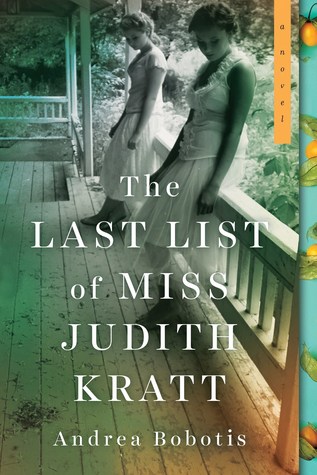
Best Debut Fiction of 2019: The Last List of Miss Judith Kratt, by Andrea Bobotis

Interestingly, my favorite as well as two honorable mentions share a social justice component.

Honorable Mentions:

https://seattlebookmamablog.org/2019/04/13/miracle-creek-by-angie-kim/

The Last Resort, by Marissa Stapley***-****

3.5 rounded upward. The Last Resort is a novel about a marriage retreat where nothing is as it seems.

Thanks go to Net Galley and Simon and Schuster for the review copy. This book is for sale now.

Readers should know that this novel holds triggers for just about everything, left, right, and center.

Miles and Grace Markell run an intensive marriage therapy camp in Mexico. The affluent couples that come here are desperate to save their crumbling marriages. Everyone is supposed to give up their cell phones and internet privileges, and once they do that, they are more or less helpless, which is part of the proprietor’s plan.

Between the punny title and the teaser that suggests that the couple that runs the retreat has the worst marriage of anybody, I was anticipating that this would be hilarious, and that’s not so. There are a couple of moments of dark humor, but mostly this is a straight-up suspense story. That said, it’s a good book, but nothing special. It took me a good long time to distinguish the couples from each other. The climax is fast approaching, and I’m still trying to remember which person Shell is, and who her husband is, and what problem has brought them here. I would probably have had greater success if I hadn’t read this book at the same time as a handful of others, but if I had been forced to read just one book, I would have chosen most of the others I was reading over this one.

This doesn’t mean you won’t enjoy this book. I had recently read another story about a retreat where everyone’s phones were seized and internet forbidden, and so in some ways my lack of interest here was a fluke. Read the synopsis; if you are interested, I recommend you get this one free or at a deep discount.

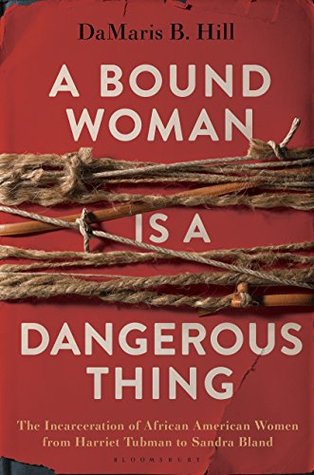
Best Poetry 2019: A Bound Woman is a Dangerous Thing, by Damaris B. Hill*****

Image

Takes One to Know One, by Susan Isaacs****

I have loved Susan Isaacs’s work for decades, and so when I saw her newest novel up for grabs on Edelweiss, I jumped at the chance to read it. This book is for sale now.

Corie Geller is a former FBI agent. Now she is the stay-home mom of a fourteen year old stepdaughter, and the wife of a prominent judge.  She works as a scout for quality Arabic fiction. And she’s bored out of her mind.

But old habits die hard, and she can’t help noticing that a member of her regular lunch group, Pete Delaney, has habits that raise red flags. He’s too normal, almost as if he’s working at it. His appearance is forgettable, his occupation is dull…but he always sits facing the door when he goes out to lunch. He sets Corie’s professional sense a-jangling. Is Pete really this bland, or is it a front for something more sinister?

The few people that Corie confides in are sure she is jumping at shadows. She needs a job, or a hobby. Briefly I wondered whether Pete and Corie were going to fall madly in love, but then I remembered who my author is. Isaacs would never.

The one person that takes Corie’s questions seriously is her father, a retired cop who’s bored also. As she and her papa peel away Pete’s façade, they grow closer to uncovering his secrets. And Josh—Corie’s husband, whose work requires a whole lot of travel—knows nothing of any of it.

The thing that elevates Isaacs above other novelists is her feminist snark. It’s put to excellent use here. Aspects that don’t work as well for me are the detailed descriptions of upscale furnishings and other expensive possessions, and the whole Arabic literature thing, which adds nothing at all to the story and is a trifle distracting; I kept wondering when it would become relevant to the story, but then it didn’t.  But both of these are minor factors.

The reader should also know that this is not a thriller. There seems to be a trend among publicists to promote all mysteries as thrillers, and perhaps this helps sales in the short run, who knows; but it doesn’t serve the author well in the long run. Isaacs doesn’t write thrillers, she writes solid, feminist mysteries that pull the reader in with the story arc characteristic of strong fiction. When I hit the 62% mark at bedtime one evening, I understood that the next time I read it, I would have to finish it, and indeed, it was too exciting to read flopped in bed as I usually do. I had to sit up straight, and I kept finding myself leaning forward as I read, as if I might need to jump up at any minute.

I would love to see Isaacs use this protagonist in a series. I’ve missed this writer and look forward to her next book, whether it’s another Corie Geller story or something else. I recommend this book to feminist mystery readers that are ready for a chuckle or two. 

2019 Best Book by a Pacific Northwest Author: Old Newgate Road, by Keith Scribner

Scribner held me in thrall with this one. I’m surprised it hasn’t turned up on more lists. This is the first of 20 best-of posts for this year; to keep track, check the Best Books page listed on my header.