According to Kate, by Chris Enss***

Kate Elder, better known as Big Nose Kate, was a colorful character in the mercurial Wild West. Together with her paramour—possibly her husband—Doc Holliday, she shot, swindled and burned her way through Kansas, New Mexico, Texas and other parts of the American Southwest. My thanks go to Net Galley and Two Dot Publishing for the review copy. This book is for sale now.
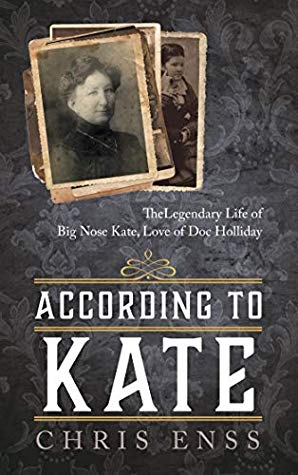
Enss is a capable writer, and I enjoy seeing women about whom little has been written brought to the foreground. Enss amassed a fair amount of material on her subject, but some of it was contradictory, and the greatest contradictor of all was Kate herself, who decided to tell her own life story when she was too old to recall everything properly. Enss tells the reader in the title and introduction that she is telling Kate’s story from the subject’s point of view, and she adds numerous footnotes explaining  conflicting information throughout the narrative.

I read things I had never known before about this time and place, and general historical knowledge is where Enss shines best. For example, a ‘soiled dove’ was allowed to own real estate, whereas married women of the time were not. There were a number of financial advantages to owning a house of ill repute. Kate grew up in a middle class household and was not without choices, but she didn’t care to be married off in the way her family had proposed. In the end she was both a shrewd businesswoman and an adrenaline junkie, one that made a point of having at least one loaded gun handy when a situation called for it. I enjoyed reading about it.

Unfortunately there is a lot of conflicting information and the gaps in the story are numerous. Anytime I start seeing the words “might,” “must have, “ “likely” and so forth, I pull back from the narrative. I can’t get lost in a story when I have to mentally filter the things that are known to have happened from the things nobody knows for sure.  I think Enss has done as good a job as could be done with the documentation available, but Kate is a hard nut to crack.

What I would love to see is historical fiction written with Kate as the protagonist, viewed through the eyes of a feminist writer such as Enss. With historical fiction one can freely fill in the gaps, provide dialogue, and make notes at the end of the story letting the reader know what she has invented or changed.

Those with a special interest may want to read this biography, but I see it largely as a niche read.
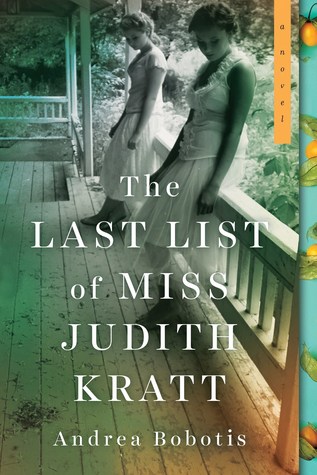
Best Debut Fiction of 2019: The Last List of Miss Judith Kratt, by Andrea Bobotis

Interestingly, my favorite as well as two honorable mentions share a social justice component.

Honorable Mentions:

https://seattlebookmamablog.org/2019/04/13/miracle-creek-by-angie-kim/

Best Poetry 2019: A Bound Woman is a Dangerous Thing, by Damaris B. Hill*****

Image

Conversations with RBG, by Jeffrey Rosen*****

This is the RBG book I’ve been waiting for. My huge thanks go to Net Galley and Henry Holt Publishers for the review copy. This book will be publicly available November 5, 2019.

Justice Ginsburg wants us to know that the sky is not falling. Though progressive thinkers see great cause for concern, primarily within the executive branch of the federal government, the U.S. Constitution hasn’t changed, and the Supreme Court, she insists, is made up entirely of strong legal minds that revere it. Precedents are still the basis of future rulings; the overturn of precedent is rare and unusual. But for activists—and she loves us—she also points out that public opinion is what alters the course of the law. Congress makes laws based on what their constituency desires. So she isn’t suggesting we put away our pussy hats and our picket signs; she just wants us to know that our advocacy works, and she appreciates everything we do to further women’s rights, civil rights, and gay rights.

Twice previously I read other books about RBG; one is a popular biography that I enjoyed, but that didn’t go deeply enough into Ginsburg’s legal ideas, and the second is just dross, minutiae gathered from her high school year book and whatnot. Whereas part of me just wants her to write an autobiography, I have to recognize that she is very elderly, has faced health challenges lately, and to stand a chance of writing any sort of memoir, she’d probably have to resign from the Court. And goodness knows, I want her to stay there, ideally forever. Instead, Rosen’s series of interviews with this feminist icon serves nicely.

Rosen has been friends with Justice Ginsberg for many years; they were drawn together initially through elevator discussions of opera. His chapters are brief but meaty, organized around key rulings and topical interviews. Rosen explains succinctly at the outset how this friendship formed and grew, but he doesn’t get windy or use the opportunity to aggrandize himself. He keeps the focus strictly on his subject. The interviews flow in an agreeable manner that is literate without being verbose or Byzantine.

We live in politically polarized times, and so even when I am reading about a political figure that I admire, I generally expect my blood pressure to rise a little, perhaps in passionate agreement. But if anyone in this nation has the long view of history and the key domestic issues that have unfolded, particularly with regard to the rights of women, it is RBG. And although I am not as senior a citizen as Justice Ginsburg, many of the changes she mentions that have occurred over the decades are ones that I can also attest to, though I hadn’t thought of them in years. For example, when I came of age in the 1970s, it was still not unusual to try to enter a bar or club only to be barred at the doorway because women weren’t allowed inside. (“Gentlemen only, Ma’am. Sorry.”) I had forgotten about these things; as her recollections unspool I see that she is right. Change happens, but lasting change happens slowly. We are getting there, at least with regard to women’s rights and gay rights. Issues of race and class are something else entirely, and she points up specific instances where justice has not progressed and change is imperative. I could say more, but none of it would be as wise or as articulate as when Ginsburg says it. If you’ve read this far in my review, you should go ahead and order this excellent book now. I highly recommend it to all that are interested in social justice, both formal and informal.

Inland, by Tea Obreht*****

This memorable novel is my introduction to Tea Obreht, and I read it free and early, thanks to Net Galley and Random House. The combination of word smithery and whimsy creates the purest literary magic, and I recommend it to anyone that has a high vocabulary level and stamina. It is for sale now.

The tale takes place just after the American Civil War, and the narrative is divided between two characters, Lurie and Nora. Lurie begins his life in Arkansas; he is orphaned early and the man that takes him in is a grave robber that uses Lurie and other boys to assist him in his nightly plundering. Lurie grows up hard, fast, and mean; he wishes that he did not see and feel the dead, but he does, and most of all he senses their cravings.  I am immediately drawn by his second person narrative as he relates his memories to someone named Burke. You don’t see many writers use the second person, and I am curious as to who Burke is. When I find out, I am even more fascinated.

Nora is one of the early (Caucasian) Western settlers, and here Obreht uses the third person omniscient. Nora is unlike any Western protagonist I have ever read, and it is delightful to see the way this author turns stereotypes and caricatures squarely upside down. Nora has her hands full, trying to care for the aged, wheelchair bound Gramma; fighting a political battle in the press that is run by her husband and sons, none of whom she has seen lately; and carrying on a running dialogue with the ghost of her daughter Evelyn, who died in infancy. To add insult to injury she is saddled with Josie, a relative Emmett insisted they must take in. Nora is carrying a heavy emotional load, but the slow revelation of the secrets that weigh her down and the way that these impact the decisions she makes and the way she solves problems is completely convincing.  Whereas Lurie’s narrative is mostly about setting, Nora’s is about character. Both are rendered brilliantly.

I initially rated this novel 4.5 stars because of a few small areas where historical revisionism has crept in, but ultimately it is too fine a work to deny all five stars. I am reluctant to say more because the surprises start early, so to relate details that occur even twenty percent of the way in feels like a disservice both to the reader and the writer. 

One feature that is present throughout both of the narratives is thirst, and it’s related so well that I found myself downing extra water in sympathy and thanking my lucky stars that I live in Seattle rather than somewhere dusty and drought-stricken. In fact, there are places in Nora’s narrative where she is busy with other tasks or discussions of an urgent nature and I find myself telling Nora to just go ahead and ask the person she’s talking to for a sip of water. Nora won’t do it because she is proud and self-reliant, and the fact that I am already talking to the character instead of the author tells you how convincing the story is.

The reader is also advised that it’s a violent, gritty tale, particularly in the beginning but in other places also, and it’s loaded with triggers. To tell it otherwise would be to deny history, but if you are a mealtime reader or avoiding harsh prose for other reasons, it’s worth knowing. But I also think that the whimsy is all the sweeter for it.

Perhaps one of every ten novels I read becomes that book, the one that I can’t stop talking about. My spouse understands that to pass through a room when I am reading it is to guarantee he will be hijacked, at least momentarily, because I am either  going to paraphrase an interesting tidbit or read a particularly arresting passage out loud. This works well for me, though, because I find myself with more uninterrupted reading time. Inland is that sort of book.  Highly recommended.

The Women of the Copper Country, by Mary Doria Russell*****

Annie Clements is a badass union warrior, nearly six feet tall with fiery red hair and a voice that carries.  When the men that work the Quincy mine strike for better wages, an eight hour day, and an end to the treacherous one man drill, Big Annie leads the women’s auxiliary, and her role makes headlines around the world. This magnificent novel, which holds closely to events as they unfurled, came to me free and early, thanks to Atria Books and Net Galley. It’s for sale right now.

The Quincy mine is owned by Calumet and Hecla, and it is one of the deepest underground—and therefore one of the most dangerous—in the US.  It’s on the upper peninsula of Michigan, an isolated location closer to Canada than to other states or even the rest of Michigan; the winters are fierce. The only thing crueler than winter there is the heart of the general manager, James McNaughton, a vicious, vindictive man, who vows that “Grass will grow in the streets of Calumet before C&H recognizes the Western Federation of Miners.”

Charlie Miller is our union organizer, traveling from camp to camp, gathering support from working families. He intends to attack the smaller, more outlying mining companies first and save the huge, wealthy ones like Calumet for after inroads have been made around them. But miners are angry about the one man drill, a recent change that saves the company on wages, but leaves a single miner at risk of being injured or buried without a second miner present to help get him out of there. The company won’t send workers in after the injured, so working in pairs is a critical part of what little safety exists. Too many have gone home dead or maimed, and emotion is high. The women’s auxiliary organizes the wives and other family members of miners, and the women are rising up as well. Miller doesn’t see a strike as winnable right now, but if the union doesn’t get behind them soon, it may well become a wild cat strike, one in which the workers strike without union backing; that would embarrass the WFM.

Russell combines beautifully woven prose with careful attention to historical detail; not much has been changed here, but in her end notes she explains what has been altered and why. Where possible she uses direct quotes, and this is above and beyond what most novelists will do.

Although the story is about Big Annie Clements, my favorite part is when Mother Jones comes to Calumet. (Those interested in labor history should also read Mother Jones’s autobiography, which is shorter and better than what any biographer has done for her.)

This is the first time I have read Russell’s work, but it won’t be the last. A measure of how much I love a book can be found in how much I read, quote, and carry on about it right here at home. My husband could scarcely enter a room without my demanding whether we have any other materials about the copper strikers, and does he know about (this, that, the other thing)? I was reading ten different books, but he was hearing about only one of them. My own grandfather was a miner and died of Black Lung many years ago, but I felt him beside me as I read; I find myself hungry for pasties, the recipe preserved from my Finnish great aunt. But I digress.

Finally, readers should also know that this is a tragic read, positively miserable in places. There are dead and dying children, and the ending isn’t heartwarming. Yet it contains elements—an unlikely romance, and in James McNaughton, a villain of monstrous proportions—that could not be written into a purely fictional tale because nobody would believe them; and yet, these are aspects that stick closely to historical reality.

For those that love excellent historical fiction, this is a must read. For those that love both historical fiction and labor history, it provides the sweetest of crossroads. Highly recommended.

When I Was White, by Sarah Valentine****

Sarah Valentine was raised to believe that she was white, and that her dark complexion was the product of her Greek ancestors. But whereas she does have Greek ancestry in her DNA, Sarah is also of African descent. This strange but compelling, searingly honest memoir came to me courtesy of Net Galley and St. Martin’s Press; it will be available to the public tomorrow, August 6, 2019.

Valentine is an excellent writer, and she spins us back in time to her childhood, spent in a private school, a Catholic upper middle class family, celebrating European cultural events. She is the only African-American or mixed race student at her school, and every now and then, someone there will make a remark that infers she is Black. This puzzles her. Her own mother makes remarks bordering on White Supremacy, assumptions about the habits and character of Black people; of course, none of this should apply to Sarah, in her view, because she insists that Sarah is Greek and Irish, and Irish, and Irish.

Reading of her experiences, I am initially surprised that such culturally clueless, entirely white parents would be permitted to adopt a Black child; but here’s the thing. She isn’t adopted. She is her mother’s biological child, and to talk about who her biological father is, is to recognize that her mother was not always faithful to her father. It’s a keg of dynamite, one that her parents carefully navigate around. Not only have they not spoken about this to Sarah; they have not spoken about it to each other. It is a fiction that holds their marriage together; toss a tablecloth over that keg of TNT there and for goodness sake, don’t bump it.

I came away feeling sorry for her father.

There’s a lot more going on between Sarah and her parents, particularly her mother, a talented but not entirely stable parent who assigns impossible standards to her daughter. Meanwhile, as Sarah grows up and leaves for college, the fiction of her heritage is uncovered, first as a mere suspicion, then later as fact.

This isn’t an easy read or a fun one. It can’t be. Sarah’s pain bleeds through the pages as we see the toxic ingredients and outcomes in her story; her mother’s mental health and her own, as well as eating disorders and the implosion of her parents’ marriage. The particulars of her lifelong struggle make it impossible to draw a larger lesson in terms of civil rights issues; there are some salient points that will speak to women that grew up in the mid-20th century as Sarah’s mother did, and as I did. And here we find one small spark of optimism, the fact that when women are raped, whether at college or elsewhere, we stand a greater chance of being believed than we did in the past. Still, it’s a grim tale overall, and I don’t think there’s any other way Sarah could honestly have told it.

Queen Meryl, by Erin Carlson**

I read this biography free and early thanks to Net Galley and Hachette Books.

I have enjoyed Streep’s movies and her feminist moxie since the first time I saw her, and so I figured this would be a good fit for me. Sadly, there’s nothing new here at all. There’s no depth of analysis, no stories of inner struggle or insight into her development. The overall tone is uniformly adulatory, which is fine as far as it goes; I don’t enjoy seeing a journalist do a hatchet job on a performer, so if she has to lean in one direction or another, I’m glad it’s on the positive side. But once again—I have seen every single thing in this book somewhere else already. I knew about the friction between Streep and Dustin Hoffman (who is also a great favorite of mine,) and I knew she takes roles that show strong women. I knew she wanted to sing, and she did it in Mama Mia. Readers that have followed this actor’s career over the decades with a magazine article here and there can’t expect to cover new ground. It’s shallow and superficial for the most part, and for me, the only good thing is that I didn’t pay for this book.

Streep’s fans that haven’t followed her career in the press may find more joy than I do here; nevertheless, my advice is to read it free or cheap if you decide you want it. It will be available to the public September 24, 2019.

The Trial of Lizzie Borden, by Cara Robertson****

“Oh, Mrs. Churchill, do come over. Someone has killed Father.”

Lizzie Borden is the subject of one of America’s most enduring legends, and Robertson is a towering legal scholar, educated at Harvard and Oxford, and then at Stanford Law. She’s participated in an international tribunal dealing with war crimes, and has been researching the Borden case for twenty years. Here she lays it out for us, separating fact from innuendo, and known from unknown. My thanks go to Simon and Schuster and Net Galley for the review copy. This book is for sale now.

The Borden family lived in the heart of Fall River, and it consisted of Andrew, father of two grown but unmarried daughters Emma and Lizzie, still in residence, and his second wife, Abby. Their mother had died when Lizzie was tiny; Andrew had remarried a woman named Abby, whom Emma never accepted as a parent, but whom Lizzie called her mother until a short time before her grizzly death. Until this time the Borden household was well respected; Andrew was possibly the wealthiest individual in this Massachusetts town, but he was a tightfisted old scoundrel, and his refusal to relocate the family to the fashionable neighborhood on the hill where well-to-do citizens lived made his daughters bitter, as appropriate suitors would not call on them in their current home.  Both had passed the age when respectable young women were expected to have married; they held that their father’s greed had ruined their chance at marriage and families of their own.  Things had come to a head when Borden was persuaded to purchase the home in which Abby’s sister lived in order to prevent her from being cast out on the street. Emma and Lizzie were angry enough that they wouldn’t go downstairs when the parents were there, and poor Bridget, the servant, had to serve dinner twice to accommodate them. Everyone locked their bedroom doors against the others. Andrew had belatedly tried to smooth his stormy home life by purchasing a comparable house for each of his daughters, but the damage was done.

The story of Lizzie Borden is not a new one, but what sets Robertson’s telling apart from the rest—apart from the meticulous research and clarity of sourcing—is her explanation of how the cultural assumptions and expectations of 1893 New England differed from ours today, and how these nuances affected the trial. They lived in a time and place in which it was assumed that women were ruled far more by their hormones and ovulation than by intellect and reason. In fact:

“Experts like the influential Austrian criminal psychologist Hans Gross contended that menstruation lowered women’s resistance to forbidden impulses, opening the floodgates to a range of criminal behaviors…Menstruation may bring women to the most terrible crimes.”

Had Lizzie confessed to the killings, she might very well have been judged not guilty; her monthly cycle would have been said to have made her violent and there was nothing to be done about it, rather like a moose when rutting.

Criminal behavior was believed to be inherent in some people and not in others, and this counted in Lizzie’s favor. The Bordens were seen as a good family, and a girl from a good family doesn’t plot brutal murders. It isn’t in her. This sort of thing, experts said, was more likely to be done by a transient or a member of the working class. The women of Fall River were polarized around this case, and though women from comfortable homes were all certain that poor Lizzie was being railroaded, working class women weren’t as charitable in their assessments.

There was a ton of evidence against her, most of it circumstantial; the most damning aspects of the case against her were ruled inadmissible, and the jury never got to hear them.

Robertson is a fine storyteller, and her narrative lays it out for us so clearly. There is occasional gallows humor, as well as amusing bits of setting not seen in cities of any size today, such as the neighborhood cow that mooed near the courtroom window at inauspicious moments while testimony was being given. However, the first half of the book is more compelling than the second half, because prosecutors and attorneys must repeat things, sometimes many times and in many ways, in order to convince judges and juries, and since this book is about the trial, Robertson must do the same. Still it is fascinating to see how the whole trial shook out.

Those interested in the Borden case, or in true crime stories in general, should read this book. It’s the clearest, most complete recounting and analysis available to the public today, written by a legal scholar that has done the work and cut no corners. `

Madame Fourcade’s Secret War, by Lynne Olson*****

“The memory of an elephant, the cleverness of a fox, the guile of a serpent, and the fierceness of a panther.”

Marie-Madeleine Fourcaude ran the largest spy network in France during World War II. Charismatic, organized, intelligent and completely fearless, she was possessed of such obvious leadership skills that even very traditional Frenchmen (and a few Brits as well) came to recognize and respect her authority and ability. I had never heard of her before this galley became available; thanks to go Net Galley and Random House. This book is for sale now. 

Fourcade was born into a wealthy family, and this fact almost kept me from reading this biography. Fortunately, others read it first and recommended it, and once I began reading I quickly caught onto the fact that no one without financial resources could have initiated and organized this network. At the outset, there was no government behind them and no funding other than what they could contribute themselves or scrounge up through the kinds of contacts that rich people have. There are a few fawning references to some of her associates—a princess here, a Duke there—that grate on my working class sensibilities, but they are fleeting. 

Fourcade’s organization ultimately would include men and women from all classes, from magnates and royals to small businessmen, train conductors, waitresses, postal clerks and so on. Some were couriers delivering information about Nazi troop placement and movement, U-boats and harbors and so forth, whereas others quietly eavesdropped as they went about their daily routines. Once they were able to network with the British, the organization became better supplied and funded, and it had an enormous impact on the fascist occupiers, which in turn drew more enemy attention to the resistance itself; among the greatest heroes were those that piloted the Lysander planes that delivered supplies and rescued members that were about to be captured. But not everyone was rescued; a great many were tortured, then killed. Fourcade herself was arrested twice, and both times escaped. 

If you had tried to write this woman’s story as fiction, critics would have said it lacked credibility. 

In reading about Fourcade, I learned a great deal more about the Resistance than I had previously known; in other nonfiction reading this aspect of the Allied effort was always on the edges and in the shadows, not unlike the spies themselves. In addition, I also came to understand that France was barely, barely even a member of the Alliance. The British bombed a ship to prevent fascists from seizing it, but they didn’t evacuate it first, and an entire ship full of French sailors were killed, leading a large segment of the French population to hate the British more than the Germans. Then too, there was a sizable chunk of the French government that welcomed the fascists. 

Revisionist histories will have us believe that the Nazis were opposed but that France was powerless to stop them, and for some that was true; yet the ugly truth is that it was the French themselves that incorporated anti-Semitism into their governmental structure before the Germans demanded it. Vichy cops had to take an oath “against Gaullist insurrection and Jewish leprosy.” When planning D-Day, U.S. President Franklin Roosevelt didn’t even want to include the French in the planning or even inform them that the Allies were invading. Let them find out the same way that the Germans would, he suggested to Churchill. But the British insisted on bringing in friendly French within the orbit of De Gaulle, not to mention those around a pompous, difficult general named Henri Gouroud, a hero from World War I who had to be more or less tricked into meeting with the Allies at the Rock of Gibraltar. The guy was a real piece of work, and some of the humorous passages that are included to lighten up an otherwise intense story focus on him.

I have never read Olson’s work before, but the author’s note says that she writes about “unsung heroes—individuals of courage and conscience who helped change their country and the world but who, for various reasons, have slipped into the shadows of history.” Now that I’ve read her work once, I will look for it in the future. 

Highly recommended to historians, feminists, and those that love a good spy story, too.