To Wake the Giant, by Jeff Shaara*****

“It’s the admirals, sir, playing with us like this is their own big-assed bathtub and we’re just toys.”

Jeff Shaara has written some of the best war stories ever published, and he’s done so for almost 25 years. I have read every last one of them. When I was invited to read and review his new novel about the Japanese attack on Pearl Harbor by Random House Ballantine and Net Galley, I was delighted, but also slightly apprehensive, because even after all these years, the subject remains an incendiary one; I needn’t have worried. This may be Shaara’s best book, and that’s saying a lot.

I’ll share a brief note about my own biases going in. My father was among the last men called to serve during World War II; he never left the U.S., however, where he was tasked with training new recruits to the still-new U.S. Air Force. But I grew up hearing about Japanese atrocities, and many of the bizarre stereotypes and misconceptions based on pseudoscience were told to me as fact. When as an adult I announced that I was about to marry a Japanese citizen, I sounded the waters with my family to see if there was resistance. I was told that my parents “still remember Pearl Harbor.” Meanwhile, my husband’s father also served during World War II—in the Japanese army. The topic was never raised by his parents around me, or at all as far as I know; but I asked my spouse a few questions to help me understand the Japanese perspective about this horrific conflict, and then I understood exactly how erroneous most of what I’d been raised to believe actually was.

So I was primed to read this book, and also a little afraid of what I might find. My internal map of Pearl Harbor was studded with emotional landmines, and at the book’s conclusion, none of them had been tripped.

Shaara tells this story primarily through the eyes of three people: Cordell Hull, U.S. Secretary of State under President Franklin Delano Roosevelt; Admiral Yamamoto, the Japanese architect of the invasion; and Tommy Biggs, a 19-year-old naval recruit from an impoverished Caucasian family in rural Florida.

Shaara faithfully incorporates a character from the rank and file in every story; he does this even if there is nobody on record that he can report on, and so often, he is forced to create a fictional character based on experiences and characteristics from several people. When I saw no such disclaimer in any of his notes, I grew curious and wrote and asked him whether this is the case with Biggs. He replied that this time there is a Tommy Biggs (though the name is not the same), but that he did add the experiences of others in order to flesh him out. So this time, each of the three chief characters is based on an historical figure.

I learned a great deal. Though it’s well known that this attack profoundly crippled the U.S. Navy, sinking or badly damaging most of the fleet, I had never considered it from the Japanese perspective. Looked at in that way, it was not only audacious, it was immaculately planned and wildly successful. I also had never considered what a blunder it was on the part of the U.S. military to leave its equipment, ships, planes, and more so unguarded. In the fallout after the attack, we learn that the Navy considered security to be the job of the U.S. Army and vice-versa. What a colossal bungle.

Japan had emerged victorious from the Russo-Japanese War, and its leadership was suffused with overwhelming confidence. Japanese racial superiority would lead to Japanese dominance throughout the China, Indochina, and across all of Asia, they claimed, because they were meant to dominate their portion of the globe. Japanese leaders were convinced that the U.S. would not seek retribution following an attack on its soil because American isolationist sentiment was so strong. They genuinely hoped that this attack would result in an end of the U.S. embargo that crippled Japan, and which existed in order to halt Japanese expansion and force Japan to withdraw from its alliance with the Axis powers. Americans, the Japanese brass told one another, were too big, too slow, too lazy to retaliate. There were voices of dissent, however:

“For any of you who believe the Americans are not worthy of a fight, that they do not have the stomach for blood, perhaps you are familiar with the American Civil War? In the 1860s, they divided and fought each other in the bloodiest war in their history. They did not require any enemy to inspire them. They fought each other. Are you familiar with football?”

Meanwhile the U.S. military, press and popular culture treated the Japanese as a bad joke. One myth dressed up as science suggested that Japan would never be able to build an air force because of an inherent defect in the inner ear of all Japanese. It was physically impossible for them to become pilots! The condescension was rife, everywhere one turned. Hollywood depicted the Japanese as ridiculous, rodent-like creatures with minds that didn’t function properly. The Chicago Tribune stated that for Japan to attack the U.S. was “a military impossibility.” Japanese were said to be too myopic to be effective against a military target. And it goes on.

There’s all sorts of blame to spread around. Nobody in Washington, D.C. had told the top brass at Pearl Harbor, Admiral Kimmel and Lieutenant General Short, about the project named Magic, which intercepted and broke Japanese code. They had no idea that Japan was rattling its sabers to such a degree.  And these two men appear to have been lazy, bureaucratic fools that ignored what little intelligence came their way. For example, shortly before the attack, the man on watch sees a Japanese sub in the water. Kimmel immediately assumes that the guard has seen a whale, and he goes back to bed.

There are three aspects of this novel that keep the pages turning for me. The first, of course, is my interest in military history. Shaara’s research is meticulous. The book is historical fiction at its best, which is when the contours of the story, even fairly detailed aspects of it, are correct, but the fictional genre is chosen so that dialogue and inner monologue can be added. Second is Shaara’s perceptive nature, and it’s this that permits him to choose the best details to include and cut what is inessential so that pacing never flags. And finally, his capacity to develop a character so that we feel we know him is matchless; in particular I bond to poor Tommy Biggs, a guy that can’t catch a break, until he can.

Nothing I can say will serve as well as what Shaara says himself. Get this book, even if you have to pony up full cover price. This is hands down the best fictional representation of Pearl Harbor on sale today. Believe it.

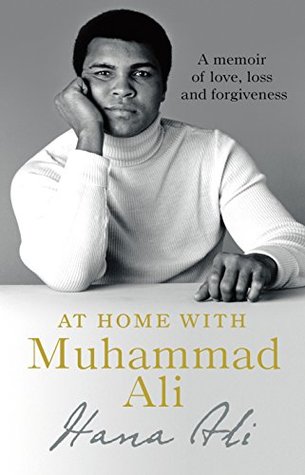
At Home With Muhammad Ali, by Hana Ali*****

Muhammad Ali is the sort of larger-than-life historical figure that nobody forgets. I was offered an opportunity to read and review this biography written by his daughter, Hana, and I jumped at the chance. Her recollections are bolstered by the vast archives that her father intentionally left, cassette tapes of every phone conversation that took place from his home, along with letters, photographs, and journal entries. Ali knew he was making history, and so he consciously left copious documentation behind. This wonderful book strikes the perfect balance, deeply affectionate and intimate, emotionally honest, yet never prurient or mawkish. My thanks go to the author for the beautiful hardcover copy, and for this opportunity.

A note before I continue: usually when I review a book, I refer to the author by his or her last name. In this case, however, the last name is shared by author and subject, and so when I use the name ‘Ali,’ I refer to the boxer, whereas I refer to his daughter and biographer by her first name.

I grew up in the 1960s and 1970s. I didn’t watch boxing, which my mother considered a nasty, violent sport; I was inclined to agree with her, and so when Dad turned on a boxing match on television, she and I beat a hasty retreat. However, it was impossible to miss my father’s agitated shouts at the TV whenever Ali was on it. Ali’s brash confidence, his refusal to humbly look at the floor while talking to white interviewers, his fervent proselytizing on behalf of the Muslim faith frightened a lot of Caucasians, particularly those who, like my family, lived a life that never intersected with people of races different from our own. But my father wasn’t just afraid of Ali; he was angry. How dare he! On television! He called him a clown; he called him an idiot. There was a lot of that going around at the time, as the Civil Rights Movement strove to change the racial contours of American society, not only in the Jim Crow South, but across the nation.

Many years later, when I began studying education in preparation for teaching public school, in particular language arts, American history and civics, one of the most critical parts of my own graduate school curriculum had to do with serving children from underserved racial and ethnic groups, and part of that was in holding up positive role models to foster self-esteem in every child. My classmates raised the name of Muhammad Ali, and I could see that they were right; say that name around any Black child, especially a little boy, and watch his chin raise perceptibly, his spine straighten, and a gleam come to his eyes. This is what interested me about Ali, not his athletic record, but his principled stand in regard to Civil Rights issues, and his assertion that Black men in America should walk tall.

As I began reading Hana’s glowing tribute to her daddy, I began to wonder more about his boxing career. Ali began boxing at age twelve! There’s a practice you won’t see today; but Louisville, Kentucky during the post-war boom was a much different place than anywhere in America today. By the time he was old enough to shave, he was already accomplished at his sport. And the more I read, the more convinced I was that I should not review this biography without watching some boxing. I went to YouTube over and over, and I watched Ali with Sonny Liston, with Joe Frazier, with George Foreman. I learned a lot about the sport, including the fact that it’s not really all that violent, and it involves just as much skill as other team sports. And also: that man was talented, and he was so damn smart.

And this is the side of Ali that the public never really saw. Who knew that he preferred brainy women with independent ideas? In the 1960s, this was a rare thing among men. Who knew that he wouldn’t let anyone, whether family or staff, raise a hand to his children? Nonviolent parenting all the way. There wasn’t much of that around back then, either. Part of his indulgent nature was due to his faith, but part of it was a deep fear that some hateful person would try to hurt him by kidnapping his daughters. Given the way Hana describes her childhood self, it might have become a Ransom of Red Chief situation. Among the mountains of documentation Ali saved is a hefty collection of letters sent home by preschools and schools decrying Hana’s scrappy behavior. Here’s one of my favorite excerpts from the recordings she shares:

“’Hana, say ‘I’m a good girl.’

“’I’m a good girrrrl.’

“’Say ‘I’m a pretty girrrrl.’

“’I’m a pretty girrrrl.’

“Say ‘I won’t bite the boys no more.’

“’I won’t bite the boys no more.’

“’Say ‘I won’t scratch the boys no more.’

“’I won’t scratch the boys no more.’”

Hana recalls him as a gentle father who remained available to his children despite his busy career; each day began with her careening down the stairs to find him in his den, where he might be having a phone conversation with one of many American celebrities as well as world leaders. He spoke with Brezhnev, Ghaddafi (who wanted to contribute to the war chest of a Black American presidential candidate), and Deng Xiao Peng, who wanted Ali to train Chinese boxers. He offered his services to President Jimmy Carter in the 1980s, hoping he might use his religion as a connection to the Iranians holding American citizens hostage.

In another section she recounts the time he happened by a police cordon. A man was out on a ledge of a skyscraper, threatening to jump; Ali persuaded the cops to let him get past the cordon and speak to the man. There are photographs of him holding the would-be jumper in his arms after he was rescued.

Whereas other public figures often bemoan their lack of privacy, Ali loved being famous, and he loved his fans. Sometimes he left home just to go out and find some of them and talk to them. It’s refreshing.

Yet Ali wouldn’t have been an easy man to be married to. Part of this dovetails with his generosity; he often tooled around in his Rolls Royce when he wasn’t training or working, and when he saw homeless people he’d load them into his car, bring them home, and put them in a guest room until he could arrange a lovely hotel suite for each of them. It’s a sweet gesture, but although Hana doesn’t mention how her mother reacted to it, I can tell you right now that for me, that would get old fast, coming home and not knowing how many strangers had taken up residence. And whereas Ali had more respect for the women in his life than most men did back then, his marriages were clearly never intended to be equal relationships.

But his relationship with Hana was an idyllic one, and this shows in the many engaging photographs that punctuate the text, one after another in which she and her father pose using identical body language, some of which are pretty funny. She also speaks with the pain she feels, even today, of her parents’ divorce, which she is convinced was primarily due to a misunderstanding.

There’s a great deal here about Ali’s religion; there’s really no way to tell his story without it, since it motivated nearly everything he did. There are places where I am ready to be done with it; but just when it threatens to slacken the pace of the narrative, Hana wisely segues on to other topics.

To remember Ali is to remember the virulence of the overt racism of twentieth century America. The way that the media played up every violent thing any Black man or boy did; the stereotypes involving the jungle, and the unpredictability of Ali’s personality, all served to underscore the false notion of hidden menace deep within the man. Ali is the first Black man I ever saw on television that didn’t keep his eyes down when talking to reporters, and who didn’t downplay his own strength. He scared a lot of Caucasian people half to death, merely by being successful, strong, and confident.

But Hana doesn’t dwell on any of the negative publicity; instead, she shows us who he really was. Ali loved to write poetry, for example, and he loved to read. He had never gained strong skills in spelling or grammar, so some of what he produced came out looking a little rough, and yet its merit is undeniable. What a voice! Who knew that a fun day out with his daughters often meant a trip to Barnes Noble to load up on good books?

The book’s ending is perhaps the most poignant of all. Hana recalls her father, an old man in his seventies, weakened by Parkinson’s, viewing footage of himself after the Foreman fight:

 “I wrestled with an alligator, and tussled with a whale. I handcuffed lightning and threw thunder in jail. Just last week I murdered a rock, injured a stone, and hospitalized a brick! I’m so mean I make medicine sick!”

Watching himself he muses, “Man, I was something!”

I defy you to finish this book without a lump in your throat or misty vision, as Hana tells us, “Sometimes I still feel like that five-year-old girl roaming the halls of a mansion, waiting for her daddy to come home.”

Highly recommended.

Hidden Valley Road, by Robert Kolker****

Happy anniversary, Doubleday. This is my thirtieth review for you.

Big thanks go to Net Galley and Doubleday for the review copy.

I wanted to read Kolker’s book because so little is written about schizophrenia for the general readership. My best friend’s older brother was schizophrenic, and sometimes she would phone me crying and whispering from the floor of her bedroom closet. The bro—let’s call him Marco–was a large person, over six feet tall with a towering red afro that made him appear even larger. He and my friend were both adopted, and their parents weren’t nearly that big. Marco hated taking his medication, and once he reached his teens, he self-medicated with every street drug he could get his hands on. As a result, he often became violent, breaking out all of the windows of the family home and assaulting his poor sweet mother with a crowbar before the cops arrived to haul him off to the hospital again.

And so I wondered, when I saw this book, whether this was a common experience (yes,) and what inroads had been made in the decades between then and now (very few.)

The Galvin family is an anomaly, a very large family of twelve children, half of whom were stricken and the other half traumatized from growing up with them. The family participated in The Human Genome Project, a compilation of genetic samples and other information aimed at unlocking Mother Nature’s terrible secrets. Of course, researchers were also absorbed in the question of nature versus nurture.

Kolker does an outstanding job of chronicling the Galvin family’s history alternately with passages about what was known about this disease at the time when the eldest sibling began to show symptoms, and what has been learned since. It’s a lot of information to organize and share, and who knows what information he weeded out as unnecessary, because one has to stop somewhere.

When the Galvin children were diagnosed in the mid-twentieth century, professionals in the field leaned heavily toward the idea that there was no hereditary cause for the condition, but instead embraced a “mother-as-monster” theory. Because of this, Mimi Galvin, the mother of all of those children, was inclined to stonewall rather than seek help. But who could blame her? Our society was only slightly removed from the days when the ‘crazy’ family member was locked in the attic. (“That thumping sound? Oh dear heaven, perhaps that old raccoon has snuck back in. Enjoy your pie; we’ll chase him out of there after you’re on your way.”) To make matters more complicated, Don, father of the brood, had a high profile position in the U.S. military, and rumors of family drama could have impacted his career.

Like my friend’s family, the Galvins dealt with the noise, the horror, the disruption by moving to the far edges of town, seeking geographical isolation so that neighborly complaints need not be an added worry.

Here’s the difficult part of writing about schizophrenia: readers want to find a grand discovery at the end; if not a cure, then a new and impressive treatment, or an historic advance in eliminating the problem. But solutions are elusive, and because of the stubborn nature of this disease, what may seem ground breaking to a researcher looks like a big, fat so-what to the average reader.

All told, Kolker has done a fine job describing what has taken place within the family and within the field; I thought he was a little hard on Mimi, who made a lot of errors but was facing a terrible dilemma during a period when our culture was very different from today. That aside, I do recommend this book to you. It will be available April 7, 2020.

Fight of the Century, by Michael Chabon et al*****

In celebration of the 100th anniversary of the American Civil Liberties Union, a large cross section of the finest writers alive have written essays, each about one landmark case. Chabon and his co-editor, Ayelet Waldman, contributed their advance to the organization, and all of the contributing authors did so free of charge. As for this reviewer, I’d have been interested in an ACLU publication, even if I hadn’t heard of the writers involved; and I’d have been interested in anything written by Chabon, even if the story or topic wasn’t in my lane. As it is, I count myself beyond lucky to have scored a review copy courtesy of Net Galley and Simon and Schuster. It’s for sale now.

This is the sort of book that invites skipping around, either according to subject, or according to the authors you love best. Because of this, I recommend buying it in paper rather than digitally, because flipping around out of order in digital format is a pain in the butt. Also, this is the sort of classical reference material that you’d want on your shelf. In fact, I want a physical copy for myself.

I haven’t read all of the entries, but I’ve read enough of them to recommend it to you. The cases discussed are meaty and interesting, and they aren’t the standard fodder that shows up in every undergraduate course on Constitutional law. Each entry is succinct, and the writers refrain from self-promotion. The entries I appreciate most so far are by Jesmyn Ward, who discusses the use of anti-loitering laws to transform free Black boys and men into slave laborers; Timothy Egan, who details a 1962 decision regarding the right to receive Communist literature in the U.S. mail; and Louse Erdrich, who discusses digital snooping and surveillance used against the Dakota Pipeline protesters in 2016. I know there are many more I want to read, but I am posting this now so that you can get a copy while it’s in the stores.

Here’s your chance. You can get an outstanding addition to your home library while contributing to a worthwhile organization whose work is more crucial now than ever. Highly recommended.

The Broken Road, by Peggy Wallace Kennedy**

“I was perhaps Daddy’s most important legacy of all.”

Thanks go to Bloomsbury and Net Galley for the review copy, which I read free and early in exchange for this honest review.

I was a child during the Civil Rights era, and although I didn’t live in the American South, I recall news footage of Kennedy’s father, George Wallace, the man that the author rightly attributes as a harbinger of the Trump movement. Instead of “Make America Great Again,” Wallace urged his constituents—including the Klan, whom he openly welcomed to his campaign—to “Stand Up for America.” When the federal government signaled that it would enforce the segregation ban, Wallace made headlines around the world by literally standing in the door of the schoolhouse in order to turn the first Black student away from a public school in Alabama.  My own father was a redneck of the first order, but even he distanced himself from this extremist. Wallace ran for U.S. president but was defeated; upon returning to the governor’s mansion, he was shot and paralyzed from the waist down. By that time Malcolm X was dead and could not have told us that this was a case of chickens coming home to roost, and yet it may well have been.

Although the book’s summary suggests that Kennedy is vastly different from her father politically, her prose indicates that her true, bitterest grievances all center on his philandering betrayal of her sainted mother and his failure to be a strong provider and dedicated family man. She tells us that even in the 1960s, she felt his racist rhetoric was wrong, and so I waited for what I thought must surely come next: the moment she either confronted him or simply moved out of the house to another part of the country to restart her life in saner surroundings. None of this happened, as it turns out. She stayed in the governor’s mansion, thrilled by the relative affluence and privilege she regarded as her due following a tumultuous, sometimes impoverished childhood.

The title is taken from a Hemingway quote, and in her own story designated the location of her maternal grandparents, whose simple, homespun nurturance provided relief to her mother and herself when her father went on the road politicking and didn’t send money home for them to live off of. At the beginning of the book she uses the expression often enough to beat it to death, but once her father becomes governor she rarely speaks of these kind, gentle people. Toward the end, she parenthetically notes that her grandmother died at some point back in the middle of the book.

It’s interesting that although Lurleen Wallace was elected governor in order to circumvent what was at the time a state law against successive terms for her husband, the author says nothing at all about her mother’s civil rights policies. We see that she won the governorship in a landslide and was loved by all, and yet if her policies diverged much from George’s, that would have created screaming headlines. It’s just one of the many inconsistencies within this memoir.

The last several chapters are devoted to her father’s redemption politically, or so she asserts. He never hated African-Americans, she tells us, but only did and said those things in order to gain office. Later in life, he asked a handful of Civil Rights leaders for forgiveness and spoke in Black churches about his error. She follows this up by pointing to the large numbers of Black voters that returned him to the Capitol.

I find myself wondering a lot of things, and foremost among them is why anyone would consider a candidate that makes the cold-blooded decision to promote violent racism for the sake of gaining office to be morally superior to one holding the genuine belief in the inferiority of other races and ethnicities. Wallace, she tells us, didn’t sign onto the Klan’s program because of his convictions, but because of what they could do for him. And while the parallels she draws with Nixon are apt ones, the rationalization of her late father’s destructive, ethically bankrupt lifetime is chilling in its own way, but she underplays this aspect of his career.

Her “daddy” lived long enough to appoint her 26-year-old attorney husband to the state bench.

The second star here is reluctantly provided because she does some very nice things at the outset with regard to her description of time and place in the life of poor white folks in mid-twentieth century rural Alabama.  If you’re looking for a silver lining to this wretched work, there it is. It’s all I can find.

I would place this book in the child-revenge category along with Christina Crawford, Patti (Reagan) Davis, and Carrie Fisher.  Read it if you want to wallow, but when you’re finished, you will likely want to shower and gargle.

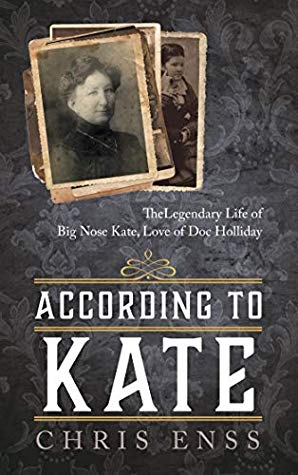
According to Kate, by Chris Enss***

Kate Elder, better known as Big Nose Kate, was a colorful character in the mercurial Wild West. Together with her paramour—possibly her husband—Doc Holliday, she shot, swindled and burned her way through Kansas, New Mexico, Texas and other parts of the American Southwest. My thanks go to Net Galley and Two Dot Publishing for the review copy. This book is for sale now.

Enss is a capable writer, and I enjoy seeing women about whom little has been written brought to the foreground. Enss amassed a fair amount of material on her subject, but some of it was contradictory, and the greatest contradictor of all was Kate herself, who decided to tell her own life story when she was too old to recall everything properly. Enss tells the reader in the title and introduction that she is telling Kate’s story from the subject’s point of view, and she adds numerous footnotes explaining  conflicting information throughout the narrative.

I read things I had never known before about this time and place, and general historical knowledge is where Enss shines best. For example, a ‘soiled dove’ was allowed to own real estate, whereas married women of the time were not. There were a number of financial advantages to owning a house of ill repute. Kate grew up in a middle class household and was not without choices, but she didn’t care to be married off in the way her family had proposed. In the end she was both a shrewd businesswoman and an adrenaline junkie, one that made a point of having at least one loaded gun handy when a situation called for it. I enjoyed reading about it.

Unfortunately there is a lot of conflicting information and the gaps in the story are numerous. Anytime I start seeing the words “might,” “must have, “ “likely” and so forth, I pull back from the narrative. I can’t get lost in a story when I have to mentally filter the things that are known to have happened from the things nobody knows for sure.  I think Enss has done as good a job as could be done with the documentation available, but Kate is a hard nut to crack.

What I would love to see is historical fiction written with Kate as the protagonist, viewed through the eyes of a feminist writer such as Enss. With historical fiction one can freely fill in the gaps, provide dialogue, and make notes at the end of the story letting the reader know what she has invented or changed.

Those with a special interest may want to read this biography, but I see it largely as a niche read.

Best Military History of 2019: Spearhead, by Adam Makos

Honorable mention:

Becoming Dr. Seuss, by Brian Jay Jones*****

Say this name to schoolteachers and children’s librarians and watch our faces light up, our backs grow a trifle straighter, our steps quicken. Dr. Seuss is the closest thing we have to a patron saint, and when I saw this biography, I wanted it as badly as I’ve wanted any galley. Big thanks go to Net Galley and Penguin Dutton, and many apologies for my tardiness. It’s a strange thing but true: when I must write an unfavorable book review, I know just what to say and can do it the same day I finish reading, but for a momentous work such as this one, I need some time for my thoughts to gel. Brian Jay Jones writes biographies of quirky visionaries such as Washington Irving, George Lucas, and Jim Henson, and he doesn’t cut corners. This biography is highly recommended to adult readers, but don’t go handing it off to your precocious fifth grader until you’ve read it yourself. Geisel’s life held some very deep shadows.

Geisel grew up with comfort and privilege as the heir to a family beer making business; the slings and arrows that came his family’s way during Prohibition taught him that small minds can do ugly things. Still, his youth was mostly untroubled; he attended Dartmouth , where he was voted Least Likely to Succeed, and then Oxford, where his studies in Medieval German floundered, his attention drifting to the margins of his notebook, where he drew fanciful creatures and turreted buildings that would later become iconic. It was Helen, his sweetheart, who suggested he follow his heart and pursue art for a living. His early success came in advertising for Flit bug spray.  Once he and his bride became financially stable enough to move out of their low rent neighborhood and into a tonier area, he discovered he had no use at all for pretension, and he wrote:

“Mrs. Van Bleck

Of the Newport Van Blecks

Is so goddamn rich

She has gold-plated sex

Whereas Miggles and Mitzi

And Bitzi and Sue

Have the commonplace thing

And it just has to do.”

He served in the military during World War II with Francis Ford Coppola making propaganda and training films. His pro-intervention cartoons are surprisingly hawkish—I have the collection titled Dr. Seuss Goes to War on my shelves—but he later realized that it was wrongheaded to demand the internment of Japanese Americans, and in some bizarre way, he intended Horton Hears a Who to be his apology for it.

His family was not Jewish, but his surname confused some people, and he received some anti-Semitic shade that inspired him to stand up for the rights of Jewish Americans.  

Jones deserves credit for confronting the anti-Japanese racism and xenophobia in this author’s early years; he doesn’t gloss over it, and he doesn’t turn it into something prurient either. He lays it straight out, along with Ted’s more enlightened thinking in his later years, and it strikes exactly the right tone. This isn’t comfortable material, but then it shouldn’t be.

The most amazing thing is to learn that Seuss—known to family and friends as Ted—wasn’t a successful author until well into middle age. He vacillated between advertising and “brat books” but hit it big when he submitted How the Grinch Stole Christmas to Bennett Cerf at Random House, which would be his second home for many years. Though he and his wife moved to Southern California and much of his work was mailed in, he became known for coming to read his book to the Random House staff in person when it was publication time.  (He was also known for being difficult at times, micromanaging the publication of his work, and this may be part of the reason he wasn’t urged to attend business in person on a more regular basis.)

Ted and Helen were unable to have children, a painful fact that they chose not to share with the public. When asked during publicity tours why a man with such a great heart for children had none himself, Ted deflected it by saying others should have the children and he would write for them.

Helen’s illnesses and Ted’s infidelity were aspects of this author’s life I knew nothing about.  It’s hard to read about, but again, Jones includes these things in the narrative not to shock us, but because they have to be there.

He was widely known and revered for his insistence that books should be fun for children to read and should not preach or moralize, but instead, should respect the readers.  He was a pioneer in this regard, and I owe him a great debt for teaching me to love literature as a preschooler, and for providing such wonderful books for my own children and students later in my life. It is this legacy that remains when the rest falls away, that reading should open new worlds for its young readers; it should not trick or manipulate its audience, but instead should speak to children with respect using language they can understand.

Highly recommended to an adult readership.

The War Before the War, by Andrew Delbanco****

You may not have had the grades or the money to attend Columbia University, but you can read Professor Delbanco’s book anyway. It’s meaty and interesting, and it clears up some longstanding myths about slavery in the USA. My thanks go to Net Galley and Penguin Random House for the review copy; this book is for sale now. 

At the outset I find this work a little on the slow side, and I wonder if I am in for five hundred pages of drone. Not to worry. By the five percent mark the whole thing wakes up. Slavery from the time of the early European immigrants to the American Civil War is mapped out, and I found myself wishing I had read it before I taught social studies instead of during retirement. Sacred cows are slain and there’s plenty of information that is new to me. For example, I did not know that the number of runaway slaves was always a fairly small, economically of little consequence but powerful in its example. I didn’t know that Caucasian people were retaliated against sometimes by sending them into slavery; since one couldn’t tell a person with a tiny amount of African-American heritage from a white person, it was possible to lie about someone whose roots were entirely European and send them down south. And although I understood that the great Frederick Douglass was hugely influential, I hadn’t understood the power of the slave narrative as a genre: 

“When [slave narratives] were first published, they were weapons in a war just begun. Today they belong to a vast literature devoted to every aspect of the slave system–proof, in one sense, of how far we have come, but evidence, too, of the impassable gulf between the antebellum readers whom they shocked by revealing a hidden world .and current readers, for whom they are archival records of a world long gone. Consigned to college reading lists, the slave narratives, which were once urgent calls to action, now furnish occasions for competitive grieving in the safety of retrospect.”

It is painful to envision a roomful of young people flipping through their phones or napping during a lecture or discussion about this damning aspect of U.S. history that haunts us even today; and yet I know it happens, because I have seen it among the teenagers I have taught. I want to roar, “Where’s your sense of outrage?” And yet it’s there; but many that are activists against cop violence and other modern civil rights issues haven’t yet made the connection between the present and our national origins. So I feel this guy’s pain. 

For the interested reader of history, the narrative flows well and the documentation is thorough and beyond reproach. Delbanco has a sharp, perceptive sense of humor and this keeps the reader further engaged. 

I recommend this book as an essential addition to the home or classroom library of every history teacher and reader. 

Invisible, by Stephen L. Carter****

InvisibleI received a review copy of this affectionate, well-documented biography free and early thanks to Net Galley and Henry Holt. This book is for sale now.

Eunice Hunton Carter was the author’s grandmother, and though her name is little known today, she was an exceptional woman, a scholar, political activist, and social diva that did extraordinary things during a time period when it was nearly impossible for women of color to rise professionally. Carter tells of her impact on what he calls “the darker nation” and in particular, of her role in taking down notorious gangster Lucky Luciano. She was largely invisible to the mainstream press; this was a time when Black people virtually never won acclaim, and women didn’t either, but it was she that devised the strategy that was needed to try to convict him.

The author is a Yale professor and has a number of successful books to his credit already. This biography is written with the professionalism one would expect; the tone is conversational and keeps the pages turning; transitions are buttery smooth; and the documentation is flawless and meticulous. Those interested in African-American history, or particularly in that of African-American women should read this book.

Carter was born into a well-to-do Atlanta family, leaders among the Negro petite-bourgeoisie. (The author uses the term “Negro” because it was the accepted, polite term during the period in which his grandmother lived.) However, the rise of terrorist groups like the Klan forced successful families of color out of the South, and so most of Eunice’s story takes place in New York City, and it is there that she became a famous woman.

Eunice was a die-hard Republican, and the author reminds us that in the early 1900s, it was still known as the party of Lincoln. Though she did not initially aspire to be politically active—a hat that her mother, Addie, already wore—she became involved in Dewey’s various campaigns after working with him in the prosecutor’s office.

The story is well documented and the voice is distinctive. Two things got in the way of my enjoyment of this biography. The first and technically most significant is focus. The author seems at times torn between his desire to write his grandmother’s biography and perhaps a desire to write about his entire family. I’ll be absorbed in the events that shape Eunice, but then her mother is mentioned—as is appropriate, since her mother is so influential in Eunice’s development—but then we’ll see more about her mother. More, more, more. Pages of Addie. When the author smoothly returns us to Eunice I sigh with relief, snuggle into my chair, and then a few pages later, there we are again. Numerous times I have typed into my reader’s notes, “Whose story is this, anyway?” Eventually I become so frustrated by Addie’s success in hijacking her daughter’s story that I stop making notes and highlight every transition, from Eunice to Addie, Addie, Addie, and ah, back to Eunice (and then to Addie again).

This irritating diversion, one that makes me feel as I am sitting in the parlor of some elderly, garrulous, lonely individual that has just poured me more lukewarm tea and picked up yet another photo album—Did I tell you about my cousin Rudy? Now there was a character, they say—mercifully abates about halfway into the story, as we move into the Luciano case. Here we are focused, and it’s a fascinating read. But during the last portion of the book, it is brother Alphaeus that needs editing down. Again, this brother has good reason to be here, since Eunice is convinced that her career suffers from his membership in the Communist Party USA; yet I feel as if a strong editor’s pen would be useful for this relative as well. Or better still: maybe let’s not read about Eunice. Maybe let’s have a biography of Alphaeus instead, since it is he that is driven to try to make the world a better place.

Because Eunice, it’s clear, is really out there for Eunice. The author makes no bones about this; yet his glee at her snobbery, social-climbing, and vast ostentatious displays of wealth is not inspirational.

When all is said and done, however, Eunice Hunton Carter deserves a place in history. Had she been born Caucasian and male, who knows? She might have become president, or at least governor of the state of New York. Her drive, talent, and energy seem to have been limitless.

As a read for general audiences, I’d say this is a 3.5 star read, rounded upward, but for those with a special interest in African-American history, or that are doing research for a more specific topic such as African-American women in politics or law, this is a must read.