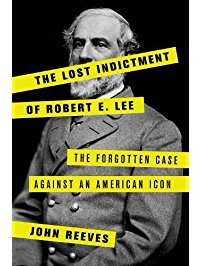
The Lost Indictment of Robert E. Lee, by John Reeves*****

LostIndictmentRobtELeeI’ve never understood why so many Americans revere the memory of Robert E. Lee, the general that turned Lincoln away at the outbreak of the American Civil War and instead commanded the treasonous Army of Northern Virginia. When I saw this title, I leapt at the chance to read and review it. Thanks go to Net Galley and Rowman and Littlefield Publishers for the DRC. The book will be available to the public June 1, 2018.

Before reading this book I wasn’t even aware that an indictment had ever been issued. This is particularly odd given that a good part of my teaching career involved teaching American history and government. I even wondered, before opening it, whether this indictment would be metaphor; no indeed. Reeves did a lot of digging in order to write this book, and that’s what makes it worth having. His sources are ones that I cannot find myself through a quick Google search or a trip to the library or bookstore. Reeves  uses sources that require traveling hither and yon in order to access special collections that libraries won’t check out to anybody ever, that’s proof that this writer had done the legwork.

Back to the indictment. Following the end of the war and the death of Lincoln, the North—contrary to mythological retellings—clamored for retribution. Let’s all be brothers and have peace? Oh hell no. Who had not lost a brother, a son, a husband to this terrible conflict? And President Andrew Johnson, working hand-in-glove with the passionate abolitionist, Judge Underwood, set out to “make treason odious.” At a bare minimum, Lee, Jefferson Davis, and the members of the Confederate cabinet most closely linked to the war itself needed a day in court. Afterward, they needed to either hang, or rot in prison for a goodly while. So the thinking went.

As usual, the devil was in the details. Why is it so difficult for government to move swiftly? A lot of terrible decisions were made here, the most noteworthy being to try these men in a civilian court rather than in a military tribunal. Too late they realized that Lee must then be tried by a jury of his peers in Virginia. This would have been disastrous, since Lee was regarded by most Caucasian Virginians as a hero, much the way we now look at Lincoln. After all, when the war broke out, most antiwar or antislavery advocates had to move North in fear of their physical safety, and only the diehard Dixie whistlers remained, so a fair and impartial jury in Virginia was a nonstarter. What could possibly be worse than letting Lee off scot-free? What would be worse would be for him to be exonerated.

Added into the stew was a heap of political scandal and the unraveling of Johnson’s presidency, and the tarnishing of Underwood’s reputation, a man controversial from the get-go.  At the end of the day they were too busy salvaging themselves to bring these men to justice.

I find some measure of comfort in the knowledge that Arlington, the huge, fancy estate that had been passed down to Lee’s wife and of which he never stopped bragging, as if property ownership and family history made his family American royalty, was expropriated by the Union, and its extensive grounds became Arlington National Cemetery. After Lee’s death, there was considerable talk among the public suggesting that the widow Lee should get her old house back; however, she overstepped when imperiously telling Congress that she also wanted the remains of all those poor boys dug up and interred some other place. There was almost nothing she could have said or done to lose the sympathy vote more quickly.

This excellent book is highly recommended to those that are interested in the American Civil War and its aftermath.

Mr. Flood’s Last Resort, by Jess Kidd*****

MrFloodsLastWho do I enjoy reading more than Jess Kidd? Nobody.

Thanks go to Net Galley and Atria for the DRC, which I received in exchange for this honest review. The book, which was also published in UK as The Hoarder, is available today in the US.  And I have to tell you also that although her work is billed as similar to Fredrik Backman, I find it to be better—and that’s saying a good deal.

Maud Drennan is a caregiver, which in the USA would translate as a combination social worker and home health provider. She’s been sent to the large, rambling home of Cathal Flood, a tall, fierce old man who has driven his previous caregiver to a nervous breakdown. Speculation abounds: is he an innocuous old fellow in need of some organization, treatment, and TLC, or is he dangerous—perhaps a murderer, even? What about the missing girl that was last seen at this address?  It’s enough to make even Maud’s staunch heart tremble:

“In the musty depths of Cathal’s lair, one eye flicks open. Noise has pulled on the strings of his web, setting his long limbs twitching. He’ll be slinking out of his trapdoor and threading through the rubbish. Crawling up the staircase with a knife clampled between his dentures and a lasso of fuse wire in his hand, ready to garrot me and hack me to pieces.”

The suspense builds as Kidd moves our point of view from Maud’s by day, to her frightening, confused dreams at night, to those of the missing and the dead. Because Maud is gifted in her ability to see those that have gone before, particularly saints, she receives their cautions and advice in ways that are often truly hilarious. The result is a story so enjoyable that it became the dessert book that I held out to myself as a reward for having finished less enjoyable galleys. Had I no other obligations, I would have gobbled this deliciously dark tale up in a weekend.

As it is, I found myself going back and rereading passages twice, partly for fun and partly to try to pick apart what makes this writing so effective. But although I can point to several components—brilliant development of Maud, Cathal, and friend Renata; some of the finest figurative language in contemporary fiction; a hugely original voice and concept; a soaring climax in which the weight of Western society’s failure to care adequately for its elders comes crashing down before us—ultimately the book is much more than the sum of its parts, an alchemy that is spun magic with a few naughty bits of raunchy humor sprinkled in, and a social justice issue nailed to the wall where we cannot help seeing it.

Should you purchase this title for your magnificent, outrageous mother on her special day, for which there are just 12 remaining days to shop? Should you order a copy for your own fabulous, fierce father, whose day is about a month later? Well of course you can, and you should, assuming you aren’t going to try to force them into a home. But it isn’t nice to break the binding open, and so they’ll be able to tell if you have fudged a free read before gifting it. Better to get a copy for yourself as well, fair and square. You’ll want to read it more than once anyway.

Warm and clever, Mr. Flood’s Last Resort is the most entertaining novel of 2018 to date, hands down.

The Comedown, by Rebekah Frumkin***

thecomedownThanks go to Net Galley and Henry Holt for the review copy.  This debut tells me that Frumkin is an author to watch. This book is now available to the public.
The story begins with Leland, an addict with a suitcase, and Reggie, the dealer that hates him. There’s Melinda, the unhappy ex-wife, and a host of other characters, including Melinda’s daughter-in-law Jocelyn. The suitcase is the hook; everyone wants it, and so of course the reader must wonder what is in it and who has it now.

This novel grabbed me at the get-go, darkly funny and brutally frank. It struck me as angry fiction, and the energy behind it was fascinating. But ultimately, there are too many characters and too many social issues wrapped into this one story, and rather than making it complex and tight, it wanders in too many directions. There’s an overly lengthy narrative toward the end, and it’s followed by some regrettable dialogue. And there are too many characters named Leland.  The story is an ambitious one, but this should probably have been more than one story, or perhaps a series. The result is a lack of focus.

I would love to see the author write something else using Melinda as the central character, and fewer guys named Leland.

Alternate Side, by Anna Quindlen*****

alternateside“If nobody can tell the difference between real and fake, who cares if fake is what you’re showing?”

Score another one for Anna Quindlen. Often prodigious writers lapse into formulas, becoming predictable, but not Quindlen, who brings a snappy, original tale to the reader every time. She makes us think, and she makes us like it. Big thanks go to Random House and Net Galley for letting me read it free and early. This book is for sale now.

The story is built around a controversy that develops around that most prized acquisition among financially successful New Yorkers: a parking place. Local ordinances have a Byzantine set of rules involving parking on alternate sides of the street, and the neighborhood’s homeowners are sick to death of going out to move the car. A privately owned parking lot leases spaces, but there aren’t enough to go around, and a seniority system makes some residents intense; think of the rent-controlled apartments that get passed down like family heirlooms, and then you’ll have the general idea.

Ultimately, however, the parking place is metaphor, and perhaps allegory, for other aspects of life that go much deeper, and the way Quindlen unspools it is not only deft, but also funny as hell in places.

New Yorkers will appreciate this novel, but others will too. This reviewer is one of those visitors that Quindlen’s characters regard with scorn, the people that pop into town, gawk, buy things, and then leave again. But I’m telling you that despite the title, this is not just—or even mainly—a book for New Yorkers.

The audience that will love this book hardest is bound to be people like the main characters: white middle-class readers old enough to have grown children. But the take-down of petite bourgeois assumptions and attitudes is sly, incisive, and clever as hell.

At one point I began highlighting, for example, the many ways in which the phrases “you people” and “these people” are wielded.

Here is a final word of caution: if you are contemplating divorce, this may tip you over the brink. On the other hand, maybe that’s just what you need.

Highly recommended to those that love strong fiction and occasionally are visited by that “crazy liberal guilt thing.”

Girls Burn Brighter, by Shobha Rao***

GirlsBurnBrighterThanks go to Net Galley and Flatiron Books for the review copy, which I read free and early in exchange for this review.  This book is for sale to the public now.

This story is billed as one of matchless friendship, and it is that, but the misery and despair are so stark and ever present as to destroy all hope, and this ambivalence is the reason for my slowness and frankly reluctance to review.

Our story is set in India, and our two protagonists are Poornima, whose struggling father runs a small textile factory that makes saris, and Savitha, one of his workers. They become friends and uphold one another through the desperate struggle for survival. Poornima’s mother is gone, and the daughter is not considered beautiful, which makes her dowry an even more essential aspect of her marriage than it would otherwise be. She herself has no desire to marry, particularly not to someone she has never met and that only plans to marry her for the income generated by the union, but her father is genuinely eager to be rid of her—one more mouth to feed—and she is hustled through the ordeal despite her misgivings.

Savitha has vowed to protect and defend her friend, but she is banished and must make a run for it.

The entire story is bleak, stark, and horrible. For those that are unaware of the fate of some women in some Asian countries, this may be worth reading for enlightenment, but for many feminists this is not news. Stories of Indian women being fatally burned or badly disfigured by accidentally-on-purpose kitchen accidents by angry in-laws that expect more of a dowry price than is actually paid have circulated since the 1980s at least. I would have found the story more compelling and less difficult to read if there was some small twinkle of hope somewhere. At the seventy percent mark I decided I couldn’t stand it, but when I skipped to the end, I discovered that at least one protagonist was still alive, which is better than I expected, and so I went back and read the rest of it. It proved to be a small reward for a great deal of horror.

Don’t get me wrong; if there was a way that even one woman in India could somehow be spared because I had read this novel, I’d be all in. But to read news that is both old and terrible to no end—because if the US government were ever to actively assert the rights of women anywhere, which it hasn’t, it sure as hell won’t be under the current administration—seems like a lot of grinding sorrow to no good purpose.

Recommended to readers with strong stomachs that have no knowledge of how women in India are treated, with the caveats above.

Not That I Could Tell, by Jessica Strawser****

NotThatIOne year ago today, I reviewed Strawser’s debut novel, Almost Missed You. When I received an invitation to read and review this, her second novel of suspense, I privately wondered whether she had written the same story all over again: missing spouse, missing kids, and is it foul play or a voluntary departure? But although there are many common elements, possibly what will become a signature aspect of her work, I can promise you that this is a very different story. Thanks go to Net Galley and St. Martin’s Press for letting me read it free and early. This book is for sale now.

Our setting is Yellow Springs, Ohio, and our protagonists are the women of the neighborhood, primarily Izzy, who comes in search of a fresh start after her sister marries the man she had her heart set on, and Clara, a stay-home mom that also recovering from a traumatic past event that is alluded to frequently but whose particulars are withheld till near the story’s climax. And we have Kristen, college administrator and estranged wife of Doctor Paul. All are close neighbors, and these women–along with other women in the neighborhood–form a tight bond.

At the outset I feel as if I’m the wrong reader for this story. It’s all so light and fluffy; I don’t need to know the name of every child in the neighborhood, nor what everyone is wearing. But I also remember that I felt that way at the start of Strawser’s last novel, and I didn’t feel at all that way further into the book, and so I keep reading. Sure enough, the adverbs drop, the wardrobes and cute kiddies fade into the background, and the tone darkens nicely (said the evil book blogger with a sinister smile).

After a lovely fall evening spent bonding with friends around a backyard bonfire, Kristen and the twins have disappeared. The police take a hard look at Paul, who is seeking half of the hefty sum in Kristen’s savings account in the divorce proceedings, but nobody can prove anything. There are no bodies; she may have taken the kiddies and left. Some things are missing that make us think she’s taken off voluntarily, and yet other aspects of her absence send up flags.

Paul, for instance, is a smooth operator, but he isn’t a nice guy.

Strawser weaves a complex, credible plot with a strong feminist subtext, one that tells us there needs to be greater support for victims of domestic violence, and also that for some of us, happy endings are possible without romantic relationships. In addition, it is heartening to see a strong work of fiction that mostly features women characters.

I recommend this novel to women and those that love them, and I look forward to seeing more of Strawser’s feminist fiction in the future.

Eloquent Rage, by Brittney Cooper****

EloquentRageCooper has had enough, and who can blame her?

I received my copy of Cooper’s essays free and early, thanks to Net Galley and St. Martin’s Press. Her prose is clear, articulate, and full of fire.

Had I read my post-Trayvon civil rights titles in a different sequence, I might very well have called this a five star collection. However, I read Samantha Irby, Ta-Nehisi Coates, Angela Davis, and Matt Taibbi first, and so the bar was set somewhere in the stratosphere when I opened this galley. I wanted Cooper’s viewpoints to be accompanied by some hard facts, complete with citations. However, for those looking to have their world view clarified and their consciousness raised, Cooper’s collection is recommended.

Sadness is a White Bird, by Moriel Rothman-Zecher*****

“There’s nothing ‘not political’ in Palestine, habibi.”

SadnessisaJonathan grew up in the United States, but now his family is in Israel, the land of his mother’s birth. He’s visited Auschwitz where much of his family died, and he can’t wait to turn eighteen so that he can train to be an Israeli paratrooper. Enough with being ‘people of word’, he figures; he wants to be a Jewish warrior, the ‘people of the sword,’ and exact some payback.  A friendship with two Palestinian teenagers complicates his life in ways he didn’t expect. I received an advance review copy of this exquisitely rendered story free, courtesy of Net Galley and Atria Books in exchange for this honest review.

Twin siblings Laith and Nimreen are Palestinians, but long days at the beach and twilit evenings spent with Jonathan, getting high and telling ridiculous jokes, blur the social boundaries observed by most Jews, and by most Palestinians. With the absurd idealism peculiar to young people that haven’t run up hard against life’s limitations, Jonathan thinks that he can have both, that he can become an Israeli soldier and keep his friendships separate from his new career. His friends know better, but still they love him.

There’s only one way to tell a story like this one, and that’s as a tragedy; that’s exactly what Rothman-Zecher does, but he does it better than anyone else I can imagine.  This doomed friendship becomes more deeply intimate the closer the day comes when Jonathan must report for duty. Ultimately it becomes a bizarre love triangle in which our young protagonist has a sexual relationship with both of them—though fortunately not simultaneously.  For a good long while this lodges in my craw, and as the story continues, I am too revolted to focus. As brilliantly written as this story is, I was headed in the direction of a four star review in protest; that was true, anyway, until I recognized the allegory. Then I was over it.

Nimreen is a teenager too, but she lives with the partitioned state every damn day of her life. She knows that Jonathan can’t have it both ways, but she hopes against hope that he’ll change his mind, that he won’t go into the service. And as Jonathan and his friends try to do anything, go anywhere where there are other people, we see exactly how polarized this place has become. They can’t hitchhike together; there are so many places where either Jonathan isn’t safe, or Laith and Nimreen are not permitted. He goes through a checkpoint where, without his suspicious-looking friends, he would simply have been waved through, and he finds out what it’s like to have one’s homeland invaded.

Rothman-Zecher does a splendid job of depicting exactly how difficult this question is. If I ask myself, have Jews been systematically robbed of their possessions, their homes, and sometimes their lives across not just hundreds of years, but across centuries? I know the answer is yes. I knew it before, but this story drives it home in a way that is visceral. And do Jews deserve to have a home that nobody can ever, ever take from them again? Again, the answer is absolutely yes.

But then we look at the Palestinians, indigenous people living in the Third World at a bare subsistence level. Their homes are almost all they possess, and does anyone have the right to march in, evict them from this place and chase them away from their homes, their families, their livelihoods? Oh hell no, of course not.

In this epic story, Rothman-Zecher bridges the scholarly with the deeply personal, fulfilling a task that can only be achieved by excellent fiction. This searing debut has put this writer on the map definitively and marked him as a new voice in literature.

Highly recommended.

I Can’t Breathe, by Matt Taibbi*****

“Try to imagine a world where there isn’t a vast unspoken consensus that black men are inherently scary, and most of these police assaults would play in the media like spontaneous attacks of madness. Instead, they’re sold as battle scenes from an occupation story, where a quick trigger finger while patrolling the planet of a violent alien race is easy to understand.”

ICantBreathe
I received an advance review copy of I Can’t Breathe: A Killing On Bay Street, courtesy of Random House and Net Galley. I had expected this civil rights title to be a good read but also to be anticlimactic, coming out as it did just after publications by literary lions like Ta-Nehisi Coates and Angela Davis. I am surprised and gratified to see that Taibbi, a journalist for Rolling Stone, holds his own quite capably. The title is for sale, and if you care about justice and an end to cop violence in the US, then you should get it and read it.

Many readers will recognize the title, which constitutes Eric Gardner’s last words and became a rallying cry for protests that spanned the globe. Why would any cop, especially one not acting alone, find it necessary to put an elderly man, a large person but not a violent one, in a choke hold over what was, after all, a misdemeanor at most? Taibbi takes us down the terrible urban rabbit hole, deftly segueing from Garner’s story, the events that led up to his death and the legal and political fight that took place afterward, to the cop killings of others, and the bizarre, farcical prosecution that takes place in the unlikely event that a cop is ever charged with having unlawfully killed another person.

Though my own life is free from this type of harassment and though I benefit from White privilege and have done so since birth, I found it hard to breathe myself as I read Garner’s story, and the behind-the-scenes machinations that result in the maintenance of the status quo. And I trembled, and still do, for the Black men in my family.

I think many people over the age of 40 understand that the attacks we see publicized online, one by one, Black boys and men that have done either nothing wrong or committed a minor offense that most Caucasian people would never be stopped for, have been taking place for a very long time. What we didn’t have was proof; what we didn’t have was the long view that allows us to see into cities, rural areas, and small towns in America such as Ferguson, where Michael Brown was killed. And there’s one other thing: we didn’t have to look at it before if it wasn’t happening in our own community, our own neighborhood. Even those of us with racially mixed families didn’t see the scope of it. Some would prefer not to know.

Here’s Taibbi’s take on how it unspooled:

“The civil rights movement ended in a kind of negotiated compromise. Black Americans were granted legal equality, while white America was allowed to nurture and maintain an illusion of innocence, even as it continued to live in almost complete separation. Black America always saw the continuing schism, but white America has traditionally been free to ignore and be untroubled by it and to believe it had reached the “postracial” stage of its otherwise proud history. That was until cell phones and the internet came along. When the murder of Eric Garner hit the headlines, it at first seemed to lift the veil.”

Taibbi’s smooth narrative and expert pacing doesn’t make this any easy book to read; nothing can. If it’s easy, you’re not paying attention. But if we ignore Eric Gardner, Michael and Trayvon and Freddie and Sandra and all the rest, we are complicit in their deaths. Highly recommended, even at full jacket price.

Best of the Year: 2017

Gallery

This gallery contains 3 photos.

2017 has been a stellar year for literature, and when I sat down to rate my top ten, I found myself stymied. Working up to it by offering the best of each genre seems more approachable, although still daunting. Most … Continue reading