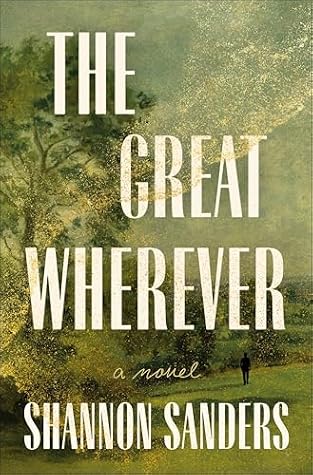
The Great Wherever, by Shannon Sanders*****

The Great Wherever by Shannon Sanders is a terrific novel. Aubrey Lamb is a young woman in a painful state. Her long-term (and affluent, and Caucasian) boyfriend, whom she expects to propose marriage, dumps her instead. One last excellent restaurant meal; now get your stuff out of my apartment. At about the same time, her beloved father dies, and since her mother was already gone, Shannon is lonely and rudderless. But she learns she’s inherited a share of a farm in Tennessee, and in seeing it, meeting other relatives there, and deciding what to do with her portion, Shannon learns a tremendous amount about who she is. Sanders’s lucky readers get to go with her, flies on the wall all of us.

My thanks go to NetGalley and Henry Holt for the review copy. I came late to the party, after the book’s publication day, but several of my Goodreads friends raved about this novel, and I had to dive in anyway. This book is for sale now.

A short way into the story, the narrator, who was unremarkable up to this point, starts speaking in the second person. I am intrigued! I knew there would be some references to the afterlife, but the way this is executed is unlike any other book I’ve read. As the narrative unspools, we are treated to parallel tales about Shannon’s ancestors and the way their experiences have shaped her grandparents, her father, and ultimately, Shannon herself. She goes to the farm in question hoping that she can sell her share and make some money fast; she certainly needs it. But she comes away richer in other ways.

I’m being deliberately vague, because the less the reader knows in advance, the more wonderful the surprises will be as they are revealed. In fact, I would advise those that haven’t already done so to avoid the promotional synopsis and go into it blind.

I will say this, however: although The Great Wherever does have an intricate—but never confusing—plot that is well planned and executed, it is ultimately the characters that make this story pop.

I heartily recommend this book to those that love excellent historical fiction; African-American stories; or expertly crafted fiction that goes deep into character.

Memphis Luck, by Gerald Duff**

In 2015, I read and reviewed Gerald Duff’s Memphis Ribs, the opening book in the Ragsdale and Walker series. It was irreverent but hilarious, and although it straddled the line between edgy but funny and straight-up offensive, it didn’t cross over, and I was still laughing out loud when it ended. I figured I was a Gerald Duff fan for life. All of us love the great literary talents, but a writer that can produce a good, hearty belly laugh is worth his weight in gold. With that in mind, I decided I’d keep an eye out for whatever else he might publish.

When Brash Books offered this second book in the series for review, I leapt on it. I’m sorry to say that I don’t love it the way I did the first.  Many of the same components are there—colorful bad guys, snappy banter between the two detectives—but the overall quality is lacking in places, offensive in others.

The mix includes a group of rip-off artists that are stalking an evangelical preacher, and a special needs teenager that the blurb tells us is autistic and also homicidal. I’m glad the blurb clarified these things, because although the character obviously has issues, none of them would suggest autism to me or as far as I can see, to anyone that has worked with autistic teens. So there’s that.

What I do like is the snappy banter between the two cops, which is one of the aspects of the first story that made it work for me. And the bizarro characters—the preacher that uses a cowboy theme to the extreme in his sermons, the odd teenager that appears to idolize him—at the outset seem pretty damn funny too.

But the corrupt Southern preacher schtick has been done quite a lot, and it’s in danger of becoming a trope. I might have locked into the whole cowboy thing, which is unique, but then there are the race jokes. And it’s the way Duff approaches race that tips this book over a deal-breaking boundary. Yes, I get it that the nasty racial remarks are all made by bad guys, but do we need so many of them? It’s as if Duff has studied every racist he’s ever known and catalogued every ugly racial insult for his future use. Less is more, but there are passages where they’re on every page, almost as if the author is looking for a good excuse to dust them off and make ample use of them. At times it’s cringeworthy; then at other times, it’s just sickening. I’m not having a good time anymore at this point, and were it not for my fondness for Brash Books and the previous book in the series, I would have quit reading it midway through. There’s lots of dialogue and it’s a quick read, but then it would be even quicker not to read it at all, and I wouldn’t have this sour feeling in my gut. Sad to say, I think Duff and I are done.

I cannot recommend this book to you.

The Comedown, by Rebekah Frumkin***

thecomedownThanks go to Net Galley and Henry Holt for the review copy.  This debut tells me that Frumkin is an author to watch. This book is now available to the public.

The story begins with Leland, an addict with a suitcase, and Reggie, the dealer that hates him. There’s Melinda, the unhappy ex-wife, and a host of other characters, including Melinda’s daughter-in-law Jocelyn. The suitcase is the hook; everyone wants it, and so of course the reader must wonder what is in it and who has it now.

This novel grabbed me at the get-go, darkly funny and brutally frank. It struck me as angry fiction, and the energy behind it was fascinating. But ultimately, there are too many characters and too many social issues wrapped into this one story, and rather than making it complex and tight, it wanders in too many directions. There’s an overly lengthy narrative toward the end, and it’s followed by some regrettable dialogue. And there are too many characters named Leland.  The story is an ambitious one, but this should probably have been more than one story, or perhaps a series. The result is a lack of focus.

I would love to see the author write something else using Melinda as the central character, and fewer guys named Leland.