The Matchmaker’s Gift, by Lynda Cohen Loigman*****

“The heart is big enough to hold both grief and love.”

I read Loigman’s debut novel, The Two-Family House, followed by The Wartime Sisters, and I loved them both, so when Net Galley and St. Martin’s Press invited me to read and review The Matchmaker’s Gift, I leapt. Once again, Loigman has me at hello. This outstanding historical novel is for sale now, and you should get it and read it.

The story is told from the point of view of two protagonists, a woman and her grandmother; they were close, but Sara the grandmother has died, so her story is told in the past, beginning in 1910, when she arrives in the U.S. as a child, along with her family. Abby is her granddaughter; her story begins in 1994. Their stories are told alternately, but both are in the third person omniscient and told in a linear time frame, so I am free to lean back, relax, and get lost in their stories, without any confusion or doubling back to check things.

Sara was a matchmaker, although she initially had to be very careful, because Jewish tradition dictated that matchmakers be married men, and she was still just a girl. But she was gifted with visions of a sort, and could tell who belonged together. And so she was forced to create matches “in secret, pairing people together like a rogue puppeteer.” She never missed. And upon her passing, she leaves a cryptic message indicating that upon her death, Abby will inherit her special talent.

Abby is nonplussed by this, and even as she grieves her beloved grandmother’s death, she is confused as to what she should do. She’s a divorce lawyer, for heaven’s sake! Is she to toss her education and become a modern day yenta? She hasn’t even found a man for herself yet, let alone for others.

It’s always a joy to find a story that diverges from the well-worn path, and novels involving Jewish matchmakers—or any others, for that matter—are thin on the ground. But that is only a small part of this novel’s appeal. I love Sara and Abby; I almost feel they are my friends. I feel their sorrows and admire their courage and integrity. When either of them meets with unfair opposition, I want to smack their detractor with my cane.

But there’s something extra that’s infused into Loigman’s stories, an intangible but unmissable warmth. Nobody can teach anyone this. I can count on one hand the number of authors that can write heartwarming stories that don’t follow formulas or insult the reader’s intelligence. Loigman is one, and this makes her golden.

When I was halfway finished reading this glorious novel, I saw that an audio galley was available. I was a bit cautious, because I had already developed a firm sense of how these women sounded in my head, and I was afraid I might not like the narrators’ interpretations, but my concern was unfounded. I had a road trip ahead of me, and I listened to the next forty percent as I drove, and there wasn’t a single moment that I didn’t love. Narrators Eva Kaminsky and Gabra Zackman do a lovely job, and I have never had such a seamless transition from the digital galley, to the audio, and back again.

Highly recommended, and bound to be one of the year’s best loved books.

Patricia Wants to Cuddle: The Audio Version, by Samantha Allen and a host of excellent narrators

Note: after hearing the audio version, I changed my rating to 5 stars. 5 stars shouldn’t be reserved for Shakespeare, for Toni Morrison, for Elizabeth Strout. 5 stars means the book is among the very best in its genre; Patricia Wants to Cuddle is among the best humorous novels being published this century.

A further note: this is the first time I can recall an audio book making a narrative easier to follow rather than harder. The presence of multiple, very skilled readers (Cindy Kay, Justis Bolding, Laura Knight Keating, Susan Bennett, and Jasmin Walker) makes it easier to tell the Catch contestants apart.

It is great to encounter my favorite parts a second time; within the last twenty percent of the book, the figurative language involving a weathervane and a turkey absolutely slay me.

Below is my original review.
________________________________________

“You have to watch out for the quiet ones.”

I had an ugly upper respiratory flu, and this excellent novel was exactly what the doctor ordered. My thanks go to Net Galley, Recorded Books, and Zando Publishing for the review copy. Patricia Wants to Cuddle will be available to the public Tuesday, June 28.

As the story begins, we are midway through filming “The Catch,” which is a reality television show similar to “The Bachelor.” Our cast includes the four lucky women to have made it this far; producer Casey; a handful of crew members; and oh dear, Jeremy, a scuzz bucket if ever there was one. Jeremy is this season’s catch. We also have a handful of locals, since we are filming on location; included is a bashful cryptid in the woods, a lonely creature that reacts very badly to stressful situations. As you may guess, Patricia is that cryptid.

These people are on Otter Island, a fictional addition to the San Juan Islands off the coast of Washington State. Think deep woods, rain, and glamping. And…what the hell was that, just now? Too big to be a bear. And why are the sheep so agitated?

Baaaaa.

The contestants are mostly not interested in love; they are interested in publicity, for various reasons of their own. The shooting schedule leaves them sleep deprived on an almost permanent basis, and so given the premise of the show—competition, not cooperation—it doesn’t take long for the women to turn on one another.

Samantha Allen is new to me, but she’s on my radar now. This story is snicker-worthy at the outset, and by the time we reach the climax, I am howling with laughter. Part of the joy comes from the plot and pacing, but the biggest laughs for me are those that combine these outrageous events with some of the funniest figurative language I have ever read. In fact, were I to rate this story solely on its humor, without rating the more traditional elements such as character development, this would be a five star read.

This book will appeal most to those that lean to the left.

Recommended to those that love darkly hilarious fiction.

A Ballad of Love and Glory, by Reyna Grande****

“We Irish know what ’tis like to be oppressed by an aggressive neighbor.”

Reyna Grande can really write. This is the first of her novels I have read, but it surely won’t be the last. My thanks go to Net Galley and Atria Books for the review copy; this book is for sale now.

A Ballad of Love and Glory encompasses two genres, romance and historical fiction. It’s the story of John Riley, an Irish immigrant to the USA in the mid-nineteenth century, who is met at the dock by military recruiters that want him and his compatriots to serve in the US army, fighting the war against Mexico. Riley arrives half-starved and worried sick about the fate of his family that he left behind. The promise of soldier’s wages is enough to persuade him, and he enlists.

It’s also the story of Ximena, a Mexican naturopath whose husband is killed by Texas Rangers. She follows the army to help care for the wounded; she and Riley are drawn together.

As for me, I am drawn to this tale by my love of military history, whether nonfiction or fiction, and by the unconventional point of view regarding the U.S. land grab. At the time of the annexation of Texas, followed by the war against Mexico, most Americans accepted the official explanation and believed that the war was initiated by Mexican aggression toward U.S. citizens across the border. Some, including an up-and-coming politician named Abraham Lincoln, saw threw the ruse and understood that the whole thing was a pretext on the part of the US designed to capture Texas, California, and points in between. This is the background information that I bring with me as I begin reading this novel.

The title and book cover both focus on romance, and if a friend hadn’t mentioned this story, I would have passed it by; most romance is too sappy for my tastes. But an entire brigade of Irish immigrants that jump sides in the midst of the conflict and fight, instead, for Mexico? I have to read this!

Grande honors historical truth in her storytelling, and as such, this is one sad read. The Irish soldiers are treated more savagely by the American-born officers than I had known, and Grande gives us plenty of detail. And although I know, when I begin reading, exactly who wins this war, it’s hard to face the inevitable once I am bonded to these characters.

That said, I do think Grande does a better job with the military end of this thing, and of developing John Riley in other regards, than romance. There’s this tension between Riley and Ximena, because he is a married man with a child back home—and I can guess immediately how this conflict will be resolved. Until that resolution, the tension, part of the “honor” mentioned in the title, is drawn to nearly ridiculous proportions; at one point, as the two are straining passionately toward one another, they both stop simultaneously, whip out their rosaries, and start saying Hail Mary’s together. I threw back my head and laughed!

Nevertheless, this is a wonderful novel. If you enjoy historical fiction; unconventional points of view; working class fiction; or tales of forbidden love, this book is for you. If you are in need of a good ugly cry, this book is your catalyst.

Last Dance on the Starlight Pier, by Sarah Bird***

I’ve been a big fan of Sarah Bird’s historical fiction since I read Daughter of a Daughter of a Queen, which was published in 2018. When I saw that she had a new book coming out, I was excited and couldn’t wait to start reading it. My thanks go to Net Galley and St. Martin’s Press for the review copy, and McMillan Audio for the recording. This book is for sale now.

Our protagonist is Evie Devlin; the setting is in Texas during the Great Depression. This is a time before government relief exists. Jobs for capable men are scarce, and for women, nearly nonexistent. Evie’s father is dead, and her mother has let her know that she won’t support her efforts to become a nurse. When hard work and determination land her a scholarship, Evie is over the moon, and she makes her way to St. Mary’s School of Nursing in Galveston. The director is not happy to see her; she disapproves of scholarship girls in general—a low class of girls, she believes—and in particular, a Protestant one! What is this world coming to? However, Sofia Amadeo likes Evie, and she wants her admitted, and since the Amadeo family’s money and power drive absolutely everything in Galveston, the director is forced to let Evie in. She and Sofie become roommates first, and then the closest of friends.

We follow Evie through nursing school, but on graduation day, she hits a snag and is sent away without her pin, which is the equivalent of a license to practice. Now homeless and nearly penniless, Evie is adrift, until she learns about the dance-a-thons that feature cash prizes. She was forced to dance for money as a small child and doesn’t care to do so again, but when she sees what passes for a nurse in the show—basically someone off the street recruited to play the role of nurse, but with no training of any kind—she persuades the manager to hire her instead. From there, romance and all sorts of other entanglements and complications ensue.

For roughly the first eighty percent of the book, I am enthralled. The plot is fascinating, the historical accuracy commendable. Soon this becomes my favorite galley. And this is why I feel such a colossal sense of disappointment, almost a sense of betrayal, in fact, when the ending is cobbled together with feel-good revisionism and wishful thinking. Without going into spoilerish detail, a member of an oppressed minority becomes Evie’s focus, and suddenly we roam so far from the historical truth that we never find our way back again. And make no mistake: the actual truth is ugly. But if you’re going to write in the kitchen, you have to be able to bear the heat. Or, something like that.

Sarah Bird is a badass writer. Just reading her figurative language alone gives me joy, and I am hoping fervently that this bizarre departure is an anomaly. I look forward to seeing what she writes next.

As for the audio, Cassandra Campbell does a serviceable job, though the Italian accent sounds a bit like Dracula. This is a common issue, I find, and so I’m not terribly concerned about this aspect. Everything else she does is right on point. If you are going to read this book—which, sadly, I cannot recommend—I’d say it’s a toss up as to audio versus print. Go with whatever you’re most comfortable with, but do it free or cheap if you decide to acquire it.

Chevy in the Hole, by Kelsey Ronan***-****

3.5 stars, rounded up. Chevy in the Hole is Kelsey Ronan’s debut novel. I love strong working class fiction, and the title and book cover spoke to me. But while it shows a good deal of promise, it’s also a cautionary example of how, in trying to do too much, one can do too little. My thanks go to Net Galley and Henry Holt for the review copies. This book is for sale today.

The protagonists are Gus Molloy, who is Caucasian, and Monae Livingston, who is Black. The book opens as Gus is being revived with Narcan on the floor of a dirty restroom in Detroit. We follow him as he meets Monae, a student working at a farm outside of Flint. Their stories are told alternately with bits and pieces of the lives of their predecessors.  

The story is promoted as a love letter to Flint, and a tribute to the resilience of its people; it’s a story of “love and betrayal, race and family.” And we do surely see all of those things, but as soon as one aspect or another is touched on, I wink and poof, it’s gone. Gus and Monae are both sympathetic characters, and I can’t help pulling for them, but I suspect the author could have developed them more fully had we not spent so much time and detail on fragments of their parents, grandparents and so on.

If the author’s purpose is to use these characters from the past to showcase the various struggles through which Flint has gone—sit-down strikes, Civil Rights marches, and now, this horrifying industrial sludge that has polluted the town’s drinking water—it could have been done in a paragraph or two, or through some other device than shifting the point of view. The frequent changes of character and time period make it confusing as heck, particularly while listening to the audio version; that’s a shame, because Janina Edwards is a warm, convincing reader.

But we frequently shift from one protagonist to the other, even after they are married, and all of these people from the past have to be sorted by both time period, and by which protagonist they are related to.  A story like this should flow. As it is, it’s work listening to it, and had I not been granted a digital review copy as well to refer to, I might have given up.

My other frustration is that both the labor history and the Civil Rights issues—with Black people shut out of company housing in the past, and the issues with cop violence as well as the pollution that is visited most within the Black community—are huge. The pollution problem is immense, and ties back into both of the other issues. This book could be a powerhouse, a call for change to reward to the plucky souls that have stuck with this place through hell and high, toxic water. Instead they present almost like postcards; oh, look at this! Now look at that! Okay, never mind, let’s go on back to the present.

That being said, the author’s mission is an ambitious one, and her word smithery is of high caliber. I look forward to seeing what else she publishes.

If you choose to read this book, I recommend using the printed word, whether digitally or as a physical copy.

Wish You Were Here, by Jodi Picoult****

Diana has a high pressure job, and so does her boyfriend, Finn. Thank goodness they’ve made reservations in the Caribbean for a two week vacation. Sun, sand, cold drinks, turtles. But when the pandemic hits, Finn can’t get away. He tells Diana to go on ahead.

My thanks go to Net Galley and Random House Ballantine for the invitation to read and review. This book is for sale now.

Nothing goes as planned for Diana. As her boat conveys her to her destination, everyone else is leaving, rather than arriving. The island is closing, an emergency measure against the pandemic. But Diana is a typical American tourist, and she knows that she has already paid for her stay, so once she is there, of course they’ll accept her…right?

The first few chapters depict our protagonist as such an entitled, smug tourist that I nearly give up out of distaste. But between the promotional blurb and my familiarity with Picoult’s work, I continue, knowing there’s a good chance that Diana will develop into a more likable character. She does.

Soon after she arrives, she runs into a handsome but irate local tour guide turned farmer, and as soon as they collide and conflict erupts, I figure, Ho hum. She’ll end up in bed with him. What else is new? And since this is near the beginning, I will tell you this much: sure she does, and plenty is new! As Diana is forced to live differently, with her luggage lost, very little wifi, no cell coverage, and nobody at her beck and call, she learns some things about herself.

Picoult is early to emerge within the growing body of pandemic fiction—hmm, will this become a genre, sub-genre maybe? And this makes Wish You Were Here all the more appealing.

Again, just before the halfway point, I think I can see how this is going to end, but I couldn’t be more wrong. At about the two-thirds mark, everything changes, and I marvel at the author’s audacity. But she makes it work, and I cannot tell you anything else without ruining it.

Because I was running late with my review, I checked out the audio version from Seattle Bibliocommons and listened alternately with reading the digital review copy I was given. Marin Ireland does a solid job as reader; as to which version I recommend, it’s a complete toss up, so go with your usual preference.

Recommended to Picoult’s fans, and to those that enjoy fiction.

Black Cake, by Charmaine Wilkerson****-*****

“I was not the first person to go through the world living two separate lives, one out in the open and the other locked up inside a box.”

Elly Bennett dies and leaves a detailed recording for her children. Wilkerson’s novel is about Elly’s life, but more than that, it’s about secrets. Everyone in this book has one or has been impacted by one in a major way, and for most, both are true. Elly and her late husband had a whopper, and they built their lives and their family around it. Their two children are Byron and Benny, and Benny’s secret is all consuming for much of her life; it has had a role in estranging her from her once-adoring older brother and parents. Meanwhile, there’s a child—now grown to middle age—in Europe that is herself a secret, and whose very identity has been obscured by one. Elly’s closest childhood friend carries a particularly potent secret, and so does the nanny that raised her. Even the lawyer that handles the estate has one.

When is it safe to let go of a secret?

I was invited to read Wilkerson’s debut novel by Random House Ballantine and Net Galley, and I thank them for the review copy. This book is for sale now, and everyone is talking about it. You’ll want to get in on it.

Our story unfolds with seventeen year old Coventina Brown, known as Covey, quietly launching a plan to join her boyfriend, Gibbs, in London. He’s gone there to go to school, and when she’s done with school, she will join him. That is, until her father, who has raised her alone, gets into big trouble with a loan shark, a local thug who now holds title to her father’s store and his home, and now wants the one thing this father has left: Covey. If Covey marries this nasty old man, the debt will be squared. Most fathers would send their daughters to safety, and then square their shoulders and solve their problem, even when their own lives hang in the balance. But alas, Johnny Lyncook is not most fathers. He’s not a particularly nice man. As one of our characters will observe later, “A shit is a shit, young or old.”

Covey escapes on her wedding day (at which Black Cake, similar to fruitcake, is traditionally served), and her experiences from that time forward will form the foundation of her own life, her (future) husband’s, and their children and other loved ones.

The story is told in the third person omniscient, with the point of view changing by chapter, along with the time period. Readers will find themselves wretchedly confused if they fail to note the chapter titles, which are the key to everything that follows. The result is a story that is assembled like building blocks, and although it works out in the end, with everything coming together for a satisfactory resolution, I am frustrated at times, because just as a character begins to take shape for me, we leave them and join someone else.

I would have enjoyed more integration and perhaps a wee bit of streamlining. For example: we learn that Johnny, Elly/Covey’s father, is ethnically Chinese, and that there are a lot of them in the Caribbean, but there appears to be no reason whatsoever to include this. It is as if Wilkerson wants to include every interesting fact about life in the Caribbean, and so there are components her that add nothing to the narrative. It’s a distraction. The story is complex enough without tidbits thrown in for no benefit. There are some small credibility issues as well. Two people within the story become famous enough to be recognized on the street, and receive breaks that they ordinarily wouldn’t; one is a distance swimmer, and the other an oceanographer. I can imagine how one or the other might be charismatic and photogenic enough to achieve this, but two? Name a famous oceanographer. Name a famous distance swimmer. See what I mean?

Nevertheless, this is in many ways a story for our time, and as such, it will make meaty discussion material in book clubs and in classrooms.  When is a person black enough, and must a biracial person choose one side of their heritage over the other? How much information do adoptive parents owe their child, and when should they provide it? What about biological parents? When is it acceptable to keep secrets related to their children’s heritage, and when not? There are MeToo and other women’s issues at play, and there are issues of race. You could probably read this thing three or four times and still come away with observations, ideas, and questions that you hadn’t found the other times.

I am grateful that this story never devolves into a cookbook.

As debuts go, this is a strong one, and I look forward to seeing what else Wilkerson publishes. I recommend this novel as a welcome distraction from the stormy months ahead.

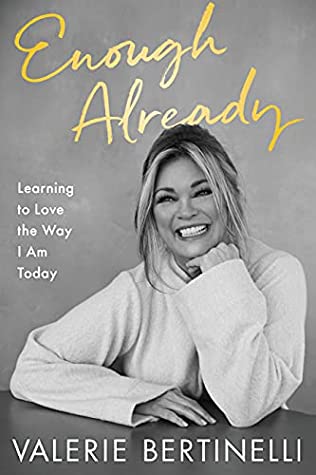
Enough Already! by Valerie Bertinelli***-****

3.5 stars, rounded up. Valerie Bertinelli rose to fame as a child actor, and as a child I watched her show, “One Day at a Time,” together with my parents. I admired and envied her, and when my mother enthused how darling, how pretty, how adorable she was, I also resented her just a teeny bit, the way we tended to resent the homecoming queen or student body president. When I saw, recently, that she’d written a memoir, I was all in. My thanks go to Net Galley and Harper Collins for the review copy. This book will be available to the public Tuesday, January 18, 2022.

For me, this is more of a three star read, but I choose to bump the rating up to four stars because there were several barn-sized hints that I should have noticed before I began reading, yet blew obliviously past. First, I didn’t get the memo that Bertinelli has written diet books and cookbooks, and has won Emmy Awards for a cooking show on the Food Network. All of these things should have given me pause, because although I do like Bertinelli’s earlier work, I never watch food programs on television. If I want to learn more about food, I’ll buy a cookbook or a diet book, but I don’t need it on my TV or any other streaming devices, and I also (giant clue number two) hate mixing recipes and cooking tips into a novel or memoir.

Yikes!

So, whereas I believed I would be reading a memoir suffused with feminist mojo that makes the author ready to turn the page on body shaming and chronic dieting, instead, I got a recipe, right up front. Pffft.  And as a woman who’s lived in plus-sized fashions for decades, I find it hard to get excited about Bertinelli’s brave decision to stop losing the same ten pounds, over and over. Ten pounds? Oh please. I guess maybe actors and models go into crisis over ten extra pounds, and feel tremendously brave about deciding to own them, but where I live, ten pounds is nothing.

When I was in third grade, my teacher said that those of us that roll our eyes stand in danger of having them get stuck up there. Since there’s no way not to do that while reading this thing, we’ll call mine a case study. If they get stuck, I’ll report back. In Braille.

As the memoir continues, I find that more than anything, this is Bertinelli’s grief book. She and her ex-husband, Eddie Van Halen, have remained unusually close in the years since their divorce, and this book is almost more about him and their son Wolfie than it is about her. I never enjoyed Van Halen’s music, which I found to contain more heavy metal than I am geared for; since I have this memoir, I figure I should take myself to cyberspace and find out whether growing older has changed my tastes. As it turns out, nope, it hasn’t. Still not a Van Halen fan.

And lastly, the narrative comes with all sorts of red flags when she talks about the warm relationship she and Eddie have continued to share—because, you know, they are both (full grown) Wolfie’s parents. When it becomes clear that he will lose his fight with cancer, she and he nip out of whatever family party they are attending to go sit in someone’s car and confess their love to one another—despite the fact that they have both remarried. (Imagine I’ve written that last bit in 24 point font, bolded, red.) The hell? I know that Hollywood types sometimes do things a bit differently, but…? And so, once more I travel through cyberspace to track down Bertinelli’s current husband, who is scarcely even mentioned in this emo memoir. I find an image; oh, so that’s him! And yup, at just about the same time the book was in the publication pipeline, the marriage crashed to a halt, with Bertinelli fuming about how she refuses to be “shamed” for how she grieves. Uh, okay. Her grief is her grief, but if I was that fellow, I’d feel as if my marriage was a party to which I hadn’t been invited. And if it was hard to play second fiddle to the famed guitarist when he was alive, I can’t even imagine how anybody can compete with him now that he’s dead. So. For those diehard fans of hers, of Van Halen’s, or of the food programming to which her career has been directed in recent years, this might be a great read for you. As for me, I came away feeling awkward and uncomfortable. If, knowing all these things, you are still interested, then go for it; but if you’re not so sure, either give it a miss, or read it cheap or free.

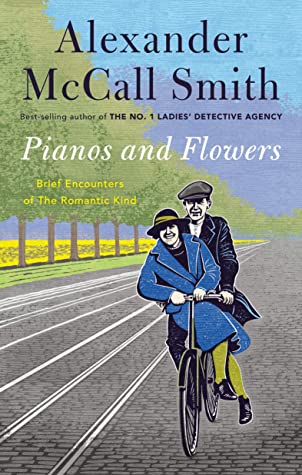
Pianos and Flowers, by Alexander McCall Smith**

Well, heck. I have so loved this author’s most famous #1 Ladies Detective series, and more recently have loved his new, satirical series starring Mr. Varg. When I saw this stand-alone collection of short stories—a genre I enjoy—I leapt at the chance to read and review it. My thanks go to Net Galley and Doubleday, but this one fell flat for me.

The collection is scaffolded by vintage photographs from The Sunday Times. Smith provides one of these photos at the start of every story, and then writes something (fictional) about the people and events displayed. I am initially deflated by these, thinking it might be a good fit for some readers, but for me more of a cure for insomnia, because Zzzzzz, when I find the italicized portion, which is intended to be a you-are-there insert. Why, why, why does every Caucasian reader under the sun think that the best way to add some World War II spice to a story, is to interject some of the racist slurs used widely at that time against Japanese people? True, it was a much more mainstream practice back then for white people to use nasty, racist terms to describe anybody and everybody that wasn’t Caucasian; you weren’t entirely safe if you were from Eastern or Southern Europe, so predominant was this tendency. Yet every author understands that if your book is to see wide circulation, you’d better not go tossing anti-Black references in as casual conversational terms. But ah—the Japanese! Now, that’s different. The Japanese don’t fight back all that much, so probably it means they don’t care. (Pause while I retch for a moment or two.)

This cheap-and-easy bit of vile, racist pop culture took this collection down from three stars to two. However, I can assure the reader that had it initially been a four or five star read, it would nevertheless have dropped to an unfriendly rating when I ran across such ugly language.

I am so done with that.

This thing is for sale if you really want it.

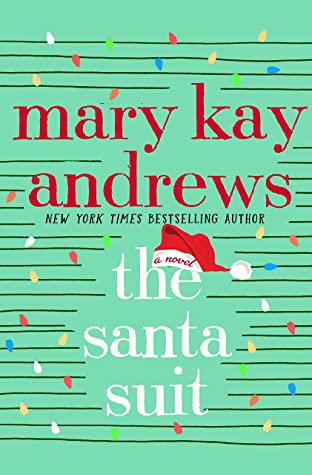
The Santa Suit, by Mary Kay Andrews***-****

3.75 rounded up.

I love a good Christmas story, but so many of them are cloying or insipid. A friend recommended this one to me, and she wasn’t wrong. My thanks go to Net Galley and St. Martin’s Press for the review copy.

Ivy is newly divorced, and she comes away from it with bruised feelings, but also money. Since she works from home, she has the choice to go anywhere, so she buys a farmhouse in a tiny town in North Carolina. She pays for it without ever seeing it in person, and it comes “as is.” At this point, I say, Welp, you’re in for it now, hon. And she is, sort of.

The realtor, Ezra, known locally as “The House Hunk,” has taken a shine to Ivy. He helps her with the heat; when she discovers that the old furniture is still there in the house, he and a friend cart it off for her, and when there’s a problem with her own furniture, he helps bring it all back in. And initially, she regards his attention as a nuisance, maybe even a stalker; but between the fine reputation he enjoys locally, and the number of times he helps her out of difficult situations, she gradually warms to him.

Ivy is a likable protagonist. She’s self-sufficient, but she isn’t cold. She sets about making friends right away. Her new bud, Phoebe, is in a state because she’s fallen in love with someone she met online, and has used a picture of someone else. Now the man Is coming to see her, and she’s panic-stricken. Other new friends include a local business person for whom she does some free, and very good, advertising, and a 96 year old man. Her dog, Punkin, goes everywhere with her, and she talks to him all the time, the way that some of us also do. When she needs assistance it’s because she doesn’t know the area, or because a job requires an extra set of hands, not because she is some helpless airhead. An engaging character indeed.

My rating reflects a couple of sloppy bits that the author and editor should have caught and dealt with immediately. They’re small, but they interrupt the magic, because they cause me to think about the two slackers rather than the story and characters. The first is when she offers Ezra coffee, but warns him that all she has is instant. Two paragraphs later, she is brewing the coffee. Oh, come on! Clean it up. A bit later, after Ezra and a friend have schlepped furniture in from the truck, he asks if she’s been out to play in the snow, and she tells him she doesn’t want to spoil its beauty. “It’s so beautiful, all that clean, untouched white.” And so I wonder: did they teleport the furniture indoors? Because otherwise, surely that snow would have been touched in a whole lot of places.

There are a couple of other inconsistencies, albeit smaller ones, and I am using a fair amount of ink to discuss problems that may seem trivial, but this is no debut author, this is a successful writer with a host of books in her repertoire, and she should know better.

The plot, on the other hand, is excellent. There was one development that I thought was obvious, but when I finished my eyeroll, I was surprised to see that she didn’t take it where I expected, and instead did something much better. I particularly like the way the romance unfolds, and the way that Ivy helps Phoebe out of her dilemma. There are other threads—involving a Santa suit, of course—that are equally delightful.

So, in spite of my complaints, I do recommend this charming, fluffy tale to you. It’s a mood elevator, and we can all use some of that. It’s for sale now.