
Category Archives: nonfiction

Best Biography of 2019: Madame Fourcade’s Secret War

The Broken Road, by Peggy Wallace Kennedy**
“I was perhaps Daddy’s most important legacy of all.”

Thanks go to Bloomsbury and Net Galley for the review copy, which I read free and early in exchange for this honest review.
I was a child during the Civil Rights era, and although I didn’t live in the American South, I recall news footage of Kennedy’s father, George Wallace, the man that the author rightly attributes as a harbinger of the Trump movement. Instead of “Make America Great Again,” Wallace urged his constituents—including the Klan, whom he openly welcomed to his campaign—to “Stand Up for America.” When the federal government signaled that it would enforce the segregation ban, Wallace made headlines around the world by literally standing in the door of the schoolhouse in order to turn the first Black student away from a public school in Alabama. My own father was a redneck of the first order, but even he distanced himself from this extremist. Wallace ran for U.S. president but was defeated; upon returning to the governor’s mansion, he was shot and paralyzed from the waist down. By that time Malcolm X was dead and could not have told us that this was a case of chickens coming home to roost, and yet it may well have been.
Although the book’s summary suggests that Kennedy is vastly different from her father politically, her prose indicates that her true, bitterest grievances all center on his philandering betrayal of her sainted mother and his failure to be a strong provider and dedicated family man. She tells us that even in the 1960s, she felt his racist rhetoric was wrong, and so I waited for what I thought must surely come next: the moment she either confronted him or simply moved out of the house to another part of the country to restart her life in saner surroundings. None of this happened, as it turns out. She stayed in the governor’s mansion, thrilled by the relative affluence and privilege she regarded as her due following a tumultuous, sometimes impoverished childhood.
The title is taken from a Hemingway quote, and in her own story designated the location of her maternal grandparents, whose simple, homespun nurturance provided relief to her mother and herself when her father went on the road politicking and didn’t send money home for them to live off of. At the beginning of the book she uses the expression often enough to beat it to death, but once her father becomes governor she rarely speaks of these kind, gentle people. Toward the end, she parenthetically notes that her grandmother died at some point back in the middle of the book.
It’s interesting that although Lurleen Wallace was elected governor in order to circumvent what was at the time a state law against successive terms for her husband, the author says nothing at all about her mother’s civil rights policies. We see that she won the governorship in a landslide and was loved by all, and yet if her policies diverged much from George’s, that would have created screaming headlines. It’s just one of the many inconsistencies within this memoir.
The last several chapters are devoted to her father’s redemption politically, or so she asserts. He never hated African-Americans, she tells us, but only did and said those things in order to gain office. Later in life, he asked a handful of Civil Rights leaders for forgiveness and spoke in Black churches about his error. She follows this up by pointing to the large numbers of Black voters that returned him to the Capitol.
I find myself wondering a lot of things, and foremost among them is why anyone would consider a candidate that makes the cold-blooded decision to promote violent racism for the sake of gaining office to be morally superior to one holding the genuine belief in the inferiority of other races and ethnicities. Wallace, she tells us, didn’t sign onto the Klan’s program because of his convictions, but because of what they could do for him. And while the parallels she draws with Nixon are apt ones, the rationalization of her late father’s destructive, ethically bankrupt lifetime is chilling in its own way, but she underplays this aspect of his career.
Her “daddy” lived long enough to appoint her 26-year-old attorney husband to the state bench.
The second star here is reluctantly provided because she does some very nice things at the outset with regard to her description of time and place in the life of poor white folks in mid-twentieth century rural Alabama. If you’re looking for a silver lining to this wretched work, there it is. It’s all I can find.
I would place this book in the child-revenge category along with Christina Crawford, Patti (Reagan) Davis, and Carrie Fisher. Read it if you want to wallow, but when you’re finished, you will likely want to shower and gargle.
According to Kate, by Chris Enss***
Kate Elder, better known as Big Nose Kate, was a colorful character in the mercurial Wild West. Together with her paramour—possibly her husband—Doc Holliday, she shot, swindled and burned her way through Kansas, New Mexico, Texas and other parts of the American Southwest. My thanks go to Net Galley and Two Dot Publishing for the review copy. This book is for sale now.
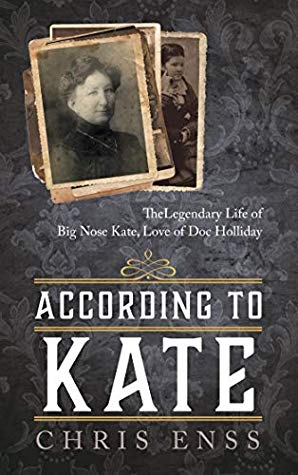
Enss is a capable writer, and I enjoy seeing women about whom little has been written brought to the foreground. Enss amassed a fair amount of material on her subject, but some of it was contradictory, and the greatest contradictor of all was Kate herself, who decided to tell her own life story when she was too old to recall everything properly. Enss tells the reader in the title and introduction that she is telling Kate’s story from the subject’s point of view, and she adds numerous footnotes explaining conflicting information throughout the narrative.
I read things I had never known before about this time and place, and general historical knowledge is where Enss shines best. For example, a ‘soiled dove’ was allowed to own real estate, whereas married women of the time were not. There were a number of financial advantages to owning a house of ill repute. Kate grew up in a middle class household and was not without choices, but she didn’t care to be married off in the way her family had proposed. In the end she was both a shrewd businesswoman and an adrenaline junkie, one that made a point of having at least one loaded gun handy when a situation called for it. I enjoyed reading about it.
Unfortunately there is a lot of conflicting information and the gaps in the story are numerous. Anytime I start seeing the words “might,” “must have, “ “likely” and so forth, I pull back from the narrative. I can’t get lost in a story when I have to mentally filter the things that are known to have happened from the things nobody knows for sure. I think Enss has done as good a job as could be done with the documentation available, but Kate is a hard nut to crack.
What I would love to see is historical fiction written with Kate as the protagonist, viewed through the eyes of a feminist writer such as Enss. With historical fiction one can freely fill in the gaps, provide dialogue, and make notes at the end of the story letting the reader know what she has invented or changed.
Those with a special interest may want to read this biography, but I see it largely as a niche read.
Best Military History of 2019: Spearhead, by Adam Makos

Guest House for Young Widows, by Azadeh Moaveni**
Those of us in the United States don’t have much of a window on the women of ISIS, and I thought this title might help me understand them better. In some ways this proves true, but in the end, I couldn’t finish this book and I can’t recommend it. Thanks go to Net Galley and Random House for letting me read it free and early.

Here’s a quote that provides a thesis:
Many of these women were trying, in a twisted way, to achieve dignity and freedom through an embrace of a politics that ended up violating both…The political fractures from which [ISIS] arose have not been fixed. History has shown that unless conditions genuinely change, a new insurgency always arises from the ashes of an old one.
Moaveni shares the case studies of individual women that have been drawn to the Islamic State. Although the organization provides its women with a measure of security and protection, promoting higher education—in the service of the organization, of course—and sometimes furnishing jobs, it draws not only women that are desperate for food and shelter, but also women from comfortable middle class backgrounds. Once they are in, they find it difficult to leave. Moaveni demonstrates myriad ways in which women provide essential support for ISIS.
There are three things that I liked about this book. The research is well done; the women discussed here provide the reader with individual stories and therefore humanize them; and she acknowledges the disparity between mainstream Islamic belief and ISIS.
On the other hand, despite disclaimers within the narrative, I was overcome by a crawly sensation when I realized that the author’s overall purpose is to rationalize the choices made by women within Islamic State. She says they are relatable; I am appalled and unpersuaded.
Those that dislike a dictatorial regime should indeed advocate for a better system. How great a risk each person is willing to assume is of course an individual decision. But there is nothing that justifies or mitigates the atrocities visited on innocent people by this dreadful pseudo-religion.
When push comes to shove, the only real dilemma for me is whether to provide one star or two in review. The second star is reluctantly assigned on the basis of the writer’s solid research; yet the ideas within it are entirely abhorrent.
Never, never, and never.
The Prison Letters of Nelson Mandela*****
This magnificent collection took 10 years to organize, collecting Madiba’s letters from the many points where they were received, and from the prisons–where many of them were not mailed out, for various technical reasons that were a poor disguise for censorship. The preface suggests that most people will want to flip through it rather than reading it cover-to-cover, but I am a habitual cover-to-cover sort, and so I read the first 50 pages in sequence. And the book’s editor is correct. This is not a cover-to-cover read.

Nevertheless, I am struck immediately by the dignity with which Mandela communicates with his captors. Time and again he writes to them in a courteous, civilized, and highly educated hand about the various ways in which his rights under South African law are being violated and what he is requesting they do to remedy it. He is persistent. He forces them to treat him as a human being. Mandela was an attorney, but he was also possessed of social instincts that nobody can teach anyone. And although I never met him, everything I have read–which is a good deal, where this man is concerned–convinces me that he was also a very nice person.
This is a tome, and it’s a treasure. I am glad I was denied a galley because this is the sort of volume I want as a physical copy. In the end my son purchased it for me for my birthday, and so I thank Benjamin. What a treasure.
If you are looking for just one book about Mandela’s life, read his hefty autobiography, Long Walk to Freedom. However, if you are a collector of books about South Africa, or about civil rights in general, or of course, about Nelson Mandela, go out and get this book now.
Conversations with RBG, by Jeffrey Rosen*****
This is the RBG book I’ve been waiting for. My huge thanks go to Net Galley and Henry Holt Publishers for the review copy. This book will be publicly available November 5, 2019.

Justice Ginsburg wants us to know that the sky is not falling. Though progressive thinkers see great cause for concern, primarily within the executive branch of the federal government, the U.S. Constitution hasn’t changed, and the Supreme Court, she insists, is made up entirely of strong legal minds that revere it. Precedents are still the basis of future rulings; the overturn of precedent is rare and unusual. But for activists—and she loves us—she also points out that public opinion is what alters the course of the law. Congress makes laws based on what their constituency desires. So she isn’t suggesting we put away our pussy hats and our picket signs; she just wants us to know that our advocacy works, and she appreciates everything we do to further women’s rights, civil rights, and gay rights.
Twice previously I read other books about RBG; one is a popular biography that I enjoyed, but that didn’t go deeply enough into Ginsburg’s legal ideas, and the second is just dross, minutiae gathered from her high school year book and whatnot. Whereas part of me just wants her to write an autobiography, I have to recognize that she is very elderly, has faced health challenges lately, and to stand a chance of writing any sort of memoir, she’d probably have to resign from the Court. And goodness knows, I want her to stay there, ideally forever. Instead, Rosen’s series of interviews with this feminist icon serves nicely.
Rosen has been friends with Justice Ginsberg for many years; they were drawn together initially through elevator discussions of opera. His chapters are brief but meaty, organized around key rulings and topical interviews. Rosen explains succinctly at the outset how this friendship formed and grew, but he doesn’t get windy or use the opportunity to aggrandize himself. He keeps the focus strictly on his subject. The interviews flow in an agreeable manner that is literate without being verbose or Byzantine.
We live in politically polarized times, and so even when I am reading about a political figure that I admire, I generally expect my blood pressure to rise a little, perhaps in passionate agreement. But if anyone in this nation has the long view of history and the key domestic issues that have unfolded, particularly with regard to the rights of women, it is RBG. And although I am not as senior a citizen as Justice Ginsburg, many of the changes she mentions that have occurred over the decades are ones that I can also attest to, though I hadn’t thought of them in years. For example, when I came of age in the 1970s, it was still not unusual to try to enter a bar or club only to be barred at the doorway because women weren’t allowed inside. (“Gentlemen only, Ma’am. Sorry.”) I had forgotten about these things; as her recollections unspool I see that she is right. Change happens, but lasting change happens slowly. We are getting there, at least with regard to women’s rights and gay rights. Issues of race and class are something else entirely, and she points up specific instances where justice has not progressed and change is imperative. I could say more, but none of it would be as wise or as articulate as when Ginsburg says it. If you’ve read this far in my review, you should go ahead and order this excellent book now. I highly recommend it to all that are interested in social justice, both formal and informal.
Becoming Dr. Seuss, by Brian Jay Jones*****
Say this name to schoolteachers and children’s librarians and watch our faces light up, our backs grow a trifle straighter, our steps quicken. Dr. Seuss is the closest thing we have to a patron saint, and when I saw this biography, I wanted it as badly as I’ve wanted any galley. Big thanks go to Net Galley and Penguin Dutton, and many apologies for my tardiness. It’s a strange thing but true: when I must write an unfavorable book review, I know just what to say and can do it the same day I finish reading, but for a momentous work such as this one, I need some time for my thoughts to gel. Brian Jay Jones writes biographies of quirky visionaries such as Washington Irving, George Lucas, and Jim Henson, and he doesn’t cut corners. This biography is highly recommended to adult readers, but don’t go handing it off to your precocious fifth grader until you’ve read it yourself. Geisel’s life held some very deep shadows.

Geisel grew up with comfort and privilege as the heir to a family beer making business; the slings and arrows that came his family’s way during Prohibition taught him that small minds can do ugly things. Still, his youth was mostly untroubled; he attended Dartmouth , where he was voted Least Likely to Succeed, and then Oxford, where his studies in Medieval German floundered, his attention drifting to the margins of his notebook, where he drew fanciful creatures and turreted buildings that would later become iconic. It was Helen, his sweetheart, who suggested he follow his heart and pursue art for a living. His early success came in advertising for Flit bug spray. Once he and his bride became financially stable enough to move out of their low rent neighborhood and into a tonier area, he discovered he had no use at all for pretension, and he wrote:
“Mrs. Van Bleck
Of the Newport Van Blecks
Is so goddamn rich
She has gold-plated sex
Whereas Miggles and Mitzi
And Bitzi and Sue
Have the commonplace thing
And it just has to do.”
He served in the military during World War II with Francis Ford Coppola making propaganda and training films. His pro-intervention cartoons are surprisingly hawkish—I have the collection titled Dr. Seuss Goes to War on my shelves—but he later realized that it was wrongheaded to demand the internment of Japanese Americans, and in some bizarre way, he intended Horton Hears a Who to be his apology for it.
His family was not Jewish, but his surname confused some people, and he received some anti-Semitic shade that inspired him to stand up for the rights of Jewish Americans.
Jones deserves credit for confronting the anti-Japanese racism and xenophobia in this author’s early years; he doesn’t gloss over it, and he doesn’t turn it into something prurient either. He lays it straight out, along with Ted’s more enlightened thinking in his later years, and it strikes exactly the right tone. This isn’t comfortable material, but then it shouldn’t be.
The most amazing thing is to learn that Seuss—known to family and friends as Ted—wasn’t a successful author until well into middle age. He vacillated between advertising and “brat books” but hit it big when he submitted How the Grinch Stole Christmas to Bennett Cerf at Random House, which would be his second home for many years. Though he and his wife moved to Southern California and much of his work was mailed in, he became known for coming to read his book to the Random House staff in person when it was publication time. (He was also known for being difficult at times, micromanaging the publication of his work, and this may be part of the reason he wasn’t urged to attend business in person on a more regular basis.)
Ted and Helen were unable to have children, a painful fact that they chose not to share with the public. When asked during publicity tours why a man with such a great heart for children had none himself, Ted deflected it by saying others should have the children and he would write for them.
Helen’s illnesses and Ted’s infidelity were aspects of this author’s life I knew nothing about. It’s hard to read about, but again, Jones includes these things in the narrative not to shock us, but because they have to be there.
He was widely known and revered for his insistence that books should be fun for children to read and should not preach or moralize, but instead, should respect the readers. He was a pioneer in this regard, and I owe him a great debt for teaching me to love literature as a preschooler, and for providing such wonderful books for my own children and students later in my life. It is this legacy that remains when the rest falls away, that reading should open new worlds for its young readers; it should not trick or manipulate its audience, but instead should speak to children with respect using language they can understand.
Highly recommended to an adult readership.
When I Was White, by Sarah Valentine****
Sarah Valentine was raised to believe that she was white, and that her dark complexion was the product of her Greek ancestors. But whereas she does have Greek ancestry in her DNA, Sarah is also of African descent. This strange but compelling, searingly honest memoir came to me courtesy of Net Galley and St. Martin’s Press; it will be available to the public tomorrow, August 6, 2019.
Valentine is an excellent writer, and she spins us back in time to her childhood, spent in a private school, a Catholic upper middle class family, celebrating European cultural events. She is the only African-American or mixed race student at her school, and every now and then, someone there will make a remark that infers she is Black. This puzzles her. Her own mother makes remarks bordering on White Supremacy, assumptions about the habits and character of Black people; of course, none of this should apply to Sarah, in her view, because she insists that Sarah is Greek and Irish, and Irish, and Irish.
Reading of her experiences, I am initially surprised that such culturally clueless, entirely white parents would be permitted to adopt a Black child; but here’s the thing. She isn’t adopted. She is her mother’s biological child, and to talk about who her biological father is, is to recognize that her mother was not always faithful to her father. It’s a keg of dynamite, one that her parents carefully navigate around. Not only have they not spoken about this to Sarah; they have not spoken about it to each other. It is a fiction that holds their marriage together; toss a tablecloth over that keg of TNT there and for goodness sake, don’t bump it.
I came away feeling sorry for her father.
There’s a lot more going on between Sarah and her parents, particularly her mother, a talented but not entirely stable parent who assigns impossible standards to her daughter. Meanwhile, as Sarah grows up and leaves for college, the fiction of her heritage is uncovered, first as a mere suspicion, then later as fact.
This isn’t an easy read or a fun one. It can’t be. Sarah’s pain bleeds through the pages as we see the toxic ingredients and outcomes in her story; her mother’s mental health and her own, as well as eating disorders and the implosion of her parents’ marriage. The particulars of her lifelong struggle make it impossible to draw a larger lesson in terms of civil rights issues; there are some salient points that will speak to women that grew up in the mid-20th century as Sarah’s mother did, and as I did. And here we find one small spark of optimism, the fact that when women are raped, whether at college or elsewhere, we stand a greater chance of being believed than we did in the past. Still, it’s a grim tale overall, and I don’t think there’s any other way Sarah could honestly have told it.

