The Autobiography of Mother Jones, by Mary Harris Jones*****

Note: I wrote this review before I began this blog, and I was shocked when I found I had somehow not included it here. There’s no disclosure regarding a review copy, because I didn’t get one. I bought this book and paid full cover price, and I will keep it until it is pried from my cold, dead hands.

Mother Jones has been called “the most dangerous woman in America”. Some refer to her as an anarchist, but in her autobiography, she denounces anarchism, though allows that these folks have their hearts in the right place. She has been called a syndicalist (which is probably closer to the truth), but the fact is that she was motivated by what she saw right there on the ground in front of her. When the Russian Revolution unfolded, she was by her own account past 90, and by the account of another biographer, in her mid-80’s, so either way, she was very, very elderly, yet she championed its achievement at the Pan-American labor conference held in Mexico:

“…a new day, a day when workers of the world would know no other boundaries than those between the exploiter and the exploited. Soviet Russia, I said, had dared to challenge the old order, had handed the earth over to those who toiled upon it, and the capitalists were quaking in their scab-made shoes.”

Jones’ career as a political organizer began shortly after she turned 30. She was a married woman, her husband an iron worker, and she stayed home with their four small children. “Yellow fever” (which I think is malaria) came and killed her whole family, and then as if that wasn’t enough, the great Chicago fire swept away her home and all her possessions.

Some would have turned to suicide. Some would have gone looking for an elderly widower to marry. Some would have gone off to find distant relatives and live with them as little more than domestic servants.

Jones reinvented herself and gave the next fifty-plus years of her life to making the world a better place.

Still clad in a widow’s black garments, she put her hair up in a chaste bun and left Mary Harris Jones behind. From this time forward, she would be “Mother Jones”. Think of it! The cinders from the American Civil War were barely cold, and women had no position in American political life, including the labor unions. Yet by becoming a mother to workers everywhere, including the women and small children laboring in mines and textile mills, she became a force to be reckoned with. It was a brilliant piece of theater, entirely sincere in its intention and in many cases successful. She was one of the most ardent champions of the 8 hour day:

“The person who believed in an eight-hour working day was an enemy of his country,a traitor, an anarchist…Feeling was bitter. The city [Chicago] was divided into two angry camps. The working people on one side–hungry, cold, jobless, fighting gunmen and policemen with their bare hands. On the other side the employers, knowing neither hunger or cold, supported by the newspapers, by the police, by all the power of the great state itself.”

When Mother speaks, people feel they should listen, and if she speaks in their better interests, they listen harder. And in the early days, at least, the boss’s goons and the local law thought twice about putting a hand on Mother. It wasn’t nice!

Later, as her impact on their wallets hardened their resolve, they would deal with her less gently. She didn’t care. She spent nights in jail when she could have left town instead. Sometimes she traveled into a coal mining enclave where every bit of property besides the public roads was owned by the mine owners. Even homes that had been rented to miners were closed to her, as was made clear enough to break almost anyone’s heart. She describes a mining family that held a union meeting at which she was present in the coal fields of Arnot, Pennsylvania. The following day the company fires and evicts the family, and “they gathered up all their earthly belongings, which weren’t much…and the sight of that wagon with the holy pictures and the sticks of furniture and the children” made the local miners so angry that they decided to strike and refuse to go back to work till their union was recognized.

The quote most well known that shows up on tee shirts, posters, and coffee mugs among the liberal and radical milieu today is knocked clean out of context, in my view. “Pray for the dead and fight like hell for the living” was delivered in order to get working men out of the local church, where the priest was trying to cool down the heat and persuade the coal miners to wait for a reward in heaven. “Your organization is not a praying institution,” she reminded them, “It’s a fighting institution!” She tells them to leave the church and meet in the local school, which their own tax dollars had bought. And she later tells other miners that striking is done to provide “a little bit of heaven before you die.”

From Chicago to the coal fields of West Virginia, from New Mexico to Pennsylvania, she was found among railroad men and their families, machinists, textile workers, and above all, miners. She had no use at all for union officialdom, and though she occasionally praised a senator or governor who saw the light of day and called off the hounds of vengeance so that unions could be organized and the workers represented, more often than not she saw them as perfidious and untrustworthy.

When Eugene Debs became a candidate for U.S. president, she embraced his campaign, though she stayed among the workers, which I think was the correct thing to do. But when Debs comes to speak to coal miners and the union officialdom wants to meet his train quietly with a few representatives, Jones proposes all the union members go to greet him. They stampede down to the train, leap over the railings, and lift Debs onto their shoulders, she says, shouting, “Debs is here! Debs is here!”

I could have been finished with this slender volume quite quickly if I hadn’t been making notes (most of which, as usual, I cannot fit into my review, but then I should leave you some choice tidbits to find for yourself, and there are still many of them!) The chapters are brief, and so the book can be read just a few minutes at a time. And the introduction is written by one no less auspicious than Clarence Darrow himself.

You may look at the price and wonder whether you should pay that price for this slender little volume. The answer is, oh hell yes. Please remember that the words of the woman herself are worth twice as many from some armchair hack who wants to pick it apart and wonder whether she was really 83 or 85 at such-and-such moment? Spare yourself the blather and go straight to the primary source. It’s worth double the cover price!

All We Are Saying, by David Sheff*****

This is a digital reprint of the last interview of John Lennon and Yoko Ono, two days before John was murdered on December 8, 1980. David Sheff is a journalist and also a die-hard fan of the Lennon’s. Lucky me, I read it free. Thanks go to Net Galley and St. Martin’s Press for the review copy. It’s for sale now.

This interview is a treasure trove for anyone interested in John Lennon, Yoko Ono, or the Beatles. 192 pages makes for a short book, but as interviews go, it’s a whopper. Lennon and Ono were about to release an album together, and so when Playboy requested an interview, they consented. The most wonderful thing about it is that because of the format, nearly everything is a direct quotation of either John’s or Yoko’s. Nobody knew during the course of the interview, which took multiple days, that John would be shot to death by a stranger two days later.

It makes for interesting reading. There are passages I love and others that make me see red, but I am not irritated with the author, who’s done a bang-up job, but rather, in places, at things said by his subjects. Most of it is tremendously entertaining. And in some places, it is almost unbearably poignant. At the outset, John makes a comment, almost off the cuff, about how the way to be really famous as an artist is to die in public, which he surely isn’t planning to do. Later, he quotes someone that says it’s better to burn out than to rust, and he says he disagrees, that “It’s better to fade away like an old soldier than to burn out.” And he notes that he has another forty years or so of productivity ahead of him.

Lennon was a happy man when this interview took place. He’d been a “house husband,” staying home and taking care of Sean, their son, although they acknowledge that it’s easier to do that when there’s a nanny available anytime he needs to go out for some reason, and someone else that will clean the house and so forth. Ono, on the other hand, is the one who’s handling their finances, and it’s a princely fortune at that.

And to me, the most interesting aspect of this interview isn’t him, it’s her. I was a child in elementary school when John left his first wife and married Yoko, but I remember the virulent, nasty things that appeared in the media. Those that don’t think any progress has been registered regarding race and gender should look through some archives. And John comments that the press treated their relationship as if he were “some wondrous mystic prince from the rock world dabbling with this strange Oriental woman.”

Ono said, “I handled the business…my own accountant and my own lawyer could not deal with the fact that I was telling them what to do…”

 John continued that there was “…an attitude that this is John’s wife, but surely she can’t really be representing him…they’re all male, you know, just big and fat, vodka lunch, shouting males…Recently she made them about five million dollars and they fought and fought not to let her do it because it was her idea and she’s not a professional. But she did it, and then one of the guys said to her, ‘Well, Lennon does it again.’ But Lennon didn’t have anything to do with it.”

There’s a lot that gets said about the women’s movement and all of it is wonderful. Once in awhile John holds forth about something he knows nothing about (anthropology and the early role of women) and he makes an ass of himself. He may have been more enlightened than most men, but he still hadn’t learned to acknowledge that there were some things he just didn’t know.

There are passages that make me grind my teeth, and all of them have to do with wealth in one way or another. Ono is from a ruling class Japanese banking family, and the airy things she and John say about being rich make me want to hit a wall. People shouldn’t pick on them for being wealthy. And oh my goodness, when Sheff mildly suggests that John and the other former Beatles surrender and do a single reunion concert for charity, his response is horrifying. He points out that the concert for Bangladesh that George Harrison roped them into doing turned out to raise no money at all for the cause because all of it went to red tape and lawsuits; ouch! But the truly obnoxious bit is when he whines about how the world just expects too much of him. He wants to know, “Do we have to divide the fish and the loaves for the multitudes again? Do we have to get crucified again? We are not there to save the fucking world.”

The part that makes me laugh is when Ono describes how The Beatles broke up at about the same time she and John got together: “What happened with John is that I sort of went to bed with this guy that I liked and suddenly the next morning I see these three guys standing there with resentful eyes.”

Those that are curious about Lennon and Ono, or that are interested in rock and roll history, should get this interview and read it. There’s a good deal of discussion about the roots of the music, and about the music he made that the radio never played. There’s a good deal here that I surely never knew. For these readers, I highly recommend this book.

Bestiary, by K-Ming Chang

It’s the best of books, but it’s the worst of books. K-Ming Chang has made her mark on modern literature, and her debut novel, Bestiary, has already made a number of prestigious lists. My thanks go to Net Galley and Random House for the invitation to read and review; sadly, its twisted edginess is too intense for me.

This much-buzzed-about book is for sale now.

How many triggers are packed into this one little book? All of them. Every trigger you can possibly think of, plus she may have made a few more up on the spot. There is violence a-plenty here, and the graphic child abuse and elder abuse provide such visceral imagery that I may never get it out of my head. I abandoned this book faster than just about any I can recall, and although I was certain it was the right thing to do for myself, I nevertheless experienced a twinge of regret along with it, because it is obvious from the first page that this author can write.

My gut hunch is that younger adult readers with cast-iron stomachs and level dispositions will be the most appreciative demographic for this one, but wimps like me will need to give it a pass. It is to the former that this book is recommended.

Love and Other Crimes, by Sara Paretsky*****

Sara Paretsky is a venerable author, one who—along with the late, great Sue Grafton—reframed the role of women in detective fiction nearly forty years ago. When I saw this collection available for review on Edelweiss, I jumped on it. It’s for sale now, and you should get it and read it—although there’s a caveat coming up that should be considered first.

Sometimes when a favorite writer releases a book of short stories, I find that I’ve already read a lot of them in one form or another. This time, nearly every story is new to me. One forms the basis of a full length book that I read a long time ago and have forgotten much of. Another is a reworked version of the short story “Wildcat,” which I purchased a short time ago. These are the only duplicate stories I can detect, and I am a voracious reader where this author is concerned.  Some of her work was included in Sisters in Crime anthologies, but I haven’t seen them. Not all of them feature the iconic V.I. Warshawski. The signature elements that include social justice issues such as women’s rights, immigration, racism, and the homeless are here in abundance, as one might hope.

My favorite selection is the second, “Miss Bianca,” a mystery in which a little girl saves a research rat and ultimately uncovers a dangerous conspiracy. Paretsky gets the tone of the child’s voice just right, making her bright within the bounds of what a child that age is capable of, and registering the thought processes and perceptions of her protagonist flawlessly.

There’s an historical mystery that involves a Sherlock Holmes retelling, and like all of that ilk, it bored the snot out of me, a first where this writer is concerned. I abandoned it halfway through. The five star rating is unchanged, because the reader can skip this story and still get her money’s worth and then some; also, I am aware that not everyone is as averse to this type of writing as I am.

Another story is set during the late 1960s, and the Civil Rights Movement is center stage. In order to convey the horror of the backlash by some Caucasian Chicagoans during this tumultuous period, the *N* word is included several times. I used the audio version of this book for some of the stories, including this one, and I feel as if it should have a warning sticker of some sort because hearing that word shouted angrily sent a cold finger right up my spine, and I don’t like to think of other readers, especially Black readers, listening to it within the hearing of their children. I don’t deduct anything from my rating, because the author includes a note about its use and her reasons for it at the end of the story; in fact, there is an author’s note at the end of many of these that makes the story more satisfying. But you should know that this word is there, so be ready for it.

When all is said and done, there are few authors that can deliver the way Paretsky can. With the considerations above included, I highly recommend this collection to you.

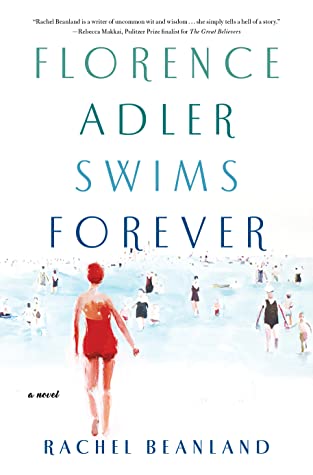
Florence Adler Swims Forever*****

It’s hard to believe that Florence Adler Swims Forever is a debut novel. Rachel Beanland has stormed our literary beaches, and I hope she does it forever. Big thanks go to Net Galley and Simon and Schuster for the review copy. This book is for sale now.

The title character dies almost immediately, which is a bit unusual all by itself. The central storyline centers on Fannie, Florence’s sister, who is in the midst of a dangerous pregnancy. She’s already had one premature baby that died at 3 weeks, and so this one Is being closely monitored. Because of this, the family closes rank in order to prevent Fannie from knowing that Florence has died until after the baby’s birth, lest she miscarry. However, Fannie isn’t the main character; the point of view shifts between the present and the past, from one family member to another, eight all told, in fairly even fashion.

My first reaction to this premise—keeping her sister’s death from Fannie for what, two months—is that it’s far-fetched to think such a plan could succeed. But as the story unfolds, I realize that information was not a constant presence during the late 1930s, as it is now. There was no television yet; a radio was desirable, but not everyone had one. Fannie asks for a radio for her hospital room, but she’s told they’re all in use. Too bad, hon. Newspapers and magazines were explicitly forbidden for visitors to bring in; the lack of news is explained in general terms as “doctor’s orders,” and back then, doctors were like little gods. If “Doctor” said to jump, everyone, the patient most of all, leapt without question. And then I see the author’s note at the end, that this story is based on an actual event from her family’s history! It blows me away.

Besides Fannie and Florence, we have the parents, Joseph and Esther, who have a meaty, complicated relationship; Fannie’s husband Isaac, who is an asshole; Fannie and Isaac’s daughter, Gussie, who is seven; Florence’s swim coach, Stuart; and Anna, a German houseguest whose presence creates all sorts of conflict among the other characters. Anna’s urgent need to help her parents immigrate before terrible things happen to them is the story’s main link to the war. All characters except Stuart are Jewish.

Because I missed the publication date but was eager to dive into this galley, I supplemented my digital copy with an audiobook from Seattle Bibliocommons. This is a wonderful way to read, because when something seems unclear to me, I can switch versions, and in the end, I feel well grounded. The audio version is read by eight different performers, and the result is magnificent.

Read it in print, or listen to the audio; you really can’t go wrong. The main thing is that you have to read this book. As for me, I’ll have a finger to the wind, because I can’t wait to see what Beanland writes next.

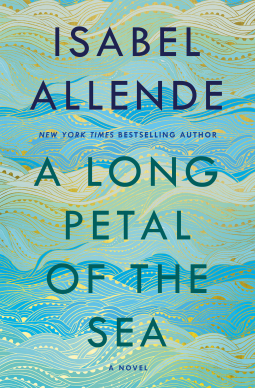
A Long Petal of the Sea, by Isabel Allende*****

Allende has long been one of the writers I admire most, one of the few novelists to gain permanent space on my bookshelves. Her stories are distinguished by her devotion to social justice issues, particularly in Latin America, and to feminism. She’s known in particular for her use of magical realism, which I confess makes me a little crazy when she imbeds it in her nonfiction titles, and also her wry, sometimes subtle humor. Much of what she writes is historical fiction, as it is here, and she is a stickler for accuracy. Her research is flawless. She has prestigious awards from all over the world. Literature teachers love her.

My thanks go to Net Galley and Random House Ballantine for the review copy. This book is for sale now.

In A Long Petal of the Sea, she takes on a particularly ambitious task, creating a fictional family and charting its course from Spain following the failure of the Spanish Revolution, to Chile, to other points in Latin America, and then back to Spain once more. There are a lot of characters to keep track of, with different threads for each that separate, then braid together again and so on. There are at least three generations here, but primarily the story is Roser’s.

It’s a well written story, though it is also the sort of literary fiction that takes a fair amount of stamina. If you’re in search of a beach read, this isn’t it. I confess I didn’t enjoy it as much as I often enjoy Allende’s work, but I also believe it’s unfair to judge an author solely by what they have already written. If this was the first book by this author that I had ever read, I would give it five stars, and so that is what I’ve done.

My one disappointment is that we don’t learn more about the Spanish Revolution and the Spanish Civil War. This is an event that’s very difficult to find in quality historical fiction and literary fiction, at least in English, and I was excited when I saw this book was based on it. Then by the 25% mark, we’re out of Spain and it leaves me sad, because I wanted to know more about that period and place.  I also missed the usual Allende humor, which she uses in other books to break up tense passages and shoot down sexist behavior in her characters; her last book, In the Midst of Winter, made me laugh out loud more than once. That humor is in short supply here. The feminist moxie, however, is in splendid form, and the class and internationalist perspectives that I treasure are alive and well.

A book should be judged on its own merits, and I’ve done that, but I want to add a shout out to an iconic writer who’s still publishing brilliant, ambitious books at the age of 78. My own goals for that age, should I be fortunate enough to see it: I’d like to be breathing; to be able to see and hear most of what’s around me; and I’d like to not be completely crazy. Publishing great literature? Perhaps not. I am delighted that Allende can do this, and I hope she has more stories in the works.

A note on the audio version: I supplemented my review copy with an audiobook I found at Seattle Bibliocommons. It’s an approachable way to get through a complex, multifaceted story, but I don’t like the way the reader voices the elderly male character. The harsh, guttural-sounding tones are too near to a stereotype. Happily, the story is mostly Roser’s, but the unfortunate noise pops in fairly regularly all the way through, and it makes for a less enjoyable listen. For those with the time and inclination for the print version, it may be your better choice.

For those that love epic historical fiction, I recommend this book to you, although if you haven’t read Allende, also consider some of her early work.

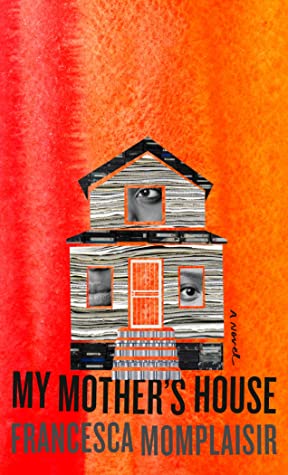
My Mother’s House, by Francesca Momplaisir***

The year seems to be riddled with novels that are brilliant conceptually, but whose execution falls short of its promise. Such is the case with My Mother’s House. My thanks go to Net Galley and Bloomsbury for the review copy.

The story is told in the third person omniscient, and the most interesting character by far is the house itself. The house has had it with its inhabitants, particularly with protagonist Lucien, a man that’s evil and demented from the top of his pointy head down to the toes of his nasty loafers. Think of the worst thing one human being can do to another, and whatever you’ve come up with, Lucien has done it.

Our rotten old man is an immigrant, a resident of a mostly Caribbean neighborhood in Queens, New York. He brought with him the wife—nearly a child-bride—that he had set his cap for early on, for she is a descendant of the Duvalier family that ruled Haiti ruthlessly for decades. Once he has married her and moved her, however, he abuses her in much the same way he does every other female in his life, including the daughters they have together.  

Do I need to tell you there are triggers all over this thing?

The house can’t take it anymore, all of the ugly within its walls. It decides that the only way to get rid of this bastard is to go down with him, and it sets itself ablaze.

One of the three stars is for this aspect of it, the animation of the house. This is where the story begins, with the house’s thoughts and actions, and I sigh contentedly, sure I am in possession of a great novel.

Alas, not so much.

I love a good horror story, but what makes such a story work is when there is an underdog to cheer for, or a victim to be rescued. This is part of Stephen King’s magic; not only does he provide visceral, original bad guys and monsters, but also some ordinary person that sees what is going on and tries to stop it. Whoever his good guy is, he develops the living heck out of them, and I feel as if I would know them on the street.

In contrast, Momplaisir gives me no possible good outcome; the only hope we have comes from the defeat and death of Lucien. That’s not enough to keep me turning the horrible pages of horrible deeds. I don’t just want to see the bad guy lose; I need a good character that might, against impossible odds, win.

Character development is also lacking. Although I learn about Lucien’s early life and the trauma that he’s endured, and which we know is often part of what warps a person, I never see him change internally. He is static all the way through, and since he’s the only important character, apart from the house, I feel cheated. His distinguishing characteristic is the need to count, because “I am nothing unless I count.” So all the way through, we hear him enumerating one thing after another, and to be honest, this device, though original, leaves me cold, and eventually it just becomes redundant. MAD Magazine—the original, from the 1960s and 1970s—would have had a field day here.

Unable to push myself all the way through the text, I seek out an audio book from Seattle Bibliocommons, and just to top all of it off, I dislike the reader intensely. The over-the-top dramatic voice would work in very small, shocking increments, but instead it is the main voice used, and by the end I just wanted to tell it to shut up. (Full disclosure: I actually did, not that anyone was there to hear it.)

In the end, I am left with a tremendously clever premise, a fantastic book cover, and then a whole lot of nothing.  How dare the publicist or whoever wrote the teaser compare this work to those of Tana French and Jesmyn Ward? For shame!

You can buy this book now, or you can take that same exact amount of money and burn it in the fireplace. Same thing, either way. Or you can do the smart thing, and go find another book by someone else.

Africaville, by Jeffrey Colvin****

Narrated by Robin Miles

My thanks go to Net Galley and HarperCollins for the review copy; after publication, I used an audio book to finish it, thanks to Seattle Bibliocommons. It’s available to the public now.

There are two reasons I was drawn to this story. The first is the setting, which is primarily in Nova Scotia’s Black community. I have never read or heard a story set there, and so I was intrigued. There’s also a Civil Rights Movement tie-in, and for me, that sealed the deal.

The book starts out as a rough read, involving dead babies and “bad luck” babies that weren’t dead but needed killing. I was so horrified that I had to restart the book several times to get past it. Now that I have, I can assure you that once you’re past the introduction, that’s it. The dead babies are done. I’m not sure I would have lead off with this aspect, because I’m probably not the only reader to pick the book up and put it down fast. In fact, had I not owed a review, I would not have returned to it. I’m glad I did.

The story itself is ambitious, covering three generations of a family there. At the outset we have Kath Ella, who has ambition, but also a mischievous streak. I find this character interesting, but there are times when I don’t understand her motivation. The story is told in the third person and not all of her thoughts are shared with us, and so there are times when I’m left scratching my head. When the end of the book arrives, I’m still wondering.

Kath’s son and grandson comprise the second and third parts of the story; apparently the term used back then for passing as Caucasian was called “crowing,” and we see some of that. There are too-brief passages involving the Civil Rights Movement against Jim Crow in the Southern U.S., and I am disappointed not to see more about this or have the characters involved more deeply. What I do see of it is the surface information that most readers will already know.

Toward the end there’s a subplot involving getting an elderly relative out of prison, and I like this aspect of it, in particular the dialogue with the old woman.

The setting is resonantly described throughout.

All told, this is a solid work and a fine debut. I look forward to seeing whatever else Colvin has to offer. As to format, although Miles does a lovely job reading, something of the triptych is necessarily lost when we don’t see the sections unfold. For those that can go either way, I recommend the print version.

The Girls at 17 Swann Street, by Yara Zgheib*****

Anna isn’t eating, and she’s so weak that she faints from time to time. Her husband, Matthias is afraid for her; this isn’t the life they envisioned when they moved from France to the States. She is admitted to a facility for women with eating disorders, and it is that address that gives the book its title. Big thanks go to Net Galley and St. Martin’s Press for the review copy, and my deepest apologies for being so late with my feedback.

I never would have expected to want to read a novel about an anorexic protagonist. In real life, Anna would have offered me her fries and her dessert, and I would have cheerfully accepted them. She in turn would inwardly shudder, my stocky grandma body providing her with a cautionary example of what happens to those that eat such things.

When I was a sweet young thing growing up in the 1970s, there were rumors that some of the girls at school kept their figures slender by throwing up after they’d eaten; a friend and I commiserated over our own lack of self-discipline. We had scarfed down our Halloween candy and not even considered ralphing it back up in the bathroom. Now we could barely fasten our jeans, while those classmates were smaller than we were.

We thought that some girls have all the luck.

It wasn’t until the death of singer Karen Carpenter that anorexia became well known, and even then, it took us awhile to clue in on the details. Because it’s about body image, and yet it isn’t. And Zgheib does a wonderful job of educating the reader using that approachable medium, fiction.

In Paris, Anna was a dancer. When she and Matthias married, she planned to go on dancing professionally, at least until they had children. But when he was presented with a prestigious promotion that required him to relocate to the United States, they packed their things; Anna had expected to continue her career in America, but she was never chosen.

The in-patient facility where she is treated has strict, clear rules about every aspect of daily life, and most of the privileges hinge around timely consumption of the food that’s provided. Anna’s struggle is profound, and her story is moving. Because it’s about food, but not really. She has buried a trauma involving the deaths of her brother and her mother, and she’s channeled her self-hatred into this eating disorder. We catch glimpses of this as she expertly dodges questions raised in therapy. One of the most moving moments, strangely, has to do with a bagel and cream cheese. She’s supposed to eat it, and she throws a pluperfect hissy. She never eats dairy, she says. She wants the vegan option! No dice, honey. But as time moves forward and this difficulty continues, she finally reveals that actually, this might have once been her favorite food. It was so delicious, and it took her such iron self-control to forget its taste. All that work, she thinks, and now it’s ruined. And she is genuinely shattered by this.

Only one sufferer in three recovers from anorexia.

Due to a backlog of galleys, I checked out the audio version of this book from Seattle Bibliocommons, and the voice actor that reads it is perfect.

Highly recommended.

The Janes, by Louisa Luna****+

 4 stars plus. Louisa Luna debuted in 2018 with the first book in this series, Two Girls Down. When I learned that Alice Vega was returning, I jumped on the galley without a moment’s hesitation. Thanks go to Doubleday and Net Galley for the review copy. This book becomes available to the public tomorrow, January 21, 2020.

Alice Vega is back home in Southern California, and she is hired as a consultant on a case for the local cops. Two dead girls have turned up, both recent immigrants with IUDs in their too-young bodies. All signs point to their having been victims of trafficking for purposes of sexual exploitation, yet there is no evidence of rape. What happened here, and where did the IUDs, which aren’t available in stores, come from? She is offered an astonishing amount of money for her services, and she decides to use some of it to hire her old partner, Max Caplan, who’s back on the Eastern seaboard entertaining job offers. When Vega crooks her little finger, Cap comes running.

Luna has a voice and style not like anyone else’s. One of the things that I love is the way she swaps the stereotypic gender roles of these two main characters. Cap is nurturing, and he loves kids. Vega isn’t a nurturer, and when huge stressors come down on her, she becomes angry and violent, but as a reader I love this because her rage is always spot on. Cap has sex when he’s in love, but Vega has sex to fulfill a biological need, and then wonders why the guy is still hanging around. Clean yourself up and get out of here, dude, I have things to do today. Run along. And while Vega’s vigilante justice would be a terrible thing in real life, in fiction it feels deeply satisfying.

In other words, Alice Vega makes my feminist heart sing.

Luna is better than most authors of the genre in that no matter how off the chain her protagonist is, I never disengage because of an unlikely plot element. We have corrupt cops; we have bureaucrats; we have secrets that would become public if Vega and Cap were prosecuted for crimes committed in the line of duty. My single twinge of regret comes when Cap sustains a head injury that renders him unconscious; wakes up dazed and confused, with some memory loss; and then shakes it off without tests or treatment of any kind. Vega reminds him to get an MRI when everything is over, but it doesn’t feel like enough. I wonder at times whether she meant to do more with it and then edited it back out.

Given that both stories, this one and the last, feature two female victims, I wonder if this will be her signature element throughout the series.

This story differs from the first in that it is darker, less funny, and ramps up to the high octane, pulse-pounding excitement of a true thriller at around 80%. The plot and characters are credible, but they lack the bounce and the zip that made the first book so memorable. Nevertheless, I love Alice Vega and eagerly await the next in the series.

Heartily recommended to those that love the genre and respect women.