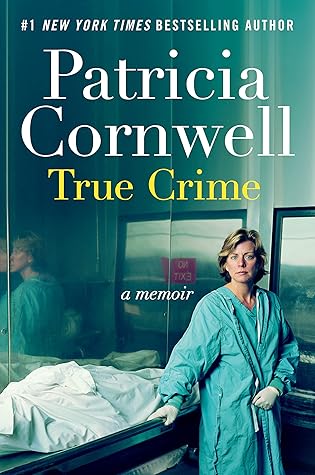
Legendary mystery writer Patricia Cornwell didn’t intend to write a memoir, but when someone decided to put her life’s story on television, she realized that if she didn’t write it, they’d make it up as they went. What began as a treatment for television writers to use as a guide morphed into a full-length book, and this is a perfect example of what an overachiever Cornwell has become.
My thanks go to NetGalley and Grand Central Publishing for the review copy. This book is for sale now.
Cornwell grew up in Miami, but moved with her mother to Montreat, North Carolina following her parents’ separation when she was five years old. It’s a miracle that anyone whose childhood was so riddled with trauma could grow up and pass for normal, let alone accomplish the things that she has done. First, her father had a breakdown, kidnapped her and her brothers, and then tried to hand them off—permanently—to his law partner. Her mother was a hot mess most of the time, and so there were periods when there was no food prepared, and she and her brothers made do by scrounging raw hamburger out of the freezer and eating it raw! Then there was the time her mom went into a fugue state and began systematically burning all of the children’s clothing—and there was no money to replace it with. Neglected children are often a lightning rod that attracts bad actors, and so the local security cop began molesting her—up until he was caught by her older brother, who put a stop to it. And the list goes on.
Nobody walks away from such experiences unscarred, but since Cornell—who was then Patsy Daniels—was a good kid, she internalized all of it, aided by a dreadful first grade teacher that told her that her constant talking in class was probably why her father had left! (As a teacher, this reviewer wants to find that person and have her license pulled, although she is probably gone from this earth by now.) Patsy gained control of her life—sort of—by developing eating disorders. She was hospitalized, but medical science actually didn’t know what to do about anorexia or bulimia, and after months in the institution with no improvement whatever, she gave up and went home. The problem vanished many years later when other aspects of her life changed.
Her love of writing and her feverish work ethic are what has made her such a success (along with great intelligence, though she doesn’t say as much.) She rode with cops and served as a volunteer in order to gain insights into that world; she went to Quantico and studied profiling; and of course, worked in the medical examiner’s office so that she could legitimately view autopsies, which are of course not open to the public. Anything she needed to learn, she found a way to do, leaving no stone unturned. She was aided and mentored by what seems to me an unlikely cast of friends and surrogate parents, including Senator Orin Hatch, Ruth and Billy Graham (mostly Ruth,) and President H.W. Bush.
The thing I appreciate about this memoir, apart from its outstanding prose and organization, is Cornwell’s willingness to disclose personal information. Sometimes, when someone is deeply private but finds herself writing a memoir anyway, she will stay on the surface and give up as little of herself as possible. Such memoirs are frustrating to read and for those that pay money for the privilege, a bit of a cheat. But once Cornwell decided to do this thing, she really did it right. And while, on the one hand, there’s a certain amount of namedropping and braggadocio, even that aspect of it is interesting; given everything she went through to arrive at the station she’s gained in life, one can hardly begrudge her.
For those that love her books, and also for those that simply enjoy a well written memoir, this book is highly recommended.