
Fragments of Isabella: A Memoir of Auschwitz, by Isabella Leitner****

fragmentsofisabellaIsabella Leitner was a Holocaust survivor, and she scribed her memoir using brief entries similar to a diary in format. The length is just 120 pages, about the size of a novella. I was asked to read and review this memoir free of charge before it was released digitally. Thanks go to Net Galley and Open Road Integrated Media for the invitation. This title was just released, so it is available now for purchase.

I confess I struggle with Holocaust memoirs these days. Part of me has decided not to read any more of them. I am out of the classroom, so my ability to educate young people of today about the horrors of the past is nearly at a standstill, apart from the knowledge I pass on to my grandchildren. Reading another Holocaust memoir isn’t going to make the ending any better; it’s always going to be horrifying, and heaven help me if I should become so accustomed to reading about the Holocaust that it doesn’t affect me that way anymore.

So though I swear off Holocaust memoirs from time to time (and am doing so right now, again), when a particular memoir is offered, frequently there is some aspect of this one that sets it apart from the crowd, and so it is with Isabella’s memories. Not many survivors managed to get out with family members at their side; Isabella and her sisters were unusually clever and imaginative in finding ways to survive. This along with the invitation induced me to roll up my sleeves and revisit this calamitous part of history once more.

When the notorious Mengele motioned with his deadly white glove to send Isabella and one of her sisters to the extermination side, they found a way to creep back around and intermingle with the side selected to be kept alive as workers. At one point they escaped and found an outstanding hiding place…but before they were identified as missing, the Germans began cooking potatoes, a luxury Isabella and her sisters could not resist, and they slunk out of their haystack and into the food line. There are a number of these instances, and I found the short chapters merciful, because I could only read this in small bits and pieces.

Most powerful of all, as far as I am concerned, is the clear, unmistakable truth that Germans knew, absolutely had to know, exactly what was going on around them. As their own lives improved materially, they chose to look the other way as skeletal work crews of Jewish and other prisoners were marched directly down the main streets of towns and villages on a daily basis:

“Germany was one giant concentration camp, with Jews marching the length and breadth of the country, but these refined, sensitive Germans never saw us. Find me a German who ever saw me. Find me one who ever harmed us.”

The memoir is of necessity harsh in its remembrance. The teaser for this story bills it as having been written for young adults, but the background material required to understand some of what is said requires a good deal of pre-teaching.  In other words, if a teacher or home-school supervisor has run out of social studies time and is looking for a shortcut to make up for teaching about the Holocaust, this isn’t it. Frankly, this reviewer and teacher wonders how a full unit regarding the Holocaust could be lower on the chain of important social studies curriculum than anything else, apart from possibly the Bill of Rights (for US students). But if one is determined to substitute one memoir for a longer unit that gives more information, use Elie Wiesel’s Night, which stands on its own.

Finally, any teacher or prospective reader needs to consider exactly how searing this material is, and all the more so to the young mind; to Jewish readers; to anyone with triggers.

I should also mention that a bisexual guard at Auschwitz, a woman that was interested sexually in one of the prisoners, is referred to as “aberrant”, not for being a guard at such a place, but for her sexual orientation.

Do I recommend this memoir to you? Those that are studying the Holocaust should read it; the fact that it’s written by a survivor makes it a primary document. But those that are looking for an engaging, enjoyable slice of history should look elsewhere. There are no light moments, no surprisingly kindly individuals that go out of their way to help. It’s a cold, hard story, and the only joy is provided up front when we learn that she gets out alive and not alone, as so many Holocaust survivors found themselves.

It’s a hard, hard lesson, but given that revisionists are diligently trying to deny that the Holocaust actually occurred, attempting to rake over the evidence as if it were not nearly as serious as we may believe, it also has a great deal of value.

Because Isabella was there.

Chancers: Addiction, Prison, Recovery, Love: One Couple’s Memoir, by Susan Stellin and Graham Macindoe****

ChancersI decided to read and review this title because I anticipated that it would be, by and large, a depiction and critique of the American prison system and Homeland Security. As it happens, that is really only a small part of this memoir, which focuses more on the couple’s relationship and the way that addiction warps and undermines trust and affection. Nevertheless, I found it really compelling, and so thank you Net Galley and Random House Ballantine for the opportunity to read and review free and ahead of the public in exchange for this honest review. The memoir will be available to the public June 7, 2016.
Susan met Graham at a beach getaway where they were two of the people sharing a large house over the course of a vacation. Later, when she needed an author photo done for a book she had written, she remembered that he was a photographer that had worked for the Guardian, and she called him to see if he was interested.
That’s when everything began.
The memoir was originally going to be Susan’s alone, but eventually it occurred to her that Graham could contribute a lot in sharing his experiences with addiction and the point of view from which he saw the world when he was in that condition.
Imagine using heroin because it is easier to hide than alcoholism. From the frying pan into the fire! And hide it he did through the first stages of their relationship. He did romance like nobody’s business and she tried to remain objective, but there’s nothing all that objective about falling in love. And so although he made some highly questionable decisions, it took her awhile to find out about the heroin, which he had told her was behind him. But the heroin wasn’t behind him, and neither was the crack. And before she knows it, she is drawn partially down his rabbit hole while keeping one foot in that of mainstream journalism. It’s a strange place to be.
This reviewer has never minced words about my dislike for cops in general and the punitive, demoralizing, racist, class-based system that is the so-called American Justice System; yet Macindoe didn’t earn much sympathy from me. His narrative is in turns puling, angry with no justification, whiny and full of self pity, up until the end when he has finally shucked the monkey from his back as he reaches his golden years.
Macindoe had climbed from his early impoverished years as a child of a Scottish miner to the middle class world of photo-journalism. He was in the USA by preference and because his son from an earlier marriage was here; thus it was hard to feel the kind of solidarity with him that automatically comes to me regarding Third World citizens that are in the US as the only means by which they can feed their families. He owned a brownstone in New York City and had published photos internationally, garnering praise and a certain level of renown. And so…seriously? Heroin?
It was Stellin that kept me turning the pages. Every time she decided to step back from the relationship I wanted to yank her into the nearest lady’s room and tell her one woman to another to lose this guy entirely. Even her former husband, now in a gay relationship, advised her to “cut bait”. And every time she decided she could offer him some assistance even though they were no longer romantically involved, every time she wondered what their relationship could be like if only he were off the smack, I wanted to howl. After all, the relationship might be interesting if one of them grew a second head or a third eye in the middle of the forehead, but what were the chances?
“Chancers” turns out to be a Scottish expression, and I will leave the reader to find out what it means.
I found this story had an addictive quality of its own, a romantic drama not unlike the soap operas that were the only adult voices I heard most days when I was a stay-at-home mother in the 1980’s. Graham was full of shit, I figured, but I still had to know what happened next.
In the course of hearing Susan and Graham’s story, I did learn a number of things about Homeland Security that I had not known before. Imagine feeling nostalgic for Riker’s Island because it was so much more compassionate than the one for potential deportees!
And so I have to say this is a good read, an ideal book to take on vacation and flop on the beach with; just don’t get so absorbed that you scorch your tender skin, because it’s mighty distracting regardless of what is happening around you.
Fascinating and recommended to those that like compelling memoirs or are interested in addiction issues and the US penal system.

Run, Don’t Walk: The Curious and Chaotic Life of a Physical Therapist Inside Walter Reed Army Medical Center, by Adele Levine*****

RundontwalkI loved this memoir. I read it in 2014 through the Goodreads First Reads program when I first began writing reviews, a few months before I began my blog. This is a memoir intended for general audiences, disarmingly funny and engaging. I recommend it to everyone.
I’ve been through physical therapy for things like whiplash from car accidents–yes, some folks really do get whiplash–but nothing like the scale experienced by the veterans and soldiers that Levine treats. And so the first sign of expertise is in the title, where she wisely excluded any reference to amputations.
Ask yourself: is there a tasteful way to laugh about amputations and amputees, as well as the people who work with and visit them?

Amazingly, there is. She’s found it.

And at first I could not accept that this was Levine’s first book, because the amount of synthesis and development of characters is not in any way rookie writing, and I don’t care how brilliant the writer might be. The blurb says “experienced writer”. Everything clicked into place when I noted that she had been writing a weekly humor column for a local news source.

I didn’t set out to learn anything here–it’s not as if I am considering becoming a PT. And as stated, this should not be viewed as a niche book just for medical folk or military types, but for the general book-loving public. It would even make a good beach read.

But I learned some things, nevertheless. I didn’t know that anyone who loses both legs ever has a shot at walking on two prostheses, for example; and indeed, some don’t, but the possibility is strong. I didn’t know some prostheses have computers. And I groaned at the obstacles put in place by the fishbowl environment where she worked: deliberately limited computer access so that anyone, celebrities, congressional staff, or John Q. Public, will see the therapists ONLY working with patients, and then therapists have to stay after work in order to enter notes about progress registered, because people who come to see the circus don’t want to see more than two people using a computer at a time. The banning of coffee for the same reason; nobody wants to see your cup! And I loved reading about the guerilla response to said ban.

Levine uses either real people with changed names, or patients and colleagues that are an amalgamation of more than one person. Characters Cosmo and Major Dumont were favorites of mine. And I loved the Jim-quote and how it is used at a party full of insufferable assholes that think that they are really something because they went to Walter Reed and WATCHED the patients and therapists for awhile. The punch line is awesome, and I won’t ruin it by telling it here.
And I really loved the Miracle reference.

I was on my third day with this book when someone in my family died. It was a total fluke, someone younger than me whose time should not have been up yet, and it hit all of us in the solar plexus. The writer’s chapter on the bone marrow transplant proved really cathartic. It wasn’t written for that purpose; I just had the right book at the right time, and so I sat with the book in my hand and cried awhile. Thanks; I needed that.

Sometimes I recommend getting a book free or cheap, but this one is worth the jacket price. Funny, absorbing, and informative.

The Autobiography of Mark Twain, Volume 3, by Mark Twain****

autobiomarktwainv3Huge thanks go to Net Galley and University of California Press, who provided me with a DRC in exchange for an honest review. It has taken me some time to read and rate it because once I had the DRC for Volume 3, I decided I should hunt down volumes 1 and 2 and read those first. Now I am finally finished, and it was well worth the effort.
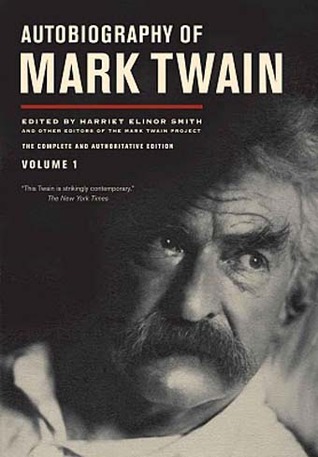
First let’s talk about the obvious thing: how dare I rate Twain four stars rather than five?  I considered the matter and reflected that if Twain himself were to rate it, he might say the same. The reason is that, as he plainly states more than once in his narrative, he is writing not for posterity, but for bulk. An unfair copyright law that was present at the time he began his autobiography permitted a copyright to stand for only 42 years, after which the work entered the public domain. Twain hired a lobbyist to attempt to gain an amendment offering the author the option to renew the copyright, and ultimately he won. But when he started the autobiography, his plan was to write 500,000 words and then republish each of his books with a portion of the autobiography attached so that it could be called a new work and thereby merit a brand new copyright. Twain’s wealth had been considerably depleted by dishonest people in his employ, not once but three times. He had made a fortune, but much of it was gone, partially due to an unscrupulous publishing agent and then later to two household employees he regarded as close to him as family. The double blow of losing so much money and learning of the duplicity of people he had loved and thought loved him was a bitter pill indeed.

So the book contains filler, and this he unabashedly admits. And at times I had found myself wondering why he included all of the letters he had received from cute children he had met onboard a ship, but until I found the bald statement that he needed 500,000 words, I had attributed it to his eccentricity. No, not so much. There is gold in this memoir, and if you like Twain, or history, or both, you should buy it and read it. He says things nobody else has said, and so even once you realize you have entered into a portion of the memoir that is just plain filler and you skim till that section ends, the next things you read will be worth your time and money.

I promise.

Twain stipulated that the autobiography in its entirety must not be published until he had been dead 100 years. He did this because if he wanted to say someone was a rotten scoundrel and then give details that might well draw a lawsuit, he could go ahead and say it; he also said he didn’t want to hurt the feelings of said people’s children or grandchildren. I’d say he succeeded. Some of those he consigns to the flames are individuals contemporary readers won’t recognize. However, he hated President Theodore Roosevelt with a fiery passion, and he doesn’t mince words where he is concerned.

Most of the memoir is not angry in tone, however; there are places where I laughed out loud. The way he talks about Carnegie, who mentally catalogued every compliment ever paid him and then went through the entire litany when one visited, adding new ones but never removing or abbreviating the old ones, just cracked me up.

Most of all, I loved his explanation of the privileges conferred upon us by old age, one of which was the right to pitch a fit if one felt like it:

“But indeed the older you grow, the less secure becomes the furniture. When I throw chairs through the window I have a sufficient reason to back it. But you–you are but a creature of passion.”

Toward the end  I wanted to sit down and cry with him. He lived a long life, but the outcome was that he outlived three of his four children—a little boy that died shortly after birth, as well as two of his three daughters—and also his lovely wife, whom he adored, and his best friends. The autobiography was to provide support for the two daughters that he feared would not see a nickel from his earlier works because of the copyright laws.

Then two things happened almost simultaneously: the law was changed, with the amendment he had fought for added so that his copyrights could be extended; and the daughter that still needed his financial support, a woman that had spent much of her life in an institution because of epilepsy but now had medication that made it possible for her to be at home with a private nurse, died in the night.

It was right before Christmas, and she had been planning a surprise for her father, a Christmas tree decorated in an unusual, very artistic and tasteful manner, as he discovered when he entered her private sanctuary after her death. There were over fifty Christmas gifts there in various stages of wrap, many of them for people Twain says he would not have even thought of shopping for, and so he just sits in that room with his memoir, and he sobs. His other daughter, Clara, has married an affluent man and is very happily married; she won’t need his money. And now Jean is gone. Twain records the fact that the purpose the autobiography was to serve no longer exists…and he stops writing.

It’s enough to break your heart.

And so it ends, but it is an epic work.

For those planning to get this memoir, I give two crucial bits of advice: first, look at the title of the book carefully. Make sure it is this exact title. If it’s turned around—if for example the title becomes “Mark Twain’s Autobiography”—that’s not the one you want; it’s a knock-off and it’s not really even readable. It’s cheaper, but it is a false economy. The Twain Project took painstaking care in sorting and assembling what amounted to two whole file drawers full (or ten feet of files) of Twain material, some of it duplicated, some of it in his own handwriting, and some of it dictated, then typed by someone else. It was a huge job, and UC did it right.

The second bit of advice is not to worry too much about reading volume 2, or if you do, purchase the book that includes volumes 1 and 2 together. For some reason, even after all the effort that was expended into the organization of this hefty memoir, there is some duplication that renders most of volume 2 the same as portions of volume 1. Maybe it was Twain’s intention to duplicate it and so the Twain Project did so to honor his wishes; I can’t say. But everything you need in order to read this memoir in its entirety can be found in volumes 1 and 3.

Even with the filler, it is amazing work, and I highly recommend it to those that love Twain; those that love history; and those that love great memoirs.

Autobiography of Mark Twain, Volume I, by Mark Twain*****

automarktwainoneInitially I was surprised not to have seen the autobiography of such a famous individual before. Twain, I learned at the outset, composed his memoir with the stipulation that it not be published until 100 years following his death, because he wanted to be entirely frank about some situations and persons without incurring the displeasure of them, their children, or their grandchildren. Twain died in 1910, and his memoir had been finished just four months. For those of us living now, it was worth the wait. Although I was fortunate enough to snare the DRC for volume 3, I had to go out and hunt down volumes 1 and 2. It’s well worth obtaining and reading for those with the attention span and literacy skills it requires.

There is a lot of material here, and you may be tempted to sample bits here and there using the table of contents. I strongly advise against it. Some of Twain’s most brilliant writing regards things you would not expect to care about. The dispute with a landlord in Italy as his wife lay dying in the villa has the full intensity, concentration, and fire he has to offer. Although I will never know for sure, I suspect that Twain was one of those rare individuals who became even more savagely articulate when angry. The heat of his rage is tremendous and oh so eloquent.

A lot of this writing is gut-bustingly funny, but some of it is also really subtle, and if you rush, you may miss it. I enjoyed reading what he thought of Jay Gould and John Rockefeller; of President Theodore Roosevelt; and of Satan, for whom he confesses that he feels a tremendous sympathy. In other passages he becomes poignant, particularly in speaking of the deaths of his wife and daughter. Nobody but Twain could say it just like this.

Should the reader ignore my advice and choose to jump around, thus missing occasional references to things mentioned earlier in the text, at least do this: be sure to read his remarks about dueling.

The memoir is not linear. He tried several times to sit down and write his life end-to-end, and destroyed some drafts; others he merely abandoned, and they made the assembly of the autobiography, most of which he dictated, all the more complicated as a result. The University of California has done a splendid job of isolating the random repetitious bits at the back of the book in an appendix, while putting the rest of it together in a way that while not linear, makes sense. There are a few interesting photos at the end as well.

Those engaged in the teaching of college level creative writing, of simile, metaphor and other figurative language may indeed want to read this magnificent memoir and pluck some favorite passages for use as examples.

Twain’s life story is not for those with limited focus or who need immediate gratification with minimal effort. This volume, all 738 pages apart from the appendix, kept me company at bedtime when everyone else in our home had the lights turned out and I was the only one still awake. In those small quiet hours I studied the prose of the master, and occasionally had to leave the bedroom in order to laugh out loud, lest I wake my spouse. I would be sorry to have finished, but volumes 2 and 3 still await my attention.

For those that love the English language, and for those with an eye for history, this memoir is not to be missed!

A Thousand Naked Strangers: A Paramedic’s Wild Ride to the Edge and Back by Kevin Hazzard *****

AthousandnakedstrangersTake a former journalist; make him a paramedic in a high-poverty, high-danger area for a decade; then turn him loose again to write about it, and he will play his readers like violins and make us like it. A Thousand Naked Strangers is a high octane, gloriously visceral ride in an ambulance and out of one, through Southeast Atlanta, Georgia. Thank you to Net Galley and to Scribner for the DRC. Since I read multiple galleys at a time and I loved this one best, I tried to feed it to myself in small nibbles, like Mary Ingalls hoarding her Christmas candy, but it was just too riveting and I could not stay away.

At the memoir’s beginning, our guy is just looking for work. With just a few months of training, he can become an EMT. His journalistic career wasn’t working out as he had expected, and he found himself working as a paperboy instead, delivering the newspaper for which he had written. That’s about as rock bottom as it gets.

He becomes an EMT; then he sets out to discover whether he wants to commit to the extra year and a half of schooling required become a medic. Once in, he’s hooked, not so much in spite of the risk and unpredictability of the job, but because of it.

And when you think about it, what other job pays so very little, involves so much danger, and gets so little respect? Teaching comes to mind, but being a rescue worker trumps even that, particularly for the low pay and insane hours–holidays missed–to do it, a person needs to be young, and to be an adrenaline junkie. And for a decade, Hazzard fits that description.

When he starts out, he is callous, as youth often are, speculating with his partner about what constitutes the perfect call. The perfect call, to their way of thinking, has requirements that are measured in the number of dead and wounded, the amount of danger. Does the patient have to survive in order for it to be a perfect call? Nah.

Over the years he matures, and he becomes more respectful of the patients with whom he deals. He talks to addicts, hookers, and children in a way that is forthright and kind. The job takes a lot out of him, but it also gives him a lot. He grows up. He deals with the dead; the nearly dead; those that are feigning death; and those that are just looking for a free ride somewhere. He delivers babies in record numbers, and he transports a guy on a roof down to the ambulance. He sees just about everything, from suicides to homicides, from the domestically abused, to the kid with a roach in her ear. He plays the wildest imaginable pranks, and once in awhile he gets called on the carpet for it.

Some of the incidents described in this memoir are just drop-dead funny, if you’ll pardon the pun, and I laughed out loud more than once. Some are incredibly dark. Some just left me with a feeling of awe. But although the tone changes many times, the pacing is absolutely consistent. Hazzard’s journalistic background shows; every single word is there for a reason. It is tight, taut, and urgently compelling, all the way through.

So it’s entertaining, but it’s also educational. I didn’t know the distinction between an EMT and a paramedic before I read this memoir. I also didn’t know that not a holiday goes by without someone having a heart attack. I didn’t know that just about everyone, regardless of their level of intoxication, says they’ve had two drinks. And I didn’t know about the tension between paramedics and firefighters, between paramedics and cops.

There’s more, but you can’t have it all in this nifty review; I’ve given you enough to move forward. If you want your own job to look easier, get this memoir. If you’re retired and have a little more time to read now, get this memoir. If you are staying home with little kids and wonder when you should call an ambulance and when you should deal with your own mess, get this memoir. And if you are considering going into the field yourself? Get this memoir!

It’s for sale January 5, 2016, but you can order it right this minute.

Bonnet Strings: An Amish Woman’s Ties to Two Worlds, by Saloma Miller Furlong*****

bonnetstringsA few years ago I read and reviewed this author’s first memoir, Why I Left the Amish. Her reasons were compelling, some of them inherent in the Amish tradition, others probably atypical of most Amish families, but all together they provided a powerful impetus, that little voice inside all but the dullest that cries out, “Man the life boats! Save yourself!” I understood, having read it, why Furlong would choose to bail, but I was left with other questions, mostly regarding a gap between the end of the book and the author’s biographical blurb. Happily, I heard from her a couple of months ago; she had written a sequel, and this is it. She volunteered kindly to send it in my direction for a chance to read and review, and it is just as riveting as the first.

The first volume dealt with the horrifying domestic abuse within her family, and the failure of the church to deal with it. Furlong wondered whether she might have remained Amish had she not dreaded her home life, or at least many aspects of it, so tremendously.

It also dealt with her independent nature and intellectual curiosity (my own terms, not hers). Why would the Amish so persistently seek to stamp out the desire of some of its own members to seek higher education, I had to wonder. Would they not want Amish nurses, professors, plumbers, electricians?

The e-mail I received from the author mentioned a PBS miniseries in which she was featured, The Amish followed by The Amish: Shunned. Once I finished reading Bonnet Strings, I decided to hold my review until I could view these productions, some four hours all told. Between what she tells us in this second memoir and what is said in the miniseries, I understand. Not that I know what it is like to be Amish; far from it. But I see now why they set such strict parameters in order to preserve their culture.

The metaphor the Amish use for the individual is that of a grain of wheat. The church is a loaf of bread, and one person can’t be in that loaf without crushing out their individual needs and desires. I have heard of other cultures abroad that take this approach—the Chinese come to mind—but for a quarter million such people to be here in the USA with its John Wayne culture of independence is remarkable indeed, and it is clear to me now that to permit its members to put even one toe into the world of freedom, independence, and yes, greater risk, is to invite its youth to leave and not return. But ninety percent of Amish children grow up to be Amish. They stay Amish. And I really think the twin practices of shunning those—even one’s own children or yikes, parents!—when they leave, combined with the standing offer of reconciliation upon return, is the powerful engine that sucks many of those that have departed back into the fold.

Furlong has been independent and living in Burlington, Vermont, has built new friendships and has a serious boyfriend, but she goes back to the Amish when they come for her. She recounts how it is almost as if a mental switch has been thrown, and she suddenly no longer feels she has a choice. Until I watched the documentaries to accompany the poignant and visceral material in her memoir, I thought this was crazy. But the combination of religion, family, and the fact that there is another language, that old German dialect spoken only by the Amish, weaves a powerful spell. It is as if a voice says, “We know you in a way no one else can.” Saloma goes back to live in her old home town once. Others go back multiple times before they are able to tear away. Actually, our author made a pretty good job of it compared to others that tear themselves away, and in the end is happier that she has returned once in order to put to rest her own doubts, her own questions about whether, once out of her father’s home, she could become a successful Amish woman.

Her memoir is punctuated with memories scribed by her husband, David Furlong, who was a part of her journey out into the world. He provides a different perspective, perhaps closer to what the reader might have seen.

In reading the memoir, it occurred to me that the practice of shunning creates selective breeding. If those that become independent are allowed to return to the community at will and be welcomed, allowed to mix and mingle, then before you know it, they would intermarry. And though science has still not teased apart the mystery of which qualities in us are inbred, and which are the result of how we are raised, the stunning level of passivity among those that remain in the community is remarkable. And it is those truly passive folk that have babies, babies, and more babies. I suspect that this is how they have managed to not only not die out, as those of us on the outside would have anticipated, but thrive and grow.

With a thoughtful memoir such as Bonnet Strings, I like to read the foreword and introduction, read the book, then go back and reread both of them again. The producer of the documentaries wrote the foreword, and she mentioned that Saloma has taken the time—some thirty years–to let her experiences gel. The memoir, therefore, is not written for a therapeutic purpose, but rather to provide an account, both of the strengths and tenacity within the Amish culture, and of the resilience required of those that simply cannot find a place within it.

Because there is no middle ground. There probably never will be.

This articulate, engaging memoir is available for purchase right now. This is a great way to spend your own holiday weekend, and it would also make a terrific gift. Fascinating!

Liar, by Rob Roberge*

liarApologies, dear reader; I hate having to pan a book. I only request galleys that I believe will be either good or great, but when I inadvertently find myself with a terrible book, I have to call it as I see it. I have another review about ready to post that will occupy this space soon.

I received this DRC free of charge from Crown Books and Net Galley in exchange for an honest review. To be honest, it is the second-worst galley I have ever read. (The very worst lacked punctuation and was unreadable.) I wondered how a book like this wound up with such a reputable publisher; an internet search tells me that he has written other books that were well received. But I can’t find any redeeming value here. I actually came out of it feeling as if I’d been played, and I read it free.

This memoir is billed as a testament of sorts to the writer’s mental illness. I have a relative who struggles with bipolar disorder, and I like the idea of educating the public and of advocating for greater support and funding for those struggling with mental illness and also addiction issues, which are another key part of this book (If it can be said to have parts at all). The two often go hand-in-hand, the mentally ill using alcohol and/or street drugs to self-medicate. So I was on board when I began reading. But soon, I found excuses to read other DRC’s instead. Today, I made myself finish this thing so I could write the review and move on.

Liar isn’t even really a memoir. Let’s start with the title; some of what is in the book is true, some of it is invented, and we don’t get to know which is which. As if that weren’t bad enough, random dark matters (the death of the last passenger pigeon is one) are dropped into the text in no particular order. In fact, the text itself is not linear. This is clearly intentional, with things that happened (or didn’t happen) from 1977 dropped in between what happened (or not) in 1995, or 1982, etc. to let us see how confused is the mind of the mentally ill individual. The whole book is a mishmash of horrors that may or may not have transpired, just as the stricken person’s mind may not always be able to discern the real from the imagined. But for that, we hardly need a whole book; one short chapter would do the trick. I wanted to believe it would prove to be an artistic and if hard to read, avante garde approach to bipolar disorder; by the end, my head hurt and I was pissed.

How can anyone charge money for this?

Part of the reason I wanted to read Roberge’s galley is because it is billed as “blackly comic and brutally frank”, but it isn’t comic, and it isn’t frank. I found two (very, very darkly) humorous moments roughly between the 15% and 20% mark and thought maybe this was where the story would get rolling. Not so much. Nothing else—and I mean nothing else—was amusing. If it had been billed more accurately as merely dark and brutal, I would not have gone anywhere near it, nor do I recommend it to you. If it were at least entirely truthful, however disorienting and disjointed its telling, I could say it shines a light on the mental health crisis in the U.S., but since some of it is just tossed in for the hell of it and didn’t occur, I can’t even, in good conscience, recommend it to those researching bipolar disorder. How could a researcher cite this book in an academic publication?

The only positive thing I can say about this shipwreck of a book, apart from its accurate punctuation, is that no matter how bad your own life looks right now, it probably looks better than this.

My Life on the Road, by Gloria Steinem*****


mylifeontheroadI’ve been thinking a lot about Steinem since the recent unfortunate episode on a TV talk show. I was heartsick. What woman gets past 80 without a single regrettable senior moment? But most of us will be fortunate enough to have a spouse, partner, adult child, or other companion who will take us aside and suggest we rethink what we’re doing or saying. “Mom, I’m getting a little worried. Can we check your meds? What do you think?”
But Steinem doesn’t have that sort of support system. The women that were closest to her for a long, long time are already dead.

So I republish this blog post asking you to think, not about the single magic moment, for which she later apologized, but instead, for all the amazing accomplishments and selfless deeds she has done on behalf of women, and for her willingness in a time when most of white America kept to itself, to learn at the feet of women of color.

Because this is her legacy; her real one.

Feminist heroes are everywhere, but if I had to name half a dozen women that were at the core of the feminist movement that followed closely on the heels of the Civil Rights movement and the movement to end the US war in Vietnam, Steinem’s name would be among them. In fact, hers might be the first name out of my mouth. It was she who coined the salutation “Ms”, and who founded Ms. Magazine. When I saw she had written a memoir, I knew I had to have it, and when Net Galley and Random House gave me the DRC, I was delighted. But this is one of the few books that if I’d had to, I’d have been willing to pay full jacket price in order to read. Heroes are thin on the ground these days, and we treasure those that still walk among us.

My reading records reflect over 300 biographies, autobiographies, and memoirs I’ve read, and I didn’t even start listing them until about 3 years ago, so who knows how many? The one thing I know to expect, when someone really famous sits down to tell us about her life, is that the ego will be there. It might be veiled, especially if the person is famous for writing as opposed to something else, or it might be big and bold. Once in awhile it’s been so bald-faced that I came away wishing I hadn’t read the book so I could go on liking the author. So for one of the most famous of living feminists, I was braced and ready.

And this icon’s ego isn’t there. I don’t mean she hides it well; I just don’t find it. And it appears as if large amounts of time spent among Native sisters in struggle—Wilma Mankiller foremost among them—taught her so much about focusing on the circle, rather than a table that has someone at its head, a big-boss type, that she let go of whatever ego she might have been thinking about building. For example, when she works as an organizer, she dreads public speaking, but looks forward to the place at which one part of the auditorium begins to answer the questions from another part, and she knows a circle has formed, one in which she becomes just another person present. I was blown away!

Steinem began her career in journalism, and she is one of the finest writers whose work I have read. For a brief time in years gone by, I dismissed her because of her sometimes-attachment to Democratic party candidates, but the sum of her contributions has been so much more that I missed the forest for the trees during that time of my life. Now I want to read everything she ever wrote.

Travel is a great metaphor, but it’s also a material fact for Steinem. She grew up with a father who was a traveling salesman, and unlike most such men, he took his family with him. For most of her childhood, there was no home, merely a series of stop-overs. This rootless existence would leave some children traumatized. Kids thrive on routine, and not all would be able to translate constant travel into a sense of the usual. But Steinem mostly remembers it as a positive attribute, and credits her parents for their capacity to question social norms during a time most Americans were madly conforming. The fact that she continued to live out of a suitcase once she was grown and on her own is the greatest testament of all to her upbringing, and to her response to it.

There are oh, so many stories, some of which made me laugh out loud, and others that made me think. You can go winnow those out for yourself. And of course, my favorites may not be yours.

But the one thing I can promise you is a really great read, one with depth, yet not difficult to access. It’s friendly and feels as if we are having coffee with an old, dear friend, right at the table with one another. A circular table.

You have to read this book. It will be for sale October 27.

Live From Death Row, by Mumia Abu-Jamal*****

livefromdeathrowMumia is a former Black Panther. The facts support his having been framed in the murder of the cop, a crime for which he was nearly executed.

Live from Death Row, written before his sentence was commuted, is not, however, a vehicle he uses to advocate for himself or plead his own case to the public. He has written other books I haven’t read, and I don’t know if he did that there.

Instead, here he uses his own situation to discuss the racism inherent both in the U.S. court system; he also talks about racism on death row.

The mandatory fresh-air time, prized and treasured by men who rarely see the clear blue sky, is an Apartheid one, at least in Supermax, RHU,SMU, and SHU (ultimate maximum security prisons, which he says have swelled since jailhouse overcrowding has made prisons tenser places and more people are tossed into “the hole”). The vast majority of prisoners are Black, though they are a minority of the population at large, and in the Pennsylvania prison he describes, 80% of those maximum security cases, those who wear Black skin, are crowded into a courtyard. They can’t see green grass or the outdoors, only four brick walls and way up there, blue sky. Why? And where are the other prisoners going?

The other prisoners (who are also maximum security) who are not Black have a SEPARATE courtyard, which is surrounded by chain=link fencing with razor-wire, but has the view. The 20% have the perk of a much less crowded space and the capacity to see Mother Earth during their treasured time outside prison walls.

As to the racist system that places Blacks on death row at such a startlingly high rate, he offers the following statistics and footnotes all of them like the scholar he was before being incarcerated, and continues to be behind prison walls. He uses a Georgia case because it is one which caused the Supreme Court to recognize the following facts:

*defendants charged w killing Caucasian victims are 4.3 times as likely to be sent to death row as those charged w/killing Blacks;

*the race of the victim determines whether or not a death penalty is returned;

*nearly 6 of 11 defendants who received the death penalty for killing Caucasians would not have received the death penalty if their victims had been Black;

*20 of every 34 defendants sentenced to death would not have been given the death sentence if their victims had not been Caucasian.

He continues to pound one damning fact upon another, and cites court cases to back them up; those above come from McClesky vs. Kemp (1987). If the case sounds old, I would argue that precedents are set by very old cases indeed, and of course, this book was published early into the 2000 decade. I doubt a more recent gathering of data would return more favorable information; in the case of jail overcrowding, I suspect the recession has made it worse.

A person would have to be hiding under a rock or in a coma not to be aware of the level of violence visited upon African-Americans by cops and vigilantes within the past year.

I applaud Mumia for using his well-known case to set the facts before us, rather than trying to build momentum to save himself. There was a considerable amount of public pressure NOT to execute him, and I do think that had to do with his sentence being commuted; as it was, my kids’ urban U.S. high school was “barely holding together”, according to a counselor I knew there, the day that Mumia’s case was turned away by the U.S. Supreme Court.

If you are interested in reading about social justice issues, this relatively slender volume holds an astounding amount of really critical information. I appreciate Mumia’s relentless effort to make the public, both in the US and internationally, aware of the atrocities that continue to visit Black prisoners in the USA, and it’s more relevant now than ever!