
Immunity: How Elie Metchnikoff Changed the Course of Modern Medicine, by Luba Vikhanski***-*****

immunityElie Metchnikoff is credited with several medical discoveries, some of which were found before Mother Russia was entirely ready to receive them. This interesting though technically challenging text is the story of his life, and especially of his scientific career and achievements. Thank you Net Galley and Chicago Review Press for the DRC, which I received in exchange for an honest review. This title will be available to the public April 1, 2016.

In the latter half of the nineteenth century, Russia still had a tsar—a royal ruler with power similar to that of an emperor—and it still had serfs, who legally could not leave the plots of land assigned to them to farm for the benefit of royal landowners. It was not an ideal climate for science or any other aspect of enlightened thinking, but Metchnikoff was not only gifted, he was immeasurably stubborn, and by such methods as posing as a college student in order to sneak into lectures, he achieved an excellent education and began to pave new inroads toward discovering how the human immune system works.

His theory that cells in the human body swarm around and dispose of microbes that enter the body in order to kill germs was true, but proving it to those with authority in Russia was not an easy thing to do. Only recently had germs been discovered to cause disease; not so long before, it was assumed that God smote certain people or their loved ones in retribution for their bad behavior or thoughts. Being a scientist in such a place was challenging, and eventually, after being snubbed repeatedly by the German academics he sought to win over, Metchnikoff found his way to Paris, and the Pasteur Institute, where he would spend the bulk of his career.

His refusal to participate in elitist cliques that feasted on 8 course gourmet meals while half of London starved warmed my heart, as did his refusal to be roped into other social pretensions. Really, in another time and place, this would be my kind of guy.

Here I must disclose the fact that the sciences are not my forte. Only since retirement from teaching in the humanities have I found the time and confidence to explore memoirs of famous scientists. Last autumn I read and reviewed the biography of Dr. Bennet Omalu, the man that discovered a brain disease that was the result of repeated blows to the head consistent with American football. Cheered by my success in understanding and reviewing that fascinating story, I decided to tackle this one…with less satisfactory results.

I have never been good at understanding science. It’s that simple.

So if science and in particular the history of immunology or disease is your wheelhouse, this may be a four or five star read for you. But although I am not scientifically minded, I do have a sturdier education than the average American, and so I think I’m being fair in saying that the average reader-on-the-street that picks this up due to general interest rather than exceptional training may find it to be a great deal of work.

I did check the endnotes; I always do. So unless the author has simply invented a lot of sources in other languages than English—which seems very unlikely indeed—then I can safely say that this author has relied primarily on sources that the average English-speaking reader will not be able to tap into. Strong documentation from a wide variety of sources.

Recommended to those with a higher than average facility for matters of science, and for those interested enough to wrestle with challenging material.

Tears in the Grass, by Lynda Archer***

tearsinthegrassTears in the Grass marks the debut of novelist Lynda Archer. It tells the story of three generations of Cree women, and in doing so also provides the reader with that tribe’s rich history and culture. Thank you to Net Galley and Dundurn for the DRC, which I received in exchange for an honest review. This book is available for purchase now.

Elinor is old. She is old enough to have been through the shameful period in North America in which Native children were forcibly wrenched from the arms of their parents and forced to attend boarding schools in order to become assimilated and indoctrinated into the dominant culture. Her traumatic memories are harsh reading, but it’s the only way that story can be shared with any degree of honesty. And there’s something she has held back from her daughter Louise and her granddaughter Alice: she has another daughter out there somewhere. She was raped by a Caucasian man, carried the baby to term, and then it was stolen from her. She knows that baby, now a woman, is out there somewhere, and she wants to meet her before she dies. She turns to Alice to get the job done:


“’Are you listening? I want you to find that child.’

‘ I don’t know what you’re talking about.’

‘Your mother’s sister. Your aunt. My daughter. I was raped in that damned school.’”


The point of view shifts throughout the narrative, with the dominant one being that of Elinor, but also including those of Louise, Alice, and a bison. It doesn’t always flow in a way that makes sense; sometimes we are rolling right along through one of the women’s narrative and suddenly the thoughts being voiced are clearly those of an animal, with no transition to mark the change. The first time, it is that of a taxidermied bison in a museum, and the effect strikes me as somewhat cartoonish rather than reverent. At other times, there is no possible way that the animal in question could be a bison, unless we allow for some magical realism.  Remember, however, that I read a DRC, and sometimes details that are going to be present in the finished work, such as lines that mark a change of setting or point of view, are missing.  Your copy may make these changes clearer.

A lot of social justice issues are worked into the flow of these three generational narratives. Louise recalls the Vietnam War, which makes her a senior citizen also. She remembers the slaying of Dr. King, and if these details are to be utilized to establish setting and develop the character, they might be more effective if included earlier in Louise’s narrative.

Alice seems the easiest for the reader to relate to, even though my own age is closer to that of Louise. Her contemporary spin and flexible thinking are more in line with what most young people of any age are likely to resemble. Her affection for her grandmother comes through the page, and although all three women are effectively developed, she seems the most tangible. Alice is lesbian, and so there is also this aspect of social justice as a subscript, though it stays primarily in the background.

But let’s go back to the grandmother for a moment. Along with the need to meet her stolen daughter, Elinor has one more key task on her bucket list: she wants to know what the secret is that Louise has been hiding from her all these years. And Louise doesn’t want to tell her or even think about it. It’s an interesting twist, and adds to the characters of both Elinor and Louise.

Though shaky in places, Tears in the Grass is a worthy debut, and the subscript, the history of the Cree people at the hands of European settlers, is a tough read but an essential one, a story often left out of the core curriculums currently taught. Kudos to Archer, who will be a writer to watch in the future.

The Autobiography of Mark Twain, Volume 3, by Mark Twain****

autobiomarktwainv3Huge thanks go to Net Galley and University of California Press, who provided me with a DRC in exchange for an honest review. It has taken me some time to read and rate it because once I had the DRC for Volume 3, I decided I should hunt down volumes 1 and 2 and read those first. Now I am finally finished, and it was well worth the effort.

First let’s talk about the obvious thing: how dare I rate Twain four stars rather than five?  I considered the matter and reflected that if Twain himself were to rate it, he might say the same. The reason is that, as he plainly states more than once in his narrative, he is writing not for posterity, but for bulk. An unfair copyright law that was present at the time he began his autobiography permitted a copyright to stand for only 42 years, after which the work entered the public domain. Twain hired a lobbyist to attempt to gain an amendment offering the author the option to renew the copyright, and ultimately he won. But when he started the autobiography, his plan was to write 500,000 words and then republish each of his books with a portion of the autobiography attached so that it could be called a new work and thereby merit a brand new copyright. Twain’s wealth had been considerably depleted by dishonest people in his employ, not once but three times. He had made a fortune, but much of it was gone, partially due to an unscrupulous publishing agent and then later to two household employees he regarded as close to him as family. The double blow of losing so much money and learning of the duplicity of people he had loved and thought loved him was a bitter pill indeed.

So the book contains filler, and this he unabashedly admits. And at times I had found myself wondering why he included all of the letters he had received from cute children he had met onboard a ship, but until I found the bald statement that he needed 500,000 words, I had attributed it to his eccentricity. No, not so much. There is gold in this memoir, and if you like Twain, or history, or both, you should buy it and read it. He says things nobody else has said, and so even once you realize you have entered into a portion of the memoir that is just plain filler and you skim till that section ends, the next things you read will be worth your time and money.

I promise.

Twain stipulated that the autobiography in its entirety must not be published until he had been dead 100 years. He did this because if he wanted to say someone was a rotten scoundrel and then give details that might well draw a lawsuit, he could go ahead and say it; he also said he didn’t want to hurt the feelings of said people’s children or grandchildren. I’d say he succeeded. Some of those he consigns to the flames are individuals contemporary readers won’t recognize. However, he hated President Theodore Roosevelt with a fiery passion, and he doesn’t mince words where he is concerned.

Most of the memoir is not angry in tone, however; there are places where I laughed out loud. The way he talks about Carnegie, who mentally catalogued every compliment ever paid him and then went through the entire litany when one visited, adding new ones but never removing or abbreviating the old ones, just cracked me up.

Most of all, I loved his explanation of the privileges conferred upon us by old age, one of which was the right to pitch a fit if one felt like it:

“But indeed the older you grow, the less secure becomes the furniture. When I throw chairs through the window I have a sufficient reason to back it. But you–you are but a creature of passion.”

Toward the end  I wanted to sit down and cry with him. He lived a long life, but the outcome was that he outlived three of his four children—a little boy that died shortly after birth, as well as two of his three daughters—and also his lovely wife, whom he adored, and his best friends. The autobiography was to provide support for the two daughters that he feared would not see a nickel from his earlier works because of the copyright laws.

Then two things happened almost simultaneously: the law was changed, with the amendment he had fought for added so that his copyrights could be extended; and the daughter that still needed his financial support, a woman that had spent much of her life in an institution because of epilepsy but now had medication that made it possible for her to be at home with a private nurse, died in the night.

It was right before Christmas, and she had been planning a surprise for her father, a Christmas tree decorated in an unusual, very artistic and tasteful manner, as he discovered when he entered her private sanctuary after her death. There were over fifty Christmas gifts there in various stages of wrap, many of them for people Twain says he would not have even thought of shopping for, and so he just sits in that room with his memoir, and he sobs. His other daughter, Clara, has married an affluent man and is very happily married; she won’t need his money. And now Jean is gone. Twain records the fact that the purpose the autobiography was to serve no longer exists…and he stops writing.

It’s enough to break your heart.

And so it ends, but it is an epic work.

For those planning to get this memoir, I give two crucial bits of advice: first, look at the title of the book carefully. Make sure it is this exact title. If it’s turned around—if for example the title becomes “Mark Twain’s Autobiography”—that’s not the one you want; it’s a knock-off and it’s not really even readable. It’s cheaper, but it is a false economy. The Twain Project took painstaking care in sorting and assembling what amounted to two whole file drawers full (or ten feet of files) of Twain material, some of it duplicated, some of it in his own handwriting, and some of it dictated, then typed by someone else. It was a huge job, and UC did it right.

The second bit of advice is not to worry too much about reading volume 2, or if you do, purchase the book that includes volumes 1 and 2 together. For some reason, even after all the effort that was expended into the organization of this hefty memoir, there is some duplication that renders most of volume 2 the same as portions of volume 1. Maybe it was Twain’s intention to duplicate it and so the Twain Project did so to honor his wishes; I can’t say. But everything you need in order to read this memoir in its entirety can be found in volumes 1 and 3.

Even with the filler, it is amazing work, and I highly recommend it to those that love Twain; those that love history; and those that love great memoirs.

Lincoln Reconsidered: Essays on the Civil War Era, by David Herbert Donald**

lincolnreconsideredI received this DRC free in exchange for an honest review. Thanks go to Net Galley and Open Road Integrated Media for letting me read it; Donald won the Pulitzer for his Lincoln biography, and I was sure this series of essays written for the purpose of dismantling myths surrounding the most revered president ever to occupy the White House would be hidden treasure rediscovered. What a crushing disappointment.

In the introduction, Herbert mentions that his section on abolitionists has drawn a great deal of criticism. Unfortunately, he appears not to have used such criticism as an opportunity to reevaluate the framework that limits his thinking in that section. More on that later;  I realized that since this is a collection of essays on various aspects of Lincoln, primarily as president, I needed to set aside the sharp distaste that overwhelmed me initially in reading this selection and see what I thought of the other entries.

I found Donald’s essay regarding Mary Todd Lincoln interesting. Another, which addressed the folklore surrounding Lincoln, part of which involved every possible religious denomination attempting to claim him as one of their own when in reality, he just wasn’t all that religious, was interesting; I could have done without the Rastus-style written dialect provided to the African-American source he quoted.

In fact, it is Donald’s writing—and lack of it—regarding African-Americans that put my hackles up. I realized part way into it that this problem is going to be a common one for any Caucasian American scholar whose main body of work around the Civil War was written before the Civil Rights movement. For a long time, the American intelligentsia was tremendously segregated, and those at almost entirely white institutions of learning would never have deigned to call upon professors at traditionally Black universities or utilize the publications of Black historians. (It’s also before the first wave of feminism of the 60’s and 70’s, and so no woman is considered a credible resource; but that is a secondary consideration to the grave matter of Donald’s easy dismissal of Black historians, due to the topic at hand.)

Anyone that has delved deeply into the study of abolition and the Underground Railroad has to know that the majority of abolitionists in the North were free Black people. They didn’t turn up in Caucasian newspapers, but they were certainly quoted in the Black press. In most cases they did not attend meetings hosted by Caucasians unless specifically invited, as happened sometimes in Quaker-sponsored gatherings. But if WEB DuBois could find this information, then David Pulitzer Donald could have found it, too. His supercilious, offhand treatment of Black people when they are mentioned at all tells us why he chose not to go there.

Had Donald done all the work, rather than choosing those that suited his personal biases, he would have known how extensive the line of support was for John Brown. But he would have had to access publications that featured the writing of Black journalists, because according to DuBois and other sources, Brown did not discuss his plan with any other Caucasian abolitionists except his sons. In short, African-Americans and the information they left behind could have better informed Donald’s essays, but in dismissing them, he came up with incorrect conclusions.

Any essay that touched on what should happen to Black slaves in the south, or that could have included what was being said and done by Black citizens in the north, shared this deficit of information and necessarily misinformed Donald’s conclusions.

The final essay, “A. Lincoln, Politician”, gave me an accurate and interesting tidbit: Lincoln had an understanding with Stanton, one that made its way into private correspondence and was thus documented, that when he came up with an idea that for reasons beyond his own knowledge was absolutely impossible to implement, Stanton was to denounce it, and then Lincoln would passively accept that his cranky Secretary of War had made the call. This makes a great deal of sense; in a way, Stanton was Lincoln’s version of Spiro Agnew—but without the corruption and financial scandal. Every president needs someone close by in their administration to play the role of bad cop in smothering popular but ill-advised initiatives, and for Lincoln, Stanton was that man.

Before reading this collection of essays, I was so impressed with Donald’s achievements that I had gone to my wish list and added his biography of Lincoln in the hope I might receive a copy—even a used one—for Mother’s Day. As soon as I reached the essays dealing with race in this collection, I went back to that list and removed the biography.

I’ve read enough by this guy.

Grant, by Jean Edward Smith*****

grantWhat, another one? Yes friends, every time I find a noteworthy biography of Grant, it leads me to another. This is not a recent release; I found it on an annual pilgrimage to Powell’s City of Books in my old hometown, Portland, Oregon. I always swing through the American Civil War shelves of their history section, and I make a pass through the military history area as well. I found this treasure, originally published in 2001 when I was too busy to read much of anything. It was a finalist for the Pulitzer; A New York Times and American Library Association Notable Book; and Publishers Weekly Book of the Year. But in choosing a thick, meaty biography such as this one—it weighs in at 781 pages, of which 628 are text, and the rest end-notes and index—I always skip to the back of the book and skim the sources. If a writer quotes other secondary texts at length, I know I can skip the book in my hand and search instead for those the writer has quoted. But Smith quotes primary documents, dusty letters, memos, and military records for which I would have to load my wide self into the car and drive around the country to various libraries in out of the way places. Source material like Smith’s is promising, so I bought a gently used copy for my own collection and brought it on home. And unlike the DRC’s I so frequently read at a feverish pace in order to review them by a particular date, I took my time with this one, knowing that if I only read a few pages each day and then reflected on them before moving on, I would retain more.

Usually the best place to read about a famous person is to read their own account. Grant’s autobiography was, at one time in US history, the second most commonly book owned by ordinary families. He was so deeply loved that many homes held two books: the Bible, and Grant’s memoir. That says a lot. And I did read that memoir quite awhile ago, and it was great. I recommend it. However, there are areas where we need an outside party to discuss things. For one thing, Grant was exceptionally modest. It takes an outsider to tell the full extent of his remarkable achievements, which Grant tended to soft-pedal. Also, alcoholism was not considered a disease during Grant’s lifetime, and his memoir simply makes no note whatsoever of his struggles with it; he doesn’t tell us about his early problems with it, or when he quit, and so he also doesn’t defend himself against later charges by enemies at times when most scholars say he was likely dry as a bone. And finally, of course, Grant was unable to tell us how the nation would respond to his death. So for those with a deep and abiding interest, it’s worth it to read multiple histories in which he is largely figured, as well as multiple biographies.

The fact that I had read a handful of Grant biographies in addition to Grant’s autobiography, yet came away with this volume studded with sticky notes marking new information as well as new insights and perspectives on known information is a good indication that Smith’s biography has met the gold standard.

We start with Grant’s childhood and his early gift for working with even the most difficult horses. Grant was physically quite compact, even by the standards of the day, about five feet five, weighing not more than 120 pounds. In another life, he could have been a jockey, but the purpose his life served gave us so much more. His education at West Point was not part of an initial plan toward a military career; his family could not afford to send him to college, and Grant sought higher education. A connected friend of his father’s got him into West Point, which charges no tuition but requires a period of service after graduation; until war broke out, his plan was to become a professor of mathematics, at which he excelled.

The war with Mexico is where he first saw service, and his job as quartermaster taught him a thing or two about priorities. Although many biographers say that Grant had no head for business, Smith argues that his early misfortunes in business were flukes for which outside causes were really to blame. As quartermaster, Grant succeeded in actually turning a profit for the army by buying flour, baking enough bread with it to feed the army and also sell to the local Mexican populace, with whom he kept friendly relations, and so Uncle Sam was able to feed his troops at bargain prices, since Grant put the profit back into food purchases and did not have to requisition the amount of other food ordinarily required. While in Texas and Mexico, he grew to greatly admire his commanding officer, General Zachary Taylor, whose understated, unpretentious manner and friendly relationships with those he commanded Grant would later emulate.

Smith carries us through all of Grant’s major battles, including Donaldson, Shiloh, Vicksburg, and The Wilderness. He argues convincingly that Grant was never corrupted, but that those that would overturn the victory for African-Americans gained by the Civil War by denying them suffrage went out of their way to smear Grant’s reputation. Grant was also somewhat naïve when it came to politics. Surely he had had to deal with military politics—struggles for control between generals and generals, between generals and bureaucrats—but he did not understand initially how limited the executive power is, and how much Congress can undermine a president.

Grant had not wanted to become president, had in fact hoped to return to the beautiful West Coast after the war, but Andrew Johnson, who succeeded Lincoln as president after his assassination, so brutally and intentionally set about dismantling Lincoln’s legacy that he felt compelled to run. He was nominated by his party unopposed, never even attended the nominating convention, and won the general election by a landslide.

The American people loved him. I myself feel he was our last truly progressive president, and although Smith never makes such a flat assertion as mine, he gives me plenty of documentation to back it with, should I ever again find myself in a position where it’s called for.

This tome is not for the novice. If the reader is new to the American Civil War, I recommend James McPherson’s Pulitzer winning Battle Cry of Freedom, which is lengthy, comprehensive, and fascinating. For those looking for less of a time commitment, Michael Shaara’s The Killer Angels, well researched historical fiction which also won the Pulitzer, is excellent. If you like it and want more, his son Jeff has continued the series one battle at a time, and I have yet to find a book he’s written that is not worth your time and money. All of these titles are reviewed on my blog.

For those that know the basics of the Civil War but are interested in learning more about Grant himself, this biography is the best I have read to date apart from his autobiography, which is also excellent.

Highly recommended to those with a strong interest; basic knowledge of the American Civil War; and college level literacy skills and stamina. Brilliant work.

The Nazi Hunters, by Andrew Nagorski*****

thenazihuntersI had promised myself not to read any more Holocaust memoirs. What is to be gained? But when I saw this title available as a review copy on Net Galley, I thought that there is actually something to cheer the spirit in recounting how some of these monsters were tracked down and brought to justice. To date this is the most comprehensive telling of that achievement that I have read. Thanks go to Simon and Schuster and also to Net Galley for the DRC. This book is available for purchase May 17.
Were it not for the efforts of Jewish survivors and the state of Israel, very few of the top-ranking Nazi officers would ever have gone to trial. Following World War II, Allied forces divided small, relatively helpless nations of Europe like a pack of robbers piecing out the spoils after a bank job. Once that was done, there was little energy or funding put into hunting down Nazis. To be sure, there was no logistical way to try and punish everyone in Germany or its neighboring states that had belonged to the Nazi party or its offshoots. There were millions. Some of them joined because it was easier to join than to not join; some did it for job security; and a surprising number did it because they loved Hitler and the Third Reich. No matter how terribly they have behaved, you can’t jail millions of people that did the wrong thing, even when their participation and complicity have resulted in the deaths of innocent millions. And so an agreement was reached that just the top guys would be hunted down and tried in an international court.

By the time the war ended, however, the USA had begun the Cold War with Russia and its satellite states, incorporated at the time as the USSR. Congress was much more interested in funding ways to combat Stalin’s version of Communism than it was in locating war criminals. And this is where Israel became such an important player.

There are passages within this meaty tome that necessarily detail the kinds of horrors visited by one or another Nazi officer in order to illustrate the level of evil the individual in question represented. It is not good bedtime material. But there is far more of the courage, cleverness, and above all teamwork involved in finding these people, documenting their crimes, and bringing them to justice, and that’s what I wanted to see.

Philosophical questions that were examined when I was a kid in school are raised once more. At what point can a person no longer defend himself by saying he was just following orders? At what point does trying to follow the law of the land—even Fascist law—no longer let a person off the hook? Many of those that stood trial were people that had initiated one or another terrible innovation in the torture or murder of other human beings. Others went to trial for their monstrous brutality. Concentration camp survivors bore witness against them. I loved reading about those that had been stripped of everything, horribly tortured and humiliated right down to the nubs of their souls in a position of some power against their oppressors. It felt right.

Addressed here also is the tremendously controversial kidnapping of the butcher Adolph Eichmann. Eichmann lived in a Latin American nation that did not extradite war criminals; Israeli forces ferreted him out, forced him onto an airplane and took him to stand trial in Israel. Those that objected to this illegal behavior ultimately had little recourse. I felt like it was one of those times when a rule is rightfully broken. (See Six Million Accusers: Catching Adolph Eichmann, also reviewed on this blog.)

For researchers and students of history, as well as those with a strong interest in this area, this book is highly recommended.

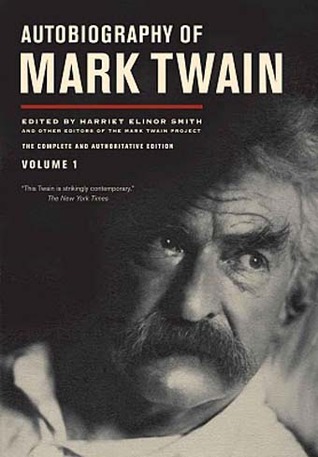
Autobiography of Mark Twain, Volume I, by Mark Twain*****

automarktwainoneInitially I was surprised not to have seen the autobiography of such a famous individual before. Twain, I learned at the outset, composed his memoir with the stipulation that it not be published until 100 years following his death, because he wanted to be entirely frank about some situations and persons without incurring the displeasure of them, their children, or their grandchildren. Twain died in 1910, and his memoir had been finished just four months. For those of us living now, it was worth the wait. Although I was fortunate enough to snare the DRC for volume 3, I had to go out and hunt down volumes 1 and 2. It’s well worth obtaining and reading for those with the attention span and literacy skills it requires.

There is a lot of material here, and you may be tempted to sample bits here and there using the table of contents. I strongly advise against it. Some of Twain’s most brilliant writing regards things you would not expect to care about. The dispute with a landlord in Italy as his wife lay dying in the villa has the full intensity, concentration, and fire he has to offer. Although I will never know for sure, I suspect that Twain was one of those rare individuals who became even more savagely articulate when angry. The heat of his rage is tremendous and oh so eloquent.

A lot of this writing is gut-bustingly funny, but some of it is also really subtle, and if you rush, you may miss it. I enjoyed reading what he thought of Jay Gould and John Rockefeller; of President Theodore Roosevelt; and of Satan, for whom he confesses that he feels a tremendous sympathy. In other passages he becomes poignant, particularly in speaking of the deaths of his wife and daughter. Nobody but Twain could say it just like this.

Should the reader ignore my advice and choose to jump around, thus missing occasional references to things mentioned earlier in the text, at least do this: be sure to read his remarks about dueling.

The memoir is not linear. He tried several times to sit down and write his life end-to-end, and destroyed some drafts; others he merely abandoned, and they made the assembly of the autobiography, most of which he dictated, all the more complicated as a result. The University of California has done a splendid job of isolating the random repetitious bits at the back of the book in an appendix, while putting the rest of it together in a way that while not linear, makes sense. There are a few interesting photos at the end as well.

Those engaged in the teaching of college level creative writing, of simile, metaphor and other figurative language may indeed want to read this magnificent memoir and pluck some favorite passages for use as examples.

Twain’s life story is not for those with limited focus or who need immediate gratification with minimal effort. This volume, all 738 pages apart from the appendix, kept me company at bedtime when everyone else in our home had the lights turned out and I was the only one still awake. In those small quiet hours I studied the prose of the master, and occasionally had to leave the bedroom in order to laugh out loud, lest I wake my spouse. I would be sorry to have finished, but volumes 2 and 3 still await my attention.

For those that love the English language, and for those with an eye for history, this memoir is not to be missed!

Dragon’s Teeth, by Upton Sinclair*****

dragonsteethDragon’s Teeth is the third in the Pulitzer-winning Lanny Budd series. Set in 1942—the present, at the time it was written—it provides the reader with a fascinating, well-informed, hyper-literate view of Europe during the years before and during Hitler’s ascent to power. While it requires a fair amount of prior knowledge in order for the reader to keep up with the story, history lovers, political philosophers, and especially those fascinated by the period in question will find it riveting. Thank you Open Road Integrated Media and Net Galley for allowing me a DRC. This title is available for purchase digitally now.

Sinclair, himself a socialist of the Utopian variety, shows us the ideas of the “reds and pinks” that were plentiful and active—yet in the end, not active enough to prevent a Fascist takeover—during this period. Budd is the heir to a munitions-maker’s fortune, and so his is the life of the idle rich. He amuses himself by hosting salons, popular at the time, which were group discussions regarding alternative political ideas. His wife Irma is heir to an even greater fortune, and is uncomfortable hosting these odd people that speak of redistributing wealth, but in time she relaxes, understanding that this is just one of Lanny’s hobbies and is unlikely to ever affect her personal comfort level. And indeed, Lanny is never going to sully his hands by taking to the streets with working class militants; in fact, apart from buying and reselling artwork, he’s never going to even hold down a job, reasoning that it would be wrong of him to take a job he does not need when someone else really does need it. He is amused and comfortable in his role as armchair socialist and angel financier to a leftwing newspaper. Yet the idea of actually taking power…hmmm.

“It seemed to have begun with the Russian Revolution, which had been such an impolite affair.”

Nobody writes setting like Sinclair. The story begins in Italy following the First World War; Mussolini has risen to power, and we can almost hear the hard heels striking the cobblestones. Budd is somewhat concerned for Hansi, his brother-in-law who is Jewish, but he also believes that money talks, and any unpleasantness can probably be squared away with a donation here and a greased palm there. As long as the seas are safe, the family considers simply waiting out all the unpleasantness on the family yacht, hoping that things will be settled down by the time they want to dock somewhere.

Hitler is out and agitating, but no one really thinks he will take over the world; if he were going to do that, he surely wouldn’t stand in the streets and scream about it, now would he? And we feel, through Lanny and his family, the stark startled horror when his power increases and his Storm Troopers become an official government organization rather than simply a pack of street thugs. At the same time, we also experience his and others’ perplexity at the name chosen by the NSDAP, because it invokes the name of Socialism for a system that is actually far-flung from it, and it calls out to the working class even as it pounds their unions to dust and sends their leaders to concentration camps.

While the working class of Europe starves or stands on line at a soup kitchen, the Budd family has the traditional six meals daily; when they are not at home, they do the charitable thing, and instruct the servants to find some “worthy poor” to consume the unused meals. Well…not in the house, of course. Somewhere else.

At times, the tone is satirical, and in a few places made me laugh out loud, mostly in the beginning. Later the tone changes and is sharper, angrier. I found it deeply satisfying.

Particularly fascinating is the statement that “He who could get and hold the radio became God.” In one form or another, this has been true since the radio was introduced into first-world homes nearly 100 years ago. Major media sources had the monopoly on information, apart from the printed press. The radio, then television…only recently have ordinary people had the means to record and disseminate information on the phone they carry with them everywhere. And it’s interesting to see the changes that result.

Perhaps your thoughts will travel in different directions than mine did in reading this interesting nugget, but it is bound to make you think. If you are looking for some escapist material to take to the beach or curl up with by the fire, this isn’t it. This is fuel for the brain, fierce material that came from a time when all of Europe had to decide which side they were on.

For those that love history, literary fiction, or political science—or all three—highly recommended!

Hitler is Alive!: Guaranteed True Stories Reported by the National Police Gazette, edited by Steven A. Westlake**

HitlerisaliveI was invited to read and review this compendium of articles from long ago by my friends at Open Road Integrated Media and Net Galley. I appreciate the invitation. The articles in the collection were really published in a tabloid by the title above during the period after World War II ended, and they are presented here as a bit of humorous nostalgia, rather like the spirit of Punch or The Onion. These articles will tickle the funny-bone of some of its readers, but it wasn’t a good match for me.

It appears that Hitler did indeed have a man-made island set up as a place of retreat; most likely, word of the USA’s nuclear weapons program had filtered through and so an alternate location was devised for him and those he needed with him. In the end, his defeat was so clear and so absolute that even he could see there was no point in going there. However, between the Allied leaders’ claims that he was dead before anyone really knew what had happened and a few other intriguing details, journalists had a great deal of fodder to chew on for the period that followed. The overall tone at times nears hysteria, and because of this, it seems comical now.

Because it was not written initially to be humorous but instead was regarded by its writer as hard journalism, there is a lot redundancy, with old facts being repeated and new ones added in. I suspect that a much more amusing novella could be written using these articles as their basis; on the other hand, Hitler has been the subject of so much other historical fiction that it would have to be unique indeed to stand out from the crowd.

Those considering purchasing this collection might do well to go to a retail site that offers a chance to read sample pages first. If it works for you, go ahead and make the purchase. I have to confess I made it about halfway through and then bailed.

This collection was published Jan 12 of this year and is available for purchase now.

Target Tobruk, by Robert Jackson****

targettolbrukMilitary history and World War II buffs will enjoy this well written third installment in Jackson’s  Sergeant George Yeoman series. I hadn’t read any of the others in the series, but it didn’t matter; it serves just fine as a stand-alone novel. Thanks go to Net Galley and Endeavour Press for the DRC, which I received free of charge in exchange for this review.

Yeoman is a pilot; Jackson served as a pilot himself in the Royal Air Force Reserve and flew many different types of planes, so he has personal experience with his topic. The story centers around the battle for Northern Africa before the USA has entered the war.

And did you know how hot the desert is? Those that are considering reading this need to know this one thing: have some water beside you as you commence. I don’t think any novel has ever made me this thirsty!

Those that are not native English speakers may find this too challenging, and so will high school students. The vocabulary, as well as the military and geographic references, calls for a solid literacy level, and those with some knowledge of World War II and the Mediterranean region will be happier reading it than those that don’t. The four star designation is for this demographic; for general audiences unfamiliar with the Africa campaign, I’d take it down to three stars.

The book would really benefit from a couple of maps and some photographs of the many different types of weapons and especially aircraft that are mentioned here.

I am slightly touchy about the racist term that was used during this time period for Japanese; I understand they were adversaries, and yet the ugly racial terms–which went so far further than anything that was said about European members of the Axis forces–turn my stomach. Because of this, I veer away from fiction that has to do with the Pacific theater of this war, because I just know it’s going to be there, probably in liberal doses. The “J” word pops up here just once. On the one hand, it really doesn’t add anything to the plot and could have been left out, but on the other, at least it is in quotation marks, reflecting a character’s mindset rather than the overall tone of the narrative. Given the nature of the story, I felt the author did pretty well in this regard.

Recommended for those with a strong interest in World War II history, this book is more of a novella in length; just 142 pages. It is available for sale digitally now.