
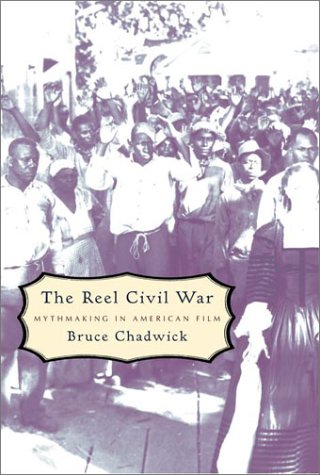
The Reel Civil War: Mythmaking in American Film, by Bruce Chadwick****

thereelcivilwarI found this gem at my favorite used bookstore in Seattle, Magus Books, which is just a block from the University of Washington. Its strength, as the title suggests, is in tracing the story of the American Civil War as told by the cinema. Those interested in the way in which movie impacts both culture and education in the USA would do well to find this book and read it.

Chadwick spends a considerable amount of time and space carefully documenting the myth produced by Gone with the Wind, a completely unrealistic, idealized portrait of the ruling planter class of the deep South. Many of us would, in years gone by, have been inclined to dismiss this concern by saying that after all, the book and movie were primarily intended as a love story, but Chadwick demonstrates that this is not so. He ferrets out actual interviews with Margaret Mitchell herself in which she insists that this is exactly the way it was. Her sources? Former plantation owners, of course.

To this day, if an avid reader goes to Goodreads.com and under the caption “explore”, goes to “listopia” and from there selects a list of readers’ favorite Civil War titles, GWTW will place within the top ten, and sometimes be the foremost title, selected over nonfiction as well as more accurate fiction. I find this horrifying.

The research regarding the Civil War itself is nothing I haven’t seen before, but Chadwick makes excellent use of strong secondary sources to document the fact that Black folks in the pre-war South were neither happy nor well treated. He takes apart the myth Mitchell constructed in a meticulous manner, one damn brick at a time. Hell yes. About ten percent of the way into the book, Chadwick’s removed, scholarly tone changes to one of articulate outrage, and I found this tremendously satisfying.

Chadwick follows Civil War films forward, after first also examining Birth of a Nation, a painfully racist film which was famous at the time because of its length; its original claim to fame was not content, but technology. For those that have not seen the film, this will be interesting reading also, and those that have seen it may pick up some new information as well.

A couple of generations later, the more realistic and highly acclaimed Roots television miniseries told the story of Black America in a way that hadn’t been represented on film before. Chadwick is again careful in his documentation and clear in his explanation.

The book’s final film treatment is of the most positive and accurate film depiction of African-Americans is the film Glory. This reviewer used this film in the classroom. It depicts the Black Massachusetts infantry that tried to take Fort Wagner and in doing so, inspired President Lincoln to order more Black troops to be armed and trained for combat in the American Civil War.

For those interested in the connection between film and American history, and of the American Civil War in particular, this book is recommended.
Coal River, by Ellen Marie Wiseman***

coalriverCoal River is a work of historical fiction set in Coal River, Pennsylvania. A region by that name exists, and was the location of pitched battles between the United Mine Workers of America and local cops, strikebreakers, and company goons. Wiseman does a creditable job in her rendering of the setting in which it all unfolded. Thank you to Kensington Publications and Net Galley for the DRC, which I received in exchange for this honest review. It is now available for purchase.

Emma Malloy has been orphaned; a fire killed her mother and father. Her only surviving family owns the local coal mine, and she is taken to live with them. Uncle Otis is a tyrannical big boss, and spirited Emma tangles with him almost immediately when she sees the way coal miners, and in particular the breaker boys, small children that worked in the mines prior to the creation of child labor laws, are treated. She is forced to work in the company store, where she sees miners’ wives lining up to purchase overpriced goods. Once they are sufficiently behind in their accounts, they are turned away, their children hungry and undernourished, unless and until the account can be brought current. It’s a wrenching thing, and Emma refuses to be complicit.

The strength in this work is that it informs readers that may be unaware of the industry’s past as to the conditions that existed. Wiseman brings in the Mollie Maguires, a group of Irish-American anarchists, as well as famed photographer Lewis Hine, whose work is credited with speeding the creation of labor laws that protected small children from adult work in mines and other dangerous industries. Those that haven’t explored this aspect of the US’s past could do a lot worse than to learn it through this novel, which renders the setting palpable and vivid. It’s a time many people aren’t aware of, before the New Deal brought food stamps, health care initiatives, and other lifesaving aid to the unemployed and underemployed. Before that time, any who didn’t work, and whose family could not keep them, starved.
A particularly moving scene is the one in which the Black Maria comes to deliver a dead miner to the door of his widow, and everyone waits breathlessly to see at which home it will arrive.

Your reviewer had a much loved grandfather that died from Black Lung, the form of emphysema contracted by coal miners, particularly those who worked in the mines from an early age as he did. If anyone ought to see this as a five-star book just from sympathy with the material, I would be the one. This is why I requested the DRC. I wish I could rate it higher, but there are a couple of issues that I can’t ignore.

The weaknesses here are twofold. The first is in character development. Emma is not a dynamic character, and indeed, the bad guys are oh so very bad, and the brave young protagonist starts out spunky and but for a few moments toward the climax, remains that way. There is a brief scene in the climax in which Hazard Flint shows a fluctuation in character, but for the most part, our characters are on the very brink of becoming caricatures.

The second problem, which could be overlooked for rating purposes but which troubles me nevertheless, is that although small children no longer work the mines, those places are as dangerous as they ever were. The story carries with it the tacit message that all of these miscarriages of justice took place in a dark past that has no relationship to the present day. If Wiseman cares for the well being of miners and their families, she would have done well to add a post-script acknowledging that miners still get Black Lung; mines still cave in and trap scores of miners every year, and many don’t make it out alive; that union busting is alive and well in the good old US of A. By ending the story as she does, she infers incorrectly that all may rest easy. It just isn’t true.

In short, this is a great story for those new to the history of child labor in America and of those that fought to end it, but as a great literary work, or as a tangible plea for social justice in the present, it is left wanting.

Chasing Ghosts: the Policing of Terrorism, by John Mueller and Mark Stewart***

chasingghostsI suspect just about everyone in the USA, or who frequently has to travel to the USA, is heartily sick of the extreme security measures that raise our taxes through the roof and cause so many delays, inconveniences, and even the confiscation of ordinary products that cost us a fair amount of money, on those occasions that we foolishly forget not to take them with us on the plane. The racial profiling makes it even worse. And so I requested this DRC from Net Galley and Oxford University Press with the expectation that I would agree with it wholeheartedly and immediately form the virtual simpatico with its writers that readers form with their favorite authors. Alas, not so much.
It’s not a terrible book, but it’s also not a great one. The writing style comes across as strangely antagonistic, odd given that I was ready to agree with them when I began the book. They make a lot of good points, particularly in comparing the expenditures of the Federal government to the amount that was spent on the Cold War and the anti-communist hysteria of the 1950’s. But whenever I read scholarly nonfiction, I am inclined to check out the end notes early on, and I was struck by the large number of times Mueller and Stewart quoted themselves (or sometimes one or the other of themselves separately). Their other sources were more likely to be newspapers and magazines rather than primary documents, which were used sparingly.

My sense is that if you’re going to challenge the status quo, you have to roll up your sleeves and do it right. In this case, a worthy thesis, at least to some extent, is less credible than it might have been with more diligent research and more legitimate scholarship.

My gut was inclined to rate this book two stars rather than three, but then I realized that my gut was responding to the ISIS mass killings in France. For the writers, it’s just pure dumb bad luck that the real terrorists created such tremendous outrage and heartfelt sympathy throughout the Western world, and in doing so underscored the reason such stringent security measures are in place, just as their book was nearing publication.

The most compelling argument against the Patriot Act and all of its associated agencies and agents is that when someone is willing to die in order to commit a mass killing, nobody and nothing can really stop them. The security measures being utilized are effective against people that want to enter an establishment or a vehicle and kill as many people in it as possible, then walk away and live to kill more people another day. This wasn’t the primary argument Mueller and Stewart rolled out. Their main argument, that the Bill of Rights is being trampled by the very government that was invented to uphold the Constitution, is a good one and I think would have been easier to get behind had events not unfolded as they did, and of course, had the source material been more impressive; yet the safety of all of us will always preclude individual liberties. So in a sense, ISIS gives the conservative, locked-down wing of the ruling class a red-carpet invitation to clamp down on civil liberty; but that would not have made a book that would sell, and perhaps that is why the authors didn’t make this their focus.

If this is an area of interest to you, you can get a copy November 30. I wouldn’t pay hard cover price for it unless you have tremendous interest and very deep pockets, though.

Glory Road, by Bruce Catton*****

gloryroadBruce Catton was known as a popular historian when he first published books about the American Civil War, because of his narrative nonfiction format. All of the books being released digitally now are ones previously published in a non-digital age. This reviewer hunted down Catton’s three volume Centennial History of the Civil War at a used bookstore some time back, and although they were among the best I have ever read by anyone on this topic, I was convinced that anything he had published earlier on the subject was probably repackaged in this trilogy, and so I stopped reading Catton, thinking I was done. Thank goodness Net Galley and Open Road Integrated Media posted the galley for this second volume of Catton’s Army of the Potomac trilogy. Now that I am disabused, I will have to find the first and third volumes also, because Catton is so eloquent that he can spin ordinarily dry-sounding military history into as good a read as the most compelling fiction.

Although his Civil War books are not written in academic format, there is no denying Catton’s research or his credentials. He was one of the founders of American Heritage Magazine, and served as its senior editor until his death. During World War II, he was the US government’s Director of Information for the War Production Board, then later worked in a similar capacity for the Department of the Interior and Department of Commerce.

Frankly, in order to spin the story of the three battles that comprise most of this volume out in such a conversational manner, dropping anecdotes in at just the right moments and then carrying on so as to make us feel as if he is a journalist traveling with the Union forces and we are concealed cleverly in his knapsack, bespeaks a remarkable amount of research. Only after reading the whole thing, spellbound, did it occur to me that for every vignette he included to make the telling more personal and more interesting, he must have edited out ten or twenty. The result is a masterpiece.

I came to this work as a former instructor in the field, and wished I had read his work in time to make use of it in the classroom. At the same time, it is sufficiently accessible that someone with no prior knowledge of the Civil War should be able to keep up just fine as long as they are able to read at the level of a high school senior or community college student. There is a definite bias toward the Union, which frankly is a requisite to my enjoyment of Civil War history. (Those that feel otherwise can go find Shelby Foote’s work.)

I never in a thousand years thought I would even consider rereading some of this war’s most painful battles—the battle of Fredericksburg being perhaps the most prominent in this regard—but Catton has some little-told things to say about these battles, and in particular about Burnside and that Tammany Hall political general, Sickles, that I hadn’t seen before. I had viewed Burnside as a failure from start to finish, but he makes a case that a lot of the mishandling of this situation was due to an ungainly Federal bureaucracy that wasn’t good at receiving information and passing it along in a prompt, useful manner. It gave me pause, and reminded me that we should never assume we know enough about something to call ourselves experts.

The Battle of Chancellorsville is likewise told in a manner fresh and readable, but the bulk of the text deals with that decisive, costly three day fight at Gettysburg. He gives an even-handed assessment of both Hooker and Meade, and again I learned some things I didn’t know before.

Catton’s writing is so engaging that it is destined to live for a long, long time after he is gone, educating subsequent generations. I found myself resolved, at the end of this volume, to look for other galleys of his work to read and review, and when there are no more left, to track down those still missing on my next pilgrimage to Powell’s City of Books.

For you, however, it is fortunate that Open Road is releasing this work digitally, so you won’t have to turn out the shelves of every used bookstore in the US in order to locate it. It will be available for purchase November 3, 2015 for your phone, computer, or e-reader, and is highly recommended to anyone with even a passing interest in the American Civil War.

Simply brilliant.

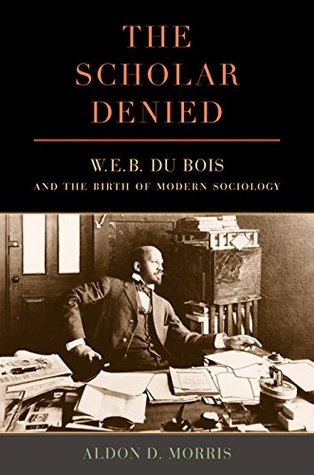
The Scholar Denied: W. E. B. Du Bois and the Birth of Modern Sociology, by Aldon Morris*****

thescholardeniedMorris considers DuBois the father of American sociology, and Morris is right. This is, of course, not the first time a Black man was robbed of credit for an accomplishment that was instead credited to a Caucasian American. It happens all the time. But until I ran across this scholarly study, I hadn’t thought about DuBois and sociology because I had never studied the latter. As an admirer of DuBois’ historical and political role, I was drawn to this book when I found it on Net Galley. Thank you to that excellent site as well as University of California Press for the DRC, which I was given in exchange for an honest review.
It is available for purchase now.

DuBois was a venerable intellectual, an academic light years ahead of most Americans of any racial or ethnic background. He was the first Black man to graduate from Harvard University, and in addition to his graduate work there, he also studied in Berlin under such luminaries as Max Weber and others. In Europe, he was treated as an equal by those he studied with, and I found myself wondering a trifle sadly—for him, not for us in the USA—why he chose to return here. And the answer is so poignant, so sweetly naïve, that I wanted to sit down and cry when I found it. Because once he had the empirical facts with which to debunk the whole US-Negro-inferiority mis-school of mis-thought, he genuinely believed he would be able to elevate African-Americans to a state of equality in the USA by laying out the facts. The racists that created Jim Crow laws in the south and an unofficial state of cold racism that let Black folk in the Northern states know where they were welcome and where they were not, would surely roll away, he thought, if he could reasonably haul out his charts, his graphs, his statistics, and demonstrate flawlessly, once and for all, that discrimination against Black people was based on incorrect information.

See what I mean? I could just cry for him.

So although DuBois was the first American to go to Europe, study sociology, and return with more and better credentials than any American academic, he could not persuade anyone with authority to bring about change, was not even allowed to present his findings to anybody except Black people in traditional Black colleges, because another school of sociologists, the Chicago school, were busy promoting armchair theories based on little data, or bogus data, all showing that Black people simply were not smart enough to become professionals or take on anything above and beyond manual labor, and of course, he was Black, so he must not be that smart, right?

Pause to allow your primal scream. It’s galling stuff.

Caucasian professors in Chicago had done a bit of reading, and with regard to Black people, decided that their craniums were too small to hold enough brain-iums. And just as there is one reactionary in every crowd that the newspapers will flock to in order to show that there is across-the-board agreement, so did Booker T Washington stand before any crowd that would listen to him (and the white academics just loved him), in order to say that it was the truth, that it was going to be a long time before the Negro was “ready” to do the difficult tasks involving critical thinking that had been so long denied him. Tiny steps; patience; tiny steps. Meanwhile, he extolled his fellow Black Americans to enroll their sons and daughters in programs teaching “industrial education”, so that they would be ready to do manual labor and put food on their families’ tables.

All of the studies that backed this line of thinking were deductive, starting with the answer (inferior beings, manual labor) and then finding the questions to fit that answer. DuBois had done inductive research because he was searching for information rather than looking for a rational-sounding way to keep a group of people entrenched in an economic underclass.

DuBois made the connection between the socialist theory he had studied and the material evidence before him: there were people getting rich off the backs of dark-skinned people, and they had a vested interest in maintaining Black folk as an underclass. Ultimately, he turned to political struggle, and that is how I knew about him, not as a sociologist, but as a Marxist. He also became the father of the interdisciplinary field of African-American studies. He helped found the NAACP.

This scholarly work, like just about anything produced by a university press, is not light reading. Rather, the author presents his thesis and synopsis, and then carefully, brick by brick, starts back at the beginning to build his case. His documentation is flawless, and his sources are diverse and strong. There is some repetition in the text, but that is appropriate in this type of writing. He is not there to entertain the reader, but to provide an authentic piece of research that will stand the test of time, so there is a little bit of a house-that-jack-built quality to the prose.

For serious admirers of DuBois’s work, this will be an excellent addition to your library. For those interested in sociology as a field, this is for you, too. And to those with a literacy level that permits you to access college-level material and who have a strong interest in African-American history and/or civil rights, this is a must-read.

For these readers, I recommend, in addition, The Souls of Black Folk, which I had not regarded as sociology-based material until now, though I have read it twice; and a collection of speeches by DuBois, which I have been intending to review for some time, and which will soon grace this page of my blog.

Morris has done outstanding work, and I like to think that if DuBois were here, he would be proud to see it.

A People’s History of the Civil War, by David Williams***

With an introduction scribed by the late great Howard Zinn (and the book edited by same), I figured I just had to add this book to my collection. It bills itself as a history of the marginalized groups of this era, those seldom represented in traditional history. I found it at my favorite local used bookstore, Magus Books, which is near University of Washington, and I scooped it immediately.

The tome sat in the upstairs powder room for months, but we didn’t look at it all that often. I had trouble climbing on board. Eventually I realized there were two things bothering me here. One is that it treats both Union and Confederate governments, along with the powerful moneyed interests backing the two sides of the conflict, as equally wrong and equally culpable. With this I sharply disagree. Whereas no doubt plenty of war profiteers made a great deal of money, and no doubt working people on both sides deserved better pay and greater prosperity, this was not an equally-wrong war. In fact, the first Marxist to live in the USA came here from Europe to fight for the Union, because that was the way to move history forward. So in a sense I disagreed with the premise of the whole book.

That much done, I noted that the overall tone was more cynical than I consider warranted. For me, the American Civil War was the last truly heroic conflict in which US forces fought. It also distinguished itself by producing an unusually high number of casualties where high ranking officers were concerned. You didn’t see American generals get dead in these proportions in either of the world wars, nor Korea, Vietnam, or any of the conflicts in the Middle East. So the snarky manner in which Williams refers to the disparity between Union brass and foot soldiers is not well placed. I found it abrasive.

In addition, if we’re talking about marginalized peoples, excuse me Mr. Williams, but where are the Black folk? The author seems to have mislaid some four million former slaves. I kept flipping through this volume trying to find some, but they are underrepresented quite badly; one might even say the author has marginalized them.

The one worthwhile thing here, the thing that kept that third star in its place, is the extensive attention paid to Native peoples during this time. I was aware of the role of the Cherokees and that was the sole extent of my knowledge of which way American Indians chose to side, when they chose a side at all. I got something for my money other than frustration and regret; I really had to look hard to find it, though.

Consequently, those doing specific research having to do with the role of Native Americans during the American Civil War should get this book. I recommend it for that niche audience only.

The American Civil War: A Military History, by John Keegan ***

theamericancivilwaramilitaryhstThis was a disappointment. Keegan’s history of World War I was outstanding, and likewise he did a brilliant job with World War II. In contrast, his treatment of the American Civil War is nothing special. His sources are secondary; he hasn’t spent countless hours sitting in local and regional libraries reading collections of letters or rare documents. The man lives in England, and as far as I can see, he may have written this book from there. His maps are insufficient, and the ones he does use are the ones you’d see in anyone else’s American Civil War literature. Likewise, his photographs are ones I already saw somewhere else.

All of that could still make a four star work if he put a fresh perspective into play. I recently read and reviewed the outstanding Our Man in Charleston, by Christopher Dickey. That book offered the British perspective on the conflict, and it was very different from that of either the Union or the Confederacy. I had hoped that Keegan would likewise offer a new perspective and a lively discussion.

The book is instead, dull, dull, and dull. I did not see one piece of information I didn’t already know…and he called John Brown a “wild man”, perpetuating the textbook stereotype that tends to be used by those that don’t care to dig too deeply.

In his end notes he thanks James McPherson, and really if you read McPherson’s Battle Cry of Freedom along with the memoirs written by generals Grant and Sherman, you’ll learn far more and with much fresher, more interesting prose. It is these to which he refers most liberally.

On the plus side, I got my copy used. On the sorry side, it was still eight bucks I could have spent on something I want.

I advise you to read something else. If you want to read Keegan, read about one of the world wars. If you want one basic yet thorough treatment of the American Civil War, read Battle Cry of Freedom. But not this book.

The “Colored Hero” of Harper’s Ferry: John Anthony Copeland and the War Against Slavery, by Steven Lubet **

thecoloredheroI was really looking forward to this biography, that of one of the Black men that fought alongside John Brown at Harper’s Ferry. It seems to have so many of my favorite elements tied together. There’s John Brown, one of my greatest heroes; the anti-slavery campaign that led up to the American Civil War, which is my field; and then, right as the Black Lives Matter movement has picked up speed, we see focus on one of the African-American fighters that was there. What’s not to love? And I had the chance to read it free, thanks to Net Galley and Cambridge University Press. I was pretty stoked.

But one of the ways in which people are disenfranchised is that their history is not recorded. Lubet has clearly given it his best shot, but there’s so much surmise (with the use of “perhaps”, “may have”, “would probably have”, and so forth) and guess work filling in the narrative, along with common information about the time and period that I already knew, that I finally just skimmed to the last chapters, which is where he seems to have some actual information as opposed to vague contours sustained largely by guesswork.

Whether it’s because of this or in addition to it, the pace is slow, slow, slow.

I can tack on a third star—and if you’ve read my reviews, you know I often do—if I can think of a niche audience that would enjoy the title I am reviewing or to whom it would be useful. Here, not so much, and in fact, at least one factual error leapt out and bit me, and I was not even fact-checking. W.E.B. DuBois claims in his biography of John Brown (which is listed in the works this writer includes in his end notes) that the only reason Harriet Tubman was not there was that she was desperately ill and unable to get out of bed. So this work is not only broader than its stated purpose and lacking in the anticipated focus, it is at least partially incorrect. If I can believe either DuBois or Lubet, I’ll roll with DuBois any day of the week. No third star.

One star reviews are few and far between. I reserve those for works that are either so badly edited and or illiterate (generally self-published works) that I just straight-up can’t read them, or else they are grossly offensive, enough so that I think the public will be offended more often than not.

Given the standards above, this work merits two stars. If you decide to read it, do free or at a deep discount unless you have really deep pockets and spend money fairly randomly. You can do that September 16.

Unholy Fury: Whitlam and Nixon at War, by James Curran ***-****

unholyfuryAll of a sudden, everybody is writing a book about or featuring Richard Nixon. Having grown up during the Watergate era, I voraciously attack anything and everything apart from the most blatant apologists’ work. This title, in which Nixon’s relationship with the government of Australia and in particular, Gough Whitlam, who became Australian prime minister during the Nixon administration, is examined, seemed like a good diversion from what I usually read. Like many Americans, I tend to focus too exclusively on matters having to do with the USA. It probably has to do with the size of the country and consequently, the sheer weight of available material on matters closest to home. But I knew next to nothing about Australia’s government, apart from their participation as an Allied force in World War II and their status as a friendly government to the US and Britain, so I dove in.

Thank you to Net Galley and Melbourne University Press for the galley, which I received free in exchange for an honest review.

Between the title’s subheading and the book’s cover, which shows Gough speaking and Nixon looking furious, one might almost conclude that the two nations were on the brink of a shooting war with one another. Not so, not so. Yet the antagonism that sprung up between the two nations during a time when both had outspoken and sometimes abrasive leaders is unquestionable. There were two primary realms of disagreement that went beyond mere personality issues. One was the role of Australia in relation to the USA, and the other was the future of Asia in relation to both countries and in general.

Before reading Curran’s biography, I had never thought of Australia as an Asian nation. I sort of considered them to be out there adrift, all by themselves, being kept company just by New Zealand the Pacific Islands. I am aware that they are on the opposite side of the equator from where I am, and so when it’s summer here, it’s winter there. That, cowboy boots, kangaroos, and an unfortunate record for treating indigenous people fairly, one which the US shares, about sum up my knowledge base.

I’m embarrassed to admit that I didn’t know the capital was Canberra.

Nixon was mostly not focused on Australia, and that, it seems, was a part of the problem. Menzies had preceded Whitlam as prime minister, and he too was an old hand who thought largely in Cold War terms. Nixon and Menzies had been fond of one another. But when elections were held and the beleaguered President Lyndon Johnson was due to leave Washington, he told Australia’s representatives, who were opposed to the US intervention in Vietnam, that they “might have one or two problems” with Mr. Nixon. It was a very droll understatement.

First, Nixon was outraged that a nation that looked to the US for security and aid would dare publicly criticize its role in Vietnam, and then—worse—in Cambodia. He regarded the Australians as a satellite that ought to be grateful and not bite the hand, etc.

Gough Whitlam took office with an eye toward creating a more independent Australia. He considered Australia very unlikely to be in danger of external attack for ten or fifteen years at least, and was aghast at Uncle Sam’s ugly doings in Indochina. He was looking for distance, and Nixon, under enough pressure from enemies without getting it from friends, erupted. Eventually Richard Nixon played a dangerous bluff on Moscow by recalling nuclear missiles from nearby Fiji, which involved the use of Australian terrain, without actually notifying the Australians. Visions of a mushroom cloud on home soil didn’t do much to endear President Nixon or the American government to Australians, needless to say.

Whereas Nixon was convinced that communist hoards would continue to advance across Asia unless Vietnam was forced to adopt a parliamentary democracy, Australia felt that it was time for the super powers to quit telling smaller nations what to do and abide by home rule in whatever form its citizens chose.

Though no actual shooting war was ever threatened or contemplated, the US did examine alternate places for its bases—a $5 billion dollar investment in 1970’s dollars—and at one point, Australian dock workers voted not to unload goods from US ships. In turn, US dock workers placed a moratorium on Australian trade, which left a good deal of beef rotting near the dock for days on end. And sometimes, with breathtaking rapidity, trade wars can in fact lead to shooting wars. It wasn’t going to happen this time, though; the USA already had its plate full.

It probably is telling of my own ethnocentrism that I had difficulty focusing on the lengthy passages leading up to the conflict. There’s a fair amount of detail regarding Australian politics that novices like me may find it hard to plow through. On the other hand, the author should have known that communists would never use the term “Vietcong”, which was a pejorative. Vietnamese freedom fighters are referred to as members of the National Liberation Force.

Even if the reader gives in and skims those bits of political nuance that will suit some interest levels but not others, there is a great deal of entertaining dialogue and detail in the meaty center of this work to make it worth reading.

The President and the Apprentice: Eisenhower and Nixon, 1952-1961, by Irwin F. Gellman***

thepresidentandtheapprenticeGellman’s biography covers Nixon’s tenure as Vice President of the USA under President Dwight Eisenhower; he covers the election campaign beforehand as well as the famous “Checkers Speech”. Thank you to Net Galley and Yale University Press for the DRC, which I took in exchange for an honest review.

It is a little bit hard to be sure about this work, because the galley I got was so rough that it was difficult to judge its fluency. I settled on 3 stars rather than 4 stars because I saw some issues with organization, small tidbits that only marginally bore mentioning showed up in multiple chapters.

That said, it’s a good resource for anyone looking to study the Eisenhower administration or Nixon’s early years in government. I learned some things I didn’t know, and I have read my share (and maybe your share too!) of Nixon-related literature. Gellman has done a great job with research, and even offers pictures of primary documents, such as Ike’s notes during Nixon’s famous speech, at the end of the book.

I learned that the USA of that time period was a much more innocent one than that which we live in now. The Checkers Speech is one good example: now it is regarding laughingly as a mawkish bit of theater, but what is not widely publicized anymore is that the American public was asked to respond as to whether he should stay on the ticket, and they flooded the Republican headquarters and media centers with letters that supported him 350 to 1.

Now that it is known that he used public dollars for personal gain as president, I had rather assumed he had done the same during the funding crisis in question, but actually, back then he was guilty of nothing. The donations that were made were a travel fund, because the Nixons didn’t have the money to travel around the country campaigning. Donors pitched in for their air fare, cab fare, and hotels. There was no law regarding campaign spending limits back then; no law was violated.

As vice president, Nixon had more responsibilities, and occupied a position of greater trust, than most who occupied the same position. He was sent overseas, not only as a good will ambassador or ribbon cutter, but to do unpleasant, tricky things, like talking down the heads of state in South Korea and Taiwan. In addition, Ike never cared to do his own dirty work domestically, and so if someone needed to be officially taken apart, there was a good chance Nixon would be tapped for the job. He had an unstoppable work ethic and was unflinchingly loyal.

If Nixon’s vice presidency is of interest to you, get a copy of Gellman’s book. It goes up for sale in late November, so you can also consider it as a holiday gift if someone you know would appreciate it.