Notorious RBG, by Irin Carmon****

notoriousrbgIf I were to review the subject of this memoir rather than the book itself, it would be a slam-dunk five star rating. As it is, I can still recommend Carmon’s brief but potent biography as the best that has been published about this fascinating, passionate justice of the Supreme Court of the United States. I have no doubt many more will follow, and it’s possible I will read every one of them. As it stands, this is a rare instance in which I turned my back on my pile of free galleys long enough to ferret this gem out at the Seattle Public Library, because I just had to read it. You should too.

I’m an old school feminist from the seventies, but Ginsberg is one from the fifties. How is that even possible? Imagine the courage it would take to step forward at a time when no women’s movement even existed! She sued Rutgers University for equal pay and won. Later, she was the first female law professor at Columbia University, and she sued them for equal pay too. She volunteered as an attorney for the New Jersey American Civil Liberties Union, represented custodians in a class action suit, and later, when the Free Speech Movement on campuses in the 1960s began to warm up, she was already red hot and ready to go.

The best parts of Carmon’s memoir are the primary documents, because we get to see RBG’s own words. Ginsburg was made a federal appeals judge by President Jimmy Carter and moved to fill a vacancy on the U.S. Supreme Court by President Bill Clinton. She’s issued a number of tremendously eloquent decisions, and has chosen to read her dissent aloud, a thing not usually done, a record-breaking five times at the time this book was written. The lacy-looking necklace that fans out on all sides of her neck is her dissent collar, and so those that hear the Court deliver its decision can see exactly where Justice Ginsberg stands as soon as they see what she is wearing.

At times such as these, in which a woman in Indiana was recently sentenced to 20 years in prison for having an abortion [reference mine], it gives women hope to know that there is a fighter on the Supreme Court who’s looking out for our interests. It doesn’t mean that women can step away from this political battle, but it’s a thing that encourages us and lends us fortitude.

In January, it is rumored that Ginsberg will release her own memoir, one that relies heavily on her court decisions. Likely this will be an even better memoir than this one. For now though, this uplifting, funny, well-documented memoir is as good as it gets. Go get it.

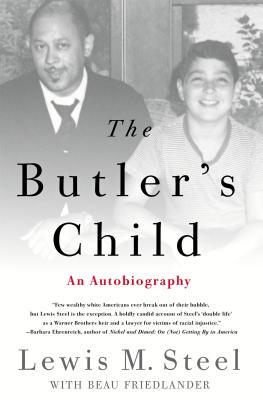
The Butler’s Child: An Autobiography, by Lewis M. Steel****

thebutlerschildLewis M. Steel has a long, noteworthy career as a civil rights attorney.  He was an observer during the Attica Prison riots; worked for the NAACP during the Civil Rights movement, and later defended boxer Hurricane Carter against a frame-up charge of murder. And I was permitted to read this story free and in advance, thanks to Net Galley and St. Martin’s Press in exchange for this honest review. I rate it 3.5 stars and round upwards; it is now available to the public.

When I first approached this title I expected to see what the life of a butler’s son was like. In fact, Steel’s social class is at the other end of the spectrum. An heir to the Warner Brothers fortune, he spent much of his time in the company of the family butler, and he was deeply affected by the emotional distance that this family servant, whom he had innocently regarded as a father figure, began to demonstrate as Steel grew older. Later, as an adult, he realized that this faithful retainer, an African-American man, surely had a family and life of his own that he went to visit on his two half-days off work, and he began to wonder what he might do to tear down the wall between the worlds of Caucasian families and Black folk. Ultimately he decided to become a civil rights attorney, and he credits the man that helped raise him as a key reason.

The NAACP of the Civil Rights era—the National Association for the Advancement of Colored People– was deeply immersed in litigation as a means to end segregation. Again and again, racist judges sat in court, north and south alike, and they told the NAACP to go to hell even when their evidence and research was baldly, plainly in the plaintiff’s favor. The NAACP continued to push litigation over mass action because of a strong conviction that if they could get a case heard by the Supreme Court, relatively liberal in many regards and headed by Chief Justice Warren, then surely justice would be done.

It didn’t shake out that way. Outraged over the way the nation’s highest court failed to provide equal protection to its Black citizens, Steel wrote an article for Time Magazine titled “Nine Men in Black Who Think White”, and was summarily fired from the NAACP, who still wanted to curry favor with that court. Many of his colleagues walked out of the NAACP offices in protest.

A common question among Caucasians that want to fight for the rights of people of color in the USA is what can we do?  How can one use this white privilege that exists whether it should or not, to change US laws and society for the better? And this question is raised exponentially when one is an heir, a ruling class scion that can do a tremendous amount for the cause in which he believes.

This reviewer has a friend that found himself in this situation. The distant but only heir of a corset magnate’s fortune, he decided that the best way to seek justice was to walk his talk. Reserving a small percentage of the fortune for himself—which is still a tasty enough chunk to own a middle class home in Seattle, take a vacation abroad annually, and eat in restaurants instead of his own kitchen—he donated the vast majority of his personal wealth to the organization he thought best. He doesn’t live in an all white neighborhood; doesn’t have a household staff; and he does blue collar work on the railroad so that he can talk politics with other working people. Because to help people the most, one needs to be among them and facing similar circumstances to those they face. So he gets up at crazy o’clock in the morning, goes out and gets greasy and banged up with everybody else, and then he goes home and cleans his own house and mows his own grass. He gets that more people listen when you put your life where your mouth is, and he believes the future of the world lies with the working class.

So when Steel commences his hand wringing over how wealthy, how privileged he is and how bad he feels about it, I want to say, Cry me a river. Steel freely admits that he enjoys his lovely home that looks down on Central Park and allows him a lovely view of the Macy’s Parade every Thanksgiving. He enjoys the servants, and his neighborhood is all white. He sent his children to all white private schools even as he fought to integrate the public schools that he wouldn’t let his own children attend in any case.

At one point, Steel mentions that his therapist told him to stop whining, and I wanted that doctor here in the room so I could offer him a high five.

Now that I have addressed the elephant in the room, I have to say that Steel’s memoir, despite the wealthy liberal whining, is worth a read for those interested in Civil Rights history and in particular the part of it that has played out in the courtrooms. You don’t have to like the author to benefit from the treasure trove of information in the pages of this memoir. Steel has been involved in some landmark cases, and he is at his best when he talks about the cases he has taken and how they shook out.

Black lives DO matter, and those of  us that think so need all the information available to fight that fight, and there are many worthwhile lessons that still apply right here, this book is worth your time and money regardless of whose memoir it is.

This book was released earlier this month, and is available for sale now.

Fragments of Isabella: A Memoir of Auschwitz, by Isabella Leitner****

fragmentsofisabellaIsabella Leitner was a Holocaust survivor, and she scribed her memoir using brief entries similar to a diary in format. The length is just 120 pages, about the size of a novella. I was asked to read and review this memoir free of charge before it was released digitally. Thanks go to Net Galley and Open Road Integrated Media for the invitation. This title was just released, so it is available now for purchase.

I confess I struggle with Holocaust memoirs these days. Part of me has decided not to read any more of them. I am out of the classroom, so my ability to educate young people of today about the horrors of the past is nearly at a standstill, apart from the knowledge I pass on to my grandchildren. Reading another Holocaust memoir isn’t going to make the ending any better; it’s always going to be horrifying, and heaven help me if I should become so accustomed to reading about the Holocaust that it doesn’t affect me that way anymore.

So though I swear off Holocaust memoirs from time to time (and am doing so right now, again), when a particular memoir is offered, frequently there is some aspect of this one that sets it apart from the crowd, and so it is with Isabella’s memories. Not many survivors managed to get out with family members at their side; Isabella and her sisters were unusually clever and imaginative in finding ways to survive. This along with the invitation induced me to roll up my sleeves and revisit this calamitous part of history once more.

When the notorious Mengele motioned with his deadly white glove to send Isabella and one of her sisters to the extermination side, they found a way to creep back around and intermingle with the side selected to be kept alive as workers. At one point they escaped and found an outstanding hiding place…but before they were identified as missing, the Germans began cooking potatoes, a luxury Isabella and her sisters could not resist, and they slunk out of their haystack and into the food line. There are a number of these instances, and I found the short chapters merciful, because I could only read this in small bits and pieces.

Most powerful of all, as far as I am concerned, is the clear, unmistakable truth that Germans knew, absolutely had to know, exactly what was going on around them. As their own lives improved materially, they chose to look the other way as skeletal work crews of Jewish and other prisoners were marched directly down the main streets of towns and villages on a daily basis:

“Germany was one giant concentration camp, with Jews marching the length and breadth of the country, but these refined, sensitive Germans never saw us. Find me a German who ever saw me. Find me one who ever harmed us.”

The memoir is of necessity harsh in its remembrance. The teaser for this story bills it as having been written for young adults, but the background material required to understand some of what is said requires a good deal of pre-teaching.  In other words, if a teacher or home-school supervisor has run out of social studies time and is looking for a shortcut to make up for teaching about the Holocaust, this isn’t it. Frankly, this reviewer and teacher wonders how a full unit regarding the Holocaust could be lower on the chain of important social studies curriculum than anything else, apart from possibly the Bill of Rights (for US students). But if one is determined to substitute one memoir for a longer unit that gives more information, use Elie Wiesel’s Night, which stands on its own.

Finally, any teacher or prospective reader needs to consider exactly how searing this material is, and all the more so to the young mind; to Jewish readers; to anyone with triggers.

I should also mention that a bisexual guard at Auschwitz, a woman that was interested sexually in one of the prisoners, is referred to as “aberrant”, not for being a guard at such a place, but for her sexual orientation.

Do I recommend this memoir to you? Those that are studying the Holocaust should read it; the fact that it’s written by a survivor makes it a primary document. But those that are looking for an engaging, enjoyable slice of history should look elsewhere. There are no light moments, no surprisingly kindly individuals that go out of their way to help. It’s a cold, hard story, and the only joy is provided up front when we learn that she gets out alive and not alone, as so many Holocaust survivors found themselves.

It’s a hard, hard lesson, but given that revisionists are diligently trying to deny that the Holocaust actually occurred, attempting to rake over the evidence as if it were not nearly as serious as we may believe, it also has a great deal of value.

Because Isabella was there.

The Center, by Stewart Alsop**

thecenterAlsop’s book is a collection of essays describing Washington, DC as it was in the 1960’s. Everything here was written then, so it’s a chance to jump back in time and see what the media—and this reporter in particular– thought was appropriate for mainstream Americans reading the news of the day.  I was invited to read and review this book thanks to Open Road Integrated Media and Net Galley in exchange for this honest review. I always hate to pan a book when I’ve been invited; it sounds as if I am insulting the host after eating at his table. However, the truth is the truth, and I see this title as fitting a narrow niche audience, but not so much the general public.

Alsop takes us back to the time that the USSR was a country and looked as if it was going to stay that way. He refers to Latvia and Estonia as former countries. Journalists that are female are referred to as “lady reporters”, and sodomy was still a crime on which the journalist frowned and assumed we would, also. He refers to justices of the Supreme Court and elsewhere as men, and with the assumption that this also is according to nature and will never change.

Perhaps the most chilling aspect of this collection is the chummy way he refers to the Miranda case, in which it was determined that those about to be charged with a crime had to be told that they had the right not to speak against themselves and to have an attorney. He explains that most of the court’s decision making was done in restaurants and over the phone long before they ever met, and so this case was “almost certainly” decided before the justices ever met in chambers.

This reviewer’s father-in-law is a retired judge that served many ethical decades for the State of Oregon, ending his career on the State Court of Appeals. Talk like Alsop’s would make his blood run cold—or maybe extra hot, actually. His ethics were so firm and fair that he would not tell his own family, when we dined in the privacy of our home or his, who he planned to vote for in the upcoming election…because judges are supposed to be above partisan politics. He did not discuss his cases with family, and I would stake the deed to my house on his not having entered into any chummy agreements over the phone when serving at any level on the bench.

So for those interested in the journalism of the 1960s, here’s a trip down the rabbit hole that will take you there, or at least to one version of it. Those interested in the sociology of that time period might also find this useful.

Those interested in building a better world may be encouraged to see how far society has come since this dark time. If you think things are bad now, check out what they were like 50 years ago. But don’t pay full jacket price unless it’s important to you.

You can have this book now if you want it.

Florence “Flo” Kennedy: the Life of a Black Feminist Radical, by Sherie M. Randolph***

Florynce Flo KennedyFlo Kennedy was a force to be reckoned with, dismissed by a portion of mainstream Caucasian America as a kook, yet far too clever, too cagey, and too damn smart to be wished away by those that wanted to defend the racist, sexist status quo. When I saw that a memoir of her life was up for grabs at Net Galley I requested a copy immediately, and then took a long time to finish reading it. Part of my tardiness is a stubborn dislike for the PDF format, and so I apologize to University of North Carolina Press and my readers for being so slow; yet a small part of it was the surprisingly dry quality of the memoir. Given the subject, I had expected this biography to set my hair on fire.

Though she was new to Randolph, according to the introduction, Kennedy was no stranger to those of us in the Boomer generation. Her audacity, her wit, and her raw courage that at times bordered on recklessness made for great theater and fascinating press coverage. Raised by parents that taught her not “to take any shit” long before the Black Power movement or even the end of Jim Crow, Kennedy pushed the margins. She studied, worked, and fought her way into Columbia Law; she defended famous individuals like Billie Holliday and Stokely Carmichael, and she did it with style.

By far the most significant part of her legacy was the leadership she demonstrated in bringing together the women’s movement of the late 1960’s and 1970’s with the Black Power movement. As a young woman sending out my own tendrils into the larger world apart from high school and my parents’ home, some of the most influential feminist speeches given were by Kennedy and Gloria Steinem, and sometimes they appeared together. I never got to see them in person, but it didn’t matter that much, because I knew what they had written and what they had said, and soon I was attending meetings of NOW, the National Organization for Women, which was the leading women’s rights organization in the US before their split over women in the military later in the 20th century. Because of women like Kennedy and Steinem, I fundraised my fare to national marches on the Capitol for women’s right to choose whether to reproduce, and to fight for the Equal Rights Amendment.

So I owe Kennedy a great deal.

Kennedy’s confidence and controlled rage positively crackled; she made headlines and was often seen on the evening news. Once when I told a classmate that I wanted to support a female candidate for president of the US, he told me that if I was going to vote for a protest candidate, I should shoot for the moon and vote for Flo Kennedy.

He had a point.

I don’t agree with everything Kennedy said or did, particularly her suggestion that rather than expending great effort to end the US war against the Vietnamese people, Americans should focus their energy toward supporting Black owned businesses. Say what? But nearly everything else she did was so vastly ahead of her time that it made me gasp in awe.

I understand that a memoir produced by a university press is generally going to be scholarly in nature, and that’s one reason I request works like this that are associated with such reputable sources. But a scholarly treatment doesn’t have to drone. By arranging a few of Kennedy’s livelier quotes up front and at chapter beginnings and endings, she might receive the treatment she deserves, instead of being consigned to the dustbin of history a mere decade, give or take a year, after she wore a tee shirt reading “I had an abortion” during her most senior years.

So although I know Randolph is new to Kennedy and probably also has some academic parameters within which she has to work, I still feel that Flo’s memoir should reflect her verve and character to a greater degree.

Nevertheless reader, if you care about women’s rights and the rights of African-Americans, if women’s history and African-American history hold meaning and importance for you, I think you should read this memoir anyway, because as of this writing, it’s really the only memoir of Kennedy that’s available. You can find some of her speeches in feminist collections, but no one else has tackled this woman’s life, and so until and unless something better comes along, you should get this and read it. Because a dry, somewhat conservative treatment of Kennedy is better than nothing.

Friendly Fire, by C.D.B. Bryan****

friendlyfireBryan was a journalist and author during the mid-twentieth century, and Friendly Fire, which originally began as a story for the New Yorker and grew into something more, tells the story of the Mullen family and their response to the death of Michael, a clean-cut young man that answered his draft notice, dutifully served and was killed by friendly fire not long after he was sent to Vietnam. Thanks goes to Open Road Integrated Media and to Net Galley for the invitation to read and review. This is right up my alley and I found it compelling. It was published digitally May 10, 2016 and is now available for purchase.

Michael Mullen was the favorite son of Iowan farmers Gene and Peg Mullen, working farmers steeped in traditional values and respect for authority, who had never questioned the US involvement in Vietnam. If the government said that US forces were fighting there to contain the spread of communism and keep Americans safe, then it must be so. Michael was the kind of young man that called people “ma’am” and “sir”.  When his effects were delivered to his family following his death, there were no fewer than three rosaries he’d carried on his person. He had expected to return from service, as his father had done from an earlier war, and inherit the family farm. His family was part of the Silent Majority to which governmental authorities referred when defending the role of the USA in Indochina.

In short, they were the last people anyone would have expected to see become anti-war activists.

Michael’s death rocked parents Peg and Gene, and their grief eventually alienated them from the three children left to them. The part of their story that galvanized me was in reading their intelligent, sharp responses during the initial period following their bereavement. For many of us facing the loss of any loved one—and the death of a child is the worst loss of all—ferreting out information about that person’s days, weeks, even months is our last link to them. But Peg and Gene took it to another level when they realized that some of the information they had received was untrue. Peg became an organizational whirlwind, searching for the names and stories of other Iowa boys that had died in that conflict and she realized that the casualties that were being reported to and in the media were incorrect. The responses she received from everyone from US officials to the parish priest were so insensitive, so baldly insulting that she and husband Gene made the war and those near their son when he died into an immense research project, reaching out to newspapers and television news widely. This reviewer grew up during this period and when I read that Peg was on the phone with national newscaster Chet Huntley’s secretary in New York, my jaw dropped!  In this era before satellites gave us phones in our pockets and information available at the touch of a keyboard, they typed letters, made long-distance phone calls, and in time even traveled to Washington D.C. in order to know how and why their son had been killed and who was to blame.

The fifth star here is denied because the beginning of the story, which goes into overmuch detail about the family’s genealogical beginnings and its long history in Iowa soil, is deadly dull. When the book was first published, the video game had not yet been invented and readers had longer attention spans.  Today if a book does not hook a reader from the start, chances are excellent it will be immediately and forever abandoned. Although the point that the Mullen farm had stood for five generations is surely relevant to the story, the author drags this portion of the story out sufficiently to glaze even the eyes of this history teacher, and together with an awkward introduction that appears to substitute for a bibliography or end notes, a lot of readers won’t get to the interesting part, and that’s a crying shame.

Ultimately the Mullens’ cause alienated them from their community, probably because they were so free in dispensing blame to everyone that drew breath. Everyone that had not actively opposed the war was called out at some point. The heat of their rage and grief lacked focus.  In many ways they undid a lot of the good they had done by cursing old friends and neighbors simply because they had never done anything about the war.

The story will interest those that research conspiracies. The Mullens believed more deception was in play than actually was, yet when a person knows he has been lied to about one thing, it is the intelligent thing to do to wonder how much more one was told is also untrue. And so as they relentlessly sought to find one particular officer that might be to blame for the friendly fire that killed their son, I wanted to bang my head on the wall, because it was so much more than that; the conspiracy, we know now, was seated in the Oval Office, jotting more names, possibly their own, onto his enemies’ list. Targeting this soldier or that minor officer was just wrong-headed, but when people are hurt, they lash out, and the Mullens did so exponentially.

The end of the book deals with the author’s own motivation in following the Mullens and their search for the truth so diligently; nevertheless, it seemed strange to find a host of author photos at the end of the book rather than of the Mullen family.

Had the editing of this digital edition been given to me along with permission to do anything I wished, I would have tightened up the beginning, put the author’s notes at the end of the book rather than the start, and deleted the photo section entirely.

Nevertheless, those with an interest in the struggle to end the US war in Vietnam will find this story well worth reading, and to them I recommend this memoir.

Love for Lydia, by H.E. Bates*****

loveforlydiaHE Bates wrote before, during, and after World War II. Many readers came to his work after seeing a televised version of it.  It was different for me. I am fond of excellent fiction, military history, and short stories, and when I cruised Net Galley and found The Flying Officer X and Other Stories, I took a chance and scored a copy. Once I had read those, I knew I would want to read more of his work when I could. So although I came to this outstanding novel in a different way than most readers, I have to tell you that I loved it every bit as much as they did. Thank you Net Galley and Bloomsbury Reader for the complimentary DRC.  I read multiple books at a time, and I feel a bit sorry for others I read at the same time I read this, because almost everything else looks shabby next to Bates’s work. Those that enjoy great literary fiction, romance, and historical fiction—which this technically isn’t, since it was written during that time rather than later, but the feeling it generates is similar—should get a copy. Once the reader opens it, she is destined to be lost to all other purposes until the last page is turned.

This spellbinding story will be released digitally Thursday, May 12, 2016.

The setting is a small town in Britain, a town with a tannery and small farms. One great house surrounded by beautiful gardens stands aloof from the rest; it houses two elderly single women and their alcoholic brother.

Then Lydia, their niece, comes to live with them.

Lydia’s arrival is cloaked in mystery. She doesn’t talk about her mother. The aunts encourage the belief that Lydia is an orphan, but we later learn that isn’t really true. And at first Lydia, who has been cocooned so carefully that she has no social graces nor any real wardrobe, futzing around in clothing that looks suspiciously like that of her elderly aunts, really needs a trustworthy young mentor close to her own age. After having eyed the local population, the aunts send for the protagonist, young Mr. Richards, whose family fortunes have slid to terrible places. Once the proud owners of considerable farmland, the Richards family is now cramped in a noisy flat that shares a wall—and the attendant noises and smells—with the tannery.

Perhaps the thing the aunts like most about young Richards is his great fondness for flowers, an unusual trait in a young man at the party-animal age. He endears himself to the aunt that gives her attention to the landscaping, commenting on the traits of flowers and making suggestions that create an instant bond between young man and old lady, but Richards is unprepared for what awaits him.

The aunts want him to meet Lydia, and they wonder whether he might take her skating on the lake. He agrees to do so. Lydia has never skated and starts out as if she were a colt trying to navigate a frozen surface, all arms and legs floundering, falling. So he is unprepared for the grace and dignity that soon possess her. They fall in love, and young love proves to be the school of hard knocks for our young man, as it is for so many.

None of this brief outline can provide Bates’s magical facility with words. This blog has reviewed hundreds of books—all read and reviewed by me—and this is one that stands out and that has stood the test of time. Bates transports us to a place we have never been and makes us feel we know it, and its inhabitants, intimately. He also lights on issues like social class and the way those with lifelong privilege might treat those without. But this is not a social justice campaign, it’s a brilliant work of fiction that sizzles in places and scorches in others. Character development is spectacularly done; I have had my nose in half a dozen books since I finished reading this one, yet I still think of Blackie, of Tom, of Nancy, of Alex, and oh of course, of Lydia. The ending is bittersweet yet strangely satisfying.

The vocabulary level that makes for such tremendous depth of character and setting also requires a strong facility for the English language on the part of the reader. Although there are no explicit sex scenes, I don’t recommend handing this novel to your love-struck sixteen-year-old as summer reading unless he or she reads at the college level.

I dare you to find a more engaging love story than this one.

Second Daughter: the Story of a Slave Girl, by Mildred Pitts Walter**

seconddaughterstoryofaslavegirlSecond Daughter is historical fiction based on the true story of an enslaved woman that went to court and won her freedom in New England around the time of the American Revolution. I received this DRC free from Net Galley and Open Road Integrated Media in exchange for an honest review. And it’s just as well, because if I had paid any money at all for this brief but troubled book, I would be deeply unhappy.

First, let’s examine the positive aspects that allowed the second star to happen. Walter has nailed setting, and when Aissa, the girl that serves as our narrator, describes the kitchen of her master’s house, we are there and can see it all. Here she does an excellent job. Other settings are also well told.

Second, the length, just 119 pages, is accessible for young adult readers, many of whom find it difficult, in these technologically advanced times, to focus all the way through a full length novel.

Unfortunately, the problems outweigh the virtues. I have two issues that plant this story on my literary wall of shame. The first is technical, the second philosophical.

Technically I see this as a decent if unmemorable read, and were I to judge this strictly on the writer’s skill, I would call this a three star novel. Overlong passages of narrative, often unbroken by action or dialogue and in lengthy paragraphs, are likely to hit the average adolescent’s snooze button early on. The choice to tell everything in past tense as opposed to the more widely used literary present deadens the pace further. When we finally do get a passage of dialogue, it is so stiff and stilted that not even the most engaging teacher, when reading this out loud to her class, could possibly breathe life into it. One character is depicted as speaking with a Sambo-like dialect, all “dis” and “dat”. If one is going to use a dialect, make it respectful and readable.  This verges on mimicry, and any Black students in the room that haven’t tuned out or gone to sleep yet are going to be pissed, and rightly so.

I can see that Walters meant well in writing from the point of view of a Black slave girl and in depicting a victory gained by Black people on their own behalf, as opposed to the usual torture, death, and despair that represented those kidnapped and forced into slavery. But this is also where I have to step back and ask what the ultimate effect of this book will be on students that read it.

For the average or below average middle school student, reading all the way through even a fairly brief novel such as this one will likely be the only book they make it through during the term in which slavery is covered in the social studies, humanities, or language arts/social studies block. Part of the power of good literature—which this isn’t, and in some ways that may be for the better—is that it drives home a central message. I can envision students that pay attention to this book, perhaps because the teacher is particularly engaging and has driven home its importance, and then walking away from the term’s work convinced that all any slave in any part of the USA ever had to do to get out of his or her predicament was to find a good attorney, take the matter to court, and bang, that’s it, we’re free. Let’s party.

This novel addresses a relatively brief period in the northern states, where slavery had been legal but had not been as widespread as in the Southern states. King Cotton had not become the dominant economic mover it would become by 1850, when its grip on all of US governmental institutions would be absolute. By then, northerners made their money indirectly from the cotton industry in everything from shipping, boat building, rope making, and banking to growing crops for consumption by Southerners and in some cases, for their slaves.

If one is going to teach about slavery, far better to do so as part of an American Civil War unit. It’s a tender, sensitive, painful thing for children of color, but it’s not okay to deceive them, however unintentionally, with the misimpression that all slaves had options that they didn’t.  Better to use portions of Alex Haley’s Roots; teach about the vast but much-ignored free Black middle class in the north that was the primary moving force behind the Underground Railroad; or to show the movie “Glory” in class to emphasize the positive, powerful things that African-American people did during this revolutionary time, than to emphasize something as obscure, limited, and potentially misleading as what Walter provides here.

I am trying to think of instances in which this book might be part of a broader, more extensive curriculum such as the home-schooling of a voracious young reader, yet even then I find myself back at the technical aspect, which results in a book that is dull, dull, dull. Literature should engage a student and cause him or her to reach for more, rather than make students wonder if it will ever end.

In general I have resolved to read fewer YA titles than when I was teaching and treat myself to more advanced work during my retirement. I made an exception for this title because the focus appeared to be right in my wheelhouse, addressing US slavery and the civil rights of Black folk in America. I regret doing so now, but it doesn’t have to happen to you too.

Save yourself while there’s time. Read something else. And for heaven’s sake, don’t foist this book on kids.

Long Walk to Freedom, by Nelson Mandela*****

longwalktofreedomI read this memoir, one of the most important of our era, before I was writing reviews. I bought it in the hard cover edition, because I knew I would want it to last a long time and be available to my children and their children. It was worth every nickel. It’s lengthy and requires strong literacy skills and stamina, but if you care about social justice and are going to pull out all the stops for just one hefty volume in your lifetime, make it this one.
The first two or three chapters flow like molasses on a hot day. Mandela is laying his ground work, but it’s tedious at the start. Fight your way through it, because the story to follow–and we’re talking about the huge majority of the book here–is absolutely riveting, and in many ways is a tremendous lesson in struggle as well.

Mandela is gone, but he is still a luminary figure in world history. In writing his memoir, some of which he did in prison, he was not following any publishing house’s advice about grabbing the reader right at the get-go. He didn’t need to toss in the usual teasers or follow a blueprint, because he was Mandela. An immensely articulate individual, an attorney before he devoted his life purely to the downfall of Apartheid South Africa, he was capable of telling his story brilliantly in many languages, and he did it.

This autobiography chronicles Mandela’s life, first as the son of a tribal chief, then as an educated Black man under apartheid (a dangerous thing to be), then the journey, both outward and inward, from attorney to the leader of a revolution. You will read about his time on Riecher’s Island, the notorious prison, and the various experiences he had in the courtroom and in captivity. He tells of the cunning ways those who were jailed for political reasons created to communicate and to an extent, continue to lead from inside prison. And he breaks up the horror with an occasional vignette of a surprisingly kindly jailor or other authority figure who does small, decent things when no one is looking.

If you are interested in the history of South Africa and the defeat of Apartheid, this is a must-read. If you ever, as I did, had a “Free Nelson Mandela” poster in your living room…read this, and celebrate.

Tail Gunner, by RC Rivas****

tailgunnerTail Gunner is the memoir of a member of the Royal Air Force during World War II. I was fortunate to receive a copy free in advance from Net Galley and Endeavor Press in exchange for an honest review. It’s both compelling and informative.

Those accustomed to modern air travel may find it hard to imagine flight during this time period. There was no source of heat, and of course it’s far colder in the sky than on the ground.  Our author was a turret gunner, and it turns out that the turret and the nose are the two coldest parts of the plane. He stoically assures us there is no reason to be too cold up there if one dresses properly, and then lays out the multitudinous layers that must have made flyers look like old-fashioned versions of the Michelin man, but with head gear and a parachute. He describes the layers of ice that formed on the metal inside the turret, and how his oxygen mask freezes while it is on his face.

None of this is all that important once one is shot down, however.

My interest in military history is recent; I studied and taught history for a long time, but for most of those years, I preferred to study the causes of war, and so my primary interest was more political and theory-based. Maybe this is why it never occurred to me that the pilot is always the boss inside a military plane regardless of the ranks of various officers. Rivas points out that there really can’t be a discussion when the pilot says to jump; the point is well taken!

This novella-length memoir is recommended to those with an interest in World War II, particularly its aeronautic aspects, and also to academics and researchers, given that this is a primary document.  It was released to the public April 8, so you can buy a copy for yourself.