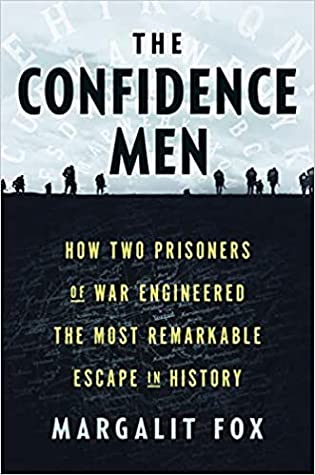
The Confidence Men, by Margalit Fox****

This stranger-than-fiction story of two World War I captives, one an English officer, the other Australian, that trick their way out of a Turkish prison camp via a long, elaborate con centered on a Ouija board is compelling and at times, funny as hell. My thanks go to Net Galley and Random House for the invitation to read and review. This book is for sale now.
The beginning is grim; grim enough that I abandon this story twice before ordering the audio version from Seattle Bibliocommons to help me get over the hump. There’s torture, deprivation, and every ugly thing that the notion of an enemy prison brings to mind. I am especially horrified because I thought this book was going to be funny! Reader, it is, but you have to get past the grim and at times, dull beginning to get to the amusing bits. Somewhere between the fifteenth and twentieth percentiles, the shift occurs, and that’s when you can expect to enjoy yourself. You may want to skim a bit through this part; I do, and it works out well.

Harry Jones was an attorney before the Great War commenced; Cedric Hill was an Aussie auto mechanic. Once captured, the two have no chance at all making a conventional escape; the camp is too isolated for either of them to get anywhere, even if they were able to leave. Instead, what they have is nothing but time, and ultimately, that and their excellent imaginations and problem-solving skills, aided by some genuinely stupid captors, is what saves them.

The most impressive aspect of their scheme is that it takes place over a very long period of time. Not many con artists would be able to keep their story straight for so long. Jones and Hill have a great deal of self-discipline and organizational skill. Also, they’re afraid, and fear can improve one’s consistency and attention to detail. Once the meat of the story begins, it is absolutely riveting!

I flipped back and forth between my digital galley and the audio version. Both are equally good, but I would give a slight edge to the audio version, assuming the reader is primarily seeking entertainment. For a researcher, the print version is better for keeping details and sources straight.

Recommended to those that enjoy history and intelligent humor.

Let’s Do Dinner, by Antoni Porowski

I’ve got a soft spot for cookbooks. Some are useful, and some are less practical, but fun to read anyway. Fans of Antoni’s television programs can hardly go wrong with Let’s Do Dinner, but his work is new to me. My thanks go to Net Galley and Mariner Books for the review copy. This book is for sale now.

The promotional blurb for this cookbook tells us that some of these recipes will be decadent, whereas others are designed for weekday dining. Apart from a couple of nice egg dishes (omelet, scramble,) I don’t see anything here that I would make. Some involve great loads of dishes, and others involve unusual flavor combinations, and I am a coward. That being said, I am plainly not his target audience. I suspect that his cooking tips are geared toward the young and childless; I, on the other hand, am a Grammy. For me, this cookbook is more of a three star read—the sort of thing I’d browse through, but wouldn’t spend money on. However, for twenty-and-thirty-somethings, I suspect the appeal will be greater, perhaps a four star read, and for his loyal fans, five stars.

I recommend this cookbook to Antoni’s fans, and to the young and adventurous cook that wants to try new things.

Another Kind of Eden, by James Lee Burke****

James Lee Burke is a living legend, a novelist who’s won just about every prize there is, and whose published work has spanned more than fifty years.  My thanks go to Net Galley and Simon and Schuster for the invitation to read and review. This book is for sale now.

Another Kind of Eden is a prequel to Burke’s Holland family trilogy. The time is the 1960s, and protagonist Aaron Holland Broussard is in Colorado working a summer job. He falls in love with a waitress named JoAnne, but there are obstacles to their happiness everywhere he looks. There’s a charismatic professor that won’t leave her alone, a bus full of drugged-out young people that have fallen under his influence, and of course, there’s corruption among the local wealthy residents, which is a signature feature in Burke’s work. Aaron is a Vietnam veteran, and he has residual guilt and grief that get in his way as well. He’s got some sort of an associative disorder, though I am not sure that’s the term used; at any rate, he blacks out parts of his life and cannot remember them. He also has anger issues, and he melts down from time to time; there’s an incident involving a gun that he forces a man to point at him that I will never get entirely out of my head, and kind of wish I hadn’t read.

I had a hard time rating this novel. If I stack it up against the author’s other titles, it is a disappointment; a lot of the plot elements and other devices feel recycled from his other work, dressed up a bit differently. But if I pretend that this is written by some unknown author, then I have to admit it’s not badly written at all. By the standards of Burke’s other work, it’s a three star book; compared to most other writers, it’s somewhere on the continuum between four and five. Since I have to come up with something, I decided to call it four stars.

All that being said, if you have never read anything by this luminary, I advise you to start with one of his earlier books–almost any of them, actually.

The Eagle’s Claw, by Jeff Shaara*****

Shaara is one of my favorite authors, and so I was delighted when I received an invitation to read and review. My thanks go to Net Galley and Random House Ballantine; this book is for sale now.

Like everyone else, I bring my own experiences and biases to this novel, and this one is a potential hot potato. I am married to a Japanese citizen, and my in-laws still reside in Japan. The implicit, and at times overt racism that many authors bring to this topic—the Pacific theater of World War II, between the U.S. and Japan—ruins my mood for days, and consequently, I won’t even go near most nonfiction or historical fiction that focuses on this aspect of American history. When Shaara published To Wake the Giant, I signed on to read and review with great trepidation; I was afraid that I would not only hate the book, but emerge from it unhappy enough to abandon the author entirely. Imagine my delight when I found the opposite was true.

Shaara’s signature format is to portray the events that unfold through the eyes of key participants, delivering staggered narratives that include admirals and pilots on both sides as well as a code breaker on the American side. Shaara sticks to the truth, and by now I know this, so I’m not distracted by the need to fact check information that is new to me. His research and attention to detail is matchless, and his capacity to develop characters on the page makes me feel I would know these men if I ran into them on the street. My review copy, sadly, did not have the maps added, merely noting on what pages they would later be added; however, I once more defer to this author’s track record. I would bet my last dollar that the maps are also excellent.

One aspect that is usually a deal breaker for me is the frequent use of the period’s predominant racist slur, when Americans mention the Japanese. There are three syllables in this word, and they should be used. For those that plead that the one syllable word is authentic to the time and place, I would invite them to imagine a similar tale featuring a hypothetical African enemy during the same time period. What would be the expected, authentic term by which Caucasian Americans would refer to such enemy combatants, and to the government from which they hail? For the obtuse, I’ll tell you, it would be the N word. So would you just go ahead and drop it in there for the sake of accuracy, or would you use greater sensitivity and explain the alteration in an author’s note? You’d do the latter. Of course you would. In fact, likely it would be the only way your novel would see the light of day, and rightly so.

But here as well, Shaara gets a pass from this reviewer despite his use of the term I abhor, and the reason is his candor, addressing the racism of the time period right up front. Though you might think it obvious, I have never seen a successful author of World War II historical fiction do this, and he is absolutely clear about it. In fact, I began highlighting the introduction—don’t skip it! And when it was done, I found I had highlighted nearly all of it.

Whether you are drawn to this book from a love of history and the desire to learn a few things painlessly, or for the escapist entertainment that great novels provide, you can’t go wrong here. This is a damn fine book. I highly recommend it to everyone.

The Prison Letters of Nelson Mandela*****

This magnificent collection took 10 years to organize, collecting Madiba’s letters from the many points where they were received, and from the prisons–where many of them were not mailed out, for various technical reasons that were a poor disguise for censorship. The preface suggests that most people will want to flip through it rather than reading it cover-to-cover, but I am a habitual cover-to-cover sort, and so I read the first 50 pages in sequence. And the book’s editor is correct. This is not a cover-to-cover read.

Nevertheless, I am struck immediately by the dignity with which Mandela communicates with his captors. Time and again he writes to them in a courteous, civilized, and highly educated hand about the various ways in which his rights under South African law are being violated and what he is requesting they do to remedy it. He is persistent. He forces them to treat him as a human being. Mandela was an attorney, but he was also possessed of social instincts that nobody can teach anyone. And although I never met him, everything I have read–which is a good deal, where this man is concerned–convinces me that he was also a very nice person.

This is a tome, and it’s a treasure. I am glad I was denied a galley because this is the sort of volume I want as a physical copy. In the end my son purchased it for me for my birthday, and so I thank Benjamin. What a treasure.

If you are looking for just one book about Mandela’s life, read his hefty autobiography, Long Walk to Freedom. However, if you are a collector of books about South Africa, or about civil rights in general, or of course, about Nelson Mandela, go out and get this book now.

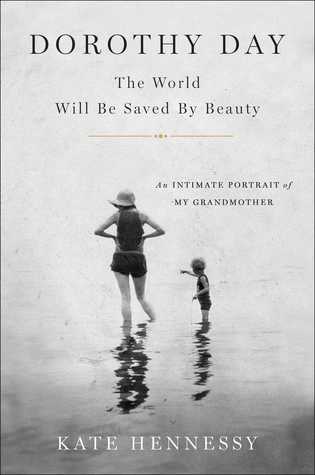
Dorothy Day: The World Will Be Saved By Beauty, by Kate Hennessy***

dorothydayDorothy Day is an interesting historical figure, the woman that founded The Catholic Worker, which was initially a combined newspaper, homeless shelter, and soup kitchen. I once subscribed to The Catholic Worker, and since it cost one penny per issue, you couldn’t beat the price. I saw this biography available and snapped it up from Net Galley; thanks go to them and Scribner, who provided me with a DRC in exchange for an honest review. This title was published in late January and is now available for purchase.
I always had a difficult time getting a handle on what The Catholic Worker stood for. The name suggests radicalism, and indeed, Day was red-baited during the McCarthy era. Day was a Catholic convert and a strong believer in sharing everything that she had with those that had nothing. She worked tirelessly and selflessly, and despite often living an impoverished existence somehow made it into her eighties before she died, an iconic crusader who became prominent when almost no women did so independently—though she was no feminist, and believed that wives should submit to husbands. Since her demise, speculation has arisen as to whether she might be canonized.

What was that huge crash? Was it a marble statue being knocked the hell off its pedestal? Hennessy takes on the life and deeds of her famous grandmother with both frankness and affection. In the end, I came away liking Day a good deal less than I had when I knew little about her. Her tireless effort on behalf of the poor included anything and everything her very young daughter had in this world, and at one point she remarked that she felt unable to ask others to embrace a life of poverty if her child wasn’t also a part of that. It was a different time, one with no Children’s Protective Service to come swooping down and note that the child was sleeping in an unheated building in the midst of frigid winter; that there was no running water, since the building was a squat; that the only food that day was a single bowl of thin soup and perhaps a little hard bread donated from the day-old stores of local bakeries; that even small, personal treasures and clothing given the child by other relatives and friends would either be stolen by homeless denizens or even given away by her mother, a woman with the maternal instincts of an alley cat. Day did a lot of good for a lot of people, and no one can say she did it for her own material well being, but she more or less ruined her daughter’s life, and even when grown, Tamar’s painful social anxiety and panic attacks derailed her efforts to build a normal life for herself.

Nevertheless, the immense contribution that Day made at a time when the only homeless shelters were ones with a lot of rules and sometimes religious requirements cannot be overlooked. She is said to have had a commanding presence, endless energy (and the mood swings that accompany such energy in some people), and a mesmerizing speaking voice. Day’s physician also treated the great Cesar Chavez, and reflected that their personalities were a lot alike.

I confess I was frustrated in reading this memoir, because I really just wanted the ideas behind the Catholic Worker laid out for me along with the organizational structure. Was the whole thing just whatever Day said it was at the moment, or was there democratic decision making? I never really found out, although I gained a sense that the chaotic events shown in the memoir reflected an unarticulated organizational chaos as well. This is a thing that sometimes happens with religious organizations; the material underpinnings are tossed up in the air for supernatural intervention, and the next thing they know, there’s an ugly letter from the IRS.

Only about half of this memoir was actually about Day; my sense was that the author did a lot of genealogical research and then decided to publish the result. The first twenty percent of the book is not only about Day’s various romantic entanglements; a significant portion of the text is mini-biographies of those men, and frankly, I wasn’t interested in them. I wanted to know about Day. Later I would be frustrated when long passages would be devoted to other relatives and their lives. Inclusion of daughter Tamar was essential, because Dorothy and Tamar were very close all their lives and shared a lot, and so in some ways to write about one was to tell about the other. But I didn’t need to know about Day’s in-laws, her many and several grandchildren, and so on. I just wanted to cut to the chase, but given the nature of the topic, also didn’t want to read Day’s own writing, which has a religious bias that doesn’t interest me.

Those with a keen interest in Dorothy Day and the Catholic Worker may want to read this, because not many books are available that discuss her life and work. On the other hand, I don’t advise paying full cover price. Get it free or at a deep discount, unless you are possessed of insatiable curiosity and deep pockets.

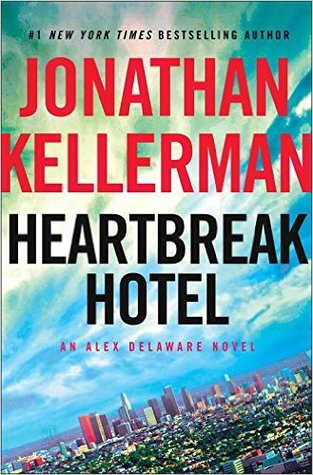
Heartbreak Hotel, by Jonathan Kellerman*****

heartbreakhotelThis is #32 in the Alex Delaware series, and Kellerman’s writing just seems to get better with every entry. Thanks go to Net Galley and Random House Ballantine for the DRC, which I received free in exchange for this honest review.

For those unfamiliar with the series, Alex Delaware is a semi-retired child psychologist who’s also an adrenaline junkie. His nest is already well padded, his wife still happy in her career, and so he spends most of his time assisting his best friend, an LA homicide detective named Milo Sturgis. The premise is the hardest thing to swallow, but Kellerman makes it easier by letting us know how affluent Delaware is, and recently there’s the added twist that because Sturgis is gay, nobody on the force really wants to be his partner. Thus it seems more natural—for the sake of a good yarn—for Delaware to slip into that position. After all, he’s been doing it for years.

This story involves the homicide of a nearly one-hundred-years-old woman that has consulted Delaware. She paid him generously for his time but confided little about what she planned to do with the information he found for her, and so when she is found dead in her bed, he smells a rat. Sure enough; she was suffocated! Now who would do that to a sweet old lady like Thalia Mars?

Our story takes a million deft twists and clever turns, and in general shows us that what we think we see isn’t always real. We encounter some underhanded, sleazy real estate practices as well as insurance fraud along the way. The case also takes in some interesting LA history.

One aspect of Kellerman’s work that I often forget and then am happily surprised by all over again, is the humor he threads through the narrative, and I laughed out loud more than once.

Although it’s only one page in length, some readers will also want to be aware there’s one graphic, brutal rape. Consider your trigger warned.

At the end of the day, stories such as this one can be curiously comforting. It’s true that tax season is just around the corner, and my toaster just died. But after reading this novel, I can find comfort in knowing that no villains are likely to turn up in my bedroom tonight and burk me in my sleep.  Perspective! There you have it.

This fun story, which went by way too quickly, will be available to the public February 14, 2017. Highly recommended to those that love a good mystery.

Bluff, Bluster, Lies and Spies, by David Perry*

bluffblusterliesThe American Civil War is part of the curriculum I used to teach, and in retirement I still enjoy reading about it. When I saw that Open Road Media had listed this title on Net Galley to be republished digitally this summer, I swooped in and grabbed a copy for myself. I was so eager to read it that I bumped it ahead of some other DRCs I already had, and I really wanted to like it.  Unfortunately, this is a shallow effort and it shows.  Don’t buy it for yourself, and for heaven’s sake don’t advise your students to read it.

It begins gamely enough with a discussion of events in Europe and how the changing contours of that part of the world affected the attitudes of England, France, Russia, Prussia, and Spain. At this point my curiosity was piqued, because I had never read anything about which side of the Civil War the last three of these countries favored.  But if the rest of the text can be believed—and parts of it cannot—the reason we never hear about Russia, Spain, and Prussia with regard to this rebellion is that they decided they had no stake in its outcome. This part of the text could have been dealt with in one sentence rather than owning a share of the introduction and being dragged in again later, but this is not the only bit of obvious filler that burdens this misbegotten book.

I am tantalized initially when Perry brings in a controversy that does interest academics: would Britain have recognized the Confederacy in order to get cotton, or was it busy with other considerations and willing to obtain cotton from colonial holdings in Egypt, India and elsewhere for the duration? This question is discussed, leaves the narrative and is broached again several times, because although the book has chapters, it isn’t organized. The same topics of discussion, and the same quotations that serve as its meager, questionable documentation are dropped into the text again and again. It’s as if Perry doesn’t expect anyone to read it all the way through and is hoping we will drop into the middle of the book somewhere to look up a fact and then leave again without seeing whether he actually knows what he’s talking about.

He doesn’t.

For example, after citing the same obscure document for pages on end—since I read it digitally, I highlighted “Dispatch 206” seven times before noting that this section, at least, is garbage—he brings up Poland. He talks about Poland and Russia’s attachment to same as a buffer state, but never shows any relationship between Poland and the American Civil War other than that Russia had other greater priorities at this time, which had already been established in an earlier section.  And he misuses the term “Manifest Destiny”. Perry apparently believes this term has equal use to multiple governments in reference to themselves around the world.

He tells us that privateers are outlawed during the Civil War and infers that this, therefore, will surely mean that all the sad pirates will dock their ships and get honest jobs. No more privateers out there now, matey!

He says that Lincoln was a slow thinker, and he refers to American diplomats as ditherers.  He documents none of it.

I read the citation section to see if more joy would be had if I pursued this book past the halfway mark. I read his author bio, which indicates no expertise regarding this conflict, which by now doesn’t surprise me.  Frankly, I don’t understand why this book ever saw the light of day, or why Open Road would republish it.

I would love to say that those with deep pockets should go ahead and order it if they can afford all the books they want, but I can’t even say that. The book is unreliable, disorganized, and badly documented. It contains falsehoods and insults the reader’s intelligence.

Put your plastic away. This is dross.

You Can Have a Dog When I’m Dead, by Paul Benedetti***-****

youcanhaveadogwhenThis is a collection of funny stories and brief essays. It’s geared for the Boomer generation, and is billed basically as bathroom reading. Thank you to Net Galley and Dundurn Press for the DRC, which I received in exchange for this honest review. I rate this book with 3.5 stars and round it upward; it will be available to the Canadian public –and presumably anyone anywhere that wants to buy it digitally—February 17, 2017.

I confess I made an assumption when I saw the title. I was expecting jokes and essays dealing with man’s best friend; actually, I find very few stories related to dogs, but an unexpected number related to death. Of course, many of the essays are not humorous, but of a more reflective nature. This is all well and good, and the quality of the writing is worthy of such a sobering topic. But when I saw the book billed as being similar to the work of Dave Barry, I wasn’t anticipating reflections on my own mortality. I was expecting jokes.

That aside, there are indeed some very funny pieces here, and although I am on the borderline in terms of being in—or out—of the Boomer generation, a lot of the humor does resonate. I love seeing Benedetti try to explain a home phone to a young person:


“I should probably explain to anyone under thirty that a home phone is an actual device about the size of a toaster that remains in your house. The reason you cannot take it with you to the bar, to your class, and into the toilet, where I’m sure you’re receiving very important calls, is that it’s attached by wires directly to the wall in your house.”


I enjoy the piece on his garden, and about his elderly mother’s dance class.  I am disquieted to learn that every person, real or imagined, in any of these stories is assumed by the writer to be Caucasian.

I also find myself wondering why every story has to have booze in it somewhere. Wine, beer, whiskey, Bailey’s, more beer, more wine, gin, Kahlua…what’s up with this?

Should you pick up a copy for yourself? I suppose that depends upon what the purchase price looks like and how much time you spend at home. If it’s affordable and you are retired, you might like to have it. If the price tag is hefty, you may want to wait.

But I imagine Mr. Benedetti would prefer you to purchase it before you get that dog. Because…yeah.


The Signal Flame, by Andrew Krivak*****

thesignalflameThere are good writers, excellent writers, and of course, indifferent writers, but once in a rare while there’s a writer that makes me sit up straight and take notice, someone with that special spark of genius that no money can buy nor school can teach. Krivak’s work is exquisite, the product of both power and restraint. If you love historical fiction, you have to read this book, which comes out January 24, 2107.

I was lucky and read it free in exchange for an honest review, thanks to Scribner and Net Galley. If you read my last review of a DRC, you know I call them as I see them; I see this one as standing, at the end of 2017, as one of perhaps a dozen that will still shine after I’ve read between one and two hundred others.

Bo, our protagonist, is the grandson of Slovakian immigrants, and has been steeped in the tradition of those that came before him. His grandfather, Jozef, served in the trenches during World War I; Jozef’s son, Bo’s father, was imprisoned for desertion during World War II and then died in a hunting accident upon his return home. Bo’s grandparents and mother have raised him and his brother Sam, who is missing in action in Vietnam. When Jozef dies, Bo is the last man left to carry on the family business and the traditions with which he was raised.

The title of the book refers to the sign for which Agamemnon was to watch for news from Troy; the book is begun with the relevant quote from Aeschylus, an old friend in literature that I hadn’t visited in nearly 40 years. I tell you this not to intimidate you, because I think this text is accessible to most high school graduates that love good literature. No, I just want you to understand that this is a work of depth and quality…and also unending sorrow.

Hannah, Bo’s mother, has been writing to the Navy twice each month for updates about the status of her missing son. Without a body, she doesn’t feel free to mourn; without a notification of death, she holds on to a tiny filament of hope that Sam may come marching home and surprise them all, any day now. Foremost in everyone’s minds is that Sam must not also be considered a deserter.

Now President Nixon speaks of ending the war with honorable peace, but there can be no real peace for Hannah; the Navy sends the same response every time she writes, “informing her that Sam was still carried in a missing status. Like he’s in a box somewhere, she would say, and the marines just haven’t gotten around to opening it yet.”

Father Rovnavaha is their parish priest, but he is also an old, dear family friend, and as he lays to rest two generations of a local family that are killed in a terrible flood, he seeks to comfort those present, perhaps himself included, by speaking of a kingdom, but Hannah has trouble believing as she once did:


“Her faith was once that strong, but she doubted it now, doubted not that there was a promise but that the promise claimed was a gift to hold, a joy that could assuage all sadness. No, she had come to believe that the only thing one could be certain of was loss. The loss of others as one lived on.  Loss as the last thing one left behind.”


Bo’s inheritance takes him in directions no one could have foreseen, and so although Krivak’s novel is indeed full of loss, it also shows us that hope can come from a direction never anticipated.

The characters here are beautifully rendered, developed so subtly that we aren’t aware of it occurring until it’s accomplished. There are no heavy-handed devices such as diaries or extensive local gossip; we see who each person is by the things that they do, and just as in life, we know who they are not only by their words, but by their actions. Krivak never lets a stereotype embrace his characters or plot; the result is so genuine that I feel I am following a dear old friend through the narrative.

Highly recommended for those that love historical fiction, as well as for anyone that needs an excuse to sit down and have a good cry.