American Socialist, by Shawn Gude*****

I first heard of Eugene Debs as a college student in the late 1970’s. Since that time, Debs has been one of my most revered heroes, the U.S.A.’s first popular Socialist, a dynamo who held to his principles even when jailed for his beliefs and his speeches, who ran for president from behind bars. His health was broken in the process, but his integrity held. And the period in which we live today is the perfect time for a popular biography of a leader from whom we can learn. I am thrilled that Shawn Gude has given us the opportunity by writing American Socialist: The Life and Legacy of Eugene V. Debs.

My thanks go to NetGalley and Simon and Schuster for the review copy. This book is for sale now.

Debs grew up in Indiana in a middle-income home, the child of a scholarly father and forward-thinking mother. Against his parents’ wishes, he left school at age 14—which was not unusual back then—to go to work on the railroad to help with the family’s expenses. He was hardly a fire-breathing radical. His boss was relatively benign, and when he helped found the working men’s organization associated with the railroad, it was more of a benevolent society than a union. In fact, he opposed the first railroad strike he heard of; but as time marched forward and the greed of the owners, known soon as “Robber Barons,” his ideas changed. When the depression of 1873 saw many left jobless, and those that were retained had their wages cut, then cut again until families began to starve, Gene recognized the need to organize and fight back.

At this time, strikes were brutally repressed; railroad owners would demand militias intervene, and innocent bystanders, including children, were sometimes mowed down, shot dead for throwing rocks and jeering.

Gene entered the political arena as a young man; his first elected position was city clerk in Terre Haute, Indiana. As union battles grew and the public became even more sharply polarized, he became more invested in the lives of working people. As he learned more of the connection between social struggles and those of the working class, he became a supporter of women’s suffrage as well as the rights of Black people, and received warm support in his campaigns from a number of their newspapers and political organizations; they quoted his speeches in their press, and he in turn often quoted W.E.B. DuBois, a leader of the Black struggle. Both DuBois and Debs, in turn, celebrated the achievements of the Russian Revolution, which Debs correctly called the first democratic government in the world.

He stood against the U.S.’s entry into World War I; the Espionage Act made it illegal to publicly oppose the war, and for this, Debs was jailed. He ran for president while in jail, and when some people wondered whether it would be wasteful to cast their votes for a candidate that had no chance of winning, he responded with a quote that this reviewer has repeated often for decades: “It is better to vote for what you want and not get it, than to vote for what you want and get it.”

I shake my head when I run across the many, many occasions in which Debs mixes Christianity and Socialism, which logically collides with the dialectical materialism at the base of scientific Socialism; apparently author Gude has no issues with it, however, or at least he doesn’t say so. But ultimately, Debs was the hero that we sorely need now; he would certainly not have opted to be photographed shaking hands with Wilson or Roosevelt, as the more reformist DSA politicians of today do with the current president, even while waving the Socialist banner.

Those that have any interest whatsoever in socialism, labor history, or alternative political ideas in general should get this book and read it. I’m glad I did.

Fallen for France, by Elizabeth Lett*****

Elizabeth Letts is a formidably talented author. Her credits include Finding Dorothy, which is one of my favorites, along with the excellent biography, The Ride of Her Life. Now she’s written a story set in Morocco and France during World War I, Fallen for France, and it does not disappoint.

My thanks go to NetGalley and Ballantine Books for the review copy. This book is for sale now.

There are three protagonists in this story, and they are connected by a beautiful Arabian horse that each of them cares for in turn, each considering themselves to be its rightful owner and protector. Ultimately it is the horse that draws the three together.

Beddou is a child that is apprenticed at an early age; once he leaves home, his master turns out to be cruel and unprincipled, but along the way, Beddou finds the Arabian mare and it becomes his reason for living. Later, it is stolen by a soldier and becomes a war horse; Beddou continues to search for it.

Estelle is a young woman whose parents have died, and she is left to care for her disabled brother. One day she finds the mare near her home in a distressed condition, and she vows to care for it, too. Eventually, however, the war claims both her brother and the horse, and her story throughout almost all of the book is her quest to find them.

Thomas is an Englishman who serves as a veterinarian during the war. He meets Estelle, and he encounters the horse as well. And so, it is through the horse that these main characters are woven together, finally connecting at the book’s conclusion.

This is not an easy read or a simple one; there are a lot of details and moving parts. Because I was running late, I used multiple formats to read it, using both the digital review copy and the audio version that I checked out at my local library. The narrator does a find job with it, but because it is so complex, I found that I needed to refer to the digital copy often just to see where I was and what the heck was going on. Hardcore audiobook lovers will likely find their way through this excellent tale just fine, but for those like me that are primarily oriented toward the written word, I recommend the digital or bound copy over the audio, unless you choose to combine them, as I did.

Before closing, I would like to commend the author for her choice of setting. Those of us in the United States read an awful lot of books set in some part of our own country, with other English-speaking countries a distant second and the rest of the world seen dimly and infrequently.

For those ready to devote the time and attention to this outstanding novel, it is highly recommended.

The Road Less Traveled, by Philip Zelikow***

Is this going to be on the test?

My thanks go to Net Galley and Public Affairs for the review copy. This book is for sale now.

I am initially drawn to this title when I see the subtitle—an opportunity to make an early peace that went unanswered—and I also want to read more about World War I. I love military history, and am sick to death of World War II material, so this felt like it might be a breath of fresh air.

Or not.

There is no doubt that Zelikow knows his field, and his research is above reproach. Students and researchers may find this book useful, albeit with a careful eye toward a very conservative point of view that affects his analysis. However, for those of us just in it for the joy of learning, I must caution that this is a slog. I read the first half in the digital format I was given, and after publication, I also availed myself of the audio version available at Seattle Bibliocommons, and it’s difficult to focus on either for long at a time, because it’s just Zzzzzzzz

Oh, I’m sorry! Was that me? Let me try again. The research is splendid; the analysis is reactionary; the presentation is a little zzzzzzzzzzzzzzzzzzzzzzz

I might have spared myself some frustration had I researched the author. Once I was able to focus long enough to get a feel for his political leanings, I ran a brief Google search, and discovered he’d been with the U.S. State Department under the Reagan and Bush administrations.

Oh.

At this point, you know enough to decide whether you want to read this thing. If you have a strong interest in the topic and aren’t squeamish about drawing information from the far right, then this is your book. Not mine, though.

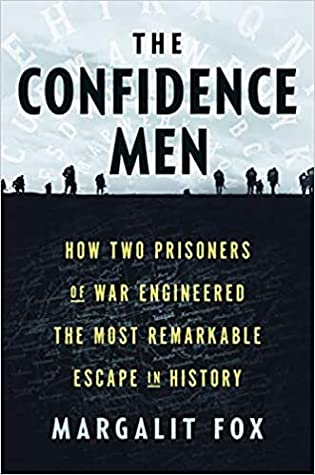
The Confidence Men, by Margalit Fox****

This stranger-than-fiction story of two World War I captives, one an English officer, the other Australian, that trick their way out of a Turkish prison camp via a long, elaborate con centered on a Ouija board is compelling and at times, funny as hell. My thanks go to Net Galley and Random House for the invitation to read and review. This book is for sale now.

The beginning is grim; grim enough that I abandon this story twice before ordering the audio version from Seattle Bibliocommons to help me get over the hump. There’s torture, deprivation, and every ugly thing that the notion of an enemy prison brings to mind. I am especially horrified because I thought this book was going to be funny! Reader, it is, but you have to get past the grim and at times, dull beginning to get to the amusing bits. Somewhere between the fifteenth and twentieth percentiles, the shift occurs, and that’s when you can expect to enjoy yourself. You may want to skim a bit through this part; I do, and it works out well.

Harry Jones was an attorney before the Great War commenced; Cedric Hill was an Aussie auto mechanic. Once captured, the two have no chance at all making a conventional escape; the camp is too isolated for either of them to get anywhere, even if they were able to leave. Instead, what they have is nothing but time, and ultimately, that and their excellent imaginations and problem-solving skills, aided by some genuinely stupid captors, is what saves them.

The most impressive aspect of their scheme is that it takes place over a very long period of time. Not many con artists would be able to keep their story straight for so long. Jones and Hill have a great deal of self-discipline and organizational skill. Also, they’re afraid, and fear can improve one’s consistency and attention to detail. Once the meat of the story begins, it is absolutely riveting!

I flipped back and forth between my digital galley and the audio version. Both are equally good, but I would give a slight edge to the audio version, assuming the reader is primarily seeking entertainment. For a researcher, the print version is better for keeping details and sources straight.

Recommended to those that enjoy history and intelligent humor.

Celebrate Women’s History Month With This Terrific New Release

I reviewed this excellent novel in January, based on a true story of American women that travel to France to help civilians during World War I. If you haven’t checked it out, have a look by clicking the link below the picture.