We Are Not Ourselves, by Matthew Thomas *****

WearenotourselvesA haunting, epic story that stays with the reader long after the final page has been turned; Thomas has created a masterpiece. Thank you once and once again to Net Galley and Simon and Schuster for the ARC.

When I saw that some goodreads reviewers had marked this book at three stars, at first I wanted to grab those people, shake them by the shoulders and ask, “What is wrong with you?”

But eventually, I came to understand, or at least I believe I do, what it was that bothered them. Our protagonist is not always a lovable one. She’s deeply flawed and hard to bond with. Those who equate a lovable character with a well written book may indeed be disappointed, not only by this story, but by many of the Great Books.

As for me, I am impressed. My measure of extraordinary literature is that I am still thinking of, or even wishing I could have a conversation with the main characters after I have finished reading. I’ve moved on to other books, and yet this one remains with me. Aw, geez; poor Ed. We didn’t know. And what’s up with Connell, anyway? It speaks to me on a deeply personal level as I find myself comparing my own family and relationships with the Leary family. Given that I am a reader who absorbs a dozen books a month and sometimes more, this says a great deal.

Our protagonist is Eileen, who grows up in an Irish immigrant family that cuts across the typical large, boisterous, poor-yet-loving stereotype of the New York Irish. Instead she is the only child in a chilly, quiet apartment. Relationships are often strange and distant despite the fact that her parents love each other and her. The second bedroom is taken, for most of her childhood, by a tenant. Her father is a genial man, well loved among the Irish workingmen’s community, a union man and a hard drinker. Her mother is lonely, hardworking, and bitter until she also takes to drink; yet her parents don’t drink together, but apart. The only fun time is when relatives from Ireland come across the ocean and spill over into her family’s wee apartment as their final pit stop before finding a place of their own.

Eileen grows up knowing that she wants more.

As her hormones work their alchemy and her body grows and changes, she becomes disarmingly beautiful, and she understands that marriage may be her ticket to better things. Once she finishes college and becomes a nurse, she wants to marry a man of great capability and ambition. She believes she has found him when she meets Ed, a brilliant young scientist with a promising career ahead of him. Between the two of them, they ought to be able to bring in the money needed to live the good life. By the time children come, he should have climbed far and high enough that she can stop working and be happily domestic in a magnificent home. It is the dream of the 1950’s, though she wants something a bit finer than a suburban house with a picket fence.

Eileen’s grasping nature and her harsh behavior, at times, toward Ed and their son are off-putting. When their only child brings home a test marked 95%, her husband exudes praise while she asks what happened to the other five percent. I cringe. At times she seems to understand that she is showing no more warmth than her own mother did, yet the habits are ingrained. She does not reach out for the hug, does not easily part with praise. And as it becomes clear that her goals and Ed’s are not really the same, the marriage begins to founder.

The harder she pushes, the more irritated I grow with her. It’s like watching a relative who is bent on self ruin; I want to talk her out of this. I want to hit the “escape” key for her. I want her to be more empathetic, more flexible. But the one thing I absolutely don’t want to do is put the book down.

Then the unthinkable happens, not at all what I expected though, and everything that has gone before takes on new meaning. As events unfold, Eileen must change also.

To say more would be to spoil the read, and you should read it. Happily, this is one book that works just fine on a digital device, and I am grateful to the publisher and Net Galley for letting me read it that way. But if you are a reader who needs the tangible object in your hands, I will tell you that this is worth investing in. All you need is an attachment to excellent literature.

Absolutely brilliant. I look forward to seeing more of Matthew Thomas’s work in the future!

Six Million Accusers: Catching Adolph Eichmann, by D. Lawrence-Young *****

sixmillionaccusersPlease lower the safety bar in front of you, and make certain your belt is securely fastened. We will be traveling at an astonishing rate of speed; keep your hands firmly on your book or digital reader. As you finish Six Million Accusers: Catching Adolph Eichmann, you may be disoriented and need to remind yourself where you are and what day it is. It’s that gripping.

My deep gratitude goes to Mr. Lawrence-Young, his publishers, and NetGalley for letting me read and review this amazing novel.

David Lawrence-Young packs a powerful story into a well plotted, brilliantly paced narrative in order to tell the story of the capture of Adolph Eichmann, one of the nastiest and most powerful Nazis responsible for the deaths of six million Jews in eight nations, not to mention millions more who were Gypsies, political opponents, disabled, gay, or who were mistaken for somebody else. And of course, these numbers don’t include those who died in the battlefields, seas and skies of the European theater of World War II. Only Hitler and Himmler were above Eichmann in the fascist pecking order.

Because story is such a potent vehicle for the truth, the author has chosen historical fiction over a more expository nonfiction format. I think he chose well. He has a long list of previously published books that precede this one, from Shakespeare to an English textbook to other works of historical fiction, but he says this one was the most difficult, and I believe it. As is true of the finest writers of this genre, he has a bibliography at tne end of his work to let us know that the story is absolutely true; he has filled in the cracks by inventing the dialogue instead of paraphrasing as he would have to do with a work of nonfiction, but this is the real deal nevertheless. This is what happened.

Once this was made plain (I always read the introduction, and I also read the author page before I begin), I dug myself into my favorite reading corner and prepared to concentrate, convinced that while compelling, the historical journey would require full focus and strong literacy skills. I was surprised to find that he wrote in a manner that will be accessible to just about anyone who wants to read it, and the need to focus is moot, because from the get-go, he has our eyes and full attention automatically. The pace builds in a glorious arc, reaching breakneck speed as we close in on Eichmann along with the team of spies and undercover representatives of Israel’s government.

The questions that arose in my mind were answered. Given that these agents slip into Argentina with the assumption that they will need to act outside that nation’s unfriendly rules of law, and are essentially going to kidnap Eichmann, I wondered why the fuss. If they were willing to go that far (not that they shouldn’t), why not just sail in under a black flag and cap him behind the ear? Why all the fuss and bother to smuggle him back to Israel to be tried?

And it became clear. Many other SS officers were dealt with in the manner I had been thinking of, but this man was so utterly symbolic of the Holocaust that the world had to see him tried, and Israel and her people had to lay out the facts, document them irrefutably, and wisely so, because half a century later would come the Holocaust deniers who would want to pretend the whole thing was a hoax, sham, or exaggeration, and the Nuremberg Trials make it much harder for anyone to do so.

A thing that gave me great pleasure was reading about the agents, including our nominally fictitious protagonist, Haim, who DID get out of Germany or other parts of Europe in time to avoid arrest, torture, and maybe death.

I was surprised, and surprised to be surprised, about the news that Israel had had to fight for its independence. As a history teacher, how is it that I did not know this? I think it’s simple. It was too recent to be in the curriculum, but since I had barely been born when it took place, I was too young to remember. And independence from Britain was important. On the surface, it looks as if they bit the hand that fed them; hey, they put up a Jewish homeland to help people escape Hitler, and now you’re going to shoot at them?

But it turns out this was very necessary. Part of Britain’s game plan was to limit how many could come out. They were more generous in their immigration policy than the USA, but that’s not saying much. Israel needed independence in order to have a nation where all Jews could safely exist. (I won’t even go into the Palestinian question which is worth many other books, a huge issue unto itself.)

Like a lot of academics, I have many Jewish friends, and though all are too young to have experienced the horror first hand, they have family stories, even legends. (“My grandmother personally rescued one of the last remaining Torahs from a burning synagogue”, a colleague told me.)

But even if I had not had their friendship, simple justice would have permitted me to sigh with satisfaction, once when Eichmann was in custody, and again when he was convicted.

Don’t just read this book; keep it. Share it with your children. The world must never, ever permit such a thing to happen again. It is by educating the next generation, and they the one after them, that we keep the neo-Nazis firmly on the fringes, which is the best place for them to enjoy the First Amendment rights they would gladly grind beneath their hobnailed boots for the rest of us if permitted to do so.

The Five People You Meet in Heaven, by Mitch Albom *****

thefivepeopleyoumeetThis book was my grief book. That may sound bad, yet you’ll note that I gave it five stars. I had unfinished business left buried deep down, while I lived an extremely busy life and dealt with other things. This book was my resolution.

My mother died while my husband was near death, and while sitting by his bedside and urgently questioning doctors and searching his medical files to see what, if anything, they weren’t telling me, my mother, 200 miles south and 80 years old, was in intensive care. She had to be a side issue. I was glad my sisters were with her when she died, but because I was so intensively involved in my husband’s care and his ultimate recovery and my own little family at home, all I had time to do for my mother was to phone her briefly to say I loved her, and have quick conversations with my sisters regarding critical decisions that had to be made.

A year and several months later, a friend and administrator at the middle school where I taught recommended this book to the whole staff, and when she asked who would like to borrow it, my hand shot up.

I should point out here that I am an Atheist. But many times, we read fiction and we buy into a premise that we would not adopt in ordinary life. So it is with Albom’s heaven, and its five greeters. And on the last page, to my absolute astonishment, I burst into tears and grieved for my mother. I had thought that I was finished grieving; after all, she was quite elderly, and had been in poor health for quite awhile; her death was hardly unexpected. But I was very much mistaken. Our mother is our mother, and it’s likely to pack a punch when she goes.

I still don’t believe in an afterlife; I put my faith in humans, and so far it’s worked out well for me. It makes sense to base our beliefs on the material world, and to realize that the bad things that do happen are due to material conditions rather than some almighty hand from who-knows-where deciding to zap us. When people tell me that everything happens for a reason, I generally don’t say anything, but I don’t believe it for a minute. Sometimes bad things just happen. Period.

But once in awhile, when a loss is powerful and visceral, it can take the edge off of the sorrow or in the case of young people who die suddenly, the stark horror, if we pretend for a little while that we will someday meet again. It’s only natural to wish for such a thing.

You will notice there’s no place on this page wherein I thank the publishers and some other source for a free galley. There wasn’t one. A friend figured out that I should read this book, and she loaned it to me. It was the right book at the right time. If you have unfinished business, or even just like a good three-hanky cry, this might be a gentle way for you to get there.


This may not be “the” grief book for everyone, but it deserves strong consideration. It is an enormous consolation for some of us when there has been too much loss at one time, and we have had to be a little too strong.

Breaking Rank: A Top Cop’s Expose of the Dark Side of American Policing, by Norm Stamper****

breakingrankDoes this look odd in my otherwise left-leaning collection? It ought to. I make no bones about the fact that I don’t like cops. I have seen it too often: the racism, the preference for protecting property over protecting human flesh and bone, the gratuitous violence. It is appalling.

Here in Seattle, the SPD has gotten so far out of control that the FBI, not exactly heroes or saints themselves, have been called in to reign them in, get the SPD to tone it down, for heaven’s sake. Don’t be so obvious about it. The recent shooting of an unarmed deaf American Indian who was plugged in the back for failing to stop-when-I-say-so, was the final straw where a lot of folks here were concerned. There was no call for anybody to shoot John Woodcarver. He was well known both among the homeless and the working crowd downtown, and one person after another testified that he was harmless. No history of any sort of violent crime; I can’t recall that he even had a record, though I can’t say I looked hard or cared. There’s never a call to shoot an unarmed man, and this was not an exceptional shooting. There’s been way too much. Furthermore, the FBI has grown frustrated with the local law’s intransigence. They mount dashcams; the cops turn them off, or point their cars facing away from the scene of action before they whip out the tasers and guns.

Just over a decade ago, Norm Stamper was the chief of police here. Prior to that, he was a cop in San Diego. During the WTO protests (World Trade Organization) in downtown Seattle, things got badly out of control. During the review that followed, Stamper’s was the head that rolled.

Rather than slink away with his tail between his legs looking for a quiet little hamlet to sheriff, he did the completely unexpected: he turned on his own. He wrote down all the dirty little secrets that he says are endemic not only here, but in pretty much every major metropolitan city in the USA. It’s endemic, he claims, and I believe.

Have you ever wondered why Black people are arrested at such a disproportionate rate? Some liberals may be inclined to write it off as a side affect of poverty and the lack of a solid foundation during childhood. (Michelle Alexander would later publish The New Jim Crow, which has all that data you need to put a stop to that lie.) Stamper says oh hell no. He has a special chapter, and it is for this chapter that the book receives my four of five stars rating, that is about why cops beat Black men. Brace yourself. He gives the code letters or names that are abbreviations for racist epithets you may have believed died in the ’60s. If so, you have led a sheltered life. Stamper proves it.

So if you can stand the heat, check out Stamper’s kitchen. It gives me joy to see one of these people come back to eat their young, and to shine a flashlight into all the dirty corners of urban police life.

A caveat from me, for those who have a beloved relative who’s in the biz: I don’t say every single cop in every city is corrupt, racist, and dirty. I only say there are too few good guys, at least those who stick around once they see what the job is really about, to make a significant difference. So relax about Uncle Tony or Grandpa Bob. If you say he is a gentleman and a hero, I believe you.

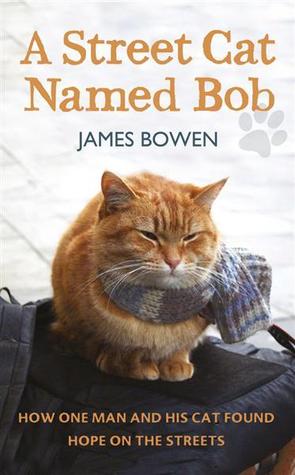
A Street Cat Named Bob, and How He Saved My Life, by James Bowen *****

AstreetcatnamedbobHow does a young man from a middle income family end up sleeping on the streets in a cardboard box, addicted to heroin?

Answer: it happens all the time. It’s closer than you think.

James Bowen does a really fine job relating, in this lovely little memoir, how it happened to him, and the role Bob, a street cat who adopted him, had in pulling him off of Methodone and toward recovery and a life in mainstream Britain.

Here’s the disclosure: I won this book through the Goodreads.com giveaways. I say this on the fifth day of my new blog with a kind of nostalgia, since this was the first book I got free in exchange for a review; it’s been just over a year since then. The review to follow is the one I originally wrote for him back then.

James Bowen’s memoir smacked me upside the head by showing me a bias I did not know I had. First, I assumed this might be poorly written, and successful in England for the content and novelty of its subject matter rather than any attendant writing skill. When I saw the elegantly simple text, the well-crafted pacing, the deftness with which the writer weaves his life’s narrative in and out of the tale about himself and his cat, I started to look for a co-author or an “as told to”. In short, I did not really believe that someone who had (as he put it) “fallen between the cracks” of society would have the skill to write this book.

Slap my Marxist mouth! I am appalled by the social Darwinist that was lurking in the shadows of my own character, and I thank Bowen for casting that particular demon out by the dumpster, where it belongs.

Bowen has a few really brilliantly descriptive passages here, but he is not a master wordsmith. What works is the continuity of the story without any pauses for maudlin self pity. What amazes and strikes deeply, at least for me, is the way he continues for an astonishingly long period of time to assume that the cat will not want to stay with him. He has taken it in, but assumes that the streets will do better for this critter than he ever could. Time and again, he offers the cat the opportunity to run away and reject him, even after he has spent nearly all of his hard-earned money gained as a street musician on veterinary care, food, and wow, even a microchip (which my own little beagle does not have). Bob has the character to stick around, though, and eventually, in a truly marvelous moment, when a well-to-do woman offers Bowen a thousand pounds for his cat, he in turn asks her the price of her youngest child.

Sometimes people who have seen life’s dark underside commit terrible crimes and take a passive voice in discussing them later. They didn’t do something, but rather, it happened. A recent headline in my home city blared that a killer had apologized for his crimes, but when I read the article, the “apology” turned out to be, “I am so very sorry for the things that happened.” Though Bowen is surely no killer, I was watching for it. I’ve worked with youngsters who have been in and around the juvenile “justice” system here in the States. They get good at distancing themselves from their own wrongdoing, seeing it as tragic but inevitable, and adults do it too. But Bowen does not do that and does not go there. Anything he did, was something he did. If it was wrong, he owns that too. It gives his writing integrity that those who feel terribly sorry for themselves cannot impart.

So here it is. This book is terrific, and you should buy it and read it. When I entered the giveaway, I signed an agreement that this review could be used for marketing purposes by the author and his agents. I wasn’t required to write it, though, and if you’ve read my other reviews, you know I never pull punches. This one was well earned, by the way the man pulled himself out of the abyss, for himself and for his kitty, and for the way he tells the story.

Good job, Bowen.

Horns, by Joe Hill ****

hornsjoehillI have to start with three things the reader should know. Then I’ll get on with it.

First, if you are looking for Stephen King II, you won’t find it here. The horror genre is the only thing I can see to connect these two gents, besides DNA. Well, if we’re picky, they both choose New England settings all or most of the time. But this writer does not use his father’s voice or style.

Second, if you have deeply held beliefs that include supernatural events, beings, and/or places, including the possibility of a bad afterlife, you may be offended by this book. He is bold, and puts it right out there in the first few pages. If you’re thinking of buying it and it may or may not push your buttons, read the first chapter before buying, or look at the first few pages online. You’ll know right away. (A taste is in the quote below).

Last but not least, if like me, you have a genuine phobia of snakes, step aside. They didn’t show themselves till the last half of the book, and I was hooked by then. If this book had been out there ten or fifteen years ago, I would have had to give it up because of them, & it would have disappointed me, because the plot is engaging and also because I paid for the book. Once they show up, they show up a lot, in vivid detail. I skimmed where I could during their scenes and read the rest a little quickly, and I got through it without the nightmares that used to plague me.

Okay. So that’s out of the way. I will tell you, I like the guy’s writing. It isn’t seamless, doesn’t mesh fluidly like the finest artists produce; I found a couple of forced elements at the end, and there is a dream sequence that is way too long and that the writer leans on way too hard to explain the list of questions he’s piled up. That said, this is a very fun ride.

The plot feels original to me, perhaps because I have never seen anyone address this subject matter with wry humor. It is cynical yet engaging. Who hasn’t wondered what hell might be like, should it exist? “Hell” is the title of the first section, and we see it immediately. Here’s a sample from page 9, which is really the third page of the story itself. He is looking at a roadside memorial, the type you see along the highway where somewhat met with mortality and their loved ones have been drawn there. It is his sweetheart that has died, and the protagonist is hung over, physically altered (title), and he sees what has been left for his beloved:

“Someone—Merrin’s mother probably—has left a decorative cross with yellow nylon roses stapled to it and a plastic Virgin who smiled with the beatific idiocy of the functionally retarded.

“He couldn’t stand that simpering smile. He couldn’t stand the cross either, planted in the place where Merrin had bled to death from her smashed-in head. A cross with yellow roses. What a fucking thing. It was like an electric chair with floral-print cushions, a bad joke. It bothered him that someone wanted to bring Christ out here. Christ was a year too late to do any good. He hadn’t been anywhere around when Merrin needed Him.”

At some point, the reader must wonder… how much of his thinking is really him, and how much of it has to do with the growths on his head? I won’t tell you, but ultimately, Hill lets us know to some degree.

If there is an echo of any writer, it is that of Michael Chabon, who is quoted twice, once at the beginning of the book, and once later, where he uses a quotation from The Yiddish Policemen’s Union about guilt. (He does not cite the work, only its writer, but I recently read it and recognized it). There is some of Chabon’s playful language and the way that he teases us with the plot, but Hill is his own writer, and it’s just as well, because no one will ever be able to replicate what Chabon does. Were Hill to try, he would find himself kneeling at the feet of the master (Chabon, not the devil, LOL).

I loved this story, warts and all, and suspect that this writer will do some really fine things in the future. As an early literary effort, this is strong.

I should add that because I am not religious at all, nothing here that is said about God or Satan disturbs me; it may be an obstacle to others, but Hill is gutsy and true to himself in his writing, even if it costs him readers. The language is crafted skillfully, and I suspect it will remain so throughout his career.

In an age of virtually unchallenged censorship, it is refreshing to see a man tell his story the way he wants to tell it.

Ballerina: Sex, Scandal and Suffering Behind the Symbol of Perfection, by Dierdre Kelly ****

Ballerinasexsufferingscandal I had originally been interested in reading ballerina Gelsey Kirkland’s 1986 expose of the ballet world, Dancing On My Grave. I’ve never been interested in dancing myself, having found out early that I was born with two left feet. However, middle age has found me reasonably well read in the areas at which I excel, and that has given me the freedom and interest to read about sports, ballet, and other things that have never been a part of my personal universe. I already know about my interests; now let’s see about someone else’s.

I became more interested when I found out that the physical therapist I’ve worked with is a ballerina with Pacific Northwest Ballet (NW USA). I was shocked! I asked her whether that wasn’t pretty terrible for the body, but she said things were changing, and indeed, although she is a slender person who walks with the distinctive grace of a ballerina, she is not emaciated, and appears to be the picture of health. So when I ran across Kelly’s e-book, given me as part of a gift bundle, I decided to have a look.

Kelly has done a lot of research, and for the most part (and in all ways central to the ballet), she really appears to know her field. She begins with the French “Opera rats” of the 1500s who were either recruited or often, promoted by their mothers as dancer-prostitutes during the dark times. (Its roots are in Greece, where fencing began.) The first publicly famous ballerina was La Fontaine, who starred in “Le Triomphe de l’Amour, at the Academie Royale de Musique, the first recorded appearance of professional ballerinas on the proscenium stage”. However, the moneyed class of men showed up for these performances, not to watch the pretty dancers, but to choose a courtesan, and the girls were taught at early ages to preen themselves to this expectation. On the one hand, those who proved themselves desirable got to eat, and so did their families; on the other, they worked like slaves, and in at least one case, a ballerina died young of venereal disease (early 1700s). Though it was possible to live at home and not become a courtesan while dancing ballet, it was unusual. This dubious opportunity had spread across Europe by the 1700’s, to Sweden, Italy, and Prussia. The French dancer Camargo created the first dancing slippers, and offered erotic promise as well as improved physical movement on the stage by moving her hemline up nearly to what fashion magazines now refer to as “ballerina length” (comparison mine, based on the photo in the book and her reference to raised skirts). Camargo also choreographed her own works, & not until I had read the full book did I appreciate how much power this represented. Guimard was the last famous French ballerina prior to the revolution.

During the “second empire” of the 19th century (a backlash against the French Revolution), Emma Livry declined to wear flame-proofing on her costume because it interfered with the other-worldly appearance she wanted to project as a Romantic dancer. (Here I found myself wondering whether the word of a 14 year old ballerina would permit the exception to be made today!)At a dress rehearsal, she fluffed her gown out and was instantly consumed in flame. She was saved by a stage hand only to live out 8 more months in horror and agony, and then die of her wounds.

“Russian ballet was rooted in the culture of the disenfranchised,” the author explains. Here is where we move off of Kelly’s turf and onto mine; she all but ignores the effect of the Russian Revolution, merely noting that there was experimentation with the dance during that period, and that the revolutionary “angry mobs” were outraged when the tsar (here I would add, as brutal a dictator as ever lived) let the peasantry freeze but sent 4 military trucks full of coal to his ballerina mistress, Kschessinska. Consequently, Lenin chose her balcony, which had become a symbol of the effete ruling class, to address his audience after the revolution. (Lenin did not revel in the luxury, but had contempt for it, using her sunken bathtub as an ashtray.) Kelly does point to changes in Russia such as “emancipation of women” and “mass democratization”, but does not comment much on how this changed ballet, apart from no longer pushing women into concubinage. I found this glossing over a bit strange, since she had just stated that Russia was the center stage of ballet; it could be she had difficulty obtaining more material. By 1931 (and Stalin), international ballet superstar Pavlova was able to dance her way to an early grave by dancing while very ill against her doctor’s wishes.

The 20th century introduced the choreographer as the new, higher power in ballet. Kelly puts more voice and less detachment into the second half of this ballet history, taking serious exception to New York’s late star director, George Balanchine, whose emphasis on frailty among his dancers and caustic remarks about the appearance of individual dancers in front of others created the toxic culture of anorexia and bulimia which gradually took over the world-wide stage for ballerinas everywhere. Numerous cited instances of ballerinas starving, yet still feeling too fat, and of instance after instance in which ballerinas were simply fired from their low-paying but hard-won positions if they attempted to advocate for themselves. Gelsey Kirkland’s memoir (the one I had originally set out to read, but couldn’t find) says that Balanchine told her “repeatedly” to “eat nothing”. Ballerinas were subsisting on coffee and chewing gum, and in addition to many other health problems, experienced more fractures because their bones had been deprived of nutrition.

One small error was the author’s nod to women’s rights issues and their effect on ballet. I understand that her realm is not feminism, but ballet, but once she decided to include it, she needed to avoid making errors. She says in this volume that “Everywhere,women were burning their bras” but this is one case where there is no citation. This is because it is myth and legend, rather than fact. Again, she has moved out of her field and into mine (contemporary U.S. and Russian history), and offered a non-fact to bolster her own arguments.

The arguments themselves are well-taken here, and are well argued in the book. Though there are progressive companies, mostly, it appears, on the US west coast and Canada, as well as Australia, where dancers are offered nutritional expertise and encouraged to envision a future without ballet, abuse and eating disorders continue. Most problematic may be that the very ballerinas who need work teaching, are those who previously starved themselves in the “old” Balanchine-rooted style, are coaching the new ballerinas and mis-teaching and mis-training them to harm their own bodies.

I won’t go into more detail about the latter half of the book, because something should be left to the reader. There are myriad outstanding quotations that make this a very interesting read.

The jury is still out, in my opinion, as to whether there is any wholesome way for a ballerina to practice and earn a living while taking care of her body. Companies that embrace modern dance, such as Alvin Alley (California, USA) seem to fare a little better, but that is my take merely from the little knowledge I have, put together with having read this book. If the history of ballet interests you, I encourage you to read it yourself.

Blind Descent, by Nevada Barr*****

blinddescentOf all of the riveting tales Barr has spun around her park ranger protagonist, Anna Pigeon, this is, I think, the most compelling (and I have read them all)! For those that want to know, it’s the sixth in a long series, each of which is set in a national park.

Have any issues with claustrophobia? If yours is intense, you may need to give this one a miss. It involves caving and spelunking, including oh my stars crawling in a tiny horizontal tunnel where five extra pounds put on over a last-minute cheesecake just could mean the end of you. Once you’ve gone miles and you can’t go forward, and your light is out…what are you supposed to do, go backwards? It’s not like it’s all one tunnel. There are places you can fall, wrong turns you can take. After all, it was not made to be entertainment, it’s a seriously bad-ass part of Mother Nature that I don’t care to think about too hard.

Now, imagine that you are on such an intense journey, and that you are Anna Pigeon (whose only really detrimental characteristic is a stereotypical view of large people…you know, lazy, poor character, untrustworthy…I said something on Barr’s website once and she responded that this is her character’s perspective, so if you are sensitive about snarky remarks regarding people who have any extra meat on their bones, beware the whole series). Okay, now with that digression aside, imagine you are Anna Pigeon, and because you are a buff, toned ranger with a good reason to do so, you have headed into one of these caving expeditions; you’re in a tight spot; and it is only there that you realize that someone on the expedition would prefer you not make it out again.

Barr’s bias against sizable people aside, her writing is otherwise so impeccably skillful that I have no choice but to give her all 5 stars. Don’t read it right before you go to sleep, unless you are COMPLETELY untroubled by things that go bump in the night!

I Been in Sorrow’s Kitchen and Licked Out All the Pots, by Susan Straight *****

IBeeninsorrow'skitchenWho knew that there is a completely separate people living on the Sea Islands off the coast of South Carolina? They are descendants of escaped slaves, and the language they speak, known as “Gullah” or “Geechee”, is a dialect similar to Creole English, but it also uses sentence structure that is borrowed from African languages and what Wikipedia calls African “loan words”. I was introduced to this culture by this wonderful novel, written by the talented Susan Straight. It was written some time ago, but remains a personal favorite; your best bet is to order it used.

The story’s protagonist is Marietta, who grows up in this isolated environment in the 1950’s, She’s written several good novels, but this one may be the most memorable so far. Her protagonist lives in an almost unreachable island off the Carolina coasts. Deep back in a nearly impenetrable area that is technologically about 100 years behind, a flushing toilet and an electrical outlet are unseen. Yet tourists somehow get there (god, aren’t they everywhere?) and so she and her family eke out a living by cutting the reeds that grow in the swamps and weaving them into intricate baskets.

She learns early that if a girl (teenage life is unknown in this culture) is six feet tall and very dark, the pale tourists will be frightened and they’ll leave. This gave me pause. I’m not generally into the whole ‘white guilt’ thing; I prefer action to introspection. But I did wonder: if a very dark woman who was seated near me suddenly stood up and she was six feet tall (to my just over five feet), would I take a step back? I don’t think I would now, but there was a time when I would have. The startled reaction comes from isolation and unfamiliarity. I grew up in a very Caucasian neighborhood; there were hundreds of students in my graduating class, and except for the foreign exchange students, there was only one African-American student. The first thing I did, upon gaining independence, was to move straight to the inner city. Isolation wasn’t for me.

But let’s get back to Marietta. When her mother dies, she is forced to move to the mainland, and experiences culture shock. She has to learn to speak standard English; everything is extremely different. Seeing the world through Marietta’s eyes made me view things very differently. What comes of it is a really off-beat civil rights lesson.

How many white authors have the nerve to write as if they can see into the very soul of an African-American protagonist? I only know of one, and I think she carries it off really well. It’s a gutsy thing to do. There’s good reason for it: Straight grew up as virtually the only Caucasian in a Black neighborhood in Riverside, California. Culturally, she considers herself Black.

If this sounds interesting to you, give it a try. See what you think, and let me know. I hope to add a discussion page to this site, which is nearing its one-week anniversary. What could be a better topic for conversation than a really good book?

I

And Ladies of the Club, by Helen Hooven Santmeyer *****

andLadiesoftheclubThis tome was touted, at the time of its first publication, as the book written by “a little old lady in a nursing home”. May we be forever ashamed to pigeon-hole the elderly in such a manner again. What they MIGHT have said, is that this woman was a college dean of students and a professor of English. She was too busy to finish her book until her retirement. How lovely it was that she lived long enough to see it published!

In sumptuousness and richness, it is like Gone With the Wind without the racism. Most wonderfully of all, it is written in the manner in which time seems to go by, as we follow the life of a woman graduating from a women’s college in the late 1800’s. When she is young, a single year takes up many chapters, but when she is very elderly, one chapter spans years and years. As we age, time goes by so quickly.

Her use of the language is so brilliant that I now count hers as one of my favorite novels. It is thicker than some dictionaries, but infinitely more absorbing, and so I read it twice, once when I was a young mother with my first tiny babes at home; we were poor enough that I saved box tops and waited for double coupon day to buy groceries, but the Book of the Month Club was our one luxury, and they sent this. I read it again later when I was teaching. I gave my mother a copy for Christmas one year, and she loved it too.

I just may go back and read it again..
If you have grown up in the era of instant gratification and sound bites, this is not your book. This is a book to curl up with on a chilly afternoon and let the world fade away. Patience and a fairly high vocabulary level and awareness of the past will help, but give it a try if you aren’t sure. It will be worth it.