Unfinished Business, by J.A. Jance*****

Judith Jance has done it again. Unfinished Business is the sixteenth in the Ali Reynolds series; not only does she weave a compelling, tightly plotted tale, but she may have broken new ground with the role technology plays in solving crimes within the storyline. Add a sprinkling of social justice issues, and what emerges is an unmissable novel. My thanks go to Net Galley and Gallery Books for the review copy. This book is for sale now.

Ali is a former journalist, but now she and her husband, B. Simpson, own and run a cyber security firm called High Noon. B. is a nice enough fellow, but we see very little of him. Most of the time he is away on business, leaving Ali to flex her badass crime solving muscles, and providing her with a healthy chunk of disposable income that makes it easier. Other continuing characters are Cammie and Stuart; Frigg, the AI entity operating out of High Noon; and Bob and Edie Larson, Ali’s parents. Our two new characters are Harvey “Broomy” McCluskey, who is a serial murderer, and Mateo Vega, a second-chancer newly out of prison and in High Noon’s employ.

The best long-running mystery series are ones that go deep into the character of the chief protagonist and sometimes others, as well. When you think about it, there are only so many interesting crimes; only so many credible motives; and only so many believable plots an author can spin that involve only the mystery at hand. What makes the most successful ones stand out is the investment the reader has in the character and her life. Jance works her characters like a champ. Within this one, we have multiple interesting side threads. Ali’s parents are aging, and although she is more than willing to support them and advocate for them, they don’t tell her everything. They are independent and intelligent. They treasure their dignity, and their privacy. Sometimes this combination spells trouble, and so it is here. We see Ali trying to juggle the ever-changing aspects of the business while B is out of town, along with health issues facing her father, who won’t talk about them; one of her children gives birth; and then there are issues with her employees.

Point of view shifts between chapters, and so we first meet Harvey, who is a resentful, entitled jerk who has murdered his mother and gotten away with it. Unfortunately, Harvey is also a tenant of High Noon’s, and he’s in arrears on his office rent. No one at High Noon knows that he is dangerous; they figure he’s a deadbeat, and he has to go. Ohhh, honey, look out!

We also meet Mateo. Mateo has spent 16 years in prison for a murder he didn’t commit. His public defender told him the plea deal was the safe bet, and so he took it. He could have been released early if he’d expressed remorse, but nobody and nothing could make him say he did it when he didn’t, so he rotted there for his entire youth. But while inside, he continued to study technology, and earned an online degree. Now he’s released, comes out with skills, and is hired by High Noon.

I love the way Jance uses all of these characters, and the thread involving Cami is particularly interesting.

I read and reviewed most of the recent books in this series, and in number 13, I called this author out for making all of the bad guys in the story Latina or Latino, and all the good guys Caucasian, except for Cami, who is Asian. It’s great to see how she’s turned it around. The social messages here—the broken prison system; issues with keeping the aged safe; the difficulty former prisoners face in starting a new life; and of course, violence against women—are all progressive ones, and none of them hijacks the plot or slows it in any way. In fact, this novel is among Jance’s best, and that’s a high bar to meet.

Highly recommended.

Lightning Strike, by William Kent Krueger*****

Lightning Strike is the prequel to William Kent Krueger’s successful, long-running mystery series based on a Minnesota sheriff, Cork O’Connor. This is my introduction to the series; my introduction to this author came in 2019, when I read and reviewed This Tender Land.  I read this free and early, thanks to Net Galley and Atria Books. It will be available to the public Tuesday, August 24, 2021.

In the prequel, Cork is twelve, and he’s on a camping expedition with his friend Jorge when they come across a body hanging off the maple tree at Lightning Strike. What’s worse, it’s someone they know; the corpse is that of Big John Manydeeds, the uncle of a close friend. Cork’s father, Liam, is the sheriff, and although he’s been told to let the adults investigate this horrific event, Cork keeps coming up with useful bits of information.

Seems he has a knack.

One of the most admirable aspects of Krueger’s writing is the way he folds his setting, characters, and plot seamlessly to create an atmospheric stew that’s impossible to look away from. The story takes place in the far northern reaches of Minnesota in (fictitious) Tamarack County, near Iron Lake and the iron range, as well as the Ojibwe (Chippewa) Indian Reservation, and the tension and conflict between tribal members, which include Cork’s mother and grandmother, toward Caucasians, which include Liam, are a central feature of this mystery. Tribal members insist that Big John would never have taken his own life, and even had he done so, he would never done it at this sacred location. At first they aren’t taken seriously, but as events unfold, it becomes increasingly clear that they are right. This was no suicide.

The key suspect in Big John’s murder proves to be the town’s wealthiest citizen, a tightfisted, overtly racist, elderly Scotsman that owns practically everything. He’s a suspect too soon to be the actual killer, I figure, and I think I can see where the story is headed, but without giving anything away, I have to tell you, Krueger introduces all sorts of twists and turns I don’t see coming, and they aren’t far-fetched ones, either.

There is dark foreshadowing all over the place, and the tension and outrage that exists between the tribe and law enforcement—well, the sheriff, really—grow to ominous proportions. Liam insists on examining facts and hard evidence; the Ojibwe are eager to include portents and messages from the great beyond. They want that nasty rich guy arrested now, if not sooner, and when Liam tells them that it doesn’t work that way because circumstantial evidence isn’t enough, that hearsay can’t win a conviction, they scoff and point out that when the suspect is Ojibwe, those things are always more than adequate. And again, they have a point. A local business owner who is Ojibwe tells him, “Sheriff, you better believe every Shinnob on the rez is watching you right now. Every step you take.”

While Liam is busy with his work, nobody is paying much attention to the boys; Cork, Jorge, and their friend Billy Downwind, who is related to Big John, poke around some more, and what they unearth is both shocking and dangerous.

Lightning Strike owned me until it was done, and though I rarely do this, I’m headed to the Seattle Bibliocommons to find the next book, which is technically the first in the series, because for this series and this writer, once cannot possibly be enough. Highly recommended!

Bird Uncaged, by Marlon Peterson****

I’ve never felt so ambivalent about a Civil Rights memoir. I read this book free and early, thanks to Net Galley and Public Affairs. It’s for sale now.

At the outset, Peterson describes his early years as the son of Trinidadian immigrants living in Brooklyn. His family belongs to the Jehovah’s Witnesses, and so that is an angle I haven’t encountered before. He describes his brilliance as a student, and the glowing future that has been predicted for him, scholarships, fine schools, and a ticket to the top. It doesn’t happen that way, though. He is involved in a robbery that becomes a homicide, and he wants us to know none of it was his fault.

What?

This is what concerns me throughout most of the book. He describes the limitations on young Black men in America, the limitations of poverty; the racist assumptions; and the “toxic masculinity.” He is sexually assaulted as a youngster, and he considers that an element in his decision-making, the trauma of his past informing the crimes he commits later. He talks about this at length, but I’ll tell you what he doesn’t talk about much. He doesn’t talk much about the near-rape in which his was the pivotal role. He asks a “chick” out, and he and his friends are planning to “run a train” on her. But she is alarmed when she realizes that there are other men in the bedroom where they’re making out, and she gets away fast. He doesn’t recall her name, and he wants us to know he wasn’t that interested in her, anyway. She wasn’t “the pretty one,” she was the friend of the pretty one. And I keep wondering why he includes this if he feels so badly about what he and his homies nearly did to her. He pleads ignorance; he was a virgin. He just wanted to lose his virginity. He had believed she would welcome a roomful of men lining up to use her.

Uh huh.

There are also a good number of solid aspects to this memoir, most of them having to do with the dehumanizing American prison system. There’s not a lot that I haven’t seen before, but obviously, the system hasn’t been significantly altered as a result of the other memoirs that have seen publication, and so there’s a further need for stories like his. He speaks of how, while doing his time, after a visit from his mother, he kisses her on the cheek, and the guards swarm him to check the inside of his mouth before his mama is out the door. I’m guessing that after that farewell, the woman is out the door in a matter of seconds. What would it hurt to hold him there for 30 seconds, let the parent get out of the room, and then check him? It’s little things like this that increase the alienation felt by those that are incarcerated. Other countries don’t do it this way, and you have to wonder why the U.S. has to be so ugly about it. He leads a program and conducts protests while he’s inside, and is successful in making small changes. Other men learn from his work and are improved by it, and that’s something to be proud of.

But back to the robbery. He keeps reminding us that he was only nineteen years old, and I cannot, for the life of me, think why he considers this a mitigating circumstance. Ask a youth psychiatrist or counselor when men are at their most dangerous, and they will tell you that the teenage years are the worst, hands-down, because young men haven’t developed impulse control. And Peterson himself points out, later in the book, that when ex-cons get out of prison after spending a long time inside, they don’t go straight because they’re rehabilitated; they go straight because they’re older, and have outgrown that nonsense. It’s inconsistencies such as this one that weaken the narrative.

Toward the end, he pulls it together and claims responsibility, and he does so eloquently. But it makes me wonder why he didn’t go back and rewrite the earlier passages. Because there are a lot of red flags back there, things that those of us that have worked with at-risk youth know to listen and look for. For example, there are a lot of passive references to his crimes, things that “happened” rather than things that he did, or things that went differently than he expected; there’s an awful lot about his trauma, the environment, and allll the “toxic masculinity,” but thefts, robberies, and the homicide for which he was the lookout man but “didn’t even have a gun,” are given relatively little ink.

I’m carrying on quite a bit about this, but I have seen glowing reviews, and he’s gotten awards for this book, and nobody is talking about the red flags, and so I feel it’s important to mention them. The fact that the book ends with much more accountability is what’s kicked my rating up to four stars.

Read this book, but do it critically. There are lessons here that are intentional, and others that aren’t.

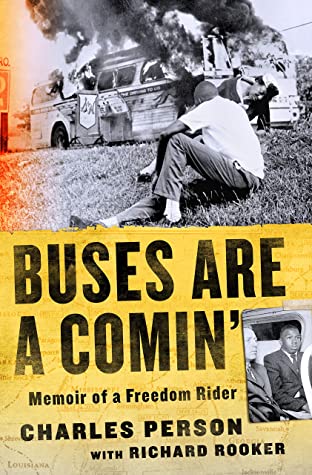
Buses Are a Comin’, by Charles Person and Richard Rooker*****

I’ve read my share of Civil Rights memoirs, and this is one of the best. My thanks go to Net Galley and St. Martin’s Press for the review copy. This book is for sale now.

Charles Person grew up in an all-Black Atlanta neighborhood in the 1950s and 60s. At the story’s outset, he describes how sleeping arrangements were juggled inside their two-room apartment, with four family members sleeping in the front room, and three, himself among them, back in the kitchen. Since everyone in the neighborhood had roughly the same economic standing, it didn’t occur to Person that his family might be considered poor. He was at the top of his class academically, college-bound. His family were faithful church goers, and his father worked two-plus jobs to provide the bare necessities, but they never went hungry. It was only later, when his neighborhood was featured on a news program addressing “Urban blight,” that he learned that the place he loved and called home was part of a “tenement.” The overall tone of his home life is set at the beginning, when he describes an incident from childhood. He and another child stole peaches off of a neighbor’s tree, and his mother marches them to the door, makes them confess—which meant looking the owner in the eye and using the word “stole,” rather than a softer euphemism—and pay for the fruit they ate. Thus we know there’s a definite moral compass here.

It isn’t until he’s grown that Person learns about racism. He gets his first job at a bowling alley, and he learns what parts of that place and the surrounding businesses he is allowed to access, and which are for whites only. Later, he insists on sending his test scores and application to a Georgia university, knowing his marks are excellent, but is notified by mail that the school will not admit Negro (the accepted term at the time) students. As the lunch counter sit-ins in North Carolina draw headlines, Person becomes part of a local student effort to end segregation at the lunch counters in their area. Person is thrown in jail, and when he is released a short time later, he is experienced, primed, and ready for more.

The story of Person’s life, and of the Freedom Rides, which make up most of the memoir, is riveting. It’s told in first person, in a you-are-there kind of narrative that drew me in. I listened to part of this story using the audio book that I borrowed from Seattle Bibliocommons, but although the reader generally does a serviceable job with the text, I recommend the print version. I winced when the reader mispronounced “mimeograph”; there are no mimes in there, honey. But mostly, there are a lot of freedom songs interspersing the story, as the riders sing in jail, sing in the bus, sing, sing, and sing some more, and I don’t know about you, but it sets my teeth on edge when in the audio version the lyrics are simply read, with or without rhythm. Many of these are well-known songs, and if I see the words on the page, I will hear the music in my head. Listening to someone recite the words in a bloodless, wooden recitation is just sad.

For anyone that misses the connection, Person draws the connection between the Freedom Rides and the struggle of the present:

“It is sixty years later, and politicians do the same today when the devalue and disrespect important African-American societal concerns by turning Black Lives Matter into All Lives Matter. Of course, all lives matter. No one argues against that, but changing the issue from “Black” to “All” steals the legitimacy of a vital concern that needs political attention and a political solution. The intentional and insidious shifting on an issue through language is a calculated move. It was by [Georgia Governor] Vandiver in 1960, and it is today. It avoids and insults at the same time.”

There is no better time to learn the lessons of the Civil Rights Movement of the mid-1900s, and apply them to the struggle against racist cop brutality in the present. If this subject makes you sit up a little straighter, you need this book. Of course, it’s also great reading for anyone that likes a good memoir, but even so, read it actively. There’s so much more work to be done.

The Soul of a Woman, by Isabel Allende*****

Isabel Allende has long been a guiding light for women, immigrants, and social justice activists. She is an old woman now, and her wisdom and word smithery have only grown deeper and wider. Thanks go to Net Galley and Random House Ballantine for the review copy. This book is for sale now.

There are four sections to this compact memoir, and overall, it is a memoir of Allende’s feminist philosophy and experiences. She also describes the trajectory of the feminist movement and the gains that have been made.  One of Allende’s most agreeable attributes is her candor, and she discusses her relationships with the men she has married with disarming frankness and humor. Her voice is like nobody else’s.

Generally speaking, I find it annoying when an author uses space in the book they’ve sold us to advertise a product or beg for funds, nonprofit or not; however, this time I wanted to stand up and cheer! Allende’s foundation exists to support women’s reproductive choices, and that includes abortion. Out of all the years I’ve blogged, over one thousand reviews I’ve scribed, and I have never seen abortion rights advocated so forcefully. I bow in admiration.

If I could have something more from this iconic writer, it would be an overall autobiography. She has written numerous memoirs, but all of them focus fairly narrowly on one particular aspect or time period. I would love to have her whole story in her own words.

Highly recommended.

The Recent East, by Thomas Grattan*****

The Recent East introduces novelist Thomas Grattan, and it’s an impressive debut. It follows a family of German-Americans from 1965, when the eldest emigrates from East Germany with her parents, to the present. I initially decide to read it because of the setting; it’s the first fiction I’ve read set in the former Soviet satellite country. However, it is the characters that keep me engaged to the last page.

My thanks go to Net Galley and McMillan for the review copy; this book is for sale now.

The story opens in 1965 as Beate and her parents are defecting:

Everyone talked about the West as if it were a secret. They leaned in to share stories of its grocery stores that carried fresh oranges, its cars with bult-in radios. Covered their mouths to mention a Dusseldorf boulevard that catered to movie stars and dictators, whole Eastern month’s salaries spent on face cream. There were entire, whispered conversations about its large houses and overstuffed stores, its borders crossed with a smile and a flick of one’s passport. Some talked about it as if it were the most boring thing. Others like it was an uppity friend. But everyone talked about it…

The first chapter makes me laugh out loud. Teenage Beate is mocked when she enrolls in school in Cologne, because her clothing is nowhere near as nice as what the kids in West Germany wear. Since her parents cannot afford to upgrade her wardrobe just yet, Beate comes up with the genius idea to alter the clothes she owns to make them look as Soviet as possible, and she “put on her Moscow face, worked on her Leningrad walk.” Sure enough, the kids at school are terrified of her now. She still doesn’t have friends, but she isn’t bullied anymore.

Morph forward in time. Beate is a mother now, living in upstate New York with her two adolescent children and unhappy husband. When the Berlin Wall falls, so does her marriage. Soon afterward, she is notified that her late parents’ house now belongs to her. She packs up her belongings and her children, then buys tickets to Germany.

Adela and Michael have always been close, but the move shakes their relationship. Their usual routines are shattered, and their mother, reeling from the divorce, becomes withdrawn and uncommunicative. What a terrible time to disengage from parenting! Both Michael and Adela roam the city of Kritzhagen at will, at all hours of the night. Michael is just 13 years old and gay; sometimes he doesn’t come home at all at night. I read these passages, written without obvious judgment or commentary, with horror. A new house, new city, new country, new continent, and it’s now that their mother forgets to set boundaries? I want to find this woman and slap her upside the head (though I guess that’s a different sort of boundary violation.) Half the houses in town stand empty, and since they have no furniture of their own and their mother is doing nothing to acquire it, Michael breaks into houses and steals furnishings. Look, Ma, I found us some chairs.

My jaw drops.

Adela goes in the other direction, becoming a conscientious student and social justice advocate. But their mother pays her no attention, either.

For the first half of this story, it seems like a four star novel to me; well written, competent, but nothing to merit great accolades. This changes in the second half, because all three of these characters are dynamic, and the changes in them are absolutely believable and deeply absorbing.

I have friends that do social work, and what they have told me is this: children that are forced to become the adults in the family, taking on responsibilities they’re too young for when a parent abdicates them, often appear to miraculously mature, competent beyond their years. Everything is organized. They may do the jobs as well as any adult, and sometimes better than most. How wonderful!

But because they aren’t developmentally ready for these things yet, what happens is that later, when they are grown, they fall apart and become breathtakingly immature, because they have to go back and live their adolescent years that were stolen from them. (As a teacher, I saw this in action a couple of times.)  And so I am awestruck by how consistently our Grattan’s characters follow this pattern.

As the second half progresses, I make a couple of predictions, one of which is sort of formulaic, but Grattan does other things, and they’re far better than what I’d guessed. We follow these characters for several decades, and at the end, we see the relationship that blooms between Beate and her grandson. When it’s over, I miss them.

Because Michael is gay and is one of our three protagonists, this novel is easily slotted into the LGTB genre, but it is much more than this. Instead, one should regard it as a well-written story in which one character is gay.

But whatever you choose to call this book, you should get it and read it if you love excellent fiction.

The Dead Are Arising, by Les Payne*

I haven’t been this disappointed in a long time. From the moment I saw this book listed on Net Galley, I was eager to read it, given that the promotion promises a lot of new information about this courageous man, a powerful advocate for the rights of people of color. When I didn’t receive a galley, I awaited the book’s release, and I went out and bought it. Less than halfway into it, I was absolutely sickened.

For starters, not all new information is important or necessary information. There’s a lot of minutiae here, as well as a fair amount of Black History 101 material, interesting to those unfamiliar with the Civil Rights Movement, Jim Crow, Northern red-lining practices, and so forth, but a real snore for those of us already steeped in these things. But beyond that—and one could argue that these historical basics are necessary inclusions for a lot of readers—Paine goes to a great deal of trouble to destroy Malcolm’s legacy.

Academics do this sometimes, and surely it’s no coincidence that the top three examples that come to mind are all biographies of African-Americans that fought for their rights, and aren’t alive now to object to what is being said about them. (In addition to Malcolm, recent biographies of Frederick Douglass and Muhammad Ali come to mind, the latter two slandered by two different authors.) Picking through the tiny, often insignificant details of their lives and combing through their speeches and writing, these authors go to great pains to “expose” small details that conflict with one another, or other signs of inconsistency, with the clear implication that the subject was a liar and a fraud.

For shame!  

Let’s talk about that for a minute. I am a grandmother myself, and I can think of important aspects of my life, especially my younger years, for which my own motivations were and are complicated, and if asked about them I am sure I would have given different answers in my twenties, my thirties, and so on. Our own thoughts and motives have a lot of layers. Perhaps we become more insightful later in life, or perhaps our memories are no longer as sharp as we believe them to be. But because we are not famous, or notorious, depending upon points of view, we are unlikely to have some academic interviewing everyone that ever fucking knew us, or combing through every speck of written documentation we leave behind us, searching for all possible details that may bring our integrity and veracity into question.

For me, it matters very little whether Malcolm’s early life was exactly as he told it. It is his ideas, and his courage in expressing them, that made him a legend, and that’s what I look for in his biography. In the 1960s, almost no African-American (or colored, as they preferred to be called during that period,) Civil Rights advocates dared to come right out and say that Black people were not only as good, but in some cases better than Caucasians. And it is Malcolm’s political evolution during the last year of his life, the time when he broke with the Nation of Islam and embraced a working class perspective that included fighters of every race, that galvanizes me. Malcolm raised a powerful voice in opposition to the U.S. war against the Vietnamese people, quipping after President Kennedy’s assassination that it was a case of “chickens coming home to roost.”

This takedown of an iconic Civil Rights warrior is shabby in every sense. For those interested in Malcolm’s political and social evolution, I recommend the book titled Malcolm X: The Last Speeches. Usually, the best way to learn about someone is to see what they themselves had to say. In this case it’s doubly true.

I don’t recommend this book to anyone.

Well-Read Black Girl, by Glory Edim, editor****

Ahem. Yes, I am in fact, over two years late with this review. I can explain.

My dog ate…no, wait. I got a flat tire when…oh. Yeah, that doesn’t work.

So now I have to tell the truth, having failed miserably, as I usually do, at lying. Here it is. About a month after I received the galley to this book, courtesy of Net Galley and Random House, national news and social media went into a virtual frenzy discussing cultural appropriation. And I froze. I started examining everything I did through that lens, and I may have gone overboard. I looked at this galley and I thought, I have no right to review this thing. And when I read the introduction anyway, I feel it even more so. Not written with me in mind, was it? Was this the literary equivalent of reading someone else’s mail? And so I did the easy thing, which was to shove it onto the back burner and read something else. Repeatedly.  

Several months later, it occurred to me that nobody would even have to know if I were to sneak it out of my files and just read the article by Jesmyn Ward, which was actually why I had originally requested it. Ward is on my read-anything list. I read it, and I liked it, and then I shuffled it back into the file. No harm done.

This spring, as the world tentatively emerges, one hopeful toe at a time, from the isolation imposed on all of us by the horrific pandemic, I realize what I should have known all along: that anybody can read anything, and form an opinion about it; and that since I was granted the galley, I actually owe a review. I straightened my spine, dusted myself off, and sat down to read it. There was no blinding light or thunder from the heavens. Nothing smote me. I read it, and I lived to tell the tale.

Most of the authors here are new to me; in addition to Ward, I also know Jacqueline Woodson’s work a bit, mostly from my years teaching language arts, when I used her YA book. Everyone here included in this compendium is a strong writer, and they are largely preaching to the choir, since the audience are also bibliophiles. But the common thread, the point they drive home—and rightly so—is the importance of finding literature about girls that look like themselves. They speak of it as empowerment and validation.

Back in the stone age, when this reviewer was enrolled in a teacher education program, we were likewise taught the importance of inclusive literature. It seemed so obvious to me, this obligation teachers surely have to make sure all of their students are represented in the books their students read, or have read to them. I figured it was a no-brainer. But when I arrived at my first teaching position in elementary school, (heaven help me and those children both,) I was shown the supply closet and there were the classroom book sets. The main characters were Caucasian boys; Caucasian boys and girls; fluffy woodland animals, mostly male; and more Caucasian boys. I sadly examined my battered Visa card and drove to the bookstore to order better books. And I was further amazed to learn, later, that my colleagues, all of whom were Caucasian, believed that the school’s book collection was terrific. Their students loved those books, and that included the children of color that made up approximately half of the population there, they told me.

Sure they did.

The essays in Well-Read Black Girl are a much-needed reminder that racism isn’t always overt; sometimes racism is exclusionary, unintentionally so. And what silences young voices, and what teaches children that books, and life in general, are not about them, worse than discovering that they are not important enough to be included in books?

When I moved to secondary education, where I belonged, I visited the book room there, and I found a set of books about African-American boys, but the message inherent was that they are constantly exposed to drugs and gangs, and it will be hard as heck not to be drawn in. And once again, I scratched my head. These Black kids, most of them were from middle class homes, or loving, well supervised working class homes. Drugs? Not so much. And what did these books teach their Caucasian classmates about Black people? I sighed and got back in the car, already apologizing silently to my Visa once more.

This collection of essays is important, not because of any particular brilliance in composition; they are well written, but not memorable for the writing itself. Instead, they are the key to understanding, from primary sources, why Black girls need books that depict Black girls and women in a positive light.

I’ve assigned four stars to this book for general audiences, but for teachers in training, it is five stars. Every teacher training program should include these essays as required reading. We have to read it until we get it right.

Mother May I, by Joshilyn Jackson*****

Joshilyn Jackson is one of my favorite authors, and so I was delighted to see that she has another novel coming out this spring. My heartfelt thanks go to Net Galley, Harper Audio, and William Morrow for the review copies. This book is for sale now.

One of the things I love about Jackson is that she recognizes and includes social class as a large factor in the lives of her characters. I am initially sorry to see that her protagonist, Bree Cabbat, is married to a wealthy man, but once the story unfolds, it becomes obvious that the story won’t work any other way. Although Bree is rolling in it now, she grew up poor, the child of a single parent that took her back-to-school shopping at a Goodwill two towns over from their tiny Georgia town, carefully making sure that Bree’s classmates not recognize their own castoffs when Bree wore them. Later, theater classes helped Bree refine her accent to make her more employable; acting lessons helped her project the carefree confidence that is common to young adults whose families have money.

Now she is married to Trey, a man “who’d grown up with Scooters and Biffs and Muffys.” As the story progresses, there are frequent subtle reminders of this; Trey has a gun safe; Trey has a bottle of whiskey, a gift, that cost over two thousand dollars; their daughters are in an upscale school with a nice theatre program, and their daughters are enrolled in extracurricular activities like Quiz Bowl and Robotics. Yes, our Bree has come up in the world, alrighty. And so when their baby is kidnapped out from under her very nose, naturally Bree’s assumption is that there will be a ransom, and that she and Trey will pay it.

But this time, she is oh so wrong.

When the call comes, it turns out to be a very elderly woman bent on exacting revenge against Trey’s business partner, who is also his cousin. Bree must do exactly as she says, because if she sees any sign of police, “I’ll break his flimsy neck…I’ll twist his little head right around backward.”

Dear God.

 This story grabbed me by the hair and didn’t let me go till I was done with it. I was initially approved for the audio version, and by the time I was given access to the print version, I had finished the first galley. Ordinarily, when something like this happens, I write my review, submit it to both places, and figure my work is done here. But for Jackson I do due diligence and more, and it’s a pleasure to read her book twice, so I did. And while both versions are excellent, I give a slight edge to the audio version. Print is a desirable medium anytime one is reading any mystery, because sometimes we want to flip back to check a detail or two. But Jackson always records her own audio books, and so I know the interpretation of the reader is always completely consistent with the writer’s intention. And in this case, the key side character—Marshall, an ex-cop that was married to Bree’s best friend, now dead—has a distinctive voice that comes through somewhat in the printed version, but much more plainly in the audio. I love the way she voices him, and although Marshall isn’t the protagonist, his role in this story is critical. The narrative shifts between Bree, who speaks to us from the first person limited, and Marshall, who comes to us in the third person.

The story carries an added social justice component: it’s MeToo on steroids. The things we learn about the men in the story add complexity, and though there’s a trigger or two here, I suspect most female readers will find the denouement deeply satisfying. I do.

The ending would ordinarily be deemed over-the-top, but because I believe the characters and story so completely by the time we get there, I also believe the resolution.

The one thing I would change here, if I wanted to be picky, would be to find a way to inject some of the epic laugh-out-loud humor I have enjoyed in Jackson’s earlier books. But that’s a tall order, given the intensity of this one.

One way or the other, this book is guaranteed to be one of the year’s very best. Don’t let yourself be left out. I strongly recommend this book to you, even at full cover price.

On the Plain of Snakes, by Paul Theroux****-*****

Paul Theroux has been a successful travel writer for a very long time, but he is new to me. Lucky me, I read this free, thanks to Net Galley and Houghton Mifflin Harcourt. It’s for sale now.

The first thing that took my notice was that this is a gutsy writer. Though he’s in his late seventies, he hops in his personal vehicle and motors south to Mexico, and then all over that nation independently, venturing into out-of-the-way spaces, mostly eschewing the usual tourist haunts that draw the spring break crowd from the US and other parts. Over and over again, locals explain to him that this road, or that, or the other is very dangerous right now; sometimes he revises his route; sometimes he takes the route but at a different time; and sometimes he goes anyway, but takes somebody with him. What he doesn’t do is go home early, or store his car somewhere and follow a tour guide around. I stand in awe.

Theroux approaches his journey as a researcher, rather than as a tourist advisor. He interviews countless individuals, even learning a little of one of the indigenous languages—in addition to Spanish– in order to communicate. I gave up trying to trace his route, instead just going with the narrative as it unspools.

I have to tell you, this is a tome. I might never have finished it had I relied exclusively on my review copy. I recognized it would be a hefty commitment to get through all of it, so once again, I turned to Seattle Bibliocommons for the audio version. I found it went much faster once I was able to do something else with my hands as I listened. Joseph Balderrama is a wonderful reader, and I quickly found myself absorbed into the journey, as if I were an unseen passenger.

Theroux takes us through the ordeal at the US/Mexico border, which was a nightmare during the time this was written, during the Trump administration. (If you have a MAGA cap in your closet, you may not enjoy this book.) He listens to Mexican citizens that live near enough to the border that they can actually see it from their homes, or from their workplaces. Some of them have lived in Mexico but worked in Texas for a long time, and the hardship they experience once the rules are changed is dreadful. And the insight I gain from listening to his interviews with people there about immigration to the US is most enlightening.

The most amazing thing to me is the way the cartels and the Mexican police force overlap, and in a number of places are exactly the same people! He describes multiple shakedowns by traffic cops while he is driving. It seems that the state pays its cops next to nothing, and so in order for them to support themselves, (particularly, we assume, those not being paid by cartels also,) they are permitted to stop anyone they believe has some money, and essentially intimidate them into a bribe. But it’s not complete chaos: once a driver has been shaken down, they are entitled to a receipt for the money they have had to forfeit so that another cop up the road cannot do the same thing.

The one tourist area Theroux passes through is Puerto Vallarta, which also happens to be the only place in Mexico that I have visited. About ten years lapsed between my visit—a very pleasant one—and Theroux’s, and I was saddened to learn how unsafe it has become, and how badly the locals, who were mostly middle class when I was there, have it now.

There are a number of fascinating passages, and I learned a lot. One village is awash with what sounds like a new sort of trans woman, (new to an American from Seattle, at least,) and another where the handmade sandals are finished with a jaw dropping method. There’s one very poor village where earthquakes occur so frequently that most of the homes are no longer standing, but many people won’t sleep indoors anyway for fear of being crushed to death. No aid from the Mexican government or any international body has ever reached them. Those people are on their own, and they are suffering.

Perhaps the sweetest parts have to do with the friendships that the writer forms with the people he meets there. I especially enjoyed reading the interviews with his new author and artist friends.

For those like myself that approach this with general interest, I’d call this a four star book. My stamina is greater than most, yet as much as I enjoyed it, it did feel a little bit lengthy. For those with a particular interest in the socioeconomic, cultural, and political realities of Mexico, it’s five stars, hands down.

Recommended to those with an interest in this field.