
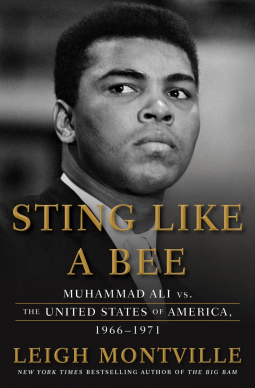
 “’It takes a lot of nerve for somebody, mainly a white, to ask me do I hate. I haven’t lynched nobody and hid in the bushes.’”
I received an advance copy free from Net Galley and Doubleday in exchange for this honest review. The book is now available for purchase.
Muhammad Ali died of Parkinson’s disease one year ago. By the time of his passing, he had earned the respect and recognition he craved. In this popular biography, Montville gives an overview of his rise to fame, but focuses primarily on Ali’s legal challenge to the US government, which strove to draft him to fight in Vietnam despite his professed status as a conscientious objector.
During the 1960s and 1970s, almost all of Caucasian America and a goodly number of African-Americans regarded Ali’s public statements either with derision or fear. Born Cassius Clay, he joined the Nation of Islam as a young adult and changed his name in the same way Malcolm X had before him. He did it in order to shuck the slave name given him at birth and adopt a new religion that taught him that Black men were not only equal to white folks, but better. Malcolm X had advocated Black pride and scared a lot of people, but he had done it from the point of view of a political activist. Ali was the first Black athlete to stand up tall and tell all of America that he was the greatest. The descendants of slave owners that willingly or not bore the guilt of the oppressors were absolutely terrified. This was the fear they seldom made themselves face, the notion that the descendants of those so grievously wronged might rise up belatedly and give back some of what their ancestors had been dealt. I was there; I remember.
Ali personified the white man’s fear of the jungle. Dude, here he comes; he’s strong, he’s angry, and he’s free!
Montville recognizes up front that when Ali died, he was an icon, both as an athlete and as a civil rights advocate. But the tone of his prose shifts from a more or less neutral journalistic tone, to a wry one—because Ali did say some outrageous things by anyone’s standard—and then, again and again, to a derisive one. The first time I saw it, I told myself I was tired and grumpy, and that I was probably being overly sensitive. My own family is racially mixed; I have raised a Black son. Sometimes I get touchy when I read things written by white authors about Black people. I should put the book down and examine it tomorrow with fresh eyes.
When I picked it up the next time I was immediately taken with the writer’s skill. His pacing is impeccable. Some of the quotes he chose are really delicious ones, although with Ali, it’s also kind of hard to go wrong. And at this point I considered that since we were on a roll, I should take the next step and examine the end notes and documentation.
Huh. Apart from a list of sources, most of which are biographies written by other people, there’s nothing. There are the in-text references a popular biographer uses, telling us, for example, that a direct quote comes from the magazine Sports Illustrated, without telling us what issue or who wrote it. And to be fair, that’s how a popular biography is written. It’s there for the masses that love boxing and aren’t going to check your footnotes. Everything within my academic heart recoils at this kind of biography, but it sells. I may not like it much, but people will buy it and they’ll read it.
But to write about a legal challenge of this magnitude and not provide specific documentation?
I could mention this within a review—as I have—and say that given this particular caveat, the biography is a four star read, and I thought that I might do that. But when I continued reading, there it was again. The author makes fun of the guy. And so just before the halfway mark, I started making careful notes of my own, because I wanted to see for myself how it is possible for a writer to appear to be neutral much of the time and yet also mock his subject. What I came away with is that the more straight-forward, respectful material is buried in the middle of each section, but the briefer sneering, snide material is usually right at the end of the section in one sentence, set apart from everything that came before it.
Writers do this for emphasis.
Fans of Ali will have to swallow hard to make it through this biography. Fans of boxing will find that it’s mostly about the legal challenge, and although Ali’s boxing matches are included, you’ll find a lot more about those in any one of the numerous other Ali biographies published earlier. And those interested in his legal fight may want to hold out for a more scholarly treatment.
When all is said and done, Ali was the greatest, but this biography is not.


 I was browsing the pages of Net Galley and ran across this gem of a memoir. Often when someone that isn’t famous gets an autobiography published by a major publisher, it’s a hint to the reader that the story will be riveting. Such is the case here; my many thanks go to Net Galley and Atria for the DRC, which I read free in exchange for this honest review. You can order it now’ it comes out Tuesday, May 9.
 History buffs rejoice; the definitive Nixon biography is here. John A. Farrell is the renowned biographer of Clarence Darrow. Now he gives us a comprehensive, compelling look at the only US president ever to resign from office under the cloud of imminent impeachment. This is the only Nixon biography that answers the many questions that left Americans—and those around the world that were watching—scratching our heads. Why, why, and why would he do these things? Farrell tells us. I read this book free and in advance, thanks to Net Galley and Doubleday, but it would have been worth paying the full retail price if I’d had to. It’s available to the public now.
 I surrender! Thanks go to Net Galley and Open Road Media, from whom I received a DRC in exchange for an honest review; however, try though I have, I cannot push past the molasses-like allegory and other figurative language to locate a plot. After painfully forcing my way through the first 20% of the book, I went to Goodreads to see what other reviewers had to say about it. Some felt as I did, but others swore that if the reader could endure the first two-thirds of the story, the last third would not only be so amazing, it would also enlighten us as to why the earlier part was necessary. Seeing this, I vowed to persevere. By the 25% mark, I found I was avoiding this DRC, because just about every other galley in my possession was either more enjoyable to read, or more rewarding, or both.
 Brevity isn’t possible here. Settle in and get comfy. Here we go.
 Gusick’s hero, Detective Darla Cavanaugh, became an instant favorite of mine when I read the screamingly funny Officer Elvis, and so when I saw that Random House Alibi was about to publish this third book in the series, I scrambled quickly over to Net Galley to snatch up a DRC. Though Gusick is a tremendously courageous writer, one that seeks to stand uncompromisingly on the side of the angels, this time he’s stepped over a line in the sand that was better left uncrossed. I look forward to the next book in the series, but am not sure I can recommend this one.
 “Is it worth being able to say what you need to say, if it means you land in prison?”
