Though I usually review books that are either newly published or are about to be, once in awhile I reach back and discuss books that have been around for awhile. This one is excellent, and I consider it unmissable.
This book is phenomenal. How much do any of us know about Genghis Khan?
One thing I learned in discussion with my spouse, who is a Japanese citizen, is that whereas we from Western cultures pronounce the warrior’s name with a hard G, Asians–including the Mongolian culture from which the Khan emerged–pronounce it softly, like a J. I figure Mongols know how the name should be pronounced, so I have begun to pronounce it that way, too.
I wanted to read this series, or at least the first entry, because although I have read at least something about most of the greatest warriors in the world over time, I had read nothing about Genghis. We have a nonfiction tome, but it’s the sort of slog one only undergoes out of desperation, or as assigned coursework.
The first two or three chapters seemed fine, but not great. I wasn’t even sure if I would read the rest of the series. By the halfway point, however, my mind had changed completely! I found myself online doing image searches for the housing, clothing, and other parts of the nomadic life.
I have purchased the next in the series. I rarely buy books for myself, because I have so many already and have such constant access to galleys that it isn’t necessary; yet now and then, there’s a book I’ve gotta have, and that’s how I feel about this series.
Highly recommended for those that are interested in this time and place in history; in Genghis himself; or in military history.
3.5 stars, rounded up. Chevy in the Hole is Kelsey Ronan’s debut novel. I love strong working class fiction, and the title and book cover spoke to me. But while it shows a good deal of promise, it’s also a cautionary example of how, in trying to do too much, one can do too little. My thanks go to Net Galley and Henry Holt for the review copies. This book is for sale today.
The protagonists are Gus Molloy, who is Caucasian, and Monae Livingston, who is Black. The book opens as Gus is being revived with Narcan on the floor of a dirty restroom in Detroit. We follow him as he meets Monae, a student working at a farm outside of Flint. Their stories are told alternately with bits and pieces of the lives of their predecessors.
The story is promoted as a love letter to Flint, and a tribute to the resilience of its people; it’s a story of “love and betrayal, race and family.” And we do surely see all of those things, but as soon as one aspect or another is touched on, I wink and poof, it’s gone. Gus and Monae are both sympathetic characters, and I can’t help pulling for them, but I suspect the author could have developed them more fully had we not spent so much time and detail on fragments of their parents, grandparents and so on.
If the author’s purpose is to use these characters from the past to showcase the various struggles through which Flint has gone—sit-down strikes, Civil Rights marches, and now, this horrifying industrial sludge that has polluted the town’s drinking water—it could have been done in a paragraph or two, or through some other device than shifting the point of view. The frequent changes of character and time period make it confusing as heck, particularly while listening to the audio version; that’s a shame, because Janina Edwards is a warm, convincing reader.
But we frequently shift from one protagonist to the other, even after they are married, and all of these people from the past have to be sorted by both time period, and by which protagonist they are related to. A story like this should flow. As it is, it’s work listening to it, and had I not been granted a digital review copy as well to refer to, I might have given up.
My other frustration is that both the labor history and the Civil Rights issues—with Black people shut out of company housing in the past, and the issues with cop violence as well as the pollution that is visited most within the Black community—are huge. The pollution problem is immense, and ties back into both of the other issues. This book could be a powerhouse, a call for change to reward to the plucky souls that have stuck with this place through hell and high, toxic water. Instead they present almost like postcards; oh, look at this! Now look at that! Okay, never mind, let’s go on back to the present.
That being said, the author’s mission is an ambitious one, and her word smithery is of high caliber. I look forward to seeing what else she publishes.
If you choose to read this book, I recommend using the printed word, whether digitally or as a physical copy.
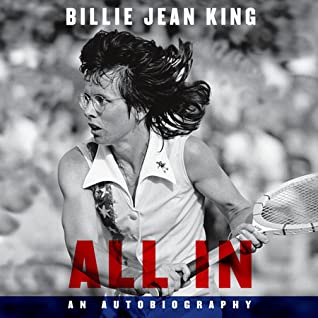
There are books, and then there’s this: the autobiography of an icon that will be read for generations. I passed—perhaps foolishly—on a review copy, because I was afraid there would be large passages of minutiae about tennis, which doesn’t interest me. I was mistaken in my concern, but it worked out well, because I borrowed an audio version from Seattle Bibliocommons, and the author reads her own book. She is an old woman now, and hearing her detail her own remarkable life is a matchless experience. It’s hard to imagine there will be a more important, or more enjoyable book published in the coming year.
Billie Jean Moffitt King is born in 1943 and grows up in Southern California in a conservative working class family; her dad is a firefighter, and her mother stays home, as most mothers did back then. There is Billie, and there is her brother, and the family are devoted Methodists. Who is to know that both children will be famous one day? Brother Randy becomes a professional baseball player, and Billie Jean becomes a record-breaking tennis star and a passionate social justice activist. If you, reader, are younger than sixty, you probably don’t even know how much you owe Billie Jean.
Growing up, King enjoys all sorts of sports, but when she is introduced to tennis, a light comes on. The problem is, tennis is a sport for the elite, even more so back then than now. To find a tennis court, you needed to either have a private court built on your palatial estate, or belong to a country club, and of course, to do that, you also have to be Caucasian. Billie Jean’s family is nowhere near affluent enough to belong. And so, early on, her passion and her obvious talent draw support from people with enough pull, or enough money, to give her access. She takes the time to thank them, but doesn’t let this bog the story down.
Over and over, however, she is shut out on account of her gender. Prize money typically pays enough to help an athlete pay their own travel expenses and buy equipment, but when women are allowed to compete in competitions prestigious enough to offer prize money, it’s only for the men. Women are expected to be grateful that they are included at all. And as King gets better at her sport and her confidence grows, she begins to push back. Nobody wants to watch women play tennis? Since when? And since when should people of color be shut out?
Although she doesn’t say so, it becomes obvious to me that in addition to athletic talent, confidence, intelligence, and almost endless energy, King has one more talent, one that isn’t recognized as such in the mid-twentieth century: she has amazing people skills. Over and over, she is able to reach compromises, make deals, and shorten the gap between conservative perceptions of women athletes, and what all athletes deserve. She discusses the various battles (though she doesn’t use this word) and how they are resolved, and I am amazed at the grace and dignity she demonstrates. Perhaps the most telling moment is when she befriends Bobby Riggs, the obnoxious bastard that she has defeated in front of the world, and later, when he is on his deathbed, takes a call from his wife. Riggs is asking for her, and he doesn’t have much time left. She is too far away to get to him in time, but she tells him on the phone that she loves him. Wow.
If you are or were a girl that participated in high school sports, or if you or your loved ones have benefited from Title IX, thank Billie Jean, who testified before Congress. She also started the first professional tennis circuit for women.
Over the years, King wins 39 Wimbledon Grand Slam titles and a host of others as well. I am a child when she plays Bobby Riggs in “The Battle of the Sexes,” and she beats him squarely. What I don’t know (and would still not have known if I’d been paying attention,) is that she does her very best not to play this tournament. Riggs is much older than she, and he hounds her—in fact, today his behavior would violate anti-stalking laws. But she calmly tells him, over and over, that she isn’t interested, and then she ignores his calls and turns away from his in-person visits. But when a fellow women’s tennis champion plays him and loses, Billie turns to her husband and manager, Larry King, and with a sigh, says, “Okay. You’d better set it up.”
At this point, I turn away from the audio book and head to YouTube to watch The Battle of the Sexes. This trip back to the society in which I grew up is hair-raising. The ways that men talk about women, in public forums! The remarks by Howard Cosell, who was the most liberal of sportscasters, about her physical appearance, and the patronizing remarks of others are appalling. I wouldn’t go back for anything in this world! But when she is asked antagonizing questions, Billie Jean comments, briefly, calmly, and without showing even the slightest offence. Her coolness on the court is mirrored in her cool public appearances. It’s remarkable.
When Gloria Steinem starts Ms. Magazine, King supports her, but she is always either asleep or busy, so husband Larry handles the mail. When he sees the request to add her name to a list of famous women that support a woman’s right to choose, as the controversy over Roe v. Wade heats up, he signs for her and then forgets to mention it to her; had he read more carefully, he would have noted the line, “I had an abortion!” King doesn’t know it’s about to be public knowledge, and her parents didn’t know she’d terminated a pregnancy. It’s not a good moment.
Later, when her feelings for other women grow stronger, she and Larry separate, but not completely. For years, she stays with him when they both show up in town at the same time, and they continue a romantic relationship, though infrequently. It is when she grows close to South African tennis player Ilana, and Ilana makes her choose, that she divorces Larry; again, they remain friends.
I could carry on all day about this woman, a champion on the court and off, but if you are interested enough to read this entire review, then you’re interested enough to get this book. I’m sure the print version is lovely, but the audio book—which sounds like a garrulous old lady telling her story, like Forrest Gump, but authentic and more accomplished—and hearing her voice wobble when she speaks of her most moving experiences, is simply unmissable.
Black Cloud Rising, the historical novel that’s already been excerpted in The New Yorker, is the book I’ve always wished someone would write. Author David Wright Falade tells the story of the African Brigade, a unit of former slaves tasked with rooting out pockets of Confederate guerilla fighters in the Tidewater region of Virginia and in North Carolina’s Outer Banks. This outstanding work of historical fiction is one of the year’s best surprises, and it’s for sale now.
My thanks go to Net Galley and Grove Press for the review copy.
Sergeant Richard Etheridge is our protagonist; he is the son of a slave and her master. This is the only small criticism I have here; it seems like every time I see a fictional former slave that goes on to do momentous things, he’s the master’s progeny. However, Sergeant Etheridge did exist in real life; I have been unable to discover whether this aspect of his beginnings is fact or fiction. If it’s fact, then I withdraw my objection.
One way or the other, this is nevertheless a fantastic novel. In fact, since I taught the American Civil War for many years and have never heard if this sergeant, I wonder, initially, if his story is even true. But a little research shows Etheridge to be have been real. I had known about the existence of this brigade, but the only aspect of it I’d seen was–oh how embarrassing—from the movie, Glory, in which an all-Black military unit volunteers to lead the charge on Fort Wagner. But there, the story is told not from the viewpoint of infantrymen, but from the Caucasian officer chosen to lead them. It’s not as if I failed to do research; but during my years in the classroom, I couldn’t find a single thing that reflected the memories and experiences of the former slaves that fought for the Union. And although this book comes too late to help me teach the upcoming generation, it will be greatly useful to teachers that come after me.
At the outset of our story, Richard approaches his master at dinner, a thing that is generally not done, to tell him that he is going to enlist in the Union Army. Because he is the master’s son, he is able to get away with this, and this has also allowed him to learn to read and write, which in turn makes him officer material. Richard is a well developed character; it is wrenching to see his loyalty and devotion to his father, as well as to his half-brother Patrick, who is the legitimate heir to his father’s estate. Repeatedly the narrative points out that “the son will always seek out the father,” and it makes me ache for this young man. Nevertheless, he does go to war against his father’s wishes, and he demonstrates leadership and skill under pressure.
There is one visceral scene in which the Caucasian master of a plantation who is linked to the guerilla Confederates, is dragged to his own whipping post and beaten by his former slaves. I find it deeply satisfying. In the end and after much bloodshed, the unit is successful in its mission to clear the area of the guerillas that threaten the Union effort.
In many ways this is a coming of age story, but those that will love it most are those that enjoy military history and all things related to the American Civil War, as well as those interested in the Black struggle. It’s a great selection for Black History Month, but it will make excellent reading during the other eleven months as well. Highly recommended.
I was invited to read and review this book by Net Galley and St. Martin’s Press. I accepted because I do love a good spy story, and there aren’t many of them being published at this time. Tim Tate has had a long, illustrious career as a documentary filmmaker and as an author, but is new to me.
So, when I began reading and found my attention wandering, I thought it was a personal problem. Too many distractions. I tried again, and when that didn’t go well, I procured the audio version and listened to it while I prepared dinners during the week. Eventually, I threw in the towel and admitted that this is simply not an engaging book. The topic sounds fascinating, but just as a gifted, dedicated author can spin dull material to gold, so can an indifferent one tell an electrifying spy story in a way that leaves the reader checking the page numbers and the clock—is this thing over yet?
It’s not all bad news: the research here is top drawer. For the researcher, this book has use, although I would caution the uninitiated into reading carefully, because history is always politically charged. Every fact that is included, and every fact that is not; the interpretation; the language used, all give a biased account, even when a researcher and writer is endeavoring to be as balanced as possible. I don’t care for this writer’s interpretation, which makes him sound like a hardened right winger, but I have no doubt that the facts that he uses are accurate ones.
Then we come to the audio, and I must wonder why, if we’re primarily dealing with the CIA and its agents, we have a narrator with a clipped English accent (and a few pronunciations that sounded very odd to me,) telling the story. I found it disorienting, but if this had been a more engaging story, I would have overlooked it.
Ultimately it comes down to wordsmithery, and I didn’t find much of it. Those interested in dabbling in this genre would do better to read Ben McIntyre and Tim Weiner.
Lynne Truss is hilarious, but with this fourth installment of the Constable Twitten series, she has outdone herself. My thanks go to Net Galley and Bloomsbury for the review copy. This book is riotously funny, and it’s for sale now.
Truss first came on my radar with her monstrously successful nonfiction grammar primer, Eats, Shoots & Leaves: The Zero Tolerance Approach to Punctuation. A decade later I began reviewing, and one of my first reviews was for Cat Out of Hell, and later, the first in the Constable Twitten series, A Shot in the Dark, followed by the second, The Man That Got Away. I somehow missed the review copy for the third, Murder by Milk Bottle, which I discovered when I received the review copy for this fourth in the series; after sulking for a bit, I took myself to Seattle Bibliocommons and checked it out so that I’d be up to date when I began reading this one. It proved to be a good idea.
I tell you all this so you’ll see why I thought I had this author figured out. She had proven to have a distinctive, rather odd fiction writing style, which began in a sort of corny, groaning, oh-my-God-is-this-the-best-you-can-do style, but then sneakily grew better and funnier until by the second half, I’d be laughing my butt off. So as I open Psycho by the Sea, I have fortified myself to give Truss a minute or two to warm up. It will be funny, I am sure, but probably not just yet.
Surprise! This time, Truss had me laughing right out of the gate.
For the uninitiated, this satirical series is set in Brighton, a coastal resort town in England, in the 1950s. Our protagonist, Constable Twitten, is brilliant but irritating. He joins a small force that consists of Chief Inspector Steine, who has, until recently, been more interested in boosting tourism by pretending that Brighton has no crime, than in breaking up the formidable organized crime gang that runs amok, than in solving any of the crimes that have been committed. That was true until the last installment, when he inadvertently covered himself in glory and is now basking in the limelight, some of it literal as he is invited to speak on television or receive yet another award for his cleverness and courage. We also have Sergeant Brunswick, who would solve crimes gladly if he weren’t so everlastingly stupid; instead, he yearns to go undercover, even when there is no earthly purpose in it; when he does, he always manages to be shot in the leg at least once.
By now the readers know that the cleaning lady in charge of the station is a criminal mastermind. Mrs. Groynes is part cleaner, part den mother, and part overlord, and she makes herself loved and indispensable by showing up with cake, providing constant cups of tea, and listening to the cops to make sure that her operation is nowhere close to being discovered. In the first of the series, Twitten discovers what Groynes has been up to, but not a single, solitary cop or civilian will believe him. He’s new, after all, and they’ve known Palmyra Groynes forever. Mrs. Groynes, a crime lord? Don’t be ridiculous!
Now it seems that Palmyra has a competitor, someone that wants her turf and is willing to mow down her operatives in order to take it. I never would have seen this coming, and it’s an ingenious development. Old characters come back, and a new one, a formidable secretary sent down from London, turns the cop shop into a much more legitimate enterprise, and also sends Groynes packing. Even Twitten wants her back.
My favorite moment is when Twitten is being held at gunpoint, and he is so pedantic and obnoxious that he bores his assailant out of shooting him.
Not only does this book hit my funny bone right away, it also features a more complex, well balanced plot, and more character development. Until now, I had assumed no real character development was being attempted, because it’s satire, satire, satire, but now, it appears one can do both, and Truss does both bally splendidly.
“Flipping hedgehogs!” You have to get this book, but it will be more enjoyable if you read the other three first. Highly recommended.
My thanks go to Net Galley and Public Affairs for the review copy. This book is for sale now.
I am initially drawn to this title when I see the subtitle—an opportunity to make an early peace that went unanswered—and I also want to read more about World War I. I love military history, and am sick to death of World War II material, so this felt like it might be a breath of fresh air.
Or not.
There is no doubt that Zelikow knows his field, and his research is above reproach. Students and researchers may find this book useful, albeit with a careful eye toward a very conservative point of view that affects his analysis. However, for those of us just in it for the joy of learning, I must caution that this is a slog. I read the first half in the digital format I was given, and after publication, I also availed myself of the audio version available at Seattle Bibliocommons, and it’s difficult to focus on either for long at a time, because it’s just Zzzzzzzz
Oh, I’m sorry! Was that me? Let me try again. The research is splendid; the analysis is reactionary; the presentation is a little zzzzzzzzzzzzzzzzzzzzzzz
I might have spared myself some frustration had I researched the author. Once I was able to focus long enough to get a feel for his political leanings, I ran a brief Google search, and discovered he’d been with the U.S. State Department under the Reagan and Bush administrations.
Oh.
At this point, you know enough to decide whether you want to read this thing. If you have a strong interest in the topic and aren’t squeamish about drawing information from the far right, then this is your book. Not mine, though.
Qian Julie Wang is born in China to a professional couple living under the shadow of governmental disfavor. Her father’s elder brother has written critically about Mao Zedong, naively signing his own name to the article, and as a result, the entire family lives under a cloud and the threat of violence, courtesy of Chinese Stalinism. When her father finds a way to relocate himself and his family to New York, it is under a tourist visa, and so they cannot legally remain in the USA, or get any sort of legitimate employment. Wang’s memoir tells of the deprivation and terror, combined with occasional lifesaving windfalls and ingenuity, of growing up as an “illegal,” and of how, against all odds, she ultimately finds success and citizenship.
My thanks go to Net Galley and Doubleday for the invitation to read and review, along with my apologies for being inexcusably late.
Wang comes to the USA, which in Chinese translates to “Beautiful Country,” as a small child. From the moment her feet touch American soil, her parents drill the story into her: “I was born here. I’ve lived here all my life.” Because they are in the US illegally, they must find work to do under the table, and so they are exploited by the most malevolent sweatshop owners. At first, Wang is also employed, toddling off to do piecework with her mother, but eventually she is enrolled in school, where she proves to be highly capable once she overcomes the barriers of language and culture.
More than anything, her life and that of her parents is dominated by fear and secrecy. Opportunities that would otherwise be helpful must often be bypassed because of the documentation required. Her parents’ emotional stability, their marriage, and her mother’s health are broken.
If this story seems unbearably grim—and I confess, this is why I delayed reading it, moving other, pleasanter stories to the top of my queue—it is ultimately a story of resilience and of triumph. Wang is a gifted writer, and she breaks up the horror by recounting small victories and pleasures that punctuate her youth. But the most important aspect of how the memoir is presented, is that everything is told through the lens of childhood, and so we see everything as a seven-year-old Chinese girl, a nine-year-old, etc. would see it.
Because I had fallen behind, I checked out the audio version of this memoir from Seattle Bibliocommons, and Wang does her own narration, which is my favorite way to hear a book, because there’s no danger that the reader will add emphasis or interpretation that conflicts with the author’s intentions. The climax arrived as I was wrapping Christmas gifts, which made me all the more aware of my level of privilege.
Wang tells us:
“Most of all, I put these stories to paper for this country’s forgotten children, past and present, who grow up cloaked in fear, desolation, and the belief that their very existence is wrong, their very being illegal. I have been unfathomably lucky. But I dream of a day when being recognized as human requires no luck—when it is right, not a privilege. And I dream of a day when each and every one of us will have no reason to fear stepping out of the shadows.”
The Liar’s Dictionary sounded like a fun read, and my thanks go to Net Galley and Doubleday for the review copy. In the end, though there are some lovely moments, the execution doesn’t live up to its promise.
This book has been in my collection of review copies for a year now, and every now and then, I’ve told myself to get with it, set aside other galleys and take care of this one. But so help me, the beginning is dry and interminable, and I found that rather than read this novel, I’d rather not read at all. Finally, I ferreted out a copy of the audio book, and when I was able to do other things with my hands, I was able to get through it, although there were still a couple of times that my mind wandered, and I had to either run it back, or dive back into the digital review copy in order to acclimate myself.
The story alternates between two protagonists in two different settings, one the present, the other the past. In Victorian London, Peter Winceworth, an alienated, abused employee, deliberately invents words to add to the dictionary to which he has been assigned. He has no personal life to speak of, and although he manufactured a lisp purely for his own amusement, his boss is so nasty to him that he can’t shake the lisp in his presence. He falls for the boss’s fiancée, but it doesn’t go well, and hence he must wreck revenge.
In the present time, Mallory is tasked with finding and eliminating the invented words. Mallory is an easier character to bond with, but neither Mallory or Peter sees a great deal of development. There are a handful of very funny moments in the mid-section of the novel, and there’s one brilliant death match between Winceworth and a homicidal pelican. Beyond that, I didn’t find much joy.
This book is for sale now if you want it, but my advice is to get it free or cheap unless your pockets are deep and you’ve got no other way to empty them.
The cover grabbed me first, two women in vintage sweaters—no faces even—and the title written in Godfather font. Oh, heck yes. I need to read this thing. The author is a newbie about whom I know nothing, so I know it may be a recipe for disappointment. I’ve taken review copies this way in the past, and have regretted it, because of course, the cover doesn’t speak to the author’s ability. But old school mobster books are fun, and they’re thin on the ground these days, so I hold my breath as I take a chance…and hit the jackpot!
This is one of the year’s best works of historical fiction, and you should get it and read it. My thanks go to Net Galley and Putnam for the review copy. This book is for sale now.
Antonia and Sofia grow up together; their fathers are both mobsters, and their houses share a wall. Not only are they thrown together for Family events from early childhood forward, but their peers ostracize them in elementary school, their family’s reputations having preceded them, so for several years, they are each other’s only option. But it’s enough.
Our story starts in 1928, and it ends in 1948. We follow the girls through childhood, adolescence, and into their early adult years. At the outset, their fathers are best friends, until Carlos, Antonia’s daddy, starts skimming, covertly building a nest egg in the hope of making a new start far away with his little family, doing an honest job, and leaving the Family behind. His theft is, of course, detected, and he disappears; Joey, Sofia’s father, is promoted, and told to take care of Carlos’s widow and daughter. Thus, we have a clear, concrete reminder, right up front, that this is an ugly, violent business. The author’s note says she wants to demonstrate the strange way that violence and love can coexist, and she does that and more.
Those readers seeking a mob story full of chasing and shooting and scheming will do well to look elsewhere. We do find these things, of course, primarily in the second half, but the story’s focus is entirely on Sofia and Antonia. Whereas setting is important—and done nicely—the narrative’s fortune rises or sinks on character development, and Krupitsky does it right. These women become so real to me that toward the end, when some ominous foreshadowing suggests that devastating events are around the corner, I put the book down, stop reading it or anything else for half a day, and brood. I complain to my spouse. I complain to my daughter. And then, knowing that it’s publication day and I have an obligation, I return to face the music and finish the book. (And no. I’m not telling.)
My only concern, in the end, is a smallish smattering of revisionism that occurs during the last twenty percent of the novel. Knowing what gender roles and expectations are like in that time and place, I have to say that, while I can see one intrepid, independent female character stepping out of the mold, having multiple women do it to the degree I see it here is a reach.
Nevertheless, this is a badass book by a badass new talent, and Naomi Krupitsky proves that she is a force to be reckoned with. Get this book! Read it now.