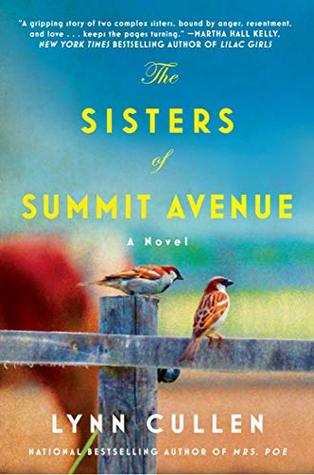
The Sisters of Summit Avenue, by Lynn Cullen***-****

My thanks go to Net Galley and Gallery Books for the review copy, which I received over a year ago. I began reading this story numerous times, but I didn’t find it engaging enough to continue, and so each time I began it, I would end up returning it to my queue in exchange for something I liked. However, I recently began moving through my backlog with assistance from Seattle Bibliocommons, where I was able to get audio versions of those I’d left by the wayside. Ultimately, this is how I was able to follow through, and it’s a good thing, because the last half of this book is far better than the first half.

The story features three women, all of them in the American Midwest in the early 1920s. The sisters are Ruth and June, and their mother is Dorothea. June is the golden one, the prettiest and most successful. Ruth, who is younger, just resents the crap out of June. And she can tell that their mother loves June more.  June, on the other hand, is Betty Crocker; one of them, anyway. One of the few career opportunities open to women involves inventing recipes for Betty; answering Betty’s mail; and playing the part of Betty on the radio. Women visit the company expecting to meet Betty, and thy are outraged to learn that no such person actually exists.

Meanwhile, Ruth and her family remain in the family home with Dorothea, and the sisters are estranged. Their mother hates to see them this way, and she schemes to bring them together.

The narrative shifts between the three women, and from the past to the present. When we are taken back to their youths, we learn what has come between them, and what assumptions, grudges, and secrets each holds that has not been said.

The first half of this book feels like it will never end. The sloppy pop-cultural references grate on me, particularly when the shortcuts result in inaccuracy. For example, when the stock market crashes, Cullen has men jumping from skyscrapers left, right, and center, when in fact, this is mostly myth, or at best, hyperbole. At most there was a single jumper in real life. Historical fiction at its best teaches us in an enjoyable way, but when readers are presented with urban legends as reality, it is a letdown.

By the halfway point, I am only still listening to this book because I have to make dinner anyway, and having put in as much time as I have, I figure I may as well finish it up. My review is on its way to being three stars at best, and possibly two. So imagine my surprise when at the 55% mark, the whole thing wakes up! The female character that has been the least interesting up until now is Dorothea, but now we learn the meaty parts that she has kept secret, and there we find the key to everything else. I am so astonished that my jaw drops, and I stop chopping vegetables and gape at my tablet, which is streaming this story. Oh, heck! Seriously? This is why…? Oh, holy crap. Who knew?

From that point forward, it’s an entirely different ballgame. When I head for the kitchen, I’m already thinking about what I heard the day before, and looking forward to the next bit.

Those that enjoy character-based fiction could do a lot worse, as long as you take the historical parts with a grain of salt. Overall, I recommend that if you read this book, you should get it free or cheap, and prepare to be patient.

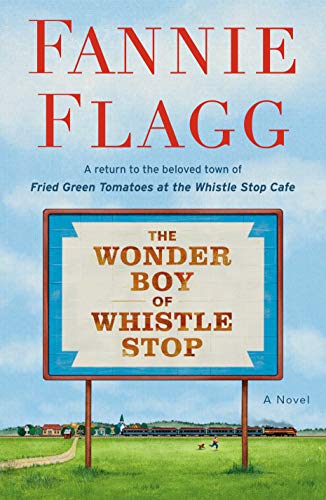
The Wonder Boy of Whistle Stop*****

They say that old writers never die, and I hope that’s true. With her last novel, The Whole Town’s Talking, Flagg announced that she was done. It was her final novel. I was sad to hear it, but grateful to have been able to read every wonderful thing she’s ever written. She has given us so much! And then, imagine my joy when I opened my email to find an invitation from Random House and Net Galley to read and review this sequel to Fried Green Tomatoes at the Whistle Stop Café, which is possibly my favorite novel of all time. Over the moon, friends. And it’s for sale now.

The tricky part of a sequel to such an iconic story is in trying to live up to what’s come before. In this case, I don’t think anyone can. That said, this is nevertheless a delightful book, and I recommend it to you, although you won’t get the full advantage from it without reading the first magnificent book first.

The format mirrors that of the first novel, (and from here forward, I will refer to it by initials: FGTWSC,) with time periods and points of view that come from a variety of settings and individuals. Whistle Stop, Alabama is no more; the freeway passed the town by, and the rest of modern transportation and technology did the same. When we return there, it’s difficult to find; boarded up buildings, tall weeds, trash, and kudzu. In fact, the start of this book is depressing as hell, and for a short, dreadful time, I wondered if the author might be slipping; but no.

The protagonist is ostensibly—from the title—Buddy Threadgoode, son of the late Ruth Jamison. Again, I find myself scratching my head, because Flagg’s protagonists are women, girls, and women. And actually, that’s true here also. Buddy is an old man, and he’s been sent to live a Briarwood, a retirement home for the elite. His daughter Ruthie married the son of the local bourgeoisie, and consequently he’s been mothballed in the nicest possible place; but he hates it, of course. He doesn’t make a scene, but who wants to be warehoused if they can help it?

However, most of the action centers on his daughter Ruthie, and then later, our old friend, Evelyn Couch. (Friends have told me I resemble this character, and I’m good with that comparison.) Evelyn gained confidence in the first novel, much of it courtesy of Ninny Threadgoode, and now she’s done nicely for herself. Husband Ed has gone to that man cave in the sky, but she has recovered from the shock and then some. And it’s roughly halfway into the story that Evelyn enters the story in a big way, and with the groundwork well established, the story takes wing.

As with the original FGTWSC, the key to keeping up with the ever-changing settings and narrators is in the chapter headings. If you skip them, you will be lost. (This fact has been established by trial and error in teaching the book to honor students in literature class.)

Flagg is a feminist, and her work reflects her subtle but unmistakable passion for social justice. Again, with the first half of this book I feared she had lost her edge; once more, I see in the second half that I am mistaken. She was just warming up. Unlike so many of the novels I’ve read recently, this story gets better and better as it progresses. At 45%, it seems like a pleasant, harmless story, and a bit of a disappointment. At 56%, I’m sitting up straighter and noticing things. At 75% I’m laughing out loud. And from there to the finish, I don’t want it to end.  

I’ve seen some lukewarm reviews for this book, and it’s understandable, in a sad way, because those reviewers are weighing this book against its predecessor. And no, this one isn’t quite as brilliant as the first, but if I deny the fifth star on that basis, then I need to go back and weed out at least 96% of the other five star reviews I have written, because FGTWSC is a matchless novel. If instead I weigh this story against those others, it stands up proudly.

When push comes to shove, I think all of us need a feel-good story like this one—which it is, despite the sorrowful beginning—all of the time, but now more than ever. Civic engagement is important, but stepping away and restoring oneself is every bit as crucial. Do yourself a favor. Switch off your news feed for a couple hours and snuggle down with this book. You’ll be more effective later for having given yourself time to recharge now.

Highly recommended.

A Long Petal of the Sea, by Isabel Allende*****

Allende has long been one of the writers I admire most, one of the few novelists to gain permanent space on my bookshelves. Her stories are distinguished by her devotion to social justice issues, particularly in Latin America, and to feminism. She’s known in particular for her use of magical realism, which I confess makes me a little crazy when she imbeds it in her nonfiction titles, and also her wry, sometimes subtle humor. Much of what she writes is historical fiction, as it is here, and she is a stickler for accuracy. Her research is flawless. She has prestigious awards from all over the world. Literature teachers love her.

My thanks go to Net Galley and Random House Ballantine for the review copy. This book is for sale now.

In A Long Petal of the Sea, she takes on a particularly ambitious task, creating a fictional family and charting its course from Spain following the failure of the Spanish Revolution, to Chile, to other points in Latin America, and then back to Spain once more. There are a lot of characters to keep track of, with different threads for each that separate, then braid together again and so on. There are at least three generations here, but primarily the story is Roser’s.

It’s a well written story, though it is also the sort of literary fiction that takes a fair amount of stamina. If you’re in search of a beach read, this isn’t it. I confess I didn’t enjoy it as much as I often enjoy Allende’s work, but I also believe it’s unfair to judge an author solely by what they have already written. If this was the first book by this author that I had ever read, I would give it five stars, and so that is what I’ve done.

My one disappointment is that we don’t learn more about the Spanish Revolution and the Spanish Civil War. This is an event that’s very difficult to find in quality historical fiction and literary fiction, at least in English, and I was excited when I saw this book was based on it. Then by the 25% mark, we’re out of Spain and it leaves me sad, because I wanted to know more about that period and place.  I also missed the usual Allende humor, which she uses in other books to break up tense passages and shoot down sexist behavior in her characters; her last book, In the Midst of Winter, made me laugh out loud more than once. That humor is in short supply here. The feminist moxie, however, is in splendid form, and the class and internationalist perspectives that I treasure are alive and well.

A book should be judged on its own merits, and I’ve done that, but I want to add a shout out to an iconic writer who’s still publishing brilliant, ambitious books at the age of 78. My own goals for that age, should I be fortunate enough to see it: I’d like to be breathing; to be able to see and hear most of what’s around me; and I’d like to not be completely crazy. Publishing great literature? Perhaps not. I am delighted that Allende can do this, and I hope she has more stories in the works.

A note on the audio version: I supplemented my review copy with an audiobook I found at Seattle Bibliocommons. It’s an approachable way to get through a complex, multifaceted story, but I don’t like the way the reader voices the elderly male character. The harsh, guttural-sounding tones are too near to a stereotype. Happily, the story is mostly Roser’s, but the unfortunate noise pops in fairly regularly all the way through, and it makes for a less enjoyable listen. For those with the time and inclination for the print version, it may be your better choice.

For those that love epic historical fiction, I recommend this book to you, although if you haven’t read Allende, also consider some of her early work.

Daughter of a Daughter of a Queen, by Sarah Bird*****

Cathy Williams was a real person, and Sarah Bird steps up to tell her story, marrying an engaging narrative with historical fact. Though I am mighty late, I received this book free and early. My thanks go to St. Martin’s Press and Net Galley for the review copy.

Cathy Williams was born a slave, though her mother told her to regard herself not as a slave, but as a captive, one of noble warrior blood whose destiny was freedom. The American Civil War led General Philip Sheridan to the tobacco farm in Missouri where Cathy and many others performed forced labor for “Old Mister.” Sheridan chooses her to work in the kitchen; she isn’t pretty, and he figures she will do what she’s supposed to, rather than being caught up in romance. She and other former slaves work in exchange for meals and protection against Rebel slave-hunters.

The American Civil War is my favorite historical period to read about, and I have a soft spot for Sheridan, so this makes the story all the sweeter for me. Before my retirement, I was a history teacher and the civil war was what I taught for one term every school year, yet I didn’t find any inaccuracies here. That’s a rare thing.

Usually, stories that are set during this period hit a climax when the war ends, and soon after that, the book is over. Bird doesn’t do that here; after all, this story isn’t about the war, it’s about Williams. Victory is declared, everyone whoops for joy, and we’re not even halfway in it yet. I like this, because it shows some continuity, and one must wonder, at times—so the war ends, and then what? The South is decimated. The army virtually dissolves. What becomes of those we have been reading about? Reconstruction starts and fails, we know this; yet one wonders about individual stories.

After the war, the army is still Cathy’s home. She is a big woman, and when a soldier friend is murdered, she takes his army coat and dresses herself up as a man, becoming Private Cathay, and she joins the Buffalo Soldiers. In real life, she is the only woman to do so.

I won’t even try to recount the many experiences Williams has; in some ways, it’s a less exaggerated version of Forrest Gump, or Little Big Man, but an African-American woman is the subject, and the story is true. Bird did some top-notch research for this thing, and between that and her considerable skill with character development, pacing, and dialogue, the result is pure gold.

It starts a little slow, but patience will reward you. There’s a fair amount of violence—how could there not be—and a number of ugly situations that might make this a bad fit for a classroom read-aloud, and that’s a shame, but the story had to be told this way. I recommend it for high school libraries, and Black History Month shelves; it might also make a fine gift for your precocious reader, depending on your comfort level and theirs. The very best thing to do, younger readers or no, is to read it yourself. I alternated my review copy with the audio version that I scooped from Seattle Bibliocommons, and the reader is a standout, so I recommend it in that form as well.

Impersonation, by Heidi Pitlor***

My thanks go to Algonquin Books for the review copy. This book is for sale now.

Allie is a single mother and a professional ghost writer. Because her income is sporadic, she picks up money between publishers’ paychecks substitute teaching and landscaping. She’s always broke, always paying the most pressing bill at the expense of others. Then her big break comes, and she’s over the moon. She’s going to write a memoir for a famous feminist, someone she has idolized for many years. The pay is more money than she’s ever earned before, and as a bonus, she will get to spend time with an icon.

Except she won’t.

Her icon is a busy woman, and she isn’t forthcoming with any personal information. Nothing. With deadlines looming, then passing, Allie desperately invents anecdotes drawn from her own experiences, hoping that if they don’t satisfy, her subject may part with some true stories of her own; but ultimately, she is the one that gets tossed under the bus.

The story begins well, witty and absorbing. If I were to review the first few chapters, this would be a four or five star review. However, in the middle of the book the plot bogs down and the pacing grinds to a crawl. I had hoped for a climax and finish that would make it worthwhile, but instead, the story becomes a pedantic manifesto. The feminist issues that are near and dear to Allie’s heart, and one may assume, Pitlor’s as well, are also mine. If anyone in this world should love this story, it should be me. And oh, how I wish it was. But because the protagonist has become such a nonentity, there is no inspirational melding of character and social issues that might have made it possible.

There’s a terrible irony here, or at least there may be. Perhaps Pitlor deliberately ceased developing Allie because Allie is a ghost writer, and her entire career is predicated on her ability to lie low. Perhaps we are meant to see her disappear, and perhaps that’s intended to be part of the message. But if so, it doesn’t work for me. I need more internal development, or more of something else.

Conceptually the story is strong; but the execution leaves something to be desired.

Anxious People, by Fredrik Backman*****

He’s done it again, only better.

My thanks go to Net Galley and Atria Books for the review copies. You can buy this book today, and I suggest you do it. The world around us may have gone nuts, but Backman helps us to remember the good in ourselves and in those around us, even in the most unlikely people. For that alone, this book is worth its weight in gold.

We start with an attempted robbery at a cashless bank; as with so many crimes done on impulse, nothing goes the way it’s supposed to. There’s no money to be robbed, and with the cops on the way, the best thing to do is to duck out quickly…until you realize that the door you chose isn’t an exit. Then there are these hostages, an insurance policy to prevent your being swept away to prison, but “it’s harder than you might think to take people hostage when they’re idiots.”

Backman often creates complex situations with huge numbers of characters in his novels, and he does better than hardly anyone else when he does it. This book, by contrast, has a more manageable number of characters, and perhaps that’s a big part of its even greater success. We have the robber; the hostages, who are the people viewing an apartment for sale, and the seller and realtor; a pair of cops that are also father and son; the therapist that sees one of the hostages; and a couple of other people. The first that we meet is Zara, a sharp-tongued, wealthy woman that is viewing the apartment even though she is obviously too rich to want it. Just about everything that comes out of Zara’s mouth is smart, mean, and very funny; we gradually learn that she does this to deflect the conversation away from herself. With apologies to Dickens, Zara is as solitary as an oyster.

Besides Zara, the prospective buyers include two dysfunctional couples. There’s an older couple, man and woman; and there’s a pair of women, one of whom is hugely pregnant. When this is revealed I roll my eyes, convinced that the climax is almost certainly going to include the obligatory emergency birth. But I should know better, by now, than to underestimate Backman.  He doesn’t use tired tropes or formulas, and Julia isn’t going to give birth during this crisis.

I don’t want to give away any of the details here, but as we get to know our collection of hostages and others, it’s pretty clear, as the title suggests, that everyone’s misbehaviors come from their anxieties, and when they criticize and pick away at others, they are actually dissatisfied with themselves. But of course, Backman’s writing is much more magical than my own, and the result is the sort of feel-good denouement that doesn’t insult our intelligence or become maudlin. At this moment I can only bring to mind three writers that consistently do this for us. (The other two are Alexander McCall Smith and Amy Poeppel.) And right now, friends, we need all of this magic that we can get.

Buy this book if you can; if your wallet is too thin right now, then get on the list at your library. Highly recommended to everyone.

The Lives of Edie Pritchard, by Larry Watson****-*****

It’s not often that a male writer gets it the way that Larry Watson does. My thanks go to Net Galley and Algonquin for the invitation to read and review, as well as the gorgeous hardcover copy. This book will be available to the public tomorrow, July 21, 2020.

Edie’s story is divided into three periods. When we first meet her, she is a young adult, married to Dean. Twenty years later, we find her in a different marriage. The last third finds her a senior citizen. When I saw how the first and second parts were structured, I thought I spotted a formula and that I knew more or less what the last third would look like. I’m delighted to say I was incorrect.

The style in which it’s written is unusual. There’s almost no inner monologue; everything is either action or dialogue. There’s no shifting point of view, either. It’s straight forward and linear. The author takes his time establishing character and setting, and so for a long time, there’s no noticeable plot curve. At about the point where I begin to be nervous, that perhaps I’ve agreed to read and review a book that isn’t very good, it wakes up. I’m not generally a fan of spare prose writing, but this is different.

Edie has married Dean Linderman, whom she dated in high school. He’s a nice guy, but his twin brother Roy is a player. Where Dean is introverted and reflective, Roy is extroverted and aggressive; and one of the ways Roy shows aggression is in trying to seduce his brother’s wife. It never stops. Every single time they are alone together, even for a few minutes, he starts in on her. And every stinking time, she tells him no. Stop it, Roy, I am married to your brother. I love Dean, not you. But getting the guy out of her hair is like trying to herd mosquitoes. And yet, a couple of times I see Edie do or say something that, while not openly encouraging, sends mixed signals, and I think, Aha. Maybe that’s why Roy keeps trying.

 Watson uses nuance and subtlety in a way not many authors do. It makes Edie come alive, because I don’t know what she’s thinking, and Watson isn’t going to take it apart in front of me. I am left to wonder…now why the heck would Edie do such a thing? And while I read, I wonder. And when I am no longer reading, I’m still wondering.

Twenty years later, we find Edie Dunn. She’s married to someone else, and she has a teenaged daughter. Like Dean before him, Gary doesn’t spend a lot of time worrying about what Edie wants. Edie is his wife, and she should do what he wants her to do. And I won’t give any more of this bit away, but once more, Edie surprises me.

Within the last section, Edie’s teenage granddaughter is going to move in with her. Edie’s companion who’s in the car with her asks if she isn’t out of practice with teenagers. Edie says, “It’s like riding a bicycle. Once you’ve fucked up as a parent, you never forget how to fuck up again.” I love this.

When I am sent a physical book to review, as opposed to digital or audio, the book goes into the bathroom. I know that I am hooked if the book comes back out of the bathroom with me at some point. Edie came out at about the sixty percent mark, and after that she didn’t get left alone unless I had to sleep.

The thing about this story that may get in the way of good reviews here is exactly the thing that makes it so good. The way that Roy—and later, other men—follow Edie around and pester her, trying to control her and later, her granddaughter, is repetitious and maddening, and that. Is. The. Point. Though it’s conveyed subtly, we know that Edie is very attractive. And again—I love that we don’t hear constantly about her clothes, her figure, and so on; rather, we know she’s gorgeous by what others say about her, and how they respond to her. And not one living male takes her seriously. They see her, and then they want her, not because they care about her or even know her, but because it would stoke the fires of their self-esteem. And all along, Edie tries, initially, to explain what she wants instead, and not a damn one of them will listen to her. But she does what she has to do, and by the end of the book, I like Edie a great deal.

Those that enjoy strong feminist fiction should get this book and read it.

The Bright Side Sanctuary for Animals, by Becky Mandelbaum*****

Becky Mandelbaum is the real deal. In 2016 she published a short story collection, Bad Kansas, which I read and loved. ( You can find my review of it here: https://seattlebookmamablog.org/2017/09/15/bad-kansas-by-becky-mandelbaum/) And so when I found this debut novel on Net Galley, I leapt at the chance to read and review it. Big thanks to Net Galley, and to Simon and Schuster. This book will be available to the public August 4, 2020.

Ariel and her mother, Mona have been estranged for six years. But when she finds a news item about her mother’s sanctuary having been torched, Ariel knows it’s time to go home, to see what has been lost and what can be saved.

The story is told from the third person omniscient, and we hear from three characters mostly. We start with Mona, whose stress levels have become nearly unbearable. She’s getting too old to do so much work, and she never has enough money. She has just one employee, working on site primarily for room and board. Perhaps this is part of what possesses her when she leaps in her truck in the dead of night to steal the neighbor’s Make America Great Again sign. She wrestles the great big thing into the bed of her pickup, and by now we can see that she is a tightly wound person whose impulse control is just a tiny fraction of what it should be.

Meanwhile, Ariel is concerned, not only about the fire, the sanctuary, and her mother, but also about her relationship. Her boyfriend, Dex—the third of the characters we hear from most– proposes just as she has begun to fantasize about ending the relationship. As the story progresses, we can see that Ariel is the sort of person that runs from her problems, sometimes literally. She accepts the ring and then says she has to go home for the weekend, and no, he shouldn’t come with her. After all, she’ll be right back. Probably.

Mandelbaum does a brilliant job of building believable, nuanced characters and complicated relationships. Five percent of the way into my galley, my notes say, “This one is going to be a thinker.” And it is, in the best sense of the word. It isn’t a pretentious piece of writing by a long shot, and it isn’t full of florid descriptions or challenging vocabulary. Instead, we have characters that are dealing with thorny personal issues that have no obvious solutions. And my favorite aspect of it is the way the mother-daughter relationship, which is the heart of the novel, is framed. Mona has made a lot of mistakes in parenting Ariel, but she loves her daughter and is a good person. Ariel is still learning how to solve problems herself. There’s a trend in fiction writing right now to draw villainous mothers as the sources of protagonists’ problems. It’s close to becoming a cliché. Mandelbaum has steered clear of this canard and created something much deeper and more interesting. In fact, there are at least half a dozen stereotypes that she has dodged expertly. The fact that she has done this in her debut novel suggests that a great career is ahead of her.

I love the way she ends this story.

Don’t deprive yourself of this glorious novel. Highly recommended.

The Night Watchman, by Louise Erdrich*****

I cannot believe it has taken me this long to read the legendary novelist, Louise Erdrich. I had my reasons—wrong ones, as it turns out—and I am grateful to Net Galley and HarperCollins for the review copy, and thus helping me pull my head out of…the place where it was. This excellent novel is for sale now.

Let me explain, first off. Many years ago, I enrolled in an alternative graduate program that emphasized respect for all cultures and races, and which required, as a graduation requirement, attendance at a full day seminar listening to a locally famous Native storyteller.  The story was delivered in a monotone, with a good deal of repetition and no effort at summarization. So, after dutifully suffering through 6 hours of it on one of the hottest days of summer, I pledged to myself that I’d never go through that again.

Twice, good friends have urged me to read Erdrich’s novels, but I was also told she was an American Indian storyteller whose heritage formed a central theme in her writing. My eyes glazed over, and I vowed to give it a miss. When The Night Watchman drew early raves, I realized that my assumptions about Erdrich might be in error, and I hustled back to Net Galley to see if I might still score a galley. It’s a lesson well learned.

The year is 1953, and the place is the Turtle Mountain reservation in North Dakota. Patrice Paranteau has finished school, but she doesn’t want to get married. She has seen her friends do so and turn into old women overnight, shivering as they hang the wash to freeze dry in winter, and collecting snow to melt so that their children can take a bath. No thanks. Instead,

I cannot believe it has taken me this long to read the legendary novelist, Louise Erdrich. I had my reasons—wrong ones, as it turns out—and I am grateful to Net Galley and HarperCollins for the review copy, and thus helping me pull my head out of…the place where it was. This excellent novel is for sale now.

Let me explain, first off. Many years ago, I enrolled in an alternative graduate program that emphasized respect for all cultures and races, and which required, as a graduation requirement, attendance at a full day seminar listening to a locally famous Native storyteller.  The story was delivered in a monotone, with a good deal of repetition and no effort at summarization. So, after dutifully suffering through 6 hours of it on one of the hottest days of summer, I pledged to myself that I’d never go through that again.

Twice, good friends have urged me to read Erdrich’s novels, but I was also told she was an American Indian storyteller whose heritage formed a central theme in her writing. My eyes glazed over, and I vowed to give it a miss. When The Night Watchman drew early raves, I realized that my assumptions about Erdrich might be in error, and I hustled back to Net Galley to see if I might still score a galley. It’s a lesson well learned.

The year is 1953, and the place is the Turtle Mountain reservation in North Dakota. Patrice Paranteau has finished school, but she doesn’t want to get married. She has seen her friends do so and turn into old women overnight, shivering as they hang the wash to freeze dry in winter, and collecting snow to melt so that her children can take a bath. No thanks. Instead,

“She was the first person in the family to have a job. Not a trapping, hunting, or berry-gathering job, but a white people job. In the next town. Her mother said nothing but implied that she was grateful. Pokey had this year’s school shoes. Vera had a plaid dress, a Toni home permanent, white anklets, for her trip to Minneapolis. And Patrice was putting a bit of every paycheck away in order to follow Vera, who had maybe disappeared.”

The point of view shifts between Patrice; a local boy turned boxer, Wood Mountain; Haystack Barnes, the white math teacher and boxing coach; and Thomas, Patrice’s uncle, who is the night watchman at the jewel bearing plant. Thomas is modeled after Erdrich’s grandfather, and the author’s notes at the end mention that his struggle to save the Chippewa land made writing this book an emotional experience.  

As the story opens, Patrice is preparing to track down her sister, who is rumored to have had a baby in Minneapolis, and Thomas is organizing a group of Chippewa to attend the hearings in Washington, D.C. The Feds have sent a letter to the tribe suggesting that since they were clearly successful, they would surely no longer require government aid or protection. Their land would be absorbed by the U.S. government and then sold to private buyers; its current residents would be relocated to cities where they could get work. And it’s a measure of exactly how clueless the average American was about the Chippewas’ plight that Barnes, who lived and worked among them, said, “I don’t understand why it’s so bad. It sounds like you get to be regular Americans.”

There are other points of view as well; the most memorable are the Mormon missionaries that have drawn the short straw and been sent to minister to the “Lamanites.” This religion holds that the inferiority of American Indians is revealed holy truth; only by converting can they be salvaged, and when that happens, the new converts will slowly become whiter. Our two missionaries dislike each other profoundly, which is unfortunate since they may only separate from one another to use the toilet. When the main story becomes intense and at times, very sad, in will pop the missionaries and before I know it, I am laughing out loud.  In addition, I admire the way the strong female characters are developed.

There are three primary threads to follow: what Patrice decides to do with her future; whether Vera will be found; and whether the Chippewa of Turtle Mountain will lose their land. All are handled with the mastery one might expect from an iconic author.

Don’t be the idiot that I was. Get this book and read it now.

Credible Threat, by J.A. Jance****

Jance is a prolific novelist, with three long-running series to her name. Credible Threat is the fifteenth in the Ali Reynolds series. Thanks go to Net Galley and Gallery Books for the review copy; this book is for sale now.

The star rating is a tricky thing sometimes. In this case, I wonder whether, had I never read anything by this author, I might tack on that fifth star. It’s the curse of the brilliant, being measured against oneself, but ultimately, I couldn’t help comparing this mystery to The A List, which came before it.

What I like—a good deal, in fact—is the trajectory Jance has taken with this series, making all of the important characters women. In addition to protagonist Reynolds, we have the villain, Rachel Higgins; a third long-running character is the AI named Frigg, who identifies as female. Two key assistants are female, and Sister Anselm, a nun friend of Reynolds, also plays a key role. There are men here, of course. There’s the victim, Father Andrew, who doesn’t last long, and the intended victim, Father Gillespie, who has the meatiest male role in this installment. Ali’s spouse is the co-owner of High Noon, the security firm through which Ali is drawn into one mystery after another, but he is conveniently called out of the country early in the game.

The story begins with a call from Archbishop Gillespie, a friend of B, Ali’s husband. He’s been getting a whole string of threatening notes placed in offertory collections all over the Phoenix area. The police have brushed him off already, and he’d like the matter handled discreetly. He is concerned about his would-be killer’s soul.

Our killer, meanwhile—whom we know right up front, so I’m not giving anything away here—is grieving, embittered, and unhinged. She has recently discovered clues in her late son’s memorabilia collection that suggest his addiction and suicide were the outcome of his molestation at the hands of the swimming coach at the Catholic high school he attended. The coach has died of AIDS, and Higgins still wants somebody to pay for her son’s death; an eye for an eye. Since it’s clear to everyone that the Roman Catholic Church stonewalled and swept abuses under the rug for generations, it makes sense, she decides, to go right to the top. But clearly, even if she were up for international travel, it would be absurd to attempt killing the Pope. Who’s in charge locally, then? Archbishop Gillespie. And so Rachel commences to plan Gillespie’s murder, sending the missives in advance so everyone will know why he had to go. She finds a fall guy to frame for her crime and is off and running.

My first impression is that this story is substantially similar to the last Reynolds mystery, in which a mother planned to commit murders to avenge her son. I’m surprised a pro like Jance would slip like this. But that’s my sole complaint.

I love the way Jance battles stereotypes, and in this case, it’s the Catholic clergy—the good ones—that benefit. Though the layers of abusers, sexual and otherwise, are deep and wide, I bristle at the cracks that are made by comics and the general public almost reflexively about all priests. I have known some wonderful men that abused nothing and nobody, who gave up marriage and family in order to spend their entire lives in the service of others, via the Church. Not all nuns are frustrated savages looking to beat children with rulers; not all priests are pedophiles. The way Jance takes that apart makes me want to stand up and cheer.  

The clever loophole that Ali finds and that Gillespie widens with regard to Frigg’s extralegal snooping is terrific.

Whether we call it four stars or five, this is a solid mystery and a good deal of fun.  I recommend it to you wholeheartedly.