Unknown's avatar

About seattlebookmama

Greetings! I am Donna Davis, a retired teacher living in my favorite city in the world. I've found that one of the greatest comforts in life is a good book. We can all use a little of that. Welcome, and enjoy! Donna Seattle Book Mama

Going to the Mountain, by Ndaba Mandela*****

GoingtotheMountainNelson Mandela’s hundredth birthday approaches. His grandson Ndaba, whom Mandela raised following his release from prison, talks about growing up with the titan that led the movement against Apartheid in South Africa. He reflects on Xhosa culture and the role that it played in the struggle and in his own development, and it is within this framework that he talks about his grandfather, and about the future of his people.

My thanks go to Net Galley and Hachette Books for the review copy, which I received free and early.

Ndaba spent his early years moving between his parents’ households. His mother struggled with alcoholism and other disorders; his father was ill, and would later die from AIDS. He tells of the surreal juxtaposition of the slum that had been his entire experience with his grandfather’s house, where he had his own room, food that was healthy and prepared for him, clothing, and even a video game system; it was just about everything a child could ask for, but it came at the price of separation from his mother, and he rebelled and acted out in response. As a man with a wider view of the past, he recognizes that this was by far the best outcome, but for many years he resisted, yet was safe because of his grandfather’s stable influence and wisdom.

He speaks of having come to Disney World as a youngster, where he was engaged in conversation with a friendly American, who asked him, as they stood in line for a ride, how big the lions are in Africa. Ndaba, of course, grew up in an urban environment and had no more seen a lion wandering around than the questioner had. He came to realize that these are the stereotypes that the Western world has for Africa: lions in rural areas, and crime in the cities. Dangerous animals; dangerous people.  He suggests that the U.S.A.  improve its own police forces before presuming to talk to South Africans about theirs.

He has a point.

The entire memoir is told using Xhosa folk tales as allegory, and the result is glorious and deeply moving. Although I seldom become teary while reading, a good hard lump formed in my throat when he spoke of taking his grandfather on his final journey to Capetown.

Highly recommended to everyone, whether you know the history of the South African Revolution or are new to it.
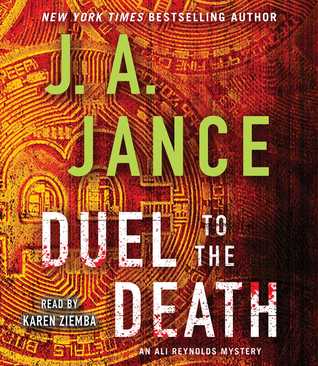
Duel to the Death, by J.A. Jance***

DuelofDeathJance is one of my favorite hometown writers, author of the J.P. Beaumont series and other books, and so I was pleased to see this title offered on Net Galley. Thanks go to that site and Touchstone for the free review copy.  It’s for sale now.
This is the 13th entry in the Ali Reynolds series, and its constant readers will likely want to read this one also. New readers may be a harder sell. Although the novel has some bright spots, it’s slow to wake up and burdened with a number of issues, some of which are deal-breakers.

The opening is slow, and there is a great deal of back story that slows down the inner narrative. If I hadn’t taken a review copy from Simon and Schuster, I would have tossed the book on my giveaway pile and called it quits. But staying with it has its rewards. Though Reynolds is featured in this story and it is set in her home and within the cybersecurity firm she and her husband own, the most important characters here are Stuart, her technical wizard, and the surprisingly charming Artificial Intelligence entity named Frigg that bonds to him. Graciella Miramar, a talented Panamanian hacker and the daughter of a drug lord, is determined to hack into Frigg in order to get the password that serves as the key to a vast fortune in Bitcoins.

I am nearly halfway into the book before I am engaged, but once I am hooked I am in it for keeps.

The immense amount of money Reynolds and  her husband toss around  prevents me from empathizing with them.  A large amount of independent wealth solves a lot of logistical problems for the novelist,  just as it does for the affluent in real life, but Jance is a seasoned writer, and I am disappointed that she takes the easy way out. In addition, the denouement—not given away here lest you decide to read it anyway—strains credibility.

All of the bad guys—we have one female villain, Graciella, and a whole list of her family members and associates—are Latino. All the Latinos, apart from the Reynolds’ domestic employee, are bad people. All the good guys are Caucasian except for Cami, who is Asian-American.  I am disquieted by the portrayal of at least a dozen immigrant characters as “gangbangers”, thieves, rapists, arsonists, and murderers. Particularly given current events and attacks on immigrants’ rights by the U.S. government, this is disturbing.

So if you are a reader who is heartily sick of fiction that wants to appear politically correct, congratulations. Here’s your book; knock yourself out. Everyone else is forewarned.

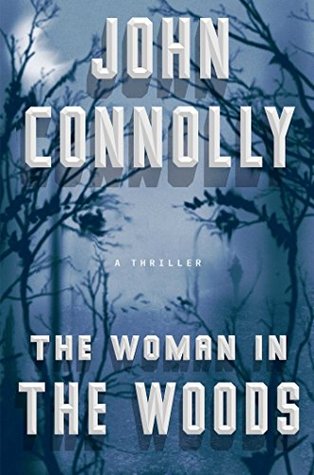
The Woman in the Woods, by John Connolly****

thewomaninthewoodsConnolly is one of a handful of writers whose names I search when I go to Net Galley. He’s consistently brilliant, and so I am grateful to Atria Books and Net Galley for the review copy. This book is for sale now.

This is number sixteen in the popular Charlie Parker series, which began as detective fiction with mystic overtones reminiscent of James Lee Burke, and in the last volume moved into the horror genre outright. Either way it’s a compelling series. One of my favorite aspects of this series is the author’s incorporation of social justice themes. Here we find a sadistic butcher hot on the trail of the shelter volunteers that assisted Karis Lamb in escaping the father of her child, and a magical book she took with her.  Karis died in childbirth and is buried in the woods, and there are nightmarish individuals—human and not—trying to find her child so they can get the book. His adoptive mother and grandfather are determined to protect Daniel at all costs.

“Tell me the special story,” Daniel said. “The story of the woman in the woods.” 

Karis’s body is dead, but her spirit is not at rest. She is looking for her boy, and a particularly chilling detail is the repeated use of Daniel’s toy phone to call him from beyond the grave. 

At the same time, Angel, one of Parker’s two assistants who is also his close friend, is lying in a hospital bed following cancer treatment, and his partner, Louis, whose impulse control is never tiptop and is now strained to the breaking point, becomes enraged when he sees a vehicle bearing a Confederate flag parked near the hospital, and so he blows up the truck. As events unfold, our supernatural villains and the Backers—sinister characters whose lives hold no joy, and whose fate is eternal damnation—are joined in their pursuit of the Atlas, the child, and now also Parker by some local white supremacists seeking vengeance on behalf of the van’s owner.

As always, Connolly juggles a large number of characters and a complex plot without ever permitting the pace to flag, and he keeps the chapters short and the details distinct so that the reader isn’t lost in the shuffle.

This will be a five star read for most of Connolly’s readers.  Rating horror stories is immensely subjective, because some readers may find this book too horrible to be fun, whereas others will appreciate the way Connolly continues to turn up the creepiness and the gore. As for me, I had a rough time getting through the first half. I didn’t want it in my head at bedtime, and the graphic torture scenes prevented me from reading while I was eating. The result is that I had to read much more slowly than I usually would do; there were too many times I just couldn’t face it, and there were other times when I could read a short amount, then had to put it down for awhile. I suspect I am a more sensitive horror reader than most, but there will be some besides me that began reading when this was a detective series, and that may find it too grisly now.

None of this will prevent me from jumping forward when the next in the series comes around.

Highly recommended to those that love excellent fiction, and that can withstand a lot of horror and a lot of gore.

Doggie in the Window, by Rory Kress***

TheDoggieintheWindowThank you to Net Galley and Sourcebooks for the review copy, which I received free of charge in exchange for this honest review. This book is for sale now.

Kress provides a great deal of salient information in this pet store expose; she’s done her research, and explains the ways in which laws fail to protect pets sold for profit, and she has some strong proposals of her own.

I expected to appreciate this book more than I did. I am a volunteer for Seattle Beagle Rescue; I write this review with Beagle Bailey, the fourteen-year-old rescue dog I am caring for in his golden years, flopped on my foot. I am also a fool that once, many years ago, purchased a cocker spaniel from a pet store. (As far as I know, nobody in Washington State actually puts puppies in a display window anymore, but sometimes they broker a purebred adoption.) That dog was gorgeous, but she was a mean little shit, and we had to adopt her out to an older couple that didn’t have children. At the time I figured it was a matter of bad breeding practices, but after reading Kress’s book, I have to wonder what was done to that pup when she was tiny.

The information here is solid, but the writing style didn’t work for me. You can only read so much wall-to-wall horror without wanting to put the book down; I get it already, don’t beat me! In addition, there’s a personal thread about the struggle she and her spouse went through trying for a (human) baby, and while I suppose that might have worked, somehow it didn’t. Instead of feeling confidential, it felt both disjointed and like an overshare.

Once I had begun reading, I realized that although I didn’t know all the low down, dirty details, I have known for decades that nobody should buy a dog from a puppy mill or a pet store, which is more or less the same thing, and it’s widely known. For many readers, this isn’t new information. Most people that go that route do it not because it’s a smart or ethical thing to do, but because it’s easy. When I made that error back in the ‘90s when I bought the cocker, it was known to most people, and to me, that this is an unwise way to get a dog, but I was already badly overbooked time-wise. A solid breeder is often hours away, and sometimes not even in the same state you reside in. And although there’s a lot of bandwagon talk about the benefit of adopting shelter animals, I had failed at this not once, not twice, but five times.

In four cases I had brought animals home that had contracted fatal diseases prior to their shelter vaccinations; the illnesses were dormant, and the shelters weren’t to blame, but when you hold a dying kitty in the veterinarian’s office that many times, you rethink shelter adoptions. And then there was the wild card puppy that turned out to be a German Shepherd and Coon Hound mix. She was one of cutest puppies you’ll ever see, and very healthy, but I can’t deal with a large dog; couldn’t control her, and she kept accidentally hurting the babies. Again, I had to search for a more appropriate home and was lucky to find a great family for her, but it was wrenching. My husband sat down and cried when that family drove away with our dog.

So I am leery of the promise of shelter adoptions; purebred rescues are great, but to get the very best dog for your needs, a solid, reputable breeder is the way to go. None of these variables appears here that I saw; I did abandon the book halfway through, so it’s possible it came up, but this didn’t appear to be the trajectory.

Those that want to know all the details, whether for personal knowledge or as animal rights activists, may want this book, but if you are looking for a sometimes sad but enjoyable read, something that balances out the joys of responsible dog ownership with the cautionary information about disreputable sources, this isn’t it.

The Melody, by Jim Crace****

“We are the animals that dream.”

TheMelodyJim Crace is an award-winning author with an established readership, but he is new to me. Thanks go to Net Galley and Doubleday for the review copy. This book will be available to the public Tuesday, June 19, 2018. Those that love literary fiction should take note.

Alfred Busi is a singer, and he was famous during his prime, but now he’s old, living alone in his villa with just his piano to keep him company. At the story’s outset he hears a noise below late at night and goes down to run the animals or the whoever out of his garbage bins, but instead he is attacked. Something or someone flies out and bites him a good one; he thinks it was a boy, a half-feral child:

“Busi could not say what it was, something fierce and dangerous, for sure…before the creature’s teeth sank into right side of his hand, and, flesh on flesh, the grip of something wet and warm began its pressure on his throat, Busi knew enough to be quite sure that this creature was a child. A snarling, vicious one, which wanted only to disable him and then escape.”

The problem—beyond the injury itself—is that Busi is elderly, forgetful, and occasionally confused. His wife is dead, and he’s grieving hard. The only people remaining in his life are his sister-in-law and her son, his nephew, and they aren’t sure he isn’t delusional. Medical staff question his reliability as well; soon, a truly nasty journalist writes a smear piece making fun of him, and it comes out just as he is scheduled to perform for the last time at a concert where he’s to receive a prestigious award. It’s all downhill from there.

Concurrently there’s discussion among the locals about the homeless people living in the Mendicant Gardens—a place entirely devoid of foliage, where makeshift shacks are erected from cardboard, scrap lumber and whatever else is on hand—as well as the fate of the bosc. I find myself searching Google here because I am confused. I have never heard of a bosc, which turns out to be a wooded area of sorts, and my disorientation is compounded by not knowing where in the world this whole thing is unfolding. If our protagonist lives in a villa, and if we’re not in Mexico, then are we in Southern Europe somewhere? I am following language cues; the names of things and places sound like they could be Italian, or maybe French. Or in Spain. The heck? I go to the author bio, but that’s no help, since Crace lives in the U.S. I try to brush this off and live with the ambiguity, but I continue wishing that I could orient myself. It’s distracting. There’s a social justice angle here involving society’s obligation to its poorest members, but I am busy enough trying to establish setting that the effect is diluted.

Nevertheless, the prose here is sumptuous and inviting. Adding to the appeal is the clever second person narrative; we don’t know who is talking to us about Mr. Busi, and we don’t know whether the narrator is speaking to a readership or to someone specific. For long stretches we are caught up in the plight of our protagonist and forget about the narrator, and then he pops back in later to remind us and pique our curiosity.

I am surprised to see this title receive such negative reviews on Goodreads. To be sure, GR reviewers are a tough lot, but there are some angry-sounding readers out there. What they seem to share in common is that they are Crace’s faithful fans, and if this title is a letdown for them, I can only imagine what his best work looks like; after a brief search I added one of his most successful titles to my to-read list, because I want to see what this author could do in his prime.

And there it is. Many people won’t want to read this, because we don’t like thinking about old age and death. Busi’s whole story is about the slow spiral that occurs for most people that live long enough to be truly old. It’s depressing. Those of us that are of retirement age don’t want to think about it because it’s too near; those that are far from it are likely to wrinkle their noses and move on to merrier things. It’s a hard sell, reading about aging, physical decay, and dementia. And there are specific passages that talk about Busi’s injuries and physical maladies that caused me to close the book and read something else when I was eating. It’s not a good mealtime companion.

Crace is known as a word smith, and rightly so. If you seek a page-turner, this is not your book, but for those that admire well-turned phrases and descriptions as art, this book is recommended.

My Own Words, by Ruth Bader Ginsburg****

MyOwnWordsThis one is a crushing disappointment. I seldom buy books anymore, but I was so pumped about this collection that I went all out and got a hard copy, expecting to love it enough to keep it in my home library forever. Sadly, this isn’t what I expected.
Obviously, no U.S. Supreme Court justice is going to have enough time to sit down and write his or her memoirs, let alone an octogenarian justice, but I had hoped to find a collection of her meaty and sometimes even audacious opinions, particularly her dissents. Instead, this slender volume is packed with filler. There are two co-authors whose names are written on the cover in miniscule print, and it is they that write sometimes windy introductions to just about everything;  to make matters worse, they don’t tell us anything you cannot find in other biographies written about this feminist luminary.

And what of Ginsburg’s writing? I didn’t buy the book to see the precocious things she wrote as a child, as an adolescent, or in college. I just want to read her court opinions. That’s it. And that’s not what I got.

I can’t give anything that bears Ginsburg’s name a rating below four stars, but seriously, if your discretionary income forces you to buy books strategically, either skip this one or get it used. Surely at some point something more scholarly will be released, and then I’ll wish I still had the dollars that I spent here.

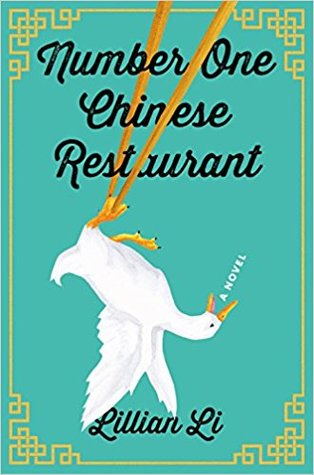
Number One Chinese Restaurant, by Lillian Li*****

NumberOneChineseLillian Li’s debut novel , a tale of intra-family rivalry, intrigue, and torn loyalties is a barn burner; it captured my attention at the beginning, made me laugh out loud in the first chapter, and it never flagged. Many thanks go to Net Galley and Henry Holt Company, from whom I received a review copy in exchange for this honest review.  Don’t let yourself miss this one. This book will be available to the public Tuesday, June 19, 2018.

The book opens with bitter scheming on the part of Jimmy, one of two brothers that fall heir to the family restaurant after their father passes away.  Jimmy has waited for the old man to die so that he could run the restaurant his own way. The Duck House serves greasy, cheap Chinese food, and he is sure he can do better. He craves elegance, a superior menu with superior ingredients. He wants renown, and he doesn’t want his brother Johnny to have one thing to do with it.

Johnny’s in China. Johnny runs the business end of the restaurant, and he takes care of the front of the house. He’ll come back to Maryland in a heartbeat, though, when the Duck House burns down.

Li does a masterful job of introducing a large cast of characters and developing several of them; although at the outset the story appears to be primarily about the brothers, the camera pans out and we meet a host of others involved in one way or another with the restaurant. There are the Honduran workers that are referred to by the Chinese restaurant owners and their children as ‘the amigos’, and we see the way they are dismissed by those higher up, even when it is they that pull Jimmy from a burning building. There’s a bittersweet love triangle involving Nan and Ah-Jack, who work in the restaurant, and Michelle, Ah-Jack’s estranged wife, but it’s handled deftly and with such swift pacing and sterling character development that it never becomes a soap opera. Meanwhile Nan’s unhappy teenage son, Pat, pulls at her loyalties, and she is torn between him and Ah-Jack in a way that has to look familiar to almost every mother that sees it in one way or another. But the most fascinating character by far, hidden in the recesses of her home, is the sons’ widowed mother, Feng Fui, who serves as a powerful reminder not to underestimate senior citizens.

Li is one of the most exciting, entertaining new voices in fiction since the Y2K, and I can’t wait to see what she writes next. Gan bei!

Baby Teeth, by Zoe Stage**

babyteethI appreciate the DRC from Net Galley and St. Martin’s Press; however, this is too ludicrous to even continue. The premise is remix of the ’70s movie, The Omen, in which an evil, small boy seeks to kill his mother, but this one is with a girl child; however, if it was well written, I would push myself through the rest of it and write something up. However, anyone that attempts an inner narrative of a preschool child of any stripe has to have some concept of what a little kid’s vocabulary and development look like, unless they provide some reason for the tot to use an adult-level conversation.  If it was established that some supernatural entity had endowed special intellectual powers on the brat, I could halfway buy into it. But this? This is sad. How did a good house like St. Martin’s end up with it? Go figure.

No.

Social Creature, by Tara Isabella Burton*****

socialcreature“Chop chop, Cinderella.”

Here it is, a story of our time.  Lavinia is spoiled and wealthy; Louise is newly arrived in New York City, and apart from her rent-stabilized apartment and a handful of part time jobs, she has nothing. Wealth and want collide and as Louise is swept up into Lavinia’s world—not to mention her Facebook and Instagram pages—the tension mounts. We know that Lavinia is going to die soon, but we don’t know how or why, and of course we wonder what will become of Louise once that happens. Burton’s story unfolds with sass and swagger, and you want to read this book, which is for sale today.  Get it. My thanks go to Net Galley and Doubleday for the review copy, which I read free in exchange for this honest review.

More than anything, Louise wants to become a writer. She has tremendous talent, but between three part time jobs and Lavinia’s endless and unreasonable demands, she has no time for it. Lavinia wants to party, and she’s generous at times, furnishing Louise with expensive dresses, high-end trips to the beauty salon, and eventually, housing. In exchange, she more or less owns Louise.

Louise moves in with Lavinia, but Lavinia has the only key.

Perhaps even more alluring to Louise are Lavinia’s seemingly endless connections to the literary movers and shakers in New York.  Lavinia, you see, has had time to write a book, and she’s done it. It’s terrible, but Louise cannot say as much. She has too damn much to lose.

Burton’s voice is like no one I have ever read, and in some ways the comparisons that have been made to well known writers are unfortunate, because her work is wholly original. The thing I love best about this story is that nothing is overstated. The narrative takes off hell-bent-for-leather, and the reader has to follow closely to find out the basic ground-level information about both both women. It’s as if we have landed as invisible companions in the middle of a party, and we have to hit the ground running, exactly as Louise has had to do.

This is risky writing. The first half has very little plot and little action; its success hinges entirely upon its characters. Burton carries it off brilliantly, with genius pacing and the disciplined use of repetition as a literary device.  This is a novel that should take all of us by storm, but failing that, it has all the makings of an amazing cult classic.

This is cutting edge fiction, written by the most unlikely of theologians. I highly recommend it, even if you have to pay full jacket price.

Us Against You, by Fredrik Backman****

“The first time Peter realized that the tiny person was sleeping soundly in his arms. What are we prepared to do for our children at that moment? What aren’t we prepared to do?”

UsAgainstYouUs Against You is the second in book in the Beartown trilogy. My thanks go to Net Galley and Atria for the invitation to read and review. This book will be available to the public tomorrow.

Beartown is in crisis. The hockey team has been undone by the arrest of their star player for rape, and Maya, his victim, has been harassed endlessly as if she were the perpetrator. Resentments simmer. There are anonymous callers. A new coach is hired, not only a woman—but a lesbian. Chins wag. New owners roll into town, friendly and treacherous, generous and oily. Violence hums beneath the surface as the town polarizes between the hometown hockey team and that in the neighboring town, to which some Beartown citizens have decamped.

Fredrik Backman, who is possibly the finest male feminist novelist in the world, is on a roll here. It’s interesting to note that although the hockey players in this story are men and boys, the best developed, most complex characters are the women. I like reading about Peter, Leo, Amat, Benji, and Teemu, but the characters that keep me coming back are Kira and Maya, Ana and Ramona. More than anything I want Kira to pack her bags and seize the opportunities presented to her, with or without Peter. Just go, woman, go. But it’s always easy to suggest that someone else should leave a troubled marriage behind, and the way that she deals with this problem—and the role that her daughter plays in the decision—is thought-provoking.

Meanwhile there are about a dozen other small threads here, and again, Backman is among the best writers when it comes to developing a large cast of town members without dropping anyone’s story or letting the pace flag. His use of repetition as figurative language is brilliant, and he is unquestionably the king of the literary head fake. If I taught creative writing to adults, I would assign my students to read his work.

I have some relatively minor quibbles here, although I know so little of Swedish culture that they may or may not be valid within that framework. I would dial the sentimentality and drama down twenty to twenty-five percent; clearly most readers love this aspect of these novels, but I would argue for a smidge more subtlety. There are occasional exaggerations that remind me that the characters are fictional. When the entire town is economically depressed, and yet everyone shows support for something by showing up in matching jackets, and when a preposterous amount of spare change goes begging in the kitty at the local bar, I wince. But then I am quickly drawn back in by the complex, compelling characterizations.

If you’re a fan of Backman’s, you won’t be disappointed. If you have never read his work before, don’t start here. Read one of his excellent stand-alone novels, or begin with Beartown, the first in this series. Recommended to those that love fiction that features excellent, complex characters, particularly female characters.