Veronica Ruiz Breaks the Bank, by Elle Cosimano****

Fans of Cosimano’s Finlay Donovan series will recognize her trusty sidekick and BFF, Vero. Over the course of the series, we’ve had many hints about Vero’s past, and Finlay sometimes wonders why Vero is so tightlipped about her personal history. This short story provides curious readers with some background, as well as some of the entertainment for which Cosimano is fast becoming legendary.

My thanks go to NetGalley and St. Martin’s Press for the review copy. This book is for sale now.

I generally avoid this sort of book, because often as not, the author returns to flesh it out into a full length novel, and as much as I enjoy reading it once, I don’t want to read it twice. But this was low hanging fruit, a shorty by an author I greatly enjoy, at a time when I couldn’t get up and move around much, and so I dove into it.

Vero is an honors student from a struggling family, and her academic career is short circuited when an envelope of money goes missing, and Vero is blamed by her sorority sisters. Vero makes a run for it; desperate for work, she takes a custodial job in a bank, and that’s where the fun begins.

This is an entertaining read, but it’s not up to the level of Cosimano’s novels. For a short story to work, a lot must be packed into it, with every single word pulling its own weight, and possibly that of its friends and family. Here, it feels like a chapter out of a book, one in which the author doesn’t want to give up any truly juicy information about the protagonist because she’s saving it for—you got it—a novel.

Of course, I cannot pretend to know what the author is thinking here; this is just an educated guess. But the product is the product, and whereas it was a fun read as a free galley, I might have felt a bit annoyed if I’d paid money for it.

Those looking for a quick, light read to take to the beach could do worse. Some people don’t have the time or stamina for a full length novel of any type; if that’s you, maybe this is your book. But as for me, I’ll hold out for the real deal in the future.

You’ll Never Believe Me, by Kari Ferrell**-***

My thanks go to NetGalley and St. Martin’s Press for the invitation to read and review. This book will be available to the public January 7, 2025.

The blurb for this book had me at hello. Korean baby girl adopted by Caucasian Americans, who then become Mormons; a childhood and adolescence rife with alienation, discrimination, and ultimately a life of crime; prison time, followed by social crusades, among them prison reform, which is hugely necessary. I was all in, but that was before I read this thing. My own daughter is half Japanese and has to listen to “Where you from?” a fair amount, so this is a sensitive area for me, too. Racial teachings within the LDS (Mormon) church are a veritable minefield, and indeed, I can see how Ferrell’s upbringing would have been fraught.

And yet, the memoir that I read was not what I expected. The memoir, the blurb said, would be laugh out loud funny; I chucked a few times at the outset, and then was mostly just horrified. I received both the digital and audio galleys, and halfway through I abandoned the audio, because Ferrell, who provides her own narration, sounds so ebullient, so proud of herself, that I couldn’t take it. Reverting to the digital made it doable, but I found myself finishing it from a sense of obligation rather than a desire to read more.

Ferrell’s friends during her adolescence are what most adults would consider to be the wrong crowd. Truancy, petty theft, lying, drinking, and drugs are hallmarks. But Ferrell neither stays there as an adult, nor reforms herself once she reaches adulthood, though her parents, even though they divorce, likely can provide her with psychiatric treatment or counseling. Instead, she escalates, and commences stealing and defrauding her friends, pretending to need an abortion, pretending to have cancer, receiving so-called loans and gifts from those that don’t have a lot of money but love her dearly, and then disappearing. Steal in Utah, move to New York City. Steal in New York, go home to the folks in Arizona. And it continues until, at long last, she is arrested, tried, and convicted.

I tried to put my finger on what it is that makes me edgy here. Why do I not believe she’s all that sorry? Partly, it’s that other people appear only briefly and vaguely here. Of course it’s Ferrell’s life that’s the focus, but I would have expected some passages that flesh out the people that have loved her and tried to help her, even if it is necessary to conceal their identities as a matter of their own preferences. What happens to them later? What hardships, if any, do they suffer because of her actions? Instead, all of them come across as shadows, and as if they don’t really matter. I would have expected some emotion around reconnecting with some of these people, trying to make amends and financial restitution, even if they don’t want to see or hear from her. She talks a fair amount about the realization that her behavior is a form of self-sabotage, cutting herself off from positive relationships, but she doesn’t talk much about how she has sabotaged, or even completely blown up, the lives of others.

Lastly, I’m disturbed by some of her assumptions. The one that comes immediately to mind is when she reminds us—as if this is well known—that lying is fun. What??

In order for a memoir to be successful, the reader must be able to bond with the author. I have been unable to do that, either because Ferrell enjoys talking about her crimes and betrayals a little too much, or because she is unable to convey remorse in her writing; either way, I cannot recommend it to you.  

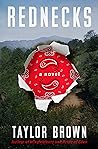
Rednecks, by Taylor Brown*****

“Law only serves them that’s in power. Ain’t no different than always…’Tis the victor who writes the history—and counts the dead.”

I’ve been an enthusiastic fan of author Taylor Brown since reading Gods of Howl Mountain, which was published in 2018. His new novel, Rednecks, is out now, and as with his earlier work, it is outstanding. My great thanks go to NetGalley and St. Martin’s Press for the invitation to read and review.

Brown tells the story of the Battle of Blair Mountain, a very real large scale battle, complete with machine guns, helicopters, tens of thousands of angry, armed miners, and the U.S. Army, an event which really did take place in the Appalachian Mountains in 1921. Over a million rounds were fired, and then the story was suppressed by the government, bosses, and big business media.

 In his author’s note, Brown tells us that the character of Dr. Muhanna, a heroic individual sympathetic to the cause of the miners, is based on his own great-grandfather. There is a meaty explanation of what parts of the story are based on the actual historical record, and what parts—small ones, to be sure—he has changed.

Apart from his skill as a writer and researcher, the thing that I have always loved best about Brown is his deep respect for the working class. It shines through every page of this novel. Mother Jones, the fiery Socialist labor organizer, is here as well, and she is possibly my favorite figure in American history. Unfortunately, she is not at her best here. Past ninety years of age and in poor health, she attempts to deceive the miners into quitting their struggle early once she learns that Washington, D.C. intends to send troops. It’s a pity that her many years of inspirational organizing and leadership are not on display here, but the facts are the facts, and this story is not, after all, chiefly about Mother, but about the miners, so I suppose that Brown has written it in the only honest way that it could be written. There are indeed passages that demonstrate her eloquence and loyalty to workers of every race and ethnicity.

As I read, I like to highlight passages to include as quotes in my review. This time, I came away with 53 quotes. Reluctantly, I am setting most of them aside; you will have to find them yourself. They’re better within the context of the story, anyway.

As a personal aside, I will mention that my own grandfather—“Papaw”—died of Black Lung disease in 1978 after having worked in a nonunion mine in South Dakota beginning in the eighth grade. He had to leave school and work fulltime, as there was not a social net back then, and he and his family would have starved if he had done otherwise. World War II brought him better fortunes, but coal dust, once lodged in the lungs, never leaves.

This is a gritty tale to be sure, one full of bloodshed and suffering, but also of immense courage and inspirational leadership. I read it in small bites lest it work its way into my dreams, until I reached the climax, at which point I had no choice in the matter, and was unable to put it down. This book is one of the year’s best. I highly recommend it to those that love labor history, historical fiction, or that just love a well-told story.

The Golden Gate, by Amy Chua****-*****

“If I told a jury that Japs killed Santa Claus, I could prove it beyond a reasonable doubt. Everything changes, Sullivan, once you’ve got a different color defendant in the box. There isn’t a jury in this state that wouldn’t send a Jap to the gas chamber if they had a chance.”

4.5 stars, rounded upward.

‘The Golden Gate marks the authorial debut for Amy Chua, a badass author whose stories will be read for a long, long time. My thanks go to Net Galley, Macmillan Audio, and St. Martin’s Press for the review copies. This book is for sale now.

Our story is set during two time periods, 1930 and 1944, in Berkeley, California. Detective Al Sullivan is investigating a murder whose roots are inextricably tangled with those of another, in 1930. Our point of view shifts often, both in time period and narrator. Most of it is told in the first person, either by Sullivan or by the elderly Genevieve Bainbridge, grandmother of the victim in the 1930 murder, now ready, in full Mama Bear protective mode, to do whatever she must to protect what family she has left.

The narrative has a strong noir flavor, and I halfway expect to find Humphrey Bogart around the corner, smoking and looking pensive. However, there is something Chua brings to the story that Bogart never did: a frank look at the injustices of the period, from the immense disparity of wealth among the denizens of Northern California, to the shameless victimization of people of color, who were much fewer in number in this part of the world then, than now.

I put this information up front, because in the early portion of the novel it isn’t obvious that the racism isn’t being highlighted, rather than propagated. I nearly discontinued reading this book because the “J” word is a hot button for me, and I initially believed that it was being used as a lazy way to depict the culture of Anglo Caucasians during this time period. I’ve seen it done many times, the use of the racial slur against Japanese because the author believed it increased the story’s authenticity. In Chua’s case, it’s the opposite.

The solution provided at the end relies overmuch on the journal of Mrs. Bainbridge, and in places, the details of the murder, and the motivation for same, are a stretch. For that reason, I initially rated this fine novel four stars. In the end, though, I realized that the social justice component more than makes up for it.

I was fortunate enough to have both the audio and digital galleys. Although the readers do a creditable job, the complexity of the story, including frequent changes of place, time period, and point of view, make for a confusing listening experience. For that reason I recommend the print version over the audio, unless both are available together.

Highly recommended.

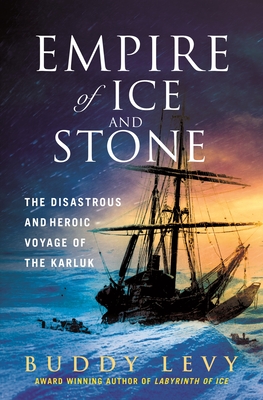
Empire of Ice and Stone, by Buddy Levy****

Empire of Ice and Stone tells of the voyage of the Karluk, a brigantine vessel that sailed from Canada to the Arctic in 1913. It was led by Captain Bob Bartlett, the world’s best ice navigator at the time, and Vilhjalmur Stefansson, a “visionary” leader in search of wealth and fame. My thanks go to Net Galley and St. Martin’s Press for the invitation to read and review; this book is for sale now.

This well told narrative details a part of history of which I have read very little. As school children, most of us in the Western developed nations read of the early explorers, but stories of voyages in the twentieth century are few and far between. This is why I take this one on, but I begin to wonder partway into it whether it is more than I have bargained for.

The first half is more than a little confusing, because there are so (so, so, so) many names to remember, and almost all of them are Caucasian men—as is usual for the time and situation. About halfway into it, I abandon my efforts to memorize all of them, and once I am satisfied with memorizing the names of the two leaders plus “Auntie,” (more in a moment) and the ship’s pets, I calm down a bit and it’s easier to follow.  I am fortunate enough to receive the audio galley as well as the digital review copy, and that combination makes it easier to follow.

That said, this is not gentle reading. There is death—in many cases slow and terrible—and betrayal around every corner. I understood that there would be some of that when I took the book, but I’ll tell you right now, if you, dear reader, have any sort of mood disorder or are going through a dark time personally, you may want to stay away from this thing.

As the bodies begin to pile up, I start to feel angry, and I remain so, to some degree, until the book is done. Because this was a dumb thing that these men did. Their ship wasn’t up to the task, they cut too many corners at the outset, and this more or less spelled doom for many of those aboard. I can’t help speaking to these men as though they can hear me, and I’m asking what the fuck got into them to do this at all? If everyone had stayed home, most likely all of them would have lived to a ripe old age. True, they made some scientific discoveries; yet air travel was just around the corner, and the whole thing could have been done much more safely later on.

The story has a definite hero (Bartlett,) and a definite villain (Stefansson,) and the farther into the voyage we go, the more obvious this becomes. However, I would have liked to hear a good deal more about the other hero. Levy tells us that a lot of these men would have been dead before the rescuers arrived had it not been for the Innuit woman that was hired, along with her small children (!) to travel with them, and the narrative bears this out. Time and again, when they are on the razor’s edge of starvation, she comes up with an innovative way to use the environment around them to provide calories. Not always delicious calories, to be sure, but alive is alive. “Auntie” is a total badass, and deserves more ink; possibly not much information is available, given the biases of the time.

The book feels longer than it actually is; however, given the amount of complex information provided, it probably shouldn’t be pared down further. At the same time, I kept thinking that this would be so much more approachable if Jeff Shaara were doing the telling (via historical fiction.)

For those that are very interested in the history of early sea voyages, and to researchers, this immaculately researched book is recommended.

The Last Hill, by Tom Clavin and Bob Drury***-****

In 2021, Clavin and Drury published Blood and Treasure, an outstanding biography of Daniel Boone, several American Indian tribes, and their relationship to the American Revolution. When I saw a chance to hear their new audiobook titled The Last Hill, I jumped on it. And the early portion of it convinced me that I was missing too much by listening but not seeing, so then I went back and requested the digital version as well. My thanks go to St. Martin’s Press, Macmillan Audio, and Net Galley for the review copies. This book is for sale now.

This meaty yet readable book details the fight for Castle Hill, a strategically essential location that leads into the core of Nazi Germany. Several entire American divisions had tried and failed to take it, and so General Eisenhower ordered the Rangers to go in. Rudder’s were the most elite, battle-hardened unit of the already elite group known as the Rangers. Led by Lieutenant Colonel James Rudder, they were ordered to fight to the last man, if necessary, and they very nearly did; 130 special operatives, as they were known, ascended the hill, and only 16 were left standing when it was over. Nobody there knew that Hitler’s Wehrmacht had been given nearly identical instructions, as it was through here that a massive number of German troops were slated to descend through the gateway and conclude the Battle of the Bulge for the Axis powers.

The most interesting and enjoyable part of this book, for me, was in the first chapters, where we see the contrast between the misleadership early on, when the Rangers were being trained in rural Tennessee, and that which Rudder provided. The troops were sent on marathon marches without canteens, and their superior officer would be driven alongside them, where they could see him relaxing in his seat and drinking as much water (or whatever?) as he chose. Some men quit; others died.  There were also war games, including “…the pit fighting competitions” that took place in a three foot deep, forty foot square hole in which “…entire platoons jumped in to attack each other like ancient Spear-Danes, screaming lusty war cries that echoed throughout the camp…by the ordeal’s conclusion, the sawdust looked as if it had been coated with red paint and the pit itself smelled like the inside of a leper. Afterward, the medical team—whose members were not spared the crucible—found themselves treating gashes, sprains, dislocations, and a no-inconsiderable number of broken bones, sometimes their own. At the end of these long days the Rangers returned to their tent city too exhausted to make the two-mile, round-trip walk to the barracks showers.” Angry servicemen, when they finally scored passes to the nearest town named Tullahoma, brawled with the locals and left the bars and taverns with splintered wood and broken glass. Lieutenant Colonel Saffarans had to go.

When “Big Jim” Rudder came in, the pit fights vanished and he marched alongside his own men, not for just a portion of the hike, but for the whole thing. When his feet became blistered, he waved away the medics and took care of himself. Soon morale improved, and so did the quality of the troops.

As we move from training to the European theater, I see less information that I didn’t already know. It’s not badly done, but I was so inspired by the earlier portion that I felt a little let down. I am also chagrined—though this is not the authors’ faults—at the casual way that the US Army threw its soldiers into the line of fire. Why could they not soften the area up before sending these poor men to the slaughterhouse? There were 260,000 grave markers in the hold of their transport ship. Whereas I have never been a proponent of nuclear war, it does seem to me that if someone was going to be hit with the bomb, Hitler’s minions were likely very strong candidates; the Japanese that were nuked at Nagasaki and Hiroshima were nearly beaten already, and the bomb was nearly superfluous. And I’ve said it in earlier reviews but I’ll say it again: it’s too bad that the U.S. Military treated white enemies gently, and its nonwhite ones ruthlessly.

Do I recommend this book to you?  If you are looking for just one book about American forces in World War II, this is probably not the one you’re looking for. It’s specific to just one part of Germany and just one hill, so it’s better suited to those that already have the basics mastered.

I might not recommend it at all, as I personally was offended by some of the remarks intended as humorous in reference to local women, as well as women in the service. Whereas I have no doubt that the misogynistic jokes told here are legitimately jokes that were told back then, there are some things that don’t bear repeating, and surely not in detail. I also wasn’t crazy about the clipped bro-speech of the narrator in the audio version.

For this reason, I recommend the printed version over the audio, for those that are interested.

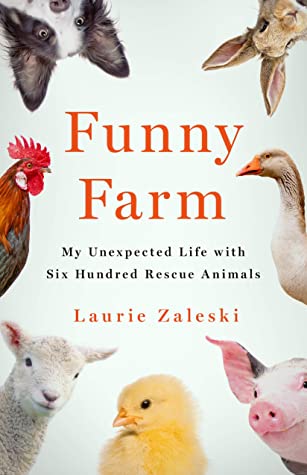
Funny Farm, by Laurie Zaleski*****

“You never know what you are capable of until the day comes wen you have to go places you hadn’t planned on going.”

Laurie Zaleski knows how to make a debut. Funny Farm: My Unexpected Life With 600 Rescue Animals has created a tremendous buzz, and all of it is deserved. My thanks go to Net Galley and St. Martin’s Press for the review copy. This book will be available to the public Tuesday, February 22, 2022.

Laurie’s early childhood was in many ways an enviable one; her mother stayed home to raise Laurie, her brother, and her sister, and her father made enough money to hire household help and buy a couple of vacation homes, too. There was nothing they lacked for, other than physical safety. Because while her father could be warm, and loving, and generous, and funny, he could also be a monster. His reign of terror was worsened by alcohol consumption. As the beatings became uglier and more frequent, Annie, their mother, chose poverty for the children and herself over the constant terror and danger of living with their dad.

“’I almost became a nun,’ Mom would joke years later. ‘Then I met the devil…’ Annie McNulty and Richard Zaleski fell in love like tripping into an open manhole: one wrong move followed by a long dark plunge.”

There’s one searing episode Zaleski recounts, toward the end of their life with Dad, in which they are all hidden in a bedroom with the door blocked shut, and their father is sneaking up on them, commando crawling up the hallway toward them so they won’t see his shadow approaching, and he has a large knife between his teeth. It sounds like something from a Stephen King novel, doesn’t it?

And so, when Annie’s efforts to build a modest nest egg to finance their flight is uncovered, she has no other option but to leave without the money. She finds a dumpy cabin in the woods, half fallen down and in no way legally rentable, and strikes a bargain with the owner. To say that their standard of living decreases is the understatement of the year, but they make it work.

Once she has made her escape, apart from the creepy forays from an unseen enemy that occur from time to time, Annie can’t turn away anyone else, human or otherwise, that is in a dark and vulnerable place. The woods surrounding their little shack begin sprouting makeshift outbuildings; there’s a little lean-to here, and a sort-of paddock there. And it keeps growing.

Zaleski is a gifted storyteller, and she alternates her narrative from the present to the past, breaking up the nightmarish episodes of her childhood with hilarious stories, most of which are about the critters. Her writing is so nimble that I find myself repeatedly checking to see what else she’s published, because there’s just no way this can be her debut. But then, that’s what they said about Harper Lee, right?

Perhaps the most glorious aspect of this book is seeing how Annie McNulty’s can-do attitude, sterling work ethic, and positivity transformed her life and lit a path for her children. She provided them with an outstanding role model, and in return, they did everything possible for her when cancer forced her to slow down.

This book will inevitably be compared to Educated and The Glass Castle because it is a memoir of someone that has overcome horrifying challenges in childhood and emerged triumphant. But make no mistake, Zaleski’s story is in no way derivative, and likely will be held up as an example for future writers. It makes my feminist heart sing!

Highly recommended.

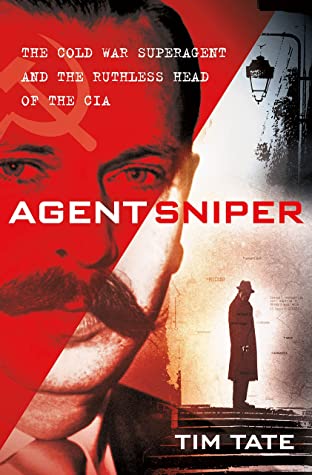
Agent Sniper, by Tim Tate***

I was invited to read and review this book by Net Galley and St. Martin’s Press. I accepted because I do love a good spy story, and there aren’t many of them being published at this time. Tim Tate has had a long, illustrious career as a documentary filmmaker and as an author, but is new to me.

So, when I began reading and found my attention wandering, I thought it was a personal problem. Too many distractions. I tried again, and when that didn’t go well, I procured the audio version and listened to it while I prepared dinners during the week. Eventually, I threw in the towel and admitted that this is simply not an engaging book. The topic sounds fascinating, but just as a gifted, dedicated author can spin dull material to gold, so can an indifferent one tell an electrifying spy story in a way that leaves the reader checking the page numbers and the clock—is this thing over yet?

It’s not all bad news: the research here is top drawer. For the researcher, this book has use, although I would caution the uninitiated into reading carefully, because history is always politically charged. Every fact that is included, and every fact that is not; the interpretation; the language used, all give a biased account, even when a researcher and writer is endeavoring to be as balanced as possible. I don’t care for this writer’s interpretation, which makes him sound like a hardened right winger, but I have no doubt that the facts that he uses are accurate ones.

Then we come to the audio, and I must wonder why, if we’re primarily dealing with the CIA and its agents, we have a narrator with a clipped English accent (and a few pronunciations that sounded very odd to me,) telling the story. I found it disorienting, but if this had been a more engaging story, I would have overlooked it.

Ultimately it comes down to wordsmithery, and I didn’t find much of it. Those interested in dabbling in this genre would do better to read Ben McIntyre and Tim Weiner.

This book is for sale now.

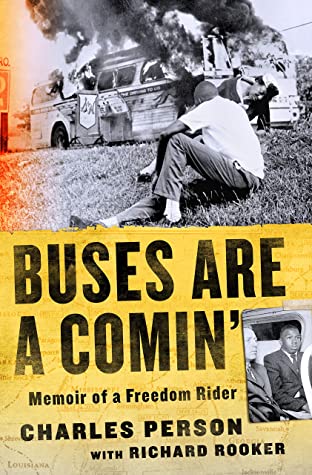
Buses Are a Comin’, by Charles Person and Richard Rooker*****

I’ve read my share of Civil Rights memoirs, and this is one of the best. My thanks go to Net Galley and St. Martin’s Press for the review copy. This book is for sale now.

Charles Person grew up in an all-Black Atlanta neighborhood in the 1950s and 60s. At the story’s outset, he describes how sleeping arrangements were juggled inside their two-room apartment, with four family members sleeping in the front room, and three, himself among them, back in the kitchen. Since everyone in the neighborhood had roughly the same economic standing, it didn’t occur to Person that his family might be considered poor. He was at the top of his class academically, college-bound. His family were faithful church goers, and his father worked two-plus jobs to provide the bare necessities, but they never went hungry. It was only later, when his neighborhood was featured on a news program addressing “Urban blight,” that he learned that the place he loved and called home was part of a “tenement.” The overall tone of his home life is set at the beginning, when he describes an incident from childhood. He and another child stole peaches off of a neighbor’s tree, and his mother marches them to the door, makes them confess—which meant looking the owner in the eye and using the word “stole,” rather than a softer euphemism—and pay for the fruit they ate. Thus we know there’s a definite moral compass here.

It isn’t until he’s grown that Person learns about racism. He gets his first job at a bowling alley, and he learns what parts of that place and the surrounding businesses he is allowed to access, and which are for whites only. Later, he insists on sending his test scores and application to a Georgia university, knowing his marks are excellent, but is notified by mail that the school will not admit Negro (the accepted term at the time) students. As the lunch counter sit-ins in North Carolina draw headlines, Person becomes part of a local student effort to end segregation at the lunch counters in their area. Person is thrown in jail, and when he is released a short time later, he is experienced, primed, and ready for more.

The story of Person’s life, and of the Freedom Rides, which make up most of the memoir, is riveting. It’s told in first person, in a you-are-there kind of narrative that drew me in. I listened to part of this story using the audio book that I borrowed from Seattle Bibliocommons, but although the reader generally does a serviceable job with the text, I recommend the print version. I winced when the reader mispronounced “mimeograph”; there are no mimes in there, honey. But mostly, there are a lot of freedom songs interspersing the story, as the riders sing in jail, sing in the bus, sing, sing, and sing some more, and I don’t know about you, but it sets my teeth on edge when in the audio version the lyrics are simply read, with or without rhythm. Many of these are well-known songs, and if I see the words on the page, I will hear the music in my head. Listening to someone recite the words in a bloodless, wooden recitation is just sad.

For anyone that misses the connection, Person draws the connection between the Freedom Rides and the struggle of the present:

“It is sixty years later, and politicians do the same today when the devalue and disrespect important African-American societal concerns by turning Black Lives Matter into All Lives Matter. Of course, all lives matter. No one argues against that, but changing the issue from “Black” to “All” steals the legitimacy of a vital concern that needs political attention and a political solution. The intentional and insidious shifting on an issue through language is a calculated move. It was by [Georgia Governor] Vandiver in 1960, and it is today. It avoids and insults at the same time.”

There is no better time to learn the lessons of the Civil Rights Movement of the mid-1900s, and apply them to the struggle against racist cop brutality in the present. If this subject makes you sit up a little straighter, you need this book. Of course, it’s also great reading for anyone that likes a good memoir, but even so, read it actively. There’s so much more work to be done.

Pride of Eden, by Taylor Brown*****

Taylor Brown is quickly becoming one of my favorite novelists. His 2018 book, Gods of Howl Mountain is one of my ten best loved books among the 1,300 I have reviewed since 2012, so I have been waiting for this book, and it does not disappoint. My undying thanks go to Net Galley and St. Martin’s Press for the invitation to read and review. This book is for sale today.

Pride of Eden is a wildlife sanctuary in Georgia, owned and run by a Vietnam vet named Anse. Anse has PTSD related to his service, and his most searing memory is of the loss of a service dog that sacrificed its life to prevent a soldier from being killed by an explosive device. Anse is a complicated character with a possible death wish, but this aspect of his character is never overplayed, and after a haunting, visceral passage at the beginning, it becomes a subtle quality that runs beneath the surface, as it likely would in real life.

Anse accepts animals of all sorts; some come from illegal private zoos, or from private owners that are surprised that their adorable lion cub has grown up to be a wild animal. But secretly, he is also a vigilante. When he sees an animal in need of rescue whose owner plans to keep it—or sell its dead body for parts—he creeps in at night and liberates it.

Tyler is the preserve’s veterinarian, a buff no-nonsense woman who is also Anse’s girlfriend. My favorite passage involving Tyler is when a man comes to see Anse, and Anse is in a mood and wants Tyler to get rid of the guy. Tyler pushes back; it might be important, and the man has traveled a long way to see him. Anse grudgingly tells her to “Send him in,” and Tyler fires back that she is “not your fucking secretary, Anse.” At the outset of the story, Tyler does not know that Anse does not acquire all of his animals legally.

The third main character is Malaya, who comes to the sanctuary looking for work:

  “What do you want to do?” he asked.

   “Anything.”

    “What are your qualifications?”

“Third infantry, two tours in Iraq. Honorable discharge. Then I contracted in South Africa, tracking ivory and rhino poachers.”

“You catch any of them?”

She uncrossed her arms, buried her hands in the pockets of her shorts. Anse could see her knuckles ridged hard against the denim. “Yes,” she said.

Malaya is complex as well. But I love Malaya not only for her meaty internal monologue, but for the things she isn’t. Most male authors (and some female ones too) wouldn’t be able to resist these tired elements, and once again I admire Brown’s respect for women, which shows vibrantly in the way he frames his characters. Malaya is not romantically interested in Anse, nor does she try to mother him. Malaya and Tyler are not jealous of one another, and they do not compete. Both characters are buff and intelligent, and at no time do they have to be rescued by men. As a result, I could appreciate this story as it unfolded without the distraction of stereotypes or overused, sexist plot devices. Neither female character is motivated by sexual assaults in her past.  

The other two characters are Horn, another damaged vigilante that collects wild animals, and Lope, Anse’s driver, who helps him move large animals.

This is not an easy read. It will attract Brown’s fans, of course, and also animal lovers; yet those same animal lovers have to wade through an awful lot of sorrow, as the story is rife with tales of animal abuse. Brown’s purpose, apart from writing outstanding fiction, is likely to raise awareness of poachers that kill endangered animals for profit, and of private game reserves that send semi-tame animals to an enclosure so that wealthy ass hats can bag some big game, take that animal’s head home to hang in the den.

 Yet there’s nothing at all here that is included to be prurient or sensationalistic; every word has a purpose, either to develop a character or drive the plot forward, or both.

My emotions run the full gamut as I am reading, and this is a sign of excellent literature. I laugh out loud a couple of times; at others, the prose is so painful that I have to walk away for awhile and then come back. But I am never sorry to be reading it. The ending is so deeply satisfying that I want to high-five someone, but alas, I am reading it alone.

Once again, Brown’s novel is destined to be one of the year’s best reads. I highly recommend it.