
Missing Sister, by Joshilyn Jackson****-*****

“We all have a little monster in us.”

Missing Sister is the newest thriller by one of my favorite authors, Joshilyn Jackson. My thanks go to William Morrow and NetGalley for the review copies. This book is for sale now.

Penny Albright is a rookie cop, a vocation she chose after her twin sister, Nix, died of an overdose. Nix was raped by a group of three men that she knew; Penny wasn’t supposed to tell anyone, but soon after it happened, Nix’s personality changed. She moved to the city, isolated herself. Before the rape, Nix had never used street drugs. Penny is too late to save Nix, but she hopes to be able to spare others the same horrific fate.

Then she and her trainer, who’s also her partner, are called to a murder scene. The victim turns out to be one of the three men that raped Nix, and Penny forces herself to show no reaction, to keep her cop face on, but inside, she is exultant.  Then, while canvassing the area, Penny inadvertently comes upon the killer, holding the murder weapon and covered in blood. She and the woman lock eyes, and then, rather than arresting her, Penny lets her go. After that, she becomes obsessed with learning the woman’s story; she is certain that the killer had a similar experience to Nix’s, or that the killer had a sister that did. She vows to hunt the killer down in order to find out what happened.

The first half of the book is frustrating. The story is told in the first person, and after hearing Penny’s determined plan to learn the killer’s story over and over again, on a never-ending, somewhat circular loop, I want to smack her upside the head and tell her to get on with it. Leave that dangerous woman alone! She can’t bring your sister back, and you can’t either, I want to tell her. A part of me felt let down, because Jackson doesn’t usually have a weak first half, or any weak part at all in her novels. But just as I’m beginning to think, what a shame, everything changes, and the story becomes a true, grab-you-by-the-hair thriller. The ending is a complete surprise, and what’s more, it makes sense. The second half more than makes up for the first half.

I was lucky enough to have both the digital and audio review copies, and Jackson reads her own story, which makes it even better.

This story smacks of a possible series, and if that’s the plan, it explains why readers have Penny’s motivation beaten into us. That motivation may be the basis for who knows how many books to come; many, I hope! For those that are able to wade through the first half to find the reward in the second, this book is highly recommended.
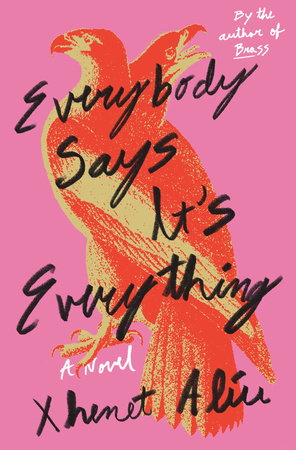
Everybody Says It’s Everything, by Xhenet Aliu**-***

2.5 stars, rounded upwards.

Xhenet (pronounced similar to “Jeanette”) Aliu is the author of Brass, the award-winning debut novel that was one of my favorites of 2018. When I saw that she had a new book, Everybody Says It’s Everything, I was so excited that I bounced up and down in my desk chair. My thanks go to Random House and NetGalley for the invitation to read and review; sadly, I found this book disappointing. The sophomore slump is real, friends.

Our story centers—to the extent that it has a center—on adopted twins, Drita and Pete, who’ve been leading quintessential American lives. Drita was a star student, and is in the midst of graduate studies when she is called home to care for her mother; Pete—actually Petrit—has been in various sorts of trouble, and now his girlfriend and son have landed with Drita looking for help, since they aren’t getting any from Pete. The story takes us through their native Albanian roots and heritage, through the war in Kosovo, and through Pete’s discouragement, hardship, and addiction.

I have a hard time connecting with any of these characters. The dialogue drags, and the poignant qualities that I found in Brass are nowhere to be found. Both are sad stories, but the protagonist in Brass had my whole heart and my full attention, whereas these characters left me feeling as if I was eavesdropping on one more group of depressed, underserved people, but also edging towards the door. I was just straight up bored, a word I rarely use in reviews. I continued all the way through because I was sure that it would turn brilliant any minute; it never did.

I look forward to seeing what this author writes next, because she has proven that she has the ability to connect with readers in general and me in particular, but I can’t recommend this book to you.

The Golden Gate, by Amy Chua****-*****

“If I told a jury that Japs killed Santa Claus, I could prove it beyond a reasonable doubt. Everything changes, Sullivan, once you’ve got a different color defendant in the box. There isn’t a jury in this state that wouldn’t send a Jap to the gas chamber if they had a chance.”

4.5 stars, rounded upward.

‘The Golden Gate marks the authorial debut for Amy Chua, a badass author whose stories will be read for a long, long time. My thanks go to Net Galley, Macmillan Audio, and St. Martin’s Press for the review copies. This book is for sale now.

Our story is set during two time periods, 1930 and 1944, in Berkeley, California. Detective Al Sullivan is investigating a murder whose roots are inextricably tangled with those of another, in 1930. Our point of view shifts often, both in time period and narrator. Most of it is told in the first person, either by Sullivan or by the elderly Genevieve Bainbridge, grandmother of the victim in the 1930 murder, now ready, in full Mama Bear protective mode, to do whatever she must to protect what family she has left.

The narrative has a strong noir flavor, and I halfway expect to find Humphrey Bogart around the corner, smoking and looking pensive. However, there is something Chua brings to the story that Bogart never did: a frank look at the injustices of the period, from the immense disparity of wealth among the denizens of Northern California, to the shameless victimization of people of color, who were much fewer in number in this part of the world then, than now.

I put this information up front, because in the early portion of the novel it isn’t obvious that the racism isn’t being highlighted, rather than propagated. I nearly discontinued reading this book because the “J” word is a hot button for me, and I initially believed that it was being used as a lazy way to depict the culture of Anglo Caucasians during this time period. I’ve seen it done many times, the use of the racial slur against Japanese because the author believed it increased the story’s authenticity. In Chua’s case, it’s the opposite.

The solution provided at the end relies overmuch on the journal of Mrs. Bainbridge, and in places, the details of the murder, and the motivation for same, are a stretch. For that reason, I initially rated this fine novel four stars. In the end, though, I realized that the social justice component more than makes up for it.

I was fortunate enough to have both the audio and digital galleys. Although the readers do a creditable job, the complexity of the story, including frequent changes of place, time period, and point of view, make for a confusing listening experience. For that reason I recommend the print version over the audio, unless both are available together.

Highly recommended.

The Grammarians, by Cathleen Schine*****

Oh hell yes. This charming little book had me on the first page, and when it was over, I was sorry to be done.  Big thanks go to Net Galley and Farrar, Straus and Giroux for the review copy.  This is the first time I have read anything Schine has written, but it cannot possibly be the last. You can buy it now.

We start in the dark; we start behind bars. Happily, it’s because our protagonists are infants, and they’re in a crib. As light streams through the open door, we enter the lives of Daphne and Laurel, who are identical twins. They are brilliant, and they are in love with the written word from the get-go.

At the outset this story seems like a romp, but its success is in the details. As children we see the girls move in lock step; the first one out of the womb is the alpha, and they both understand this. But as they grow up and define their places in the world, there’s tension and at times, competition. In order to develop relationships and families separately, they have to pull away from each other, and when two people are very close, the only way they can become independent is through a hard break. Schine is absolutely consistent in the development of her characters, and this also includes their intellectual gifts.

One aspect of fiction that grates on my nerves is when I see a gifted child protagonist that’s developed in an amateurish way. Some writers want to use a child in their writing, but don’t have any clue about the qualities inherent in a child at the age they have chosen, and so they build giftedness into the character as an excuse, so that they can provide the child with adult-level dialogue and dodge the stages of childhood.  Schine doesn’t do that. Instead, she creates completely believable little geniuses that are nevertheless coping with the growing pains, developmental milestones, attitudes and frequent self-centeredness that characterize children and adolescents. Her care and skill result in characters that are entirely believable. I like the side characters a lot also.

The wit and sass shown by Daphne and Laurel as they indulge in their secret twin language as well as word play using standard English is original and makes me laugh out loud more than once, but as they grow older, both twins encounter broader philosophical issues that connect language with class, ethnicity, and other variables, and they must find their way through the ethical slough. They don’t choose the same paths, and their anger and pain toward one another is visceral. But in the end…well. You’ll have to find that out for yourself.

This book is highly recommended to those that have twins in their lives; those that love the English language; and those that want to howl with laughter. However, I don’t recommend it to anyone whose first language isn’t English.

I read several books at a time, and while I was reading this one, it became the reward for finishing a chapter in a less rewarding read. You, however, can reward yourself right now by ordering a copy.