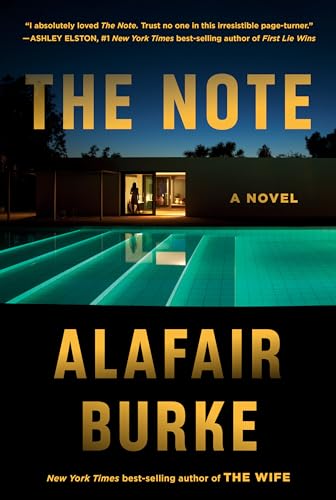
The Note by Alafair Burke is a thriller that sends three lifelong female friends on a gal pal vacation together; they have skeletons in their closets, scandals from their pasts, and that’s part of the bond. But try though I might, I couldn’t bond with any of them or care about their dilemmas.
My thanks go to NetGalley and Knopf Publishers for the review copy. This book is available now.
The internal narrative was so flaccid that I kept having to go back to reread parts of it, because I realized that I’d zoned out while reading and had no idea what had just happened. Once I had the plot straight, I struggled to recall the names of all three women. (Kelsey, May, and…?) These characters struck me, when they struck me at all, as vapid and self-absorbed. The dialogue seemed banal.
When I saw in the promotional blurb that these three women would be vacationing together in The Hamptons, it gave me pause. I don’t like reading about rich people, and with a rare exception now and then, I don’t like rich people, period. But there have been a number of times that a terrific novelist has made me forget all about my no-no list, so I crossed my fingers. I’d read one other of Burke’s novels and it was pretty good, so I thought I’d give this one a go; it was a mistake.
I’m trying to think of a saving grace, some positive aspect that I can insert here in order to keep this review from being brutal, but honesty, I come up dry. I cannot recommend this book to you.
Mortality is mortality. It comes to you when it’s ready. We don’t set the clock.
The Dave Robicheaux series by James Lee Burke is one of the finest ever written. As the faithful know, Clete Purcel is Dave’s partner in whatever he does. Once they were cops that called themselves “The Bobbsey Twins from Homicide.” (You probably need to be a boomer to get the reference.) Now they are on their own, but they are still like family to one another. This is the 24th in the series, and it’s the first to be told from Clete’s point of view. It’s a brilliant idea for two reasons: first, because Clete is a well written and wildly popular character, and also because it gives us a chance to see Dave through someone else’s eyes, someone that loves him, but isn’t him.
My thanks go to NetGalley and Grove Atlantic for the invitation to read and review, along with my profound apology for being so very late. This book is for sale now.
In this installment, a new drug ring has come to Louisiana, and it’s creating still more violence, more death, and more crime in general. Clete, who is now a private detective, is hired by a woman named Clara Bow. (If the name rings bells, it’s because the real Clara Bow was a famous movie star from the silent film era.) The Clara that hires Clete wants him to look into the activities of her skeevy ex-husband. Once he begins, we hardly have enough time to breathe. Clete hits the ground running, and there are no slow passages till the book concludes.
My favorite passages are the ones in which a woman named Chen, whom Clete rescues, then falls for, tells him how he appears to her. Here’s one: “You always gentleman, Mr. Clete. Your cats sleep on your face and you no mind. The world kill men like you because you brave and you kind.”
Later, Chen promises him that she won’t go back to taking drugs. “That because I go to a meeting every day with the Work the Steps or Die Motherfucker group. The Motherfuckers are very nice.” He advises her not to use that term in public. Don’t you love it?
Like every book in the series, this one moves seamlessly from scenes with quirky characters and dark humor, to glorious literary passages that I have to read more than once just to admire the writing, to passages that are gritty and violent and occasionally terrifying. Let me put it this way: you will never be bored.
Can you dive in mid-series? I did; then I became so enamored that I went back and read all the rest of them.
System Collapse is the seventh book in Martha Wells’s acclaimed Murderbot Diaries series, and it’s a humdinger. Fans have been waiting for this one, and they will not be disappointed. My thanks go to NetGalley and Tor Publishing for the review copy. This book is for sale now.
If you are one such fan, I’ve already told you what you need to know; for the uninitiated, I’ll continue. I am a reluctant science fiction reader. I generally avoid anything that involves complex world building or a new vocabulary extensive enough to require a glossary. I absolutely don’t read science fiction series anymore, because I am not that dedicated. As we age, our brains become less flexible, and so whereas I loved reading a handful of excellent but rather intricate series when I was thirty, I’m just not up for it in my retirement years. I include this information because I know that a good number of my readers are also at or near retirement age, and may be similarly reluctant. So, first: you can do this, and it will be painless.
I was finally persuaded to try this series—not for review, merely as an audiobook from the library, which is about as low risk as it gets—when readers from a number of unrelated places in my life all recommended it. I saw good things from a couple of my Goodreads friends online. How nice, I thought, but I’ll pass. Next came my children, my eldest and my youngest, both grown, of course. Their rabid enthusiasm cracked my resolve a tiny bit, but I thought, maybe later. The final straw came when a couple of lifelong friends came to visit from out of state last spring. They were embarking on a road trip around the Pacific Northwestern USA, concluding their stay here in Seattle, and they, too, were wildly enthusiastic—and one of them doesn’t read for pleasure much at all! They listened to the audiobooks of the entire series up through the sixth, which is what was available at the time, and heartily recommended it.
Well, I thought. I could check the library. I could probably listen to the first one while watering the plants, and if I don’t like it, I’ll just send it on back. But of course, I didn’t send it back; I checked out the rest of the series, and friend, if you have to stand around for thirty or forty minutes daily with a hose in your hand, this is the way to do it.
The Murderbot is a being that is part machine, part human, and the term for this within the fictional world it inhabits is “sec unit,” because it has been invented for the security of the human beings inside the various spacecraft that are flying around out there, and also partly for the security of the ship also; but as we learn, the ship can sometimes take care of itself.
“Murderbot” is the specific name that our protagonist has chosen. And the main character is indeed about ninety percent of what’s important here. We don’t need a host of invented words. There are a bazillion other characters, and no effort is made to introduce them to us gradually, but it doesn’t matter. Just let it flow over you and at some point, the most important characters will click in.
This seventh installment in the series is the first time that I have read it with my eyes. I wasn’t sure how this would go, since voice actor Kevin R. Free is so adept at reading the series that I had begun to equate his voice with the character; I needn’t have worried. In fact, I find that I prefer reading it this way, because the internal monologue is immense, and it’s much easier to tell when the character’s ruminations have ended and the action resumes when I can see the (many, many) parentheses. Also, the humor here is often sly, and when listening to the story, I don’t get a pause that provides me with time to consider what’s been said; we’re off and running, and if I don’t want to miss anything, I have to forget all about that little witticism and move forward. Reading by sight allows some reflection.
The series is drop dead funny, and it is also timely, as AI makes more inroads toward humanity of its own, raising all sorts of ethical questions for the future.
For any fans of the series that are still reading, despite having been dismissed at the start of this review: my favorite character, apart from the protagonist, is Art, the ship that is also Murderbot’s beloved friend. Murderbot’s sarcasm is matchless, except when Art is around. matching snark for snark with Murderbot as it does here, and foreshadowing suggests that when #8 is written and available, the same will be true.
And I cannot wait for the next in the series. Highly recommended!
My thanks go to Net Galley and 8th Circle Press for the review copy. This book is for sale now.
When I saw the cover of this children’s book, I thought it had strong possibilities. It’s original, and I thought it was conceptually strong, so I read it. Having done so, I have come away underwhelmed.
For a book like this, a takeoff on Rudolph the Red-Nosed Reindeer, two things are important. We need resonant, bold, eye-catching artwork to engage the little person that is reading it, or to whom it is being read, and we need a regular cadence. We’re supposed to be singing this book to the same tune as the song, and while the text certainly rhymes, it’s nowhere near in pocket. It’s awkward as hell, actually. Get out your metronome and try it, I dare you.
And as for the artwork, it can best be described as minimalist. When I saw Mothman on the cover, I was thrilled. Kids would love it, I thought. But that’s basically what’s on every single page. Mothman, plus a small amount of unengaging other stuff. There’s no bold artwork at all, and very little art of any kind. The illustration of our protagonist is the entire show, over and over.
I’ve since learned that this is a series. I haven’t seen any of the other books, but I’m going to guess they are more of the same. In fact, if I continue writing much longer, I will talk myself into dropping the rating to 2.5 stars instead of 3.
It feels lazy to me; it didn’t come close to meeting my expectations. When I took the galley, I thought that if this book was as good as I hoped it might be, I would purchase a copy of it for my grandsons. I’m not going to do that now, and if I won’t, I cannot recommend you buy it either.
Ray Carney has a foot in both worlds, and he isn’t given to thinking too deeply about that. As the son of a badass criminal, he considers that he has turned out quite respectably; yet, when Cousin Freddie occasionally brings a consignment piece of jewelry to his store, he doesn’t ask many questions about its history. Thus begins a slow, steady slide, from being a mostly-straight retailer, to a mostly-crooked fence. But oh, what a glorious story it makes!
My thanks go to Doubleday and Net Galley for the invitation to read and review. You can buy this book now.
The first time I read Colson Whitehead was when The Underground Railroad was published five years ago. It was unquestionably a work of genius, but it was also a fair amount of work to read. Then The Nickel Boys came out, and when I finally found a copy, it was well written yet so harsh, and at a difficult time for me personally, that I thanked my lucky stars that it wasn’t a review copy, and I gave myself permission to abandon it. So thus far, my admiration for this author has been tempered by the awareness that I would need to roll up my sleeves, or to brace myself, or both.
Harlem Shuffle contains none of that. It’s told in linear fashion, beginning in the late 1950s and ending in the late 1960s. The writing is first rate, as one might anticipate, but it’s also an unmitigated pleasure to read.
Our protagonist, Carney, has married up. His beautiful wife Elizabeth comes from a family with lighter skin, higher social position, and a good deal more money. Elizabeth loves him, but she has expectations. As his young family grows to include a son and daughter, the pressure increases. But let’s not kid ourselves; this isn’t just about Carney supporting his family:
“If he got a thrill out of transforming these ill-gotten goods into legit merchandise, a zap-charge in his blood like he’d plugged into a socket, he was in control of it and not the other way around. Dizzying and powerful as it was. Everyone had secret corners and alleys that no one else saw…The thing inside him that gave a yell or tug or shout now and again was not the same thing his father had. The sickness drawing every moment into its service…Carney had a bent to his personality, how could he not, growing up with a father like that. You had to know your limits as a man and master them…His intent was bent but he was mostly straight, deep down.”
Freddie comes to Carney with a plan: he and his confederates intend to rob the Hotel Theresa, which is the pride of Harlem, the place to stay for Negro patrons of breeding and taste. It was almost sacrilege; and yet, it would also be a fantastic take. Would Ray Carney put out some feelers to find out who could move the sorts of valuable baubles that might be found in the hotel safe? Ray tells him of course not. No no no no no. A thousand times no! And then, he commences doing exactly that.
There are several aspects of this tale that make it exceptional. Whitehead resists the amateurish urge to fall back on pop culture of the period, instead imparting the culture and the pressures of the time more subtly. Racism against Negroes (the acceptable term of the time) by Caucasians; racism by light-skinned Negroes against darker ones, such as Carney; cop violence against all of them; the difficulty faced by Harlem merchants that want to carry first-class products but must first persuade snooty Caucasian company representatives; protection rackets endemic to Harlem, run by Negro criminals as well as cops, so that envelopes had to be passed to multiple representatives every month; and a plethora of other obstacles, stewed into the plot seamlessly, never resembling a manifesto. There’s Whitehead’s matchless ability to craft his characters, introducing each with a sketch so resonant that I had to reread them before moving on; highlight them; then go back and read them a third time after I’d finished the book. My favorite secondary character is Pepper, an older thug so terrifying that even the cops wince when they’re near him. And then there are brief shifts in point of view, and again, my favorite of these is Pepper’s.
Carney isn’t a brilliant decision maker, but he is an underdog, and he’s a survivor as well, and both of these things make me cheer him on. I haven’t had so much fun in a long damn time. When events escalate, Carney finds himself rolling a corpse into a fine carpet, and I can only hope that he chose a relatively cheap rug, because otherwise, what a waste! Those that love the genre mustn’t miss this book, filled with everything anyone could ever want in a noir-style crime novel. Do it, do it, do it!
The time is the 1950s; the place is Moab, Florida, a tiny town where everyone knows everyone else. Winston Browne is the sheriff; Eleanor Hughes is a frustrated single woman that fears she is headed for spinsterhood; and a small girl, Jessie, is on the lam from a creepy cult that considers her to be “a little abomination.”
I read this book free, courtesy of Net Galley and Thomas Nelson Publishers. It’s for sale now.
The story begins with Winston in his doctor’s office. There’s bad news about his chronic cough. Tests show it’s not only malignant; it’s metastatic. In other words, Winston should put his affairs in order.
Winston is a friendly guy, but he’s also an introvert. He tells no one of his condition. He’s single, and there’s no family to warn, so he goes about his life about the same as before he learned his diagnosis.
Jessie is awakened in the middle of the night by one of the Sisters, who hustles her into a waiting vehicle. She’s being busted out of the Temple compound by softhearted women that know the girl is doomed if she remains. Jessie has an independent spirit, and so when she is dropped off at the train station with instructions of where to go and who to trust, she follows her instincts instead. Her instincts take her to Moab, Florida.
Eleanor—you can call her Ellie—is fed up with Jimmy. They’ve dated for year upon year, and she is so frustrated by his inaction that she can scarcely stand the sight of him. If he is so crazy about her, then why doesn’t he propose? She’ll never have a husband or a family, and it’s all his fault. But then Winston comes along, and the birds sing in the trees.
For the first half of this book, I thought it would be a four star read. It was a good enough tale, but I had my reservations. For starters, where are the Black people in Moab? If we’re meeting the townsfolk—and we surely are—how is it that all of them are Caucasian? A visit from Jackie Robinson is all well and good, but this is Florida, for heaven’s sake. Is Moab a sundowner town?
I run a quick search, knowing that the African-American population during this mid-1900s was much lower than it is now, and I am grudgingly convinced that there might well be a little town in the boondocks with only white residents. Back then, it could have happened, so…okay.
It is during the second half that everything falls together and I am swept away by the characters. No more consulting the Google oracle; the intimacy has become too strong for me to step back.
It’s difficult for me to find a feel-good book without schmaltz. Most books that are billed as heartwarming tend to make me roll my eyes or retch a little. Dietrich works magic, though, and although it takes a minute or two to reel me in, ultimately I am captivated. The droll, understated humor that drops in and out at just the right moments is a key element. The captions that appear regularly make me guffaw more than once; don’t skip over them! They’re terrific. The text is punctuated now and then by contributions from the Moab newsletter, whose minutiae underscores just what a dull place this town usually is.
However, let me also say a quick word here about the audio version. I began reading this book close to the publication date, and so when I was partway into it, I checked out the audio book from Seattle Bibliocommons. By doing so, I could extend my reading sessions, switching over to the audio when I had to do something else with my eyes and hands. The author reads his own narrative, and he has a wonderful voice, warm with just the right amount of drawl. The best way to enjoy this book is to access both the print version and the audio; if you must choose one or the other, it’s a toss-up, perhaps with a slight edge toward the audio.
Some readers will be pleased to know that there is no off color language or sex involved. If a movie were made based on this book, it would most likely show a General Audiences rating.
Highly recommended to those that love a feel good story, historical fiction, or Southern fiction.
What kind of nerve does it take to go up alone in a fighter plane and duel with an enemy? Race of Aces is an account of the best Allied fighters in the South Pacific during World War II. My thanks go to Net Galley and Hachette Books for the review copy. When I missed the publication date, I obtained a copy of the audio book from Seattle Bibliocommons. This proved to be a very good thing.
John R. Bruning does a fine job introducing each of the best fighters to us, and when he begins with a young man from Portland, Oregon, which is where I grew up, I was instantly engaged. There are five fighters whose stories are told here: Portlander Gerald Johnson, Richard Bong, Tommy McGuire, Neal Kearby, and Charles MacDonald. The framework for the story is a competition for a prize offered by the iconic pilot, Eddie Rickenbacker, who promised a bottle of excellent bourbon to the first pilot to break his record of 26 planes shot down. The men’s heroism—and sometimes recklessness—makes for a compelling narrative for readers of military history.
I begin by listening to the audiobook as I make dinner, following up later each day by going over the digital review copy. However, I soon discover that the detailed descriptions of noteworthy dogfights are impossible to envision unless I do both at the same time. Soon my routine is to listen to the passages in between battles, knowing that whatever I am doing, I’d better drop it and grab my tablet so I can follow along once the pilots take to the air. When I do this, I am rewarded with a clear mental movie of what is unfolding. Some of these fights are breathtaking in their intensity.
A flying ace is someone that shoots down five or more enemy planes. The vast majority of World War II flyers were competent and may at some point have shot down a plane or two, but the aces were few and far between. They were often working with substandard equipment—with the best American machinery reserved for the war in Europe. One noteworthy statistic caught my attention. “Fewer than 5 percent of combat fighter pilots achieved acehood, but they accounted for 47 percent of all the enemy planes knocked out of the sky.”
Again and again, I read instances in which the Allied fighter pilot plays a game of chicken with his opponent, flying straight at the enemy plane; usually the enemy veers off at the last minute, and once in awhile it’s the Allied fighter. There’s one noteworthy instance when they fly so close that the American pilot’s wing knocks into the Japanese plane; they find a smear of green paint on it after he lands. And so I kept wondering, what if nobody blinks? Of course, my mindset is diametrically opposite that needed for warfare; I think like a teacher. Don’t run with scissors. Slow down. Watch where you’re going, young man. Don’t wave your pencil or you’ll put somebody’s eye out. These guys, on the other hand, were warriors:
“Carl held his course and refused to break first. Blev watched in horror as he flew straight into a Zero, the two planes exploding with all the violence of a 500-mile an hour collision.”
Despite short rations at times, missing mechanical tools and parts of planes, and a number of other challenges, these men crippled the Japanese air corps in this part of the world, and because of this, the five aces were particularly loathed by the Japanese pilots. One of them is shot down toward the end, and although he survives the crash, he is shot repeatedly after he goes down. It’s just as well that he’s dead by the time they get to him:
“After he fell to the jungle floor, the Japanese stripped everything off him, including his boots, watch, clothes, jacket, and dog tags. They left his naked body unburied, sprawled facedown at the base of the tree, his parachute still entangled in its branches like a canopy for his anonymous grave.”
It’s a weird sort of compliment.
The audiobook frees me to check details not provided in the book itself. There is a description of the different aircraft available to the men, and as I listen. I search for images of them and find some diagrams; there are parts of the craft mentioned and I have no idea what they are. Hopefully those that pick up the finished copy may find some photographs or illustrations, but I have none, so I run some searches.
Ultimately, I don’t care at all who wins the bottle of bourbon, and I have trouble remembering who is who, apart from Gerald Johnson. But that doesn’t bother me; I am not in this thing for individual biographies of the pilots, or because of the Rickenbacker contest. I want to know more about the World War II pilots, and the contest between the five men provides an excellent framework for that information.
The audiobook, while useful, does have some small glitches. The narrator should have taken the trouble to find out how to pronounce place names. The story begins in Oregon, and every time the word “Willamette” is used—Willamette Valley, Willamette River, and so on—the mispronunciation sets my teeth on edge. I catch myself snarling at the reader as if he is there in the room with me. His general manner while describing the military aspects of the book, which of course is most of it, has a documentary feel to it, and it works well, but now and then we veer into the private lives of the pilots, and when more sensitivity and nuance are called for, the reader is still using that clipped documentary voice you’d associate with a movie shown in your high school social studies class. Because of these things as well as the complexity of the fight scenes, I recommend the printed version over the audio. However, if you can swing it, the best way of all is to use them both simultaneously.
Nobody can dispute that Bruning knows his material, and copious research was done to produce this book, at least on the American side of it. It is a bit longer than it needs to be, and my own preference would be to edit it down a bit. Also, although the “J” word is only used in quotations, it shouldn’t be used at all. Those that squawk about authenticity should try inserting the “N” word, which was also freely used during this time period, into the quotes, just to test the assertion, and then it’s obvious that of course no reputable author should publish such a thing. Racist terms, no matter how common to the time described, have no place in any reputable history publication, and he should have worked around them.
With these caveats, I recommend this book to those that enjoy military history.
What a way to start off the new year! Chris Harding Thornton has written one of those debut novels, the sort that makes an author reluctant to publish a second book, lest it fail to live up to the first. Lucky me, I read it free; thanks go to Net Galley and Farrar, Strauss and Giroux. It’s for sale tomorrow, and those that love excellent working class fiction should get a copy right away.
The setting is rural Nebraska, for a single week in 1978. It’s one of those tiny towns where not only does everyone know everyone else, but also just about every single thing that has happened in the lives of everyone else. Or at least they think they do; gossip takes on a life of its own. We have three protagonists, and their points of view alternate, always in the third person omniscient. Harley Jensen, the deputy sheriff, opens the story; then we meet Pam Reddick, a miserable, trapped, 24 year old housewife living in a singlewide trailer with her baby and a husband who’s always working; and Rick, the man Pam is married to, who works for his father, buying and renovating old mobile homes. Now there’s a job for you.
Both of the men, Harley and Rick, are leading lives of avoidance. As a child, Harley found his mother on the kitchen floor after she blew her own face away with a shotgun. The table was set, and the gravy was just beginning to form a skin on top. Gravy boat; bare, dirty feet facing the door after she fell over; cane bottom chair, shotgun, and…yeah. So now Harley is middle aged, single, childless; he maintains a careful distance emotionally from everyone. He does his job, but he’s no Joe Friday. He maintains a stoic, lowkey demeanor most of the time, putting one foot in front of the other, so that people won’t look at him with pity, which is intolerable:
People evidently needed that. They needed to know that you could overcome a thing like what happened here and keep going. That or you were just broken—more broken than they’d ever be. That worked fine, too. The one thing they couldn’t abide was that you just lived with it. You drank and slept and did laundry with it. You waited at the DMV and clocked in and out with it.
The opening scene in which we meet Harley finds him driving his usual patrol, eager to pass the last homestead he routinely checks for prowlers, vandals, or partiers. It is his parents’ home, now derelict and unsaleable. He prefers to zip past it, but he can’t today because there’s a truck down there. Turns out to be Paul Reddick, the wily, sociopathic brother of Rick, whom we’ve yet to meet. This scene is as tense and still as the air right before the tornado hits. It’s suffused with dread, and we don’t fully understand why yet. It sets the tone for the rest of the story.
Pam Reddick is too young to be so bitter, but it isn’t stopping her. She doesn’t love her husband, and if she ever did, we don’t see evidence of it. They are married because of Anna, their now-three-year-old daughter. This fact gives me pause, since Roe v. Wade came down in 1973; abortion is legal. But then I realize, first, that the Supreme Court made a ruling, but it didn’t furnish clinics, and an out-of-the-way place like Pickard County may never have had access. Pam and Rick have so little money that a trip to the nearest clinic and the payment for the procedure was about as likely as an all expense paid trip to Europe. No, she’d have that baby all right. And she has. But she has no enthusiasm for parenting or her daughter, who looks just like her daddy. Pam goes through the barest motions of motherhood, and only that much because her mother and her mother’s friends always seem to be watching.
Rick, on the other hand, is a guy you can’t help but feel sorry for. The entire Reddick family is a mess. Their father, who is a shyster, has more or less abandoned their mother, who has mental health problems, the severity of which depends on who is talking. The whole town knows about the night when, following the murder of her eldest son, she was seen in the backyard, stark naked, burning clothing in a barrel. His younger brother, Paul, whom we met earlier with Harley, uses street drugs and steals his mother’s prescriptions; he’s been in and out of trouble most of his life. Worse still, perhaps, is the fact—and it isn’t spelled out for us, but as the narrative unfolds, it becomes evident—that Paul is smarter than Rick. Nobody tells us Rick is stupid; rather, his inner monologue fixates on the mundane and tends to turn in circles. And here, we can see also that poor Rick loves Pam and Anna deeply, and considers them the very best part of his young life; he counsels Paul to settle down, find someone like Pam so that he can have a good life, too. And while Rick knows that Pam is unhappy, he tells himself that she’s mad about nothing, that she’ll settle down. He’s working hard, and we can see that; the guy is a slob, but he’s industrious, on his back in the dirt ripping fiberglass out of an old trailer, stripping wallpaper, replacing pipes. And when he goes home, exhausted and reeking, his feet are sore and itching, and the thing he finds most soothing, and which makes Pam crazy, is rubbing his feet on the radiator until pieces of dead skin come off in strips, which he of course doesn’t clean up.
At this point, I’m ready to get my purse out and give Pam some get-away cash. I couldn’t live that way, either. The worst of it is that Rick is already doing his very best.
The plot unfolds like a burning tumbleweed descending a dry hillside, and it is masterfully written. Much of its brilliance lies in what is not said. There are probably half a dozen themes that bear study, for those so inclined. The violence and poverty are obvious, but more insidious is the way this county chews up the women that live there.
Another admirable aspect of the narrative is the restraint with which cultural artifacts are placed. We aren’t barraged with the headlines of 1978, or its music or movie actors. Thornton doesn’t take cheap shortcuts. Yet there are occasional subtle reminders: the television’s rabbit ears that have to be adjusted to get a decent picture; the Corelle casserole dish.
So, is this book worth your hard-earned money? If you haven’t figured that out by now, you’re no brighter than poor Rick. Go get this book now. Your own troubles will all look smaller when you’re done.
Cathy Williams was a real person, and Sarah Bird steps up to tell her story, marrying an engaging narrative with historical fact. Though I am mighty late, I received this book free and early. My thanks go to St. Martin’s Press and Net Galley for the review copy.
Cathy Williams was born a slave, though her mother told her to regard herself not as a slave, but as a captive, one of noble warrior blood whose destiny was freedom. The American Civil War led General Philip Sheridan to the tobacco farm in Missouri where Cathy and many others performed forced labor for “Old Mister.” Sheridan chooses her to work in the kitchen; she isn’t pretty, and he figures she will do what she’s supposed to, rather than being caught up in romance. She and other former slaves work in exchange for meals and protection against Rebel slave-hunters.
The American Civil War is my favorite historical period to read about, and I have a soft spot for Sheridan, so this makes the story all the sweeter for me. Before my retirement, I was a history teacher and the civil war was what I taught for one term every school year, yet I didn’t find any inaccuracies here. That’s a rare thing.
Usually, stories that are set during this period hit a climax when the war ends, and soon after that, the book is over. Bird doesn’t do that here; after all, this story isn’t about the war, it’s about Williams. Victory is declared, everyone whoops for joy, and we’re not even halfway in it yet. I like this, because it shows some continuity, and one must wonder, at times—so the war ends, and then what? The South is decimated. The army virtually dissolves. What becomes of those we have been reading about? Reconstruction starts and fails, we know this; yet one wonders about individual stories.
After the war, the army is still Cathy’s home. She is a big woman, and when a soldier friend is murdered, she takes his army coat and dresses herself up as a man, becoming Private Cathay, and she joins the Buffalo Soldiers. In real life, she is the only woman to do so.
I won’t even try to recount the many experiences Williams has; in some ways, it’s a less exaggerated version of Forrest Gump, or Little Big Man, but an African-American woman is the subject, and the story is true. Bird did some top-notch research for this thing, and between that and her considerable skill with character development, pacing, and dialogue, the result is pure gold.
It starts a little slow, but patience will reward you. There’s a fair amount of violence—how could there not be—and a number of ugly situations that might make this a bad fit for a classroom read-aloud, and that’s a shame, but the story had to be told this way. I recommend it for high school libraries, and Black History Month shelves; it might also make a fine gift for your precocious reader, depending on your comfort level and theirs. The very best thing to do, younger readers or no, is to read it yourself. I alternated my review copy with the audio version that I scooped from Seattle Bibliocommons, and the reader is a standout, so I recommend it in that form as well.
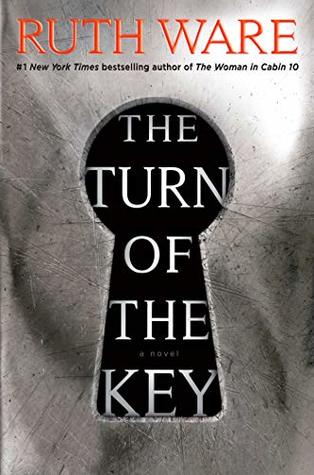
Ruth Ware is on a roll. The
Turn of the Key is a lot of fun; I received it free and early, thanks to
Net Galley and Gallery Books.
Our protagonist comes across the job posting almost by accident
while web-crawling, looking for something else. It sounds too good to be true,
a live-in nanny position with a professional salary and the use of a car. The
location is a beautiful home in Scotland, and the children are 3 adorable
little girls, along with a middle schooler who’s away at boarding school. But
the funny thing is, they haven’t been able to keep anyone in the position.
Rowan is called for an interview, and she stays overnight in
the room that will be hers. It’s gorgeous. The bed is sumptuous, and she has a
private bathroom, with state-of-the-art everything. The house was originally an
historic pile, but it’s been updated with all sorts of smart house features.
This, I think, is what sets this mystery apart from others,
because it speaks to an anxiety many of us face today. Everywhere, we are
monitored. Cameras keep us and our belongings safe, but we are always watched.
We don’t always know whether we are being watched or not; sometimes cameras are
tiny and concealed, and sometimes there are drones that come and go. Every time
Rowan—who of course gets the job—has a bad moment, either because she has
snapped at one of the kids, or because her clothing is stained or disheveled,
or because she’s getting ready to take a shower, she wonders if someone is
looking at her.
To me the most surprising thing is that she never pushes
back. Why doesn’t she ask about the camera in her bedroom? When she is told
that she is only getting about a third of her monthly salary, with the rest
being held back as a “completion bonus” after one year, she doesn’t bat an eye.
At the end we learn of an additional motivating factor that could account for
these things, but that factor feels contrived to me and doesn’t add to the story.
It actually weakens it, partly because Megan Miranda just published a mystery
with similar features.
The ghostly noises that come in the night are augmented by
the smart home features, and here I can only bow in admiration. I also
appreciate the poison garden, which is wickedly cool.
The red herrings are obvious ones, and I figured out most of
the outcome early on. The shocker at the end didn’t seem credible to me. It
took me a long time to buy into the format. The beginning is in the form of a
letter our protagonist writes from prison to obtain legal help. But Ware is
skilled at creating a hypnotic narrative, and by the ten percent mark I forgot
about that aspect and focused on the story itself. Despite a predictable
outcome or two, I found the ending satisfying.
That said, I love the use of the microphone feature in gmail that gives Rowan’s charge Ellie, the kindergartener, the capacity to send messages; particular the cute little errors (the messages that read “fairy” instead of “very” and so forth) are adorable.
This is a fast read and a deeply absorbing one. It’s
available now.



 Seattle Book Mama