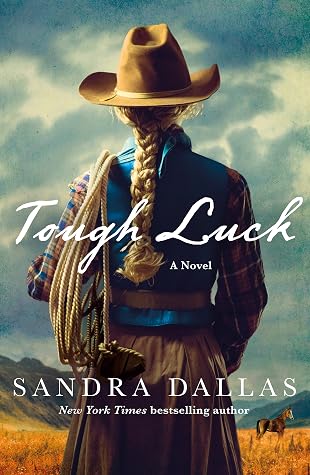
Tough Luck, by Sandra Dallas****

Tough Luck, a novel by Sandra Dallas, is the story of two almost-orphans, Haidie and her younger brother, Boots, that set out on a journey from Oklahoma to Colorado in search of their father. He’d left to find work some four years prior, planning to either send for them, along with their mother and older brother, Cheet; but Ma has died, and Cheet—the scoundrel—sells the farm, dumps his siblings in an orphanage, and takes off with the money. After escaping the orphanage, which is grim and abusive, Haidie is determined that she and her younger brother will make their way to Colorado and find their father.

My thanks go to NetGalley and St. Martin’s Press for the invitation to read and review. I’m over a full year late in doing so, a fact I’m not proud of, but despite my lateness, I have enjoyed this read, and I believe others that enjoy quality historical fiction will enjoy it as well.

Any author that writes historical fiction in the first person with a child as the protagonist has their work cut out for them. The ones that earn my scorn are those that make their main character so precocious that they speak as if they were an adult. This is, of course, complete nonsense, since brilliant children are still children; I am delighted to say that Dallas doesn’t use this cheap, ineffective device. Haidie is a bright child and most of her decisions are good ones, but she’s no Einstein, and she doesn’t talk like one. Having brother Boots along is important because it provides an opportunity for dialogue.

I do love American history, and so I am also waiting for Dallas to play fast and loose with historical fact. Instead, she is dead accurate, and despite the tall job she’s given herself, sending a couple of children across the plains and into the Rockies without an adult escort in the time before there were highways or readily available maps to follow, she nevertheless makes the story credible. I believe Haidie completely, and I believe the various villains and thieves, as well as the more decent people that she runs across during her journey. The settings are well rendered, too.

Because I fell behind in my reading, I checked out the audio book at my local library. Narrator Mia Hutchinson-Shaw does a fine job in bringing these characters to life.

This is an entertaining read, despite the sorrow and deprivation with which it begins, and I recommend it to those that love the genre.
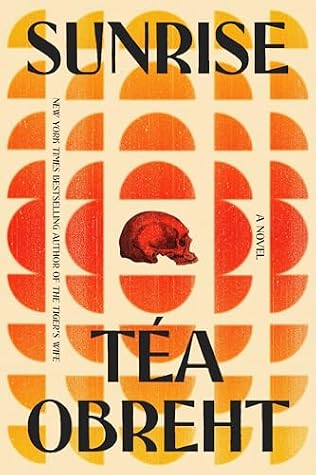
Sunrise, by Tea Obreht*****

Sunrise is just the sort of bizarre yet brilliant novel I’ve come to expect from author Tea Obreht. My thanks go to NetGalley and Random House for the invitation to read and review. This book is for sale now.

Our protagonist is Nina, a nanny on vacation with her boyfriend, Ben. Ben was the pilot of the plane flying over the Northern Rockies; Nina bailed, and Ben is nowhere in evidence. She’s landed in a river, and is remarkably free of major injuries, but she’s cold, scared, and alone. There’s no search and rescue within hearing or sight, so she knows it’s up to her to reach help.

Friends, it’s gonna take a long time.

The book is divided into 5 sections. The first is described above; the next three feature earlier residents of Sunrise, the ghost town Nina eventually reaches; and the last circles back to Nina. The sections are tied together at the end, but not in the way any other author would do it.

The first section feels tedious at times, limited as it is to Nina’s internal monologue. She walks, she rests, and she spends a good deal of time deciding whether she’s hungry enough to allow herself one of the handful of protein bars she possesses. How many days is this going to take? She has no idea. As Nina trudges, she ruminates, and in doing so, we gain more knowledge of her past and her relationship with Ben. Had this been any other author, I might have abandoned the whole thing; reader, I am very glad that I persevered, because the last ten percent of this book makes it completely worth it!

This is the third of this author’s books that I’ve read. The first was Inland, which remains one of my favorite galleys to date. The second, The Morningside, is not as powerful as the other two, including this one, but it’s still well worth reading. Sunrise, however, is the first one that’s made me stand up and cheer.

Those that have the patience for unconventional plots, and that appreciate a protagonist that’s full of surprises and badass feminist moxie, will have a hard time finding a more satisfying novel. Highly recommended!

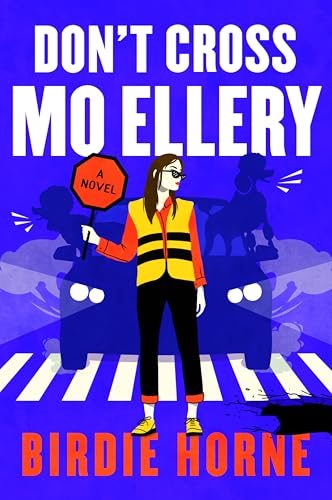
Don’t Cross Mo Ellery, by Birdie Horne**-***

Don’t Cross Mo Ellery is a wacky girl detective novel by Birdie Horne, which is a pen name used by co-writers Eden Robins and MW Garguilo. Mo is a twenty-something hot mess. The story opens with her simultaneously getting dumped by her better-off boyfriend of ten years and getting fired from her job. It’s loaded with cringe humor and appears to be a new series entering the general lane of Stephanie Plum and Finlay Donovan, only not as good.  Nevertheless, I thank NetGalley and William Morrow for the invitation to read and review. This book will be available to the public August 11, 2026.

The book starts with sex, ends with sex, and has sex in the middle. There’s awkward sex, hot sex, and interrupted sex, with a fair amount of crossover between these types and between genders. Oh, there’s also sex with just one person. I’m not using the word for this. There are some that will enjoy it, or at least find it funny, but it leaves me with a mild headache from rolling my eyes so often.

The premise here is that Mo gets a job as a crossing guard because that’s all she can find. In the course of her duties, she is harassed by a difficult driver who then dies behind the wheel while she’s on the job. In order to find out who killed him, she teams up with an insistent older neighbor and a (precocious, of course, of course, of course) elementary school student, which she doesn’t realize is illegal and unprincipled until midway through. I believe none of these characters even slightly.

It’s possible that I am in the wrong demographic for this book. My memory harks back to the early female detective series that were well written and empowering. At a time when young women needed to hear that they could do anything, including occupying traditionally male occupations, these were a balm. Mo Ellery, on the other hand, can’t find her butt with both hands.

There are poodles in this thing, and they are the characters that I enjoy.

The narrator is Cia Court, who does as good a job as is probably possible.

So there you are. If you still want this thing, you can pre-order it; as for me, I’m out.

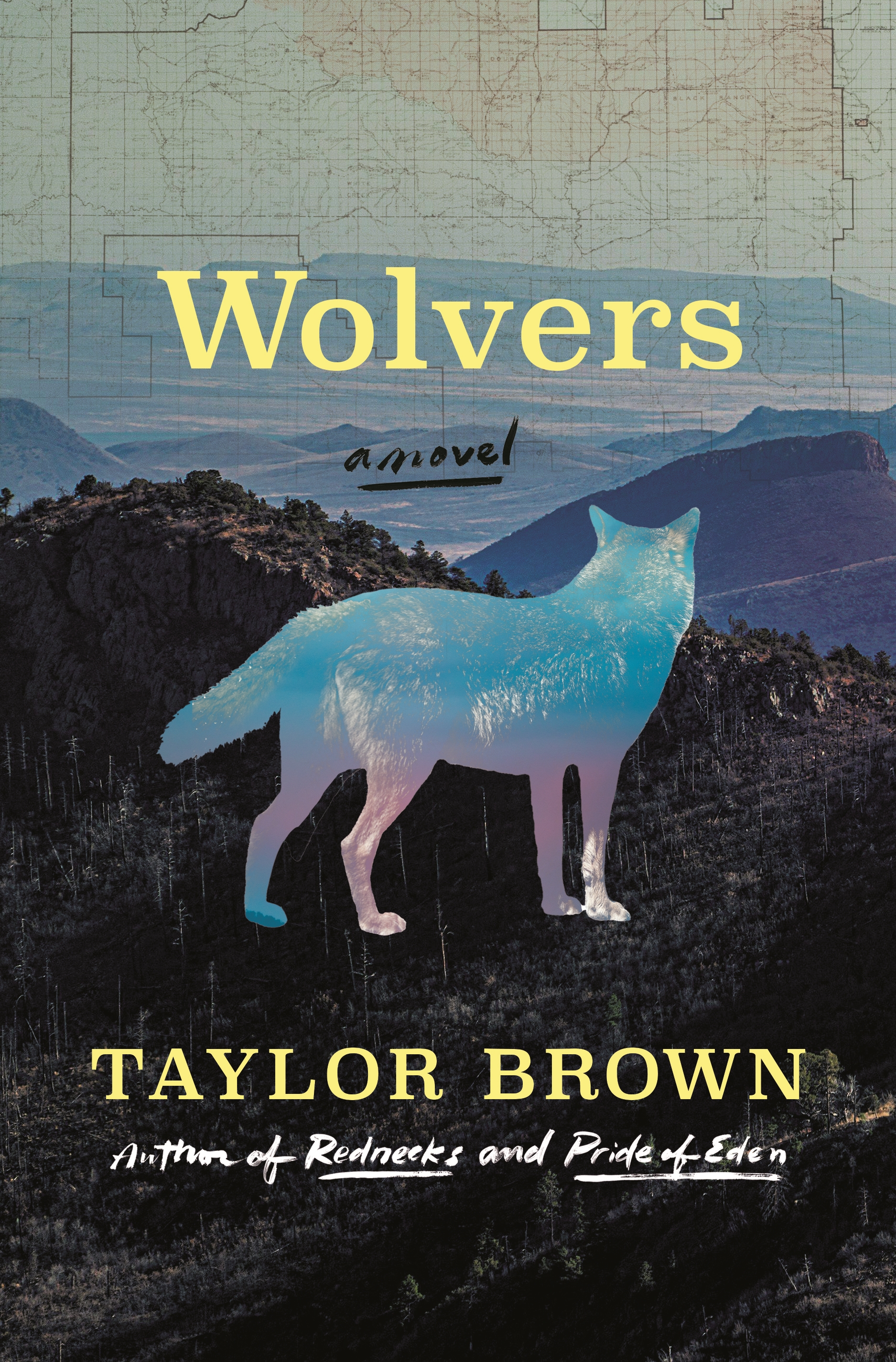
Wolvers, by Taylor Brown*****

Taylor Brown has become one of my favorite authors. He creates believable characters and memorable plots, and his recurring themes have to do with championing the poor and dispossessed, and an urgent sense of environmentalism. My great thanks go to NetGalley, RB Media, and St. Martin’s Press for the review copies. This book is for sale now.

Trace Temple hates wolves. His family has spiraled downward since losing its New Mexico ranch, a ranch that was in the family for generations, because of a massive legal penalty incurred by shooting an endangered wolf. It’s legal to kill a wolf that has preyed on one’s livestock, but the circumstances under which that can be done are very specific ones. Trace’s father thought he was shooting the wolf that had eaten his sheep, but he accidentally shot the wrong wolf, and it cost him and his family everything. The patriarch went to prison, and Trace’s mother developed an addiction that has become all consuming. So when some sketchy characters approach Trace and propose to hire him to shoot One-Eleven, the legendary alpha of a wolf pack that ranchers have long hated, he’s all in. But an experience that occurs while he’s on the hunt causes him to change his mind.

Once Trace is out of the running, the organization hires someone else, a man called Murdoch. Murdoch wants to kill the wolf, and he wouldn’t mind killing Trace, too.

The story starts a bit slow, then gathers steam as it goes. The Gila wilderness where all of this takes place is resonantly depicted, and given that nearly everything that Brown has written to this point is set in the Appalachians or some other part of the American South, this is all the more impressive.  The dialogue pops! There aren’t many characters in this story, and the two-legged characters that get the most ink are males; it’s all the more amazing, then, that Brown’s respect for women shines through, and it does so naturally. By the last quarter of this story, nobody could have kept me from finishing it.

There’s some gore here; the story could not have been told authentically without it. Humans get hurt, and some get dead, and so do wolves; but none of the damage is superfluous or titillating. And I loved the ending.

Brown explains what’s real and what’s fictional at the end of the book, and he even includes a two page bibliography for those interested in the subject matter.

I was lucky enough to have both the digital and audio versions of this story, and it’s the first time I’ve listened to one of Brown’s books. Ramiz Monsef does an outstanding job as narrator, and for that reason, I recommend this format for those that like audio books. But whatever your preference is, this novel is highly recommended.

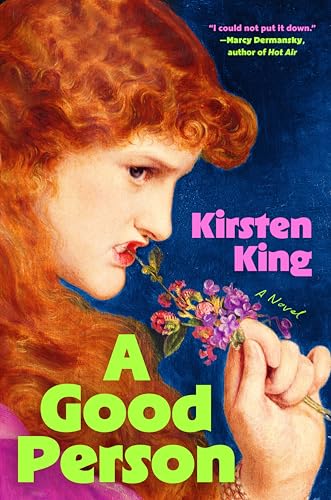
A Good Person, by Kirsten King***

A Good Person is the debut novel of Kirsten King. This is one of those rare times when I decide to read a book based largely on the cover. My thanks go to NetGalley and Putnam for the review copy; this book will be available to the public March 31, 2026.

Lillian is lonesome. She has few friends and no love life. When she spies Henry in a coffee shop, she decides to change all of that, and she propositions him; from there develops a relationship that Lillian’s friend Jamie regards as a “situationship,” meaning a hook-up situation, but Lillian is determined will become true love.

That’s not really how it shakes out, though.

The thing about Lillian is that she’s abrasive. In fact, she’s a walking, talking ball of snark and negativity. She doesn’t like most people, and they feel the same about her. But when Henry says he doesn’t want to see her anymore, she does and says rash things, and unfortunately, some of it unfolds on social media. When Henry is found dead, she is an immediate suspect. And while I find Lillian to be about as toxic a main character as I’ve found in many years, I can’t help but root for her to be exonerated, because whatever else she is, I am certain she’s no killer.

Because of the hilarious looking cover, I expect this book to be humorous in a dark sort of way, but I am mistaken. In fact, it proves to be darker than I am up for. A little more than halfway in, I find myself counting the pages. The ending has an interesting twist to it, and King has crafted a credible anti-hero. The narrative unfolds in the first person, and that makes it darker still. Foreshadowing is deft and in just the right amount.  But while there are some nice moments, I can’t say I enjoy this novel, nor can I recommend it.

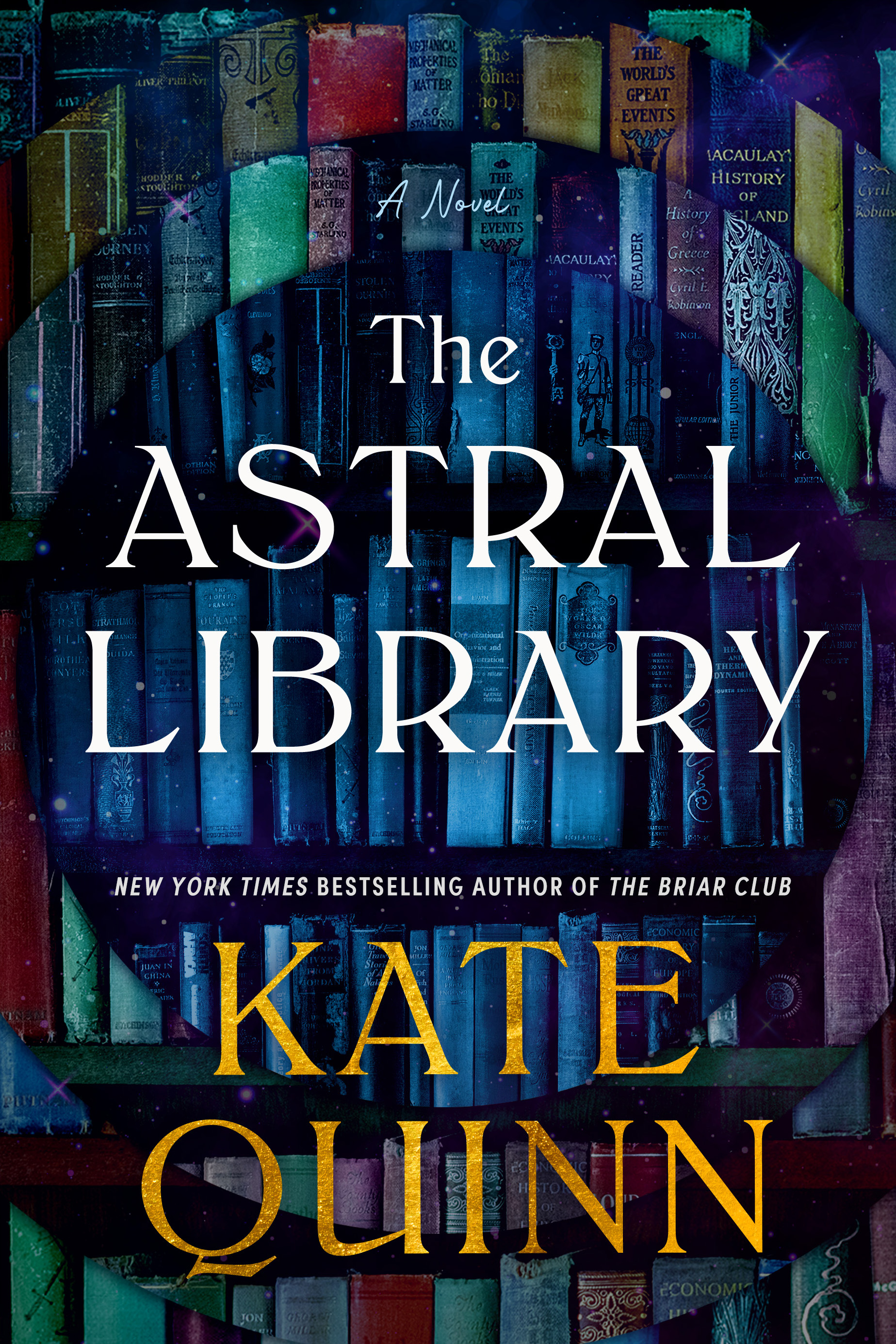
The Astral Library, by Kate Quinn*****

“Here there be dragons.”

The Astral Library by Kate Quinn is not to be missed. My thanks go to NetGalley and William Morrow for the review copy; this book is for sale now.

Kate Quinn is a well-established author, but I didn’t encounter her work until 2024, when I read and reviewed The Briar Club. I loved that novel so hard that I was dismayed to see that this new one was not historical fiction. Fantasy? (Heavy sigh!) Oh, all right. Fine. I’ll read it anyway.

My initial impression was that this was a lazy way to build a plot. Place 1, place 2, place 3 and so on. Ho hum. But like Quinn’s version of Boston Public Library, this book is not what it seems to be on the surface. There’s also an important social message about censorship and book burning that’s built into the plot, and I don’t care how much others may hate seeing “politics” in a novel; this is a message thoughtful readers can get behind. The librarian in charge of the special section is a magnificent character, as is the fashion designer that befriends Alix. As for Alix, I love that she is plus-size!

It was a good decision.

Our protagonist is Alix Watson, a young woman that’s recently aged out of the foster care system. Her mother abandoned her when she was still small because her new boyfriend “wasn’t into the whole kid thing.” She left Alix with a couple of frozen meals and went to California.

Foster kids tend to be shuffled from place to place, seldom bonding or sticking, and so the Boston Public Library became Alix’s happy place. Now here she is, a grown woman—barely—and the library has become one of her parttime employers. She is nonplussed one day when she receives a written invitation to visit a little-known part of the library, a secret place where the books are alive and patrons may step into them—literally! Choose a story whose time and place appeals to you, and off you go.

Those looking for a coming of age story with feminist roots could hardly do better; those just looking for a darn good story will find it here. The outstanding ending pushed this one out of four-star territory and into five.  Highly recommended.

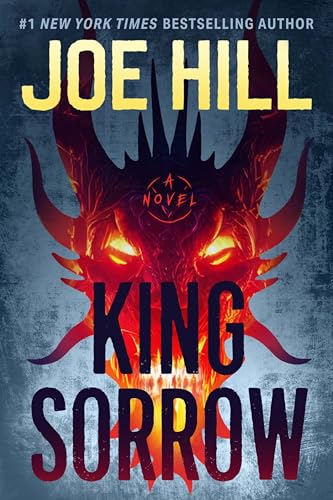
King Sorrow, by Joe Hill*****

Arthur Oakes is in a jam. He is a student at Rackham College in Maine, and to make ends meet, he has a work-study position in the library’s rare books collection. But he finds himself unexpectedly being blackmailed into stealing books from that very place, a nightmare of epic proportions; the solution proves to be an even greater nightmare. He and his friends summon a dragon to get rid of the blackmailers, but now the dragon won’t go away.

My thanks go to NetGalley and William Morrow for the review copy. This outstanding tome is for sale now.

This author has no doubt learned to take comparisons between his writing and that of his mega-famous father, Stephen King, in stride. My own impression from reading both is reaffirmed here: he’s every bit as good and perhaps, at times, better. His father has mellowed in his old age, and he’s become reluctant to kill his most sympathetic characters. Hill, however, has no such compunctions. It increases the suspense to know, while reading, that he actually might do that.

Arthur has become involved with a townie, Gwen Underfoot, whose family has cleaned for the family of his friend, student Colin Wren, for generations. Add in some other friends, Alison Shiner and the twins, Donna and Donovan—clever of Hill to insert some D&D into a dragon story—and we have a cabal.

One of the earliest points of interest for me is that nobody in this circle of friends seems to doubt for a moment that the effort to summon a dragon will be successful. I had expected self-conscious eyerolling, but their approach is well researched and oddly businesslike. King Sorrow arrives with a vengeance, and he does not disappoint! The saga that unspools from there is an epic one, over 800 pages, so those that like to hurry through short novels will need to steer clear or adjust their thinking. As for me, never at any point did I see anything that resembled padding. There is never a slow moment, and while at the outset I made a point not to read this story too close to bedtime, lest it affect my dreams, once I reached the story’s climax there could be no stopping till the journey was completed.

I don’t read a lot of horror these days; most grandmas don’t. But when I make an exception, I want it to be damn good, and this book qualifies. Highly recommended to those that appreciate things that go bump in the night, and especially dragons.

Over Yonder, by Sean Dietrich*****

Sean Dietrich has written another fine novel, Over Yonder, one full of quirky characters, weird yet oddly credible situations, and a whole lot of heart. My thanks go to NetGalley and Thomas Nelson Books for the review copy. This book is for sale now.

Dietrich has been writing for a long while, but this is just the third of his books that I’ve read. As I begin this one, I develop a niggling suspicion, wondering whether this author uses a formula. This would be a sad discovery, because till this point, I have greatly loved his work. And so the question I have to answer before I can do much else is whether that’s true, or whether he is writing unique stories using a signature style. Here is what I am seeing: each story focuses on a girl—teen or child—who’s down on her luck, possibly facing a crisis, with no adult that will help her or advocate for her; an older man dealing with misfortune of his own such as a fatal or serious illness, and who is otherwise isolated and in need of redemption; and a chance meeting of the two in a small town in the deep South.

I suppose, after reading this third one I am inclined—as you can see from my rating—to say this is a signature style rather than a formula. I hate to be played. If I felt this was a formula, I would feel annoyed and my review would not be generous, but that’s not what happens.

Caroline is 17 and pregnant. Her boyfriend, Tater Bunson, is at the wheel of his ’93 Honda.

“Caroline stared out the lace-like cracks of the passenger window’s single bullet hole at downtown Knoxville…her hair was the color of a carrot. She was ninety-four percent freckles. Her small, upturned nose, full cheeks, and cherub face brought to mind a character from the highly successful Cabbage Patch Kids product line…Tater spun the wheel right. The car made a sound not unlike a Folgers can of rocks falling down a public stairwell. The spiderweb crack on the passenger window came from a .22 caliber bullet that had passed through the glass during Tater’s last heated disagreement with his mom.”

Woody Barker used to be a priest. He has a houseboat and a bad heart, and not much else. He can qualify for a heart transplant, but only after he quits smoking, and it’s not going well. He’s lonely; he had hoped to pick up with his ex-wife once he got out of prison, but now that he’s out, he sees that she has a boyfriend, and it looks like he’s out of luck. Then an old girlfriend summons him to her deathbed. She wants him to meet his 17-year-old daughter. Who? What??

Dietrich’s wry humor and visceral figurative language are out in force here. Highly recommended to those that enjoy strong Southern fiction with deeply developed characters.

Clete, by James Lee Burke*****

Mortality is mortality. It comes to you when it’s ready. We don’t set the clock.

The Dave Robicheaux series by James Lee Burke is one of the finest ever written. As the faithful know, Clete Purcel is Dave’s partner in whatever he does. Once they were cops that called themselves “The Bobbsey Twins from Homicide.” (You probably need to be a boomer to get the reference.) Now they are on their own, but they are still like family to one another. This is the 24th in the series, and it’s the first to be told from Clete’s point of view. It’s a brilliant idea for two reasons: first, because Clete is a well written and wildly popular character, and also because it gives us a chance to see Dave through someone else’s eyes, someone that loves him, but isn’t him.

My thanks go to NetGalley and Grove Atlantic for the invitation to read and review, along with my profound apology for being so very late. This book is for sale now.

In this installment, a new drug ring has come to Louisiana, and it’s creating still more violence, more death, and more crime in general. Clete, who is now a private detective, is hired by a woman named Clara Bow. (If the name rings bells, it’s because the real Clara Bow was a famous movie star from the silent film era.) The Clara that hires Clete wants him to look into the activities of her skeevy ex-husband. Once he begins, we hardly have enough time to breathe. Clete hits the ground running, and there are no slow passages till the book concludes.

My favorite passages are the ones in which a woman named Chen, whom Clete rescues, then falls for, tells him how he appears to her. Here’s one: “You always gentleman, Mr. Clete. Your cats sleep on your face and you no mind. The world kill men like you because you brave and you kind.”

Later, Chen promises him that she won’t go back to taking drugs. “That because I go to a meeting every day with the Work the Steps or Die Motherfucker group. The Motherfuckers are very nice.” He advises her not to use that term in public. Don’t you love it?

Like every book in the series, this one moves seamlessly from scenes with quirky characters and dark humor, to glorious literary passages that I have to read more than once just to admire the writing, to passages that are gritty and violent and occasionally terrifying. Let me put it this way: you will never be bored.

Can you dive in mid-series? I did; then I became so enamored that I went back and read all the rest of them.

Highly recommended.

Fever Beach, by Carl Hiaasen**-***

What happened? I used to absolutely love novels by Carl Hiaasen. In his most recent release, Fever Beach, we see a conflict between good—in the person of our main character, Viva Morales—and evil, played by a variety of Proud Boys wannabees and other undesirables. The good person is always good; the bad guys have no redeeming qualities. Only Viva’s ex-husband is a dynamic character.

Still, my thanks go to Doubleday and NetGalley for the review copy. This book is for sale now.

As I read, I keep reminding myself that this is not a book I’m supposed to take too seriously, to lighten up and just roll with it. I certainly used to do so when reading Hiaasen’s work. But perhaps because of the stereotyping and complete lack of nuance, what might otherwise have seemed droll and satirical, instead comes across like a whole lot of cheap shots fired off the bow.

Mind you, I am certainly not a fan of ultraright organizations, and the rising tide of bigotry, fascist ideology and anti-Semitism concerns me greatly. But in an already highly polarized nation and world, all I can think as I read is that this story isn’t helping. It is the snobbery and elitism of the highly educated that has driven a large number of folks into the arms of extreme right; some intelligently reject the elitism and cancel culture consciously, but they aren’t in this book. In real life, those that are poorly educated and/or intellectually handicapped, as the bad guys in this book are, would in most cases give their right arms to wake up “clever” like Viva.  It strikes me as counterproductive to write a book that makes fun of right-wing intolerance, while practicing intolerance from a different angle.

Back in the day, before anyone judged anyone else by the color of their hat, I used to roar with laughter at this author’s work. Did it change, or did I? I would like to think it is the former.

I rated this book 2.5 stars and have rounded it upward, more from a fondness of his early novels than anything else. I do recall reading another of his more recent books—not for review, but just because I felt like it—and saw some of the same problems, so I will tell you that this book will probably work for you if you enjoyed his last one. Apart from that, I cannot recommend it.