
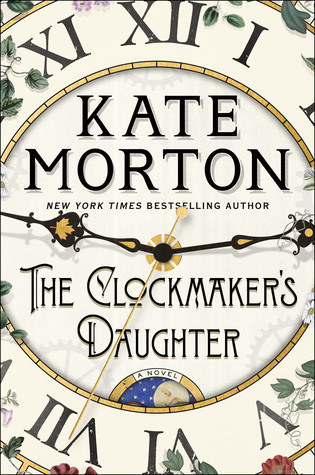
The Clockmaker’s Daughter, by Kate Morton***

TheClockmakersDaughterKate Morton is queen of the British historical mystery, and so I leapt at the chance to read and review The Clockmaker’s Daughter. My thanks go to Net Galley and Atria Books. This book will be available October 9, 2018.

This story starts strong with a spellbinding first person narrative told by the woman whose spirit resides eternally at Birchwood Manor. She came here with Edward, a wellborn cad that “could make the very devil pray”, one that called her his muse. Edward seduced her, yes, but he would never have married her.

Elodie Winslow is an archivist in present-day London.  In the course of her duties, she runs across two pictures in a leather satchel. One is a photograph, quite old, and the other is a sketch of a house that seems familiar to her somehow. And so of course, faithful readers are cued right away to watch for a connection between Elodie, and the people, setting, and events that are introduced at the book’s beginning.

Find me a writer that can create more resonant settings in a British historical mystery; I dare you. For the first quarter of this novel, I was in it, steeping in the escapist paradise Morton provides, drinking in the several characters and narratives. But at the thirty percent mark, when yet another new thread, another new character—or is it an old character pretending to be a new character—is introduced, I find myself searching for a nice brick wall to smack my forehead against. It’s hard to get to know any of these characters with so many new ones added.

Usually with Morton’s books, the details and subsections are worth the reader’s careful attention because it all comes together so well at the end. Here, there’s excellent setting and a lot of secrets but not enough plot or character development, and so before the story is even halfway done I find myself eyeing the page numbers. How much longer…?

I also find myself wondering what story elements are classic, and which are simply overused. The old house with the secret doors?  I will never get tired of this element, especially when the writer is as capable as Morton. But bullies at a boarding school—meh. I am ready to be done with that one. And the sack of kittens to be drowned? I gave myself permission to skip a page, because it is. Not. Worth. It.

Many of Morton’s faithful fans will be pleased; her trademark style is unmistakable, and if that’s what you want, here it is. But a story this complex needs more legs to go with it, and less reliance on stale devices.

Am I done reading Morton? Not by a long shot. Every author has a story or two that isn’t magical. But when a story requires this much effort on the part of the reader, the payoff needs to be greater than it is here.

Recommended to diehard Kate Morton fans; even so, get it free or cheap, but don’t pay full jacket price this time.
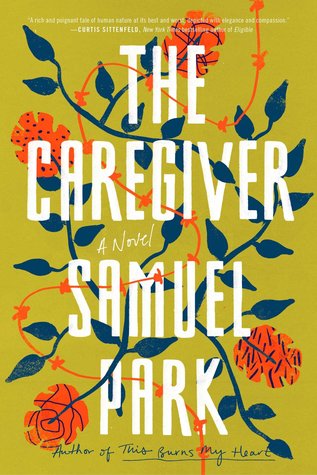
The Caregiver, by Samuel Park*****

TheCaregiverThe Caregiver is one of the year’s best surprises. I read this book free and early, thanks to Net Galley and Simon and Schuster. Our protagonist is Mara Alencar, and our setting is split between present day Los Angeles, and Rio de Janeiro, Brazil in the 1980s. I am drawn to the story initially because of the setting, which I don’t see often; but it is Mara that keeps me turning the pages. Those that treasure excellent, character-based literary fiction should get this book and read it.
Mara is just a kid, and all she really wants is food, shelter, and the comfort and companionship of her mother, Ana. Ana is a young single mother that works as a voice-over actress, repeating the lines of English-language programs in Portuguese. The pay is low, and Ana’s self-discipline is negligible. Life is a constant struggle.

One evening Ana is visited by a group of students that claim they plan to rob a bank in order to fund a revolution. Ana’s job is to distract Chief Lima so that a comrade can be liberated from prison. The comrade will play an important part in the revolution; as for Ana, she will be paid handsomely, and then she will be free to go if she likes. Mara doesn’t like these rough people and their threatening demeanor, but Ana hears the amount they will pay, and once she receives an advance, she’s in.

Everything is seen through Mara’s eyes, both in childhood as these events unfold, and later, looking back during her years working as a caregiver to a manipulative older woman that shares some of Ana’s characteristics. As a child, Mara is often afraid or confused, or both. Her mother reminds her often that she is all that matters, and that the two of them will always be together; in the next moment, she will do something so blindingly selfish, so completely inappropriate that I want to yank the woman into the kitchen and remind her that she has a child and responsibilities. She will tell Mara, not for the first time, that she could never stand to lie to her because they are so close, and she loves her so much; but we turn the page and sure enough, she lies to her child, or she is gone for days on end with no warning or explanation. There are occasions when she seems to lie unnecessarily, and I want to throw my tablet at the wall, I am so frustrated.

The ending is a complete surprise, and it makes perfect sense within the chaotic context of the time and place.

The most admirable aspect of this story is the consistency of the narrator. A writer that can tell a story from a child’s point of view without mixing up the developmental level that affects a child’s perceptions, vocabulary level, and capacity to analyze what she sees is hard to find. A male writer that can do this, and that can also consistently write a woman’s story in the first person without giving himself away is a unicorn. Samuel Park convinces me that I am listening to a woman tell her story, and repeatedly I am pulled under, only to be reminded when I go to make notes at the end of my writing session that this is a male novelist. This doesn’t happen. I am gob-smacked at his level of perception and originality.

I never met Park, but I grieve for him anyway as a reader. Please come back, Mr. Park. One book is not enough; forty-one is too young.

Highly recommended.

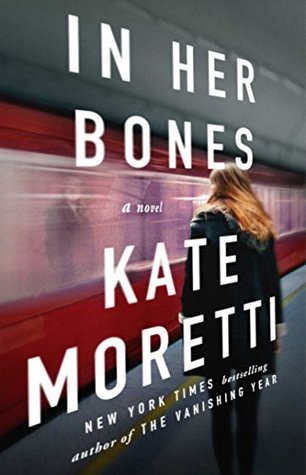
In Her Bones, by Kate Moretti****

InHerBonesMoretti’s mysteries are addictive, and when I found this galley in my email, I jumped it to the front of the queue. Big thanks go to Net Galley and Atria for letting me read it free and early. You can buy it now.
Edie is an outcast, spurned by her friends when her mother Lilith is arrested as a serial killer. Since it is so rare for a serial murderer to be female, the press is everywhere; meanwhile, all Edie has left is her brother Dylan and later, his young family. Otherwise, the people to whom she feels most closely bonded don’t know Edie, don’t realize that she is watching them, obsessing over them in person and in cyberspace; they are the bereaved family members of Lilith’s victims. It gives me chills.

One day Edie takes her voyeuristic tendencies to the next level; when the man she’s been stalking is found dead, police immediately suspect Edie of being his killer. And as we read Edie’s narrative, which tells us some things but not everything, we wonder too: is Edie a lonely, isolated young woman searching for connection to another human being; or is she a chip off the old block, a stone cold killer just like her mama?

The first person narrative alternates with a third person study of Lilith, and so the voice switches from Edie’s very personal story to a clinical, dry report regarding her aberrant mother. (Let me tell you, whatever issues you may have with your own mother—she’s going to seem like the mother of the year once you’ve read this.)

I’ve read a few unhappy reviews by online friends. but I like this book. It helps if you approach it as a mystery rather than a thriller; those in search of a grab-you-by-the-hair page-turner may not get what you’re looking for, but I wanted an interesting story with an original premise and a credible ending, and this is that. In addition, the third person case notes written by social workers and their ilk ring true to me. In fact, I made a wry note to myself, wondering whether Edie or Dylan might have been in one of my classes; I have never taught the children of a serial killer to my knowledge, yet the wanton neglect and lack of nurturance, even a simple effort to provide the basics eludes Lilith in a way that seems familiar. You think I am exaggerating? Not so much. There are terrific parents; there are indifferent parents; and there are, I am sad to say, more than a few Lilith Wades out there in the parent pool.

This is my third galley by this writer. Whereas I liked The Blackbird Season a little more than this one, mostly because of its amazing word smithery, I find this story more original and memorable than The Vanishing Year, which has the sort of denouement that makes me roll my eyes. Here Moretti pulls the ending together in a way that keeps me thinking about the characters rather than the author, and I sigh with appreciation when it’s done.

All told, it’s a solid mystery with a satisfying conclusion. Recommended to all that enjoy the genre.

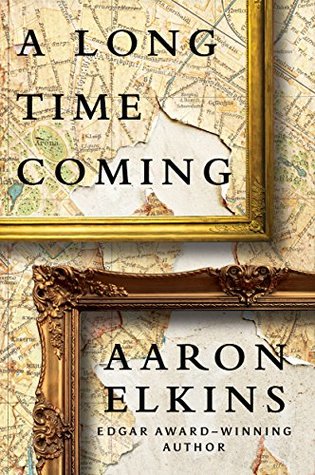
A Long Time Coming, by Aaron Elkin**

ALongTimeComingAaron Elkin has been writing mysteries for a long time, but he is new to me.  When I saw this title listed on Net Galley, I went to Goodreads and found that his work is well regarded by some of my friends; add to this his residence in my own Pacific Northwest, and I am ready to give his work a try. Thanks go to Net Galley and Thomas and Mercer for the DRC, which I received free of charge in exchange for this honest review.

The story starts well. Val Caruso is an art curator, and his personal life is a mess. He’s stone cold broke, and so when he is approached to do a job involving a stolen-but-found Renoir, his interest is piqued. An ancient Holocaust survivor claims ownership of a painting that has been sold to someone else, and Caruso is hired to help. I particularly enjoy the character of Esther, the domineering but charming friend that connects the two men; alas, we will soon leave her behind when we go to Milan.

At the outset the amount of art related information feels just about right to me. The book is sold as a popular read rather than a niche item for art aficionados, and I am cheered by this, since I have little to no interest in art. As we travel to Milan, however, the art lectures become oppressive. By the forty percent mark I find myself watching the page numbers roll by, oh so slowly, and cursing myself for having taken the galley. Brush strokes? Historical nature of paint color? Who the hell cares? The travelogue aspect of the book also starts well, but eventually the level of detail slooows this story to a crawl. I find myself cynically wondering whether this series is simply a ruse for the author to claim his globe-trotting expenses on his tax returns.

Elkin has a solid reputation built on an earlier series, and at some point I may give that one a whirl, but Val Caruso and I are done.

Where the Crawdads Sing, by Delia Owens*****

wherethecrawdadsKya Clark lives with her family in a shack deep in a North Carolina marsh.  The year is 1969. They are miserably poor, but Kya’s mother tells her it will be alright, as long as the women of the family stick together. But then one day, she leaves. Older brother Jodie tells Kya that Ma will be back, because it isn’t in a mother to leave her children, but Kya isn’t so sure. Ma is wearing her alligator heels, and she doesn’t turn midway and wave like she always has. And one by one, everyone in her family leaves, and they don’t return. Kya is not even old enough to enter first grade, and she is alone.

This haunting novel is the best surprise of the summer, and it’s for sale today. Thanks go to Net Galley and Putnam Penguin for the review copy.

Owens is a wildlife scientist of some renown; here she changes lanes with her debut novel. She uses her knowledge base to create an evocative setting that is real and immediate, but she never adds scientific information at the expense of pacing. Instead, the setting is used to reinforce Kya’s character; this is unusual in a researcher turning toward fiction writing. Professors and other specialists tend to shoehorn in every fact that they think the reader ought to know regardless of what it does to the flow of the narrative. Instead, Owens blends setting and character seamlessly, spooling Kya’s life before us with the patience and discipline of the finest master storyteller.

Kya barely survives, digging mussels to eat and selling them at a waterside convenience store owned by an African-American entrepreneur known as Jumpin’.  Little by little, Jumpin’ comes to realize exactly how dire this child’s situation is, and he and his “good sized” wife, Mabel, contrive to provide her with a few of life’s necessities without frightening her or hurting her pride. I would have preferred to see these resonant characters voiced without the written dialect, but there are no stereotypes in this book.

Tate is an older boy that has been a family friend since she was tiny, but she doesn’t remember him, and thinks she is meeting him for the first time after he begins leaving her beautiful bird feathers on a stump in the swamp. It is he that teaches Kya to read, and he becomes her first love.

The narrative shifts between Kya’s life and an investigation of a murder. Chase Andrews, a local football hero and the son of a local bigwig, is found dead at the base of a nearby water tower. Kya, who is poorly groomed, impoverished, and has no family to protect her becomes the focus of the investigation. Townspeople have long considered her to be “swamp trash,” and this discrimination is age old; Kya can remember her mother telling her that she must never run when she goes into town, because if she does someone will say that she stole something.

One of the most appealing aspects of this novel is that the mystery of Chase’s death never eclipses the main story. The book isn’t about Chase or his demise; it’s about Kya in the marsh, and as she becomes an official suspect, we only want what is best for her.

I read several stories at a time, now that I am retired, but this is the one that occupied my thoughts when I was doing other things. I kept thinking about that poor little girl out there. I can almost always put a book down; it’s what I do, after all. This one is exceptional.

Those that love excellent literary fiction; Southern fiction; or romance need to get this book and read it, even If you have to pay full jacket price.


Dagger John, by John Louhery ***-****

DaggerJohn I received a review copy of this book from Net Galley and Three Hills Publishing, which is affiliated with Cornell University, free of charge. This book is now for sale.

Since retirement, I have often taken my reading outside of my comfort zone, and at times I’ve been rewarded. I took a chance in requesting this biography because I have a peripheral interest in church history, and American history and Irish history are more direct interests. However, in this case there is too much assumed knowledge to be readily accessible to an acolyte of the region. My only trip to New York was a weekend tourist jaunt, and I have never been to the church in question.  However, I am drawn to the resistance he put forth during the “Know Nothing” period of anti-immigrant sentiment, and now is certainly the time to receive such a cautionary tale.

The claim that this man “made” Irish America seems overstated to me.

That’s not to say that it won’t interest you. The documentation is as unimpeachable as one would expect from a highly regarded university, and scholars with a specialized area of interest will likely find this a treasure because it is so specific. A niche audience may rate this title as four stars; I find it too dry a read to imagine five. But it isn’t intended to be a popular read but a scholarly one.

A solid niche read for those with interests that are aligned with the author’s.

The Black and the Blue, by Matthew Horace*****

theblackandtheblue“Even as a federal agent, I have been on surveillance or supporting an operation and have had an officer approach me and say that the neighbors called about a “suspicious” vehicle, which meant it was a black guy driving a car. I’ve been the man in that suspicious vehicle.”

Matthew Horace worked as a cop at the federal, state, and local level for 28 years, and he is plenty sick of the “toxic brotherhood.” The quote above refers to an incident that occurred in Mill Creek, a (very white) suburb outside Seattle, Washington where I live, but it’s not just here; it’s everywhere in the US. Specifically, he tells us about cities where some of the most notorious cop violence has created resistance such as New Orleans, Chicago, Baltimore, and Ferguson.

There are essays provided by police chiefs from some of these places as well as from Kathleen O’Toole, who was chief here in Seattle; O’Toole’s prose reek of electioneering, the sort of style that speaks for itself. Many of these contributors contradict Horace’s own assertion that the problem is endemic, and is absolutely not a case of a few bad apples. More than one of these essays hold the fascination I’d feel if forced to watch a rattlesnake before it strikes; the sanctimony, the grandiose claims of justice supposedly served. The most interesting of them all is from an African-American police chief in Chicago, whose personal stories of her family members having been abused—including her sons—stand diametrically opposed to what she does for a living, and yet she maintains her tightrope walk, determined to make a difference where only the smallest, if any, seems likely.

By now I should have thanked Net Galley and Hachette Books for the review copy, which I received free and early. This excellent book is available to the public Tuesday, August 7, 2018.

There has been a flurry of books published about this subject since it became national news. More than anything, the internet and cellular phones have stripped the gatekeeping capacity of the major news outlets; cops that were able to beat and even kill people and lie about it later are being outed left and right. Even I, who am an old lefty and have never really believed cops were there to protect ordinary people, am shocked by much of what’s been revealed. I wondered, as I began reading, whether Horace could add to what’s already been said and shown. What could he add to the body of information provided by Ta-Nehisi Coates, Angela Davis, and Matt Taibbi? (Many years ago, Norm Stamper, former Seattle police chief, also wrote an expose that included a chapter on why cops beat Black men.)

As it happens, Horace has a lot of information that I hadn’t read, and it isn’t just a matter of fine detail. For example, who knew that in New Orleans, cops were not merely accepting graft, but actively robbing Black-owned businesses, guns drawn, and making off with their cash and other valuables? It’s the sort of thing that lives in your head for a long time after you read it; but then again, it should be.

The sourcing is impeccable.

Those with an interest in Black Lives Matter, in civil rights in general, or with an interest in race issues within the so-called criminal justice system in America should get this book, for full price if necessary, and read it. Read the whole thing. So much of our future depends on how we respond.

Lake Success, by Gary Shteyngart****

Lakesuccess“’All I know is I never had any advantages,’ Barry said. ‘I wasn’t even lucky enough to be born to immigrant parents.’”

Schteyngart’s wry new novel takes a swift kick at the funny bone of the American ruling class. My thanks go to Net Galley and Random House for the review copy.

Barry grew up as the son of the pool guy, the man that serviced the swimming pools of the wealthy. Now between one trade and another—some of it inside, some of it legal—he has become one of the wealthiest men in Manhattan. His entitlement and vast privilege rubs up against his flimsy social conscience; meanwhile he tries to avoid coming to terms with his two-year-old son’s Autism. (When the children of the very rich are Autistic, it’s referred to as “on the Spectrum.”) His midlife crisis comes to a head when rumblings suggest he may be held accountable for his dubious business practices, and with his marriage teetering on the brink and the law breathing heavily down his collar, Barry flings himself onto a Greyhound bus and rubs elbows with the hoi polloi. Obsessed with becoming a mentor to someone with brown skin, Barry takes his rolling case of impossibly expensive wristwatches and embarks on a series of failed friendships and romances as he hurls himself due south and then west to San Diego. Who knows? Maybe he will even start an urban watch fund so that children that live in poverty can learn to appreciate fine timepieces.

Humor is a hard field for many authors. Some get stuck on a single joke, which is funny at the outset but tired by the end of an entire novel; others simply bomb, and unlike stand-up comics, the bad humor is enshrined forever in published form. So I approach humorous novels cautiously; but Schteyngart is no novice, though he is new to me, he has a good sized body of humorous work before this. The result is smooth and professional, but also original and at times laugh-out-loud funny.

The ending is brilliant.

This book will be available September 5, 2018.

The Line That Held Us, by David Joy****

thelinethatheldusDarl Moody and Calvin Hooper have been best friends forever, and so when Darl has the worst kind of accident, he knows who to turn to. You know what they say real friends will help you bury. The body in question is Carol Brewer; Darl was hunting out of season, and when he glimpsed something moving through the woods he thought it was a wild pig. Turned out he was wrong; turned out to be Carol, poaching ginseng on Coon Coward’s land. But you can’t bring the dead back to life, and you sure can’t call the cops for something like this. Carol is Dwayne’s brother, after all. Dwayne is a huge man, half- crazy and rattlesnake mean. There are no bygones in Dwayne Brewer’s world. There is only revenge.

My thanks go to G.P. Putnam and Net Galley for the galley, which I received free in exchange for this honest review.

“I’d be lucky if all he did was come after me,” Darl said, “But knowing him, knowing everything he’s done, you and me both know it wouldn’t end there. I bet he’d come after my mama and my little sister and my niece and nephews and anybody else he could get his hands on. That son of a bitch is crazy enough to dig up my daddy’s bones just to set him on fire.”

“[Calvin tells him] “You’re talking crazy, Darl.

“Am I?”

So Carol disappears…for awhile. But Dwayne won’t be satisfied till he knows what has happened to his brother, who is all the family he has left. Once he finds out, of course all hell breaks loose.
Joy is a champion at building visceral characters and using setting to develop them further. I know of no living writer better at describing hard core rural poverty to rival anything the Third World can offer:

“The house had been built a room at a time from scrap wood salvaged and stolen. Nothing here was permanent and as each addition rotted away, a new one was hammered together from plywood and bent nails off another side so that slowly through the decades, the five-room shanty shifted around the property like a droplet of water following the path of least resistance. Red Brewer was no carpenter. Chicken coops were built better. So were doghouses. But this place had been the roof over their heads and had kept the rain off the Brewer clan’s backs all Dwayne’s miserable life.”

The murderous rage of Dwayne Brewer contrasts with the tender, poignant love that exists between Calvin and his girlfriend Angie, who has just learned she is pregnant. Calvin understands throughout all of this that he has a lot to lose, and this makes the conflict between Dwayne and Calvin a more unequal one.

I would have liked to see Angie better developed, and I blanched a bit at the line where she thinks that the only important thing is what’s growing in her uterus. But the story isn’t really about Angie, and I have seen Joy develop a strong female character in one of his earlier books. I hope to see more of that in his future work.

Meanwhile, the passage where Dwayne visits Coon Coward—some four or five pages long—just about knocks me over. This is what great writing looks like.

I struggled a bit with the ending, and this is where the fifth star comes off. The first 96 percent of this tale is flat-out brilliant, but I feel as if Joy pulls the ending a bit, and I can’t see why. None of the rest of the book points us toward this conclusion.

Last, the reader should know that there is a great deal of truly grisly material here. We have a torture scene; we have numerous encounters with a decaying corpse. If you are a person that does most of your reading during mealtime, this might not be the best choice.

For those that love excellent literary fiction or Southern fiction, this story is recommended. It will be released August 14, 2018, but you can pre-order it now.

Paper Ghosts, by Julia Heaberlin***

PaperGhostsGrace is convinced that Carl Feldman killed her sister Rachel. The once celebrated photographer was tried for the murder of a young woman and acquitted; now he is very elderly, and residing in assisted living due to dementia. Grace poses as his daughter, and she wants to take him on a road trip.

My thanks go to Ballantine Books and Net Galley for the invitation to read and review. This book is now for sale.

The outset feels delightfully creepy, as in small bits and pieces Grace tells us what she knows and what she wonders about. We don’t know where she plans to take him, or what she intends to do with him, only that she isn’t who she claims to be and her intentions aren’t what she says they are.

The story is uneven in its quality. The first half is superior to the second half; at first I can buy the premise, which is full of holes—why would they release him to her? How could someone her age have enough money to do this, even with saving every penny she’s earned? How is she so careless with his meds, and how can he suddenly behave as if he is much younger and more vigorous than he has been for years? –but as the story continues, I find myself stopping now and then and rolling my eyes. I put it down, then come back to it, and the same thing happens. By the time I reach the ending, which feels cobbled together and not authentic at all, I am ready to be done.

Fans of Heaberlin’s may enjoy this book, but my advice is to wait till you can get it free or cheaply.