The Autumn Springs Retirement Home Massacre, by Philip Fracassi*****

It’s not just every day that I run across a five-star slasher novel, but author Philip Fracassi hasn’t written just any slasher novel, either. The Autumn Springs Retirement Home Massacre is one of this autumn’s most agreeable surprises. My thanks go to NetGalley, Macmillan Audio, and Tor for the review copies; this book will be available to the public September 30, 2025.

When a friend recommended it, she said it was funny and also different from her expectations. I agree on both counts. I was anticipating a book with plenty of old-folks barbs, sort of like the satirical carol, “Grandma Got Run Over by a Reindeer.” I considered whether I was up for it, given that I am a grandma myself, and decided my sense of humor hadn’t aged out. Sure, let’s give it a go.

Instead, though the book is indeed darkly funny in places, it also has aspects I didn’t anticipate. How many humorous slasher stories have character development, for instance? How many have genuinely poignant moments? And finally, on a more traditional yardstick, I find myself completely surprised by the solution.

Our protagonist is Rose Dubois, a 70-year-old retired school teacher. She buys a unit in the retirement community, not because she’s too decrepit to remember her medications or because she needs constant monitoring, but because she is ready to live in a smaller home near other people her own age. Her daughter has been urging her to come live with her instead, but Rose has friends here. She likes her little place, and she values her independence. She doesn’t want to go anywhere else.

Then her pals begin dying. The first is her bestie, and it stings, but also raises questions. The death—without giving anything away—seems out of character. But surprises happen, and they’re not all nice ones, so she and Angela’s other friends grumble, but move on.

But as the title suggests, there’s another. And another. Where will it stop? Rose and her remaining friends vow to stop it themselves, since the local cops and the home’s administrators don’t seem terribly concerned.

The story also raises the issue, a very real one, of the public’s lack of concern for the elderly. Hey, old people die. That’s what we do! And moreover, before we go, older folks become nearly invisible. The author’s moving note in the afterword explains why he took the approach he did.

Not long after I began reading, I was given access to the audio version, narrated by one of my favorites, January LaVoy. Although the print version is delightful, I give a slight edge to the audio because its format, which is mostly linear, lends itself well to this medium, and also because LaVoy always brings something extra to her narration.

Highly recommended to all that enjoy mysteries and a little gallows humor.

The Doorman, by Chris Pavone*****

“It’s up to everyone to draw a line, and hold it.”

Chris Pavone writes white-knuckle thrillers, and he’s one of the best in the business. His new novel, The Doorman, is one you won’t want to miss. My thanks go to NetGalley, Macmillan Audio, and Farrar, Strauss and Giroud for the review copies; this book will be available to the public May 20, 2025.

Our story rotates around three main characters, providing the point of view of each in turn; the setting is The Bohemia, an exclusive apartment building in New York City. Julian Sonnenberg, a middle aged art gallerist whose marriage is dying, lives there, as does Emily Longsworth, wife of the ultra-wealthy and ultra-hated Whit Longworth, racist war profiteer; and Chicky Diaz is the doorman, who sees all and hears all. They don’t know it yet, but their fates will soon be linked.

I’ve been reading Pavone’s novels for a long time, and each time he surpasses himself. The common thread that I treasure most, however, is his deep affinity for the working class, and his respect for women. In fact, I don’t know of any male novelist that is better than Pavone when it comes to developing female characters, and that is even more impressive when I consider his genre, because in most true thrillers, the pace is so fast and furious that there’s no time to develop any characters at all. Yet somehow, Pavone does it, and he does it without sacrificing the heart pounding, screaming pace that accelerates until the almost unbearable climax, which in turn is very close to the conclusion.

I was lucky enough to have access to both the digital and audio versions of this story; Edoardo Ballerini does a fine job narrating the latter. You can’t go wrong in either direction.

Highly recommended to those that love the genre and lean to the left.

You’ll Never Believe Me, by Kari Ferrell**-***

My thanks go to NetGalley and St. Martin’s Press for the invitation to read and review. This book will be available to the public January 7, 2025.

The blurb for this book had me at hello. Korean baby girl adopted by Caucasian Americans, who then become Mormons; a childhood and adolescence rife with alienation, discrimination, and ultimately a life of crime; prison time, followed by social crusades, among them prison reform, which is hugely necessary. I was all in, but that was before I read this thing. My own daughter is half Japanese and has to listen to “Where you from?” a fair amount, so this is a sensitive area for me, too. Racial teachings within the LDS (Mormon) church are a veritable minefield, and indeed, I can see how Ferrell’s upbringing would have been fraught.

And yet, the memoir that I read was not what I expected. The memoir, the blurb said, would be laugh out loud funny; I chucked a few times at the outset, and then was mostly just horrified. I received both the digital and audio galleys, and halfway through I abandoned the audio, because Ferrell, who provides her own narration, sounds so ebullient, so proud of herself, that I couldn’t take it. Reverting to the digital made it doable, but I found myself finishing it from a sense of obligation rather than a desire to read more.

Ferrell’s friends during her adolescence are what most adults would consider to be the wrong crowd. Truancy, petty theft, lying, drinking, and drugs are hallmarks. But Ferrell neither stays there as an adult, nor reforms herself once she reaches adulthood, though her parents, even though they divorce, likely can provide her with psychiatric treatment or counseling. Instead, she escalates, and commences stealing and defrauding her friends, pretending to need an abortion, pretending to have cancer, receiving so-called loans and gifts from those that don’t have a lot of money but love her dearly, and then disappearing. Steal in Utah, move to New York City. Steal in New York, go home to the folks in Arizona. And it continues until, at long last, she is arrested, tried, and convicted.

I tried to put my finger on what it is that makes me edgy here. Why do I not believe she’s all that sorry? Partly, it’s that other people appear only briefly and vaguely here. Of course it’s Ferrell’s life that’s the focus, but I would have expected some passages that flesh out the people that have loved her and tried to help her, even if it is necessary to conceal their identities as a matter of their own preferences. What happens to them later? What hardships, if any, do they suffer because of her actions? Instead, all of them come across as shadows, and as if they don’t really matter. I would have expected some emotion around reconnecting with some of these people, trying to make amends and financial restitution, even if they don’t want to see or hear from her. She talks a fair amount about the realization that her behavior is a form of self-sabotage, cutting herself off from positive relationships, but she doesn’t talk much about how she has sabotaged, or even completely blown up, the lives of others.

Lastly, I’m disturbed by some of her assumptions. The one that comes immediately to mind is when she reminds us—as if this is well known—that lying is fun. What??

In order for a memoir to be successful, the reader must be able to bond with the author. I have been unable to do that, either because Ferrell enjoys talking about her crimes and betrayals a little too much, or because she is unable to convey remorse in her writing; either way, I cannot recommend it to you.  

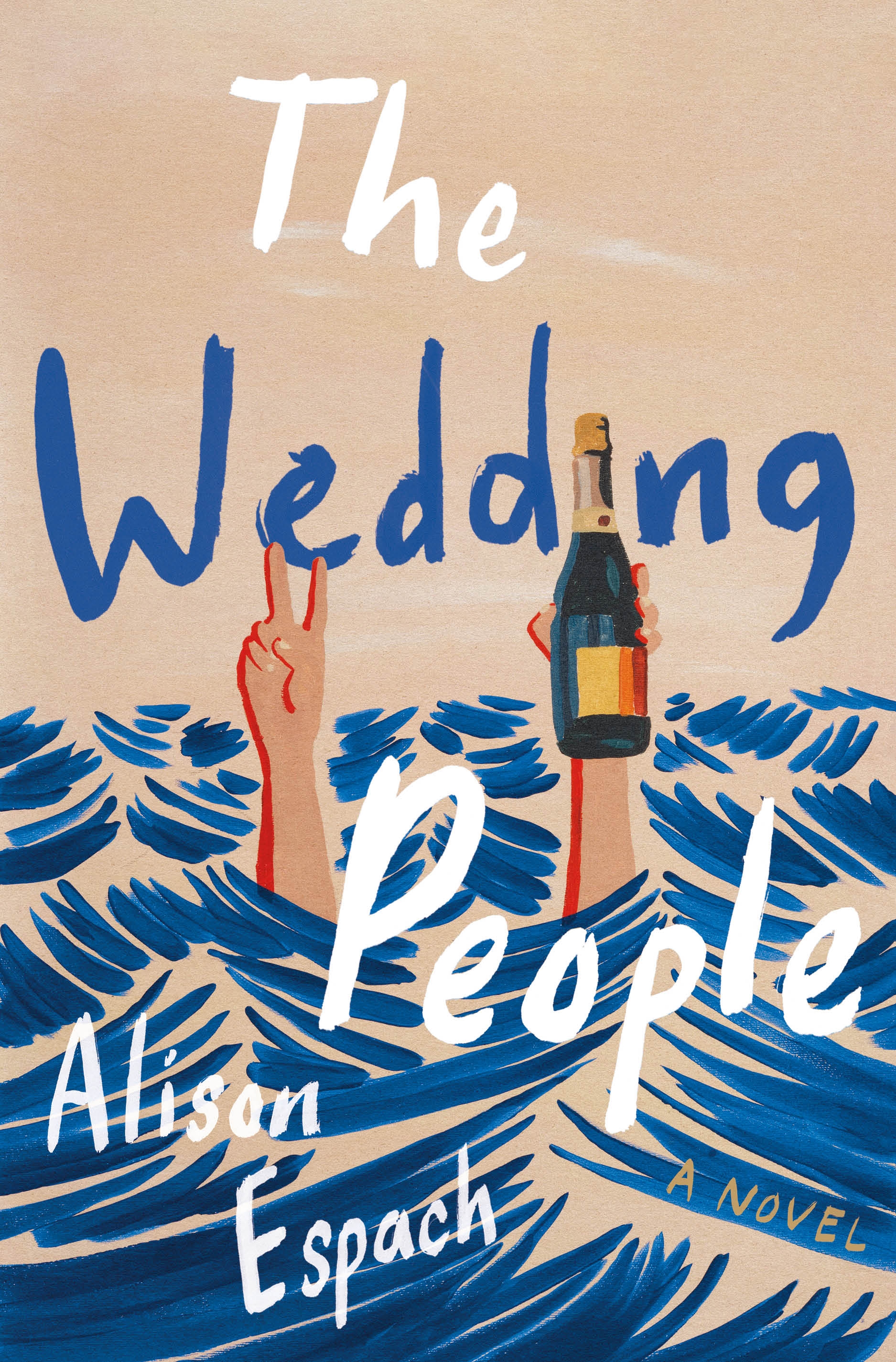
The Wedding People, by Alison Espach*****

It’s a good sign when I finish reading a book, and I’m smiling. Alison Espach’s new novel, The Wedding People, not only left me smiling at the end; it made me laugh out loud almost from the get-go, and it will do the same for you.

My thanks go to NetGalley, Henry Holt, and Macmillan Audio for the review copies. This book is for sale now.

I’m not usually fond of romances, but a friend mentioned the premise of this one, and I couldn’t resist. In a nutshell:  Phoebe, the protagonist, worn down by the pandemic and devastated when her husband leaves her, heads off to the posh hotel where they’d intended to spend their vacation. She takes no luggage or even her phone, because she plans to kill herself once she’s inside that lovely place.

Upon arrival, it’s clear that a mistake has been made. The entire hotel has been reserved for a wedding. But Phoebe’s room hasn’t been double booked, and so she is allowed, with apologies, to proceed to her room. However, the bride—wealthy, entitled, Bridezilla—learns of Phoebe’s presence, goes to her room, and orders her to leave. As they argue, Phoebe discloses her reason for coming, and assures her that she’ll be gone—so to speak—by the time the wedding takes place. But Lila, our bride, is having none of it. How dare Phoebe spoil her wedding! Absolutely not. She isn’t going to have guests gathering just as a corpse is being wheeled out to the morgue, right through the lobby! Phoebe must change her plans.

I won’t share any further developments, but I will tell you this: Espach can write.

Long ago, I decided that five star reviews should not be reserved for the rare gem bound to become a timeless classic. I give five stars to any novel that makes me unusually happy, and that represents the best being published within its genre. This book is one of those.

Helen Laser is the voice actor narrating the audio version, and she makes it even funnier. If you are strictly a visual reader, that’s fine, but if you like both formats, go with the audio this time, or use the audio and print versions together, which is what I did.

Highly recommended to those that enjoy a good romance, a good laugh, or both.

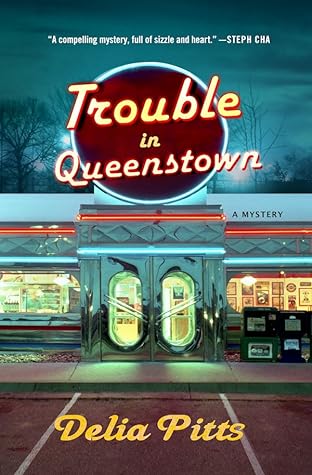
Trouble in Queenstown, by Delia Pitt***-****

Delia Pitts has been writing mysteries for quite some time, but she is new to me. In Trouble in Queenstown, she introduces hardboiled sleuth Evander Myrick. Myrick’s friends call her Vandy, and that helps to distinguish her from her elderly father for whom she is named; he’s in a memory care unit.

My thanks go to NetGalley, Macmillan Audio, and St. Martin’s Press for the review copies. This book is for sale now.

At first glance, I thought that this detective fiction was set in New Zealand. Queenstown, right? But in this case, the locale is Queenstown, New Jersey. The story opens with Vandy cleaning up a mess in her office just as Leo Hannah storms in and wants to see Evander Myrick. He assumes Myrick will be a Caucasian male, and that Myrick herself is a member of the cleaning staff.

Oops.

Hannah comes to hire Vandy in the wake of his wife’s murder. He knows exactly who did it, he tells her, and he wants her to prove it, starting with some surveillance. Vandy isn’t sure she should take this job, but she has to pay top dollar to keep her daddy in the best facility, so she reluctantly signs on. As the story progresses, there are numerous twists and turns, and the violence escalates. By the story’s end, three different people have tried to hire her for exactly the same case!

The thing I appreciate here is the way Pitts addresses cop racism. So many detective novels require the reader to suspend belief, to assume that every cop is fearlessly dedicated to finding out the unvarnished truth and arresting the perpetrator of the crime, regardless of race, ethnicity, or sexual orientation. But as Vandy conducts her investigation, Pitts keeps it real. At one point the detective speaks with a salon stylist that worked on Ivy’s hair, and he tells her that Ivy was afraid of someone at home. Vandy asks if he contacted the police.

“’The police?’ He jerked his neck, pursing his lips as if I’d farted. ‘Girl, you think the cops came here?’ He sniffed. ‘You don’t look like a fool. Maybe I read you wrong.’”

Sadly, the second half of the book doesn’t impress me as much as the first half does. I have a short list of tropes that I never want to see again in a mystery novel, and she trips a few, including my most hated one. I won’t go into details because it’s too far into the story, and I don’t want to spoil anything, but when it appears, I sit back, disengage from the text, and roll my eyes. Ohhh buh-ruther. As I continue reading, I can see who the murderer is well in advance, and the climax itself is a bit over the top, though without the tropes, I mightn’t have noticed this last issue.

In addition to the digital review copy, I have the audio. The reader does a fine job.

The more mysteries a person reads, the staler tropes become. I am perhaps more sensitive than most readers, having logged over a thousand novels in this genre. Readers that have not read many mysteries are less likely to be aware of, and therefore bothered by overused elements, and so this book may please you much more than it did me. But for hardened, crochety old readers such as myself, I recommend getting this book free or cheap, if you choose to read it. Newer readers may enjoy it enough to justify the sticker price.

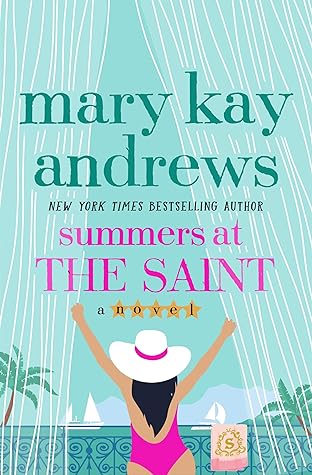
Summers at the Saint, by Mary Kay Andrews****

Summers at the Saint is the latest novel by veteran author Mary Kay Andrews. I am not usually a fan of what I think of as light and fluffy books, but over the last couple of years, I’ve developed an appreciation for this author’s work. This story centers on a fashionable beach resort hotel and those that run it, with the focus primarily on the women. It’s a good summer read—not a bad choice to take to the beach, actually. My thanks go to NetGalley, Macmillan Audio, and St. Martin’s Press for the invitation to read and review. This book will be available to the public May 7, 2024.

Our protagonist is Traci Eddings, the young widow of Hoke Eddings, heir to the Saint Cecilia resort. Traci has inherited part of the business from her late husband, but there is a power struggle in play as the book opens. The old man is dying, and the surviving heirs are scheming. The business seems to be on the rocks, or near to it, and Traci can’t figure out why. She makes several smart changes, hires good people, and yet…

We have interesting side characters. Parrish is Traci’s niece, whom she persuades to postpone her studies for one more summer as Traci implements the changes that are needed. We have the new cook, Felice, as well as Livvy, a capable young woman that Traci hires away from the diner where she is waiting tables; and we have Livvy’s mother Shannon, who used to be Traci’s best friend. Shannon completely dumped Traci many years ago, leaving Traci bewildered and hurt; she still feels that way. Lastly we have Whelan, who is working at the Saint as a pretext while he tries to unravel the circumstances that led to the death of his younger brother at the resort’s pool many years ago.

The book’s strongest aspect is the side characters, particularly Felice, Shannon and Livvy. Other characters are one dimensional, either entirely good or entirely awful. Rather, this is a plot based book. There are a great many moving parts, with a blend of genres that include romance, mystery, beach reads, women’s fiction, and contemporary family drama. It is in weaving the many pieces of this story that Andrews’s experience shines through. If there is a plot element that conflicts with another, or that is simply illogical, I didn’t spot it. At the end, everything and everyone is accounted for; in fact, I might have preferred not to have every single aspect resolved, and every positive character quite so perfectly happy. I seldom argue in favor of ambiguity, but in this case, it wouldn’t hurt.

I was fortunate enough to receive both the Kindle and audio versions, and once more, Kathleen McInerney does a fine job of narration with all of the women characters and the internal monologue. Her voice isn’t deep enough to voice the men’s characters well, and I suggest adding a second, male narrator next time around.

The story held my attention quite nicely as I did my morning bike ride, and I recommend it to Andrews’s loyal readers, and to those that enjoy a good beach read.

Darling Girls, by Sally Hepworth****

Sally Hepworth writes creepy, spooky stories involving families, and I have friends that swear by her, but this is the first of her books that I’ve read. My thanks go to Macmillan Audio, St. Martin’s Press, and NetGalley for the invitation to read and review. This book will be available to the public April 23, 2024.

Jessica, Norah and Alicia are closer than most sisters, even though they are not biologically related. All three spent most of their formative years at an Australian foster home called Wild Meadows, under the gimlet eye of Miss Fairchild, an abusive foster parent. Miss Fairchild was adept at keeping up appearances, but once a visitor—an infrequent occurrence—was gone, the place got dark. The woman was cruel and unpredictable, dreaming up horrifying punishments for even slight perceived infractions. Open rebellion was unthinkable. But it was when she began accepting babies that they resolved to turn her in.

Now all are grown, but they remain tightly bonded, and the call comes in: bones have been found under the foundation of the razed house. They must all report to the local police, which in turn means returning to the vicinity of Wild Meadows.

I can see why this author has such a loyal following. The way the narrative flows is flawless, and although we transition often from the past to the present as well as between the three girls’ stories, there’s never even momentary confusion. The list of characters is kept manageable, and all of them are believable. I begin reading via audiobook because that’s the version that was offered me, but once I began, I asked for and received the digital galley also. Usually this is a necessity in order to keep up with what I am hearing, but I scarcely needed it. Narrator Jessica Clarke provides the perfect listening experience.

For me, the joy of this well written novel is somewhat dampened by the horrors of the girls’ experiences. The child abuse is so cruel, and so specific that I sometimes stopped listening early and went away with a ball of lead in my gut. I suspect that this is something most likely to be experienced either by those that were themselves abused as children, or—like me—those that have worked with such children. Although part of me still wanted to know what came next, another part of my thought that if I wanted this kind of nightmare, I should just go back to work!

Reader, you probably know what you can read and what you should stay away from. If this sort of novel is unlikely to haunt you, go for it. I doubt there are many that can do this thing better. With that caveat, this book is recommended to those that enjoy the genre.

The Last Outlaws, by Tom Clavin***

Tom Clavin is the author of Blood and Treasure: Daniel Boone and the Fight for America’s First Frontier, which is one of the best nonfiction galleys I’ve ever had the pleasure of reading, and so when I saw his new book, The Last Outlaws: The Desperate Final Days of the Dalton Gang, I jumped at the chance. My thanks go to NetGalley and Macmillan Audio for the review copy. This book is for sale now.

Sadly, I didn’t find the same level of fascination this time around. Outlaws! The Dalton Gang! How could this not be absorbing? And yet.

It is possible that had I read it rather than listened to it, I might have thought better of it. The narrator speaks in a clipped voice that at times approaches a monotone. I recall having an older male relative fast-reading some sort of legal agreement out loud. He obviously didn’t want to read it but had been told he must read every word before signing, and so he rushed through it, out loud, without pausing between the sentences, just to get through it. This seemed a little like that, as if the voice actor was bored to tears and wanted to be done. There is a place about a quarter of the way in where both he and the narrative perked up some, and I thought, Ah, here we go.

But we didn’t.

On the plus side, Tom Clavin gets his information straight before he writes anything, ever, so whereas those looking for entertainment should look elsewhere, those that genuinely want the information should get this book, either digitally or as a bound copy, and read it. Those doing research for a history essay or the like could do a lot worse than this.

So there you have it. Clavin is a capable author, and I am not done with him, but this narrator and I are finished.

Gator Country, by Rebecca Renner***-****

3.5 stars, rounded upward.

Rebecca Renner is a journalist who has written for National Geographic and a host of other prestigious newspapers and magazines. Gator Country is her first book. Lucky me, I read it free and early. My thanks go to Macmillan Audio and Net Galley for the review copy. This book is for sale now.

Gator Country is the true story of wildlife officer Jeff Babouta and the sting that brought in a number of poachers and slowed the ravaging of the alligator population in the Florida Everglades. Babouta is coasting toward retirement when he is approached, and although he is reluctant, he is eventually convinced that he is the best qualified officer to carry out this assignment. To do it, he has to live away from his family for years, posing as a newbie gator farmer. This is a legal profession, but it’s also one that is rife with poachers. In order to bring the poachers in, he must first convince them to mentor him and befriend him in his farming operation. He spends years gaining their trust and learning from them, but then has to turn them in.

I thought hard about whether to read this book, because generally speaking, I don’t have warm feelings toward cops, and the past ten years have intensified that sentiment. But rangers and other wildlife cops are a bit more ambiguous; some of them do more good than harm. So it is with Babouta.

There are, Renner tells us, basically two types of poachers. Some are the small, independent people that she says are just trying to feed their families, and some are the large scale despoilers, those working on a large scale to provide gator parts to buyers from China, where they are prized for their medicinal properties and folk cures. Renner is sympathetic toward the former but not the latter.

In following Babouta’s story I pick up odd bits of knowledge. I have never been to the Everglades, nor do I plan to, and so had I not read this book, I would probably never have known that there are bottlenose dolphins there. Who knew? There are a number of such tidbits that I pick up along the way, and this is one of the best things about reading—or listening to—nonfiction.

That said, the audio becomes a complicated read for two reasons. One is that the narrative skips around a great deal. The main part is Babouta’s, but we also hear about Peg Brown, a legendary poacher whose name keeps coming up as Babouta converses with his new colleagues. I have no idea why I or any reader needs to know so much about the guy; from where I sit, Brown hasn’t earned his place in this book, but then it’s not my book. The story is needlessly complicated by Brown as well as a handful of other bits that are woven into the narrative, such as the journalist following along, and we would be better off without these.

The other issue with the audio is that when we shift the point of view, the person whose story we’re hearing has exactly the same voice as Babouta. Now and then I would have to pause and run it back, just to figure out who we’re talking about, or hearing from.

Even though the synopsis makes it crystal clear that the book is about wildlife poaching, rather than an alligator version of Jaws, I expected to hear of some close calls, some scary moments. But the scary moments are mostly about humans.

At the beginning, this book was such a snooze that in order to force myself to keep listening, I found other things to do with my hands. About a third of the way in, however, the story woke up, and after that I was mostly interested, apart from the occasional divergence of topic and point of view. For those that are sufficiently interested to want to read this book, I recommend that you either stick to the print version, or if you strongly favor the audio, get the print version to help you stay oriented and follow along. I would also try to get it free or cheap, unless you have an endless amount of cash to burn.

The Golden Gate, by Amy Chua****-*****

“If I told a jury that Japs killed Santa Claus, I could prove it beyond a reasonable doubt. Everything changes, Sullivan, once you’ve got a different color defendant in the box. There isn’t a jury in this state that wouldn’t send a Jap to the gas chamber if they had a chance.”

4.5 stars, rounded upward.

‘The Golden Gate marks the authorial debut for Amy Chua, a badass author whose stories will be read for a long, long time. My thanks go to Net Galley, Macmillan Audio, and St. Martin’s Press for the review copies. This book is for sale now.

Our story is set during two time periods, 1930 and 1944, in Berkeley, California. Detective Al Sullivan is investigating a murder whose roots are inextricably tangled with those of another, in 1930. Our point of view shifts often, both in time period and narrator. Most of it is told in the first person, either by Sullivan or by the elderly Genevieve Bainbridge, grandmother of the victim in the 1930 murder, now ready, in full Mama Bear protective mode, to do whatever she must to protect what family she has left.

The narrative has a strong noir flavor, and I halfway expect to find Humphrey Bogart around the corner, smoking and looking pensive. However, there is something Chua brings to the story that Bogart never did: a frank look at the injustices of the period, from the immense disparity of wealth among the denizens of Northern California, to the shameless victimization of people of color, who were much fewer in number in this part of the world then, than now.

I put this information up front, because in the early portion of the novel it isn’t obvious that the racism isn’t being highlighted, rather than propagated. I nearly discontinued reading this book because the “J” word is a hot button for me, and I initially believed that it was being used as a lazy way to depict the culture of Anglo Caucasians during this time period. I’ve seen it done many times, the use of the racial slur against Japanese because the author believed it increased the story’s authenticity. In Chua’s case, it’s the opposite.

The solution provided at the end relies overmuch on the journal of Mrs. Bainbridge, and in places, the details of the murder, and the motivation for same, are a stretch. For that reason, I initially rated this fine novel four stars. In the end, though, I realized that the social justice component more than makes up for it.

I was fortunate enough to have both the audio and digital galleys. Although the readers do a creditable job, the complexity of the story, including frequent changes of place, time period, and point of view, make for a confusing listening experience. For that reason I recommend the print version over the audio, unless both are available together.

Highly recommended.