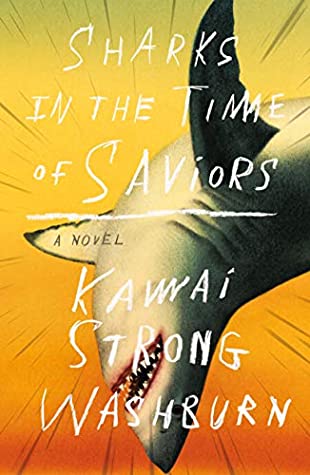
Sharks In the Time of Saviors, by Kawai Strong Washburn*****

A story like this one only comes along once in a rare while, luminous, intimate, and deeply affecting. My great thanks go to NetGalley and also Farrar, Strauss and Giroux for the review copy. This book is available to the public, and you should get it and read it.

Initially I was drawn to this book for several fairly superficial reasons. The cover is certainly arresting; the title is perplexing. But the biggest draw for me was that it was set in Hawaii, and all of the characters are native Hawaiians. In my corner of the world, the Pacific Northwest, there are a lot of Pacific Islanders. Why anyone would leave such an idyllic climate for the dark, soggy winters we see here used to be a mystery to me, but ultimately, people follow the jobs, and so many Seattle residents come from there.

As a history teacher, I’ve always felt that my students deserve to be included in the curriculum, and so in addition to teaching about Caucasians during whatever time period we’re examining, I work in African-Americans, Latinx, Native peoples, and a variety of Asian ethnicities, but time and again I hit a wall when I tried to find something for my Islander students. And when I’ve taught literature, it’s been the same struggle. Islander kids get shut out every time.  And so now I am retired, and here’s my appeal to other educators out there. Put this book in your classroom.

For the rest of you: apologies. Let’s get on with it.

As we open, the setting is Hawaii in 1995, and the protagonists are two parents and three children, all members of the Flores family. They’re on vacation when seven year old Noa falls into the ocean where sharks are circulating. But instead of devouring the boy, one of the sharks delivers him back to his family, carrying him gently in its jaws, “Like you were made of glass, like you were its child.” The first chapter is told in the second person, with Malia, the mother, recalling the event, speaking to Noa. She tells him, “The gods were hungry for change, and you were that change.” It’s obviously a miracle, and others see it happen also. Their lives will never be the same.

As the story continues, we hear from all of the family members. At first, Noa appears to be gifted with a magical healing ability, but he is still a child, and the demands on him are grueling, exhausting. But this is not the only change his magical abilities produce. Noa is the youngest child in the family, but now the siblings’ hierarchy is completely flipped, and the resentment felt by his brother and sister is dreadful. At one point Kaui, who is academically talented, fumes that she is “just his shadow, shaped like a sister.”  And his brother Dean, who is an athlete, explains:

You’re out at breakfast without him, eating cereal and joking with Mom and Dad, Kaui coming in, and you get them all laughing and smiling, just because of you. But then Noa shows up right, and suddenly it’s all questions about what’s happening with his day and did he sleep okay and here’s some thoughts about which extracurricular program he should enroll in…Hard not for get angry at that. I felt it like a fist flexing inside my own chest.

To make matters even more fraught, there’s an economic downturn that makes it impossible for the parents to support the family. They begin charging people that come to be healed by Noa, and so the youngest child is not only the golden favorite because of his miraculous ability; he’s also the family breadwinner. And again: it’s an awful lot to put on the shoulders of one small child.

The dialect combines with the authorial voice to create characters that I swear I would know if I ran into them, and in many ways, they remind me of the adolescents that I taught. Because I was so unconscionably late here, I checked out the audio version at Seattle Bibliocommons, and I have never heard an audiobook I loved more. The voice actors are so convincing that I can hear them now, more than a month and several other audiobooks, after I finished it.

For me, that would be enough. Create visceral enough characters and I don’t even care much about the plot. But the plot is also gobsmackingly brilliant! I believed I could track where it was headed up until perhaps the 60% mark, and then there’s one surprise turn, and another, and another, till at the end I was simply sitting with my mouth open and my eyes on the text as the audio gave way to the afterword and credits. I had to remind myself to breathe.

This is one of those rare galleys that I could see reading again just for the love of it. This review is my 923rd for NetGalley, and I have chosen to reread fewer than 10 of them, so let that indicate the measure of esteem in which I hold this novel.

The Book of Fire, by Christy Lefteri****

My thanks go to NetGalley and Random House Ballantine for the invitation to read and review. I found myself drawn to this novel because it’s different from everything else I have read. I’m fairly sure that I have never read a book set entirely in Greece; then there’s the fire, and the way that the forest interacts with the rural community living in and around it; many people have relied upon it, in one way or another, to make a living.  The Book of Fire is an interesting read, and it’s available to the public now.

Having said this, my first 25% or so of the story finds me with buyer’s remorse (or, reader’s remorse?) The thing is sorrow, grief, and more sorrow. I begin to think maybe I’ll abandon it, because eventually one disengages when there’s no hope of any kind for a brighter outcome. But just as these thoughts begin to crystalize, there is a subtle shift, and then the whole thing becomes more toothsome.

The story is told in alternating timeframes, with the current day being told to us in the first person, while the past is told as if it is a fairytale, and so in it, our protagonist, Irini, is referred to most of the time as “the mother,” her spouse is “the husband,” and their child is “the girl.” It took me a long time to figure out the protagonist’s name, but then there is dialogue, and that helps.

Initially, the protagonist confides to us what she has done. She found the arsonist in the burnt forest; he was on the ground beneath a tree with a rope around his neck. The branch above him is broken, so it’s either a botched lynching or a botched suicide, but not entirely botched, because he’s in bad shape. She begins to try to help him, but then she remembers what he has done, and she walks away from him. When she returns the next day, full of remorse, he’s dead. And so already we have this fact thrown in there along with the man’s own crime. We don’t know whether he did this or it was done to him until nearly the end.

In time more details emerge to muddy the waters of responsibility, so then she has a hundred little ethical questions to examine, and these are joined with a powerful environmental message. Because of this, I think this novel would be terrific for book clubs, and also for the high school classroom. There’s no sex in it, and the vocabulary is accessible. And despite my early fears, the entire book is not a portrait of grief and misery.

Recommended to those that enjoy literary fiction.

North Woods, by Daniel Mason*****

By now the word is out about this genre-bending novel. North Woods, by Daniel Mason, is nothing short of brilliant. My thanks go to NetGalley and Random House for the invitation to read and review; this book is available to the public now.

This book is all about the setting; there are some terrific characters, but don’t get too attached to any of them, because for the most part, they come and then leave. Rather, our story is about a cabin in the woods of upstate New York, and the acreage surrounding it, and how its use changes over the years.

We commence before the American Revolution, and so in the beginning, the narrative has the style of a very old diary, with antiquated spelling and language. This section is the reason I am so dreadfully late reading and reviewing this book. Honestly, the first fifteen percent or so is as dull as watching paint dry. I would begin reading it, but then my eyes would glaze over and I knew I had some other things to read by authors I knew and loved, and so I would switch books. But my Goodreads friends were raving about this book in unusually large numbers. Nobody didn’t like it. And so I summoned my self-discipline and went to it in a determined fashion, fortified by the audio version, which I received from Seattle Bibliocommons. This was very helpful. And once I got past that dry beginning, I began to understand why other readers were raving about it.

The first characters that are noteworthy are twin daughters named Alice and Mary, who are left to run the apple orchards on their own when their father goes off to war. He is a Loyalist, determined to save New England for his king. He doesn’t survive the war, which is just as well, because the locals hate him; he chose the wrong side to fight for. Neither daughter marries, and the property eventually goes to someone else.

The chain of owners is varied and, in many regards, absolutely hilarious. We see one new owner after another explore the house and the grounds, and of course, none of them has a full picture of the previous owner. I love the fact that I know more about this place than its most recent purchaser, and the assumptions that they make range from the merely incorrect to the disastrous. I cannot say too much more, although I particularly enjoy the character of George, whose phlegmatic, unattractive qualities are rendered uproarious in the audio version, and also the medium, a complete charlatan who’s horrified when she inadvertently awakens some actual supernatural beings. I would love to say more, but that would ruin it for you, and that would be a crime because surprise is an important part of the book’s success.

There is a formidable cast of actors that take on the reading for the audio book, and for those readers that are on the fence between audio and print, I recommend the audio version; better still, use both together.

After reading this one clever, memorable book, I will be watching to see what Daniel Mason writes next, because whatever it is, you know it will be good.

Highly recommended to those that enjoy historical fiction, literary fiction, humor, and horror.

Liberation Day, by George Saunders*****

Liberation Day is a collection of the best short stories you will ever encounter. I had never read George Saunders before, but when I received an invitation from Random House and Net Galley to read and review this book, I remembered him by reputation and jumped at the chance. This book is for sale now.

Sometimes I feel conflicted when I see words like “Booker prize winner” and “exquisite” I feel torn. The book may be brilliant, but it also may be a whole lot of work to read. I am happy to report that is not the case here. Every one of these nine stories could serve as the cornerstone of a collection; the title selection is first, but I suspect that is more about length than anything, as it approaches novella length. It’s science fiction but also vaguely political; a group of people have had their brains scrubbed to near emptiness, and they are mounted on a “speaking wall.” Their sole purpose is to provide entertainment as a sort of scripted Greek chorus. They may only speak upon command; they assume this is a good arrangement, because they have no memories of their prior lives. But then the home (and Speaking Wall) owners are visited by their adult son, who concocts a scheme to liberate the speakers.

Many of these stories have stylized prose and invented words that might be difficult for a reader whose first language isn’t English.  “Mother’s Day,” which is one of my favorites, begins:

“This distinguished-looking gentleman would appear at your door somewhat sloshed and ask, Were your trees slaggard? Were they gublagging behind the other trees? Did they need to be prodderated? And hold up the little device. In this way they had nearly lost the house.”

Happily, for underconfident readers, there is an audio version available. I used it part of the time because I was running behind. There’s a different narrator for each story; actor Tina Fey does one of them! My notes are full of praise for these performers, who make a brilliant book even more so.

I especially enjoyed “The Mom of Bold Action,” which features the ultimate unreliable narrator, and my absolute favorite, “Ghoul”. Imagine, if you will, landing in Hell, or its amusement park equivalent, but there are still rules of etiquette to be observed; in particular, you are expected to be positive, and constantly encourage the other ghouls as they commit the ultimate misdeeds assigned to them. I laughed so hard at this one that it made my family a little cranky, and I had to go off by myself to hear the rest. Worth it.

The stories are a mixed bag in terms of genre, and all are outstanding.

Highly recommended in whatever format makes your heart happy.

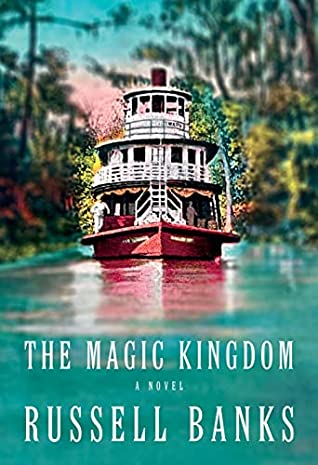
The Magic Kingdom, by Russell Banks*****

Some writers may fade as their bodies begin to fail them, publishing books that aren’t quite up to their usual standards; Russell Banks, on the other hand, seems to have saved one of his best for last. The Magic Kingdom tells the epic tale of Harley Mann, a boy that spends most of his boyhood on a Shaker plantation in Florida, and then becomes a real estate mogul later in life. My thanks go to Net Galley and Knopf Doubleday for the review copy. This book is for sale now.

Harley’s father dies when he is young, and his mother is forced to take him and his many siblings elsewhere. At first, they land in a religious cult on a plantation that works them like slaves; then Elder John, the head of a Shaker Colony in Florida, rescues them. Harley’s mother and most of his siblings become Shakers and remain with the colony until its eventual demise, but Harley has his doubts.

Nobody can craft character the way that Banks has, and he has melded a fascinating setting, one which begins over a hundred years in the past and follows Mann into his dotage in 1971, and which also incorporates a fair amount of Florida geography and history. Most of the story centers around Harley’s deep and abiding love with Sadie Pratt, a young woman being treated for tuberculosis in a nearby sanitarium. Sadie is not a Shaker, but is friend to them, and visits often when her health permits; Harley, just coming of age, falls for her hard. There’s a good deal of tension between Harley and Elder John, who despite all of his adherence to Shaker beliefs and practices on the surface, is also privately building himself a personal stake that only Harley knows about. By the time the book is over, I find myself wondering whether Harley’s character represents a real historical figure. No indeed; this is just the kind of magic that one finds in Banks’s novels, his capacity to build characters so real that they are nearly corporal.

The little shots off the bow that are fired at the Disney Corporation—by Harley, of course, and his representative after his demise, not by Banks—add a tinge of edgy amusement.

Because I had fallen a bit behind, I procured the audio version of this book from Seattle Bibliocommons, and so I can tell you that the narrator does a fine job, and it’s as easy to get lost in this story listening to it as it is reading it from the text; I did some of each.

This novel is brilliant, and all that love excellent literary fiction or historical fiction should get it and read it.

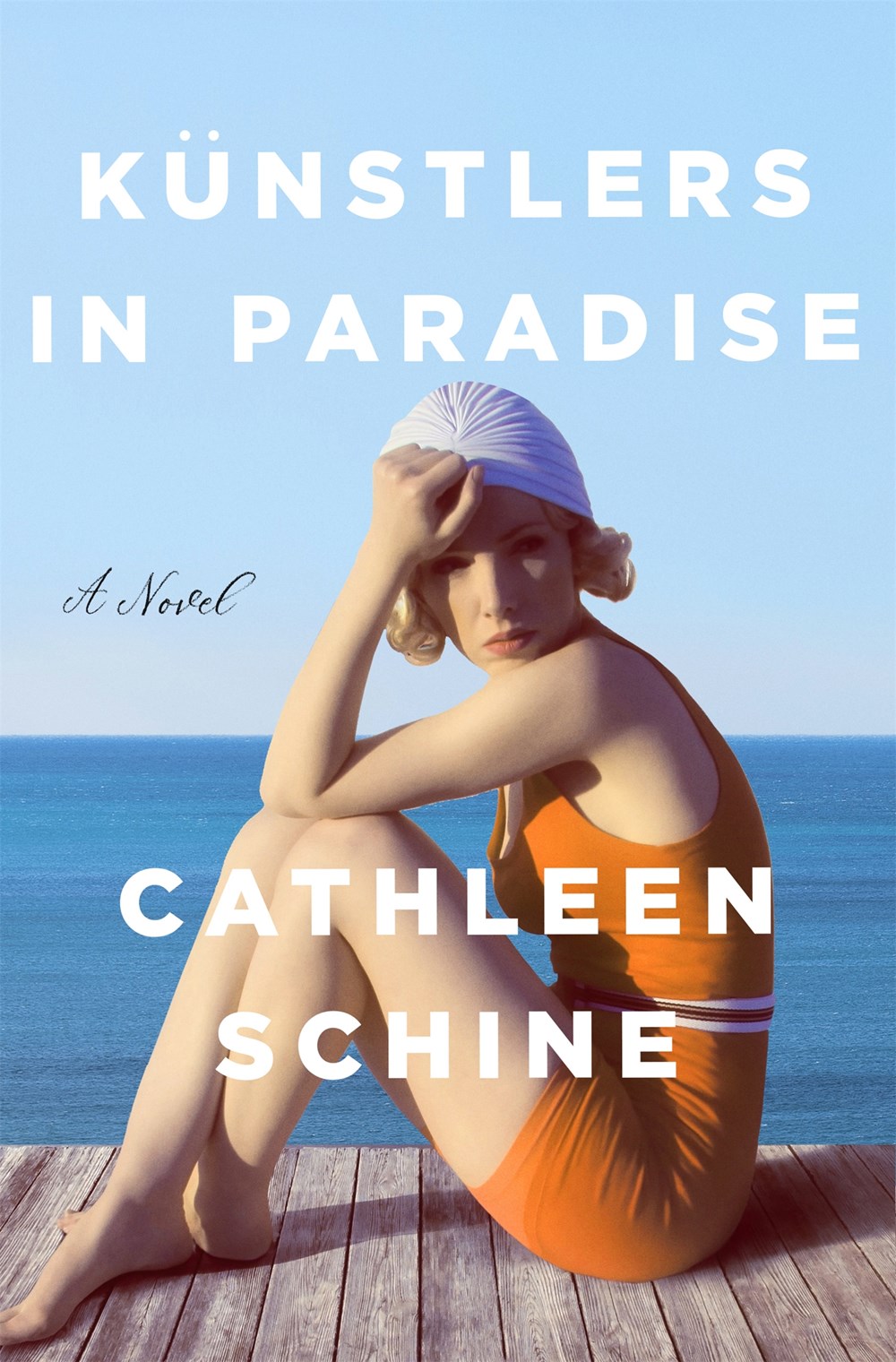
Kunstlers in Paradise*****

4.5 stars, rounded upward. My thanks go to Net Galley, Henry Holt Publishers, and Macmillan Audio for the review copies. This magnificently quirky novel is for sale now.

Julian Kunstler is kind of a mess. He’s a twenty-something New Yorker whose girlfriend has just dumped him. He has no job, and he doesn’t want one; at least, not the low-paying, entry-level variety of jobs for which he is qualified. He takes himself home to his parents who have been paying his way, confident that they will understand his plight and increase his allowance. Instead, he hits a wall. What are your plans for the future, Julian? (None.) What do you plan to do for money? (Get it from you.) Just as a dramatic situation has begun to unfold, they hear from his 93 year old grandmother, Mamie, who lives in Los Angeles. She wants him to come to stay with her awhile; she needs assistance. He’s not so sure that he wants to go, but when his parents insist, he gets on that plane. Once there, the pandemic strikes, and he is trapped in lockdown with his grandmother and her elderly companion, Agatha.

Mamie has always been fond of Julian, and although she does need a driver for doctor appointments and the like, what she wants, more than anything, is to tell her life story. Most of it, anyway. It begins in Austria, as Jewish artists like her father, a successful composer, are being pushed out of public life by the Nazis. (Here, I emit a small moan; I am heartily sick of Holocaust stories. Happily, we don’t stay there long, and this story is worth it.) She goes on to describe the shock she experiences in suddenly being transplanted into a completely different climate, language, and culture, and much of Mamie’s story is droll. And Julian, who never would have sat still for these tales had they come from his parents, listens. At first, he listens impatiently, assisted by Mamie’s generous liquor collection. As time goes on, he begins to listen with greater patience and understanding. And by the end of a year’s time, he listens with genuine interest. His own exile from New York is pale, after all, in comparison to the exile his predecessors endured.

The most dynamic character is, of course, Julian, but through Mamie’s stories, we see how life has already changed her. Agatha is enigmatic until the book is nearly over, and I love what Cline does with her, too.

If I were to change one thing, I would edit down the material about the genius composer friend that emigrates from Austria and is close to the family. This reviewer was a music major once upon a time, and if this part of the narrative is a bit much for me, then probably many others will feel the same. Of course, if the reader comes to the book with a deep interest in Schoenberg, then it may prove quite satisfying.

I am fortunate to have access to both the digital print galley and the audio version, and reader Jesse Vilinsky is hands down the funniest, most skillful voice actor I have ever had the pleasure to hear. Cline’s book is very good, but in the hands of Vilinsky, it is infinitely better. Her interpretations of Mamie and Julian are spot on, hilarious at times, moving at others. The way she voices Agatha is absolute comic genius!

For those that love quirky humor and historical fiction, this book is highly recommended.

Lucy by the Sea, by Elizabeth Strout*****

Lucy is a widow, and she misses her second husband, David, terribly. Her entire life, or most of it, anyway, has been marred by deprivation, cruelty, and tragedy. Then finally she meets and marries a lovely man, and they are happy together until death parts them. She thinks of him constantly. But now the pandemic has taken hold, and although she isn’t really paying attention, her first husband, William, is. William is single now, too, and he and Lucy see one another from time to time because of their two daughters, both grown now. And so in this, the fourth of the Lucy Barton books, William obtains the keys to a friend’s cabin, clear up on the coast of Maine, and he swoops in and takes Lucy away with him, away from the contagion. Just for a week or two, she figures.

My thanks go to Net Galley and Penguin Random House for the invitation to read and review. This book is for sale now.

I must confess that after reading the first two in the series, My Name is Lucy Barton and Anything is Possible, I decided to give it a rest. Strout is a literary genius, of that I have no doubt, but the stories she wrote were so grim, and her formidable authorial skill only made them sadder. I decided for my own good to walk away.

But then I was invited to read and review the third, Oh William, and early reviews suggested more joy and less wretchedness, and after I read it, I was glad I had done it. That holds true here as well, although, like Becka and Chrissy, Lucy and William’s daughters, I am a little concerned for her. But I’m getting ahead of myself.

William is more alert than Lucy, or perhaps, like so many, she has been in denial. “It’s odd how the mind does not take in anything until it can.” She is reluctant to go. A friend has died; what about the funeral? She shouldn’t miss that! The friend, however, has died of COVID19, and William tells her there won’t be a funeral. But then…what about her hair appointment? Her lunch date? Cancel them, he tells her.

The most delicious thing about the Lucy books is the depth with which Strout develops character. In fact, there’s almost no action taking place. The books are eighty or ninety percent character. So naturally, the reader that needs an intricate plot to be happy won’t find satisfaction here, but those of us—and I am one of them—that are happiest exploring rich, dynamic characters are in for a treat.

It’s a strangely nostalgic journey. So many of the attitudes and expectations that gripped us during the early days of the pandemic are in full flower in these pages, and though it’s only been a couple of years, it was such a unique period that I find myself nodding when one character or another says something that sounds exactly like me, or a family member, or a friend.

But back to Lucy and William. They were married for nearly twenty years before he ran off with someone else, and now they have been divorced for about the same length of time. When Lucy asks William why he invited her to go with him, he tells her that he wanted to save her life; but in fact, there’s more to it, and this becomes clearer as we progress. And as much as I want dear Lucy to be happy, I also want to remind her that a man that will up and leave after twenty years for no reason other than an infatuation with someone else, is unlikely to be trustworthy on an emotional level. Watch yourself, Lucy. It’s good that you’re out of the germ pool, but hang onto your heart.

As for me, I look forward to seeing how things develop; the ending leaves little doubt that there must be an Amgash #5.

Faithful readers will want to read this book; for newbies, you can read them out of order and they’ll make sense, but because Strout is building her character as we go, it’s better to read them in order if you can. And also for newbies: Lucy and William are both Caucasian Boomers, and so the most enthusiastic readers will probably come from this demographic. Highly recommended.

The Sorcerer of Pyongyang, by Marcel Theroux*****

“How did someone created by one reality begin to operate by the rules of another?”

The Sorcerer of Pyongyang is an excellent work of literary fiction by novelist Marcel Theroux. This is the first time I’ve read his work, but it will not be the last. My thanks go to Net Galley and Atria Books for the review copy; this book is for sale now.

I am drawn to this novel initially because of its setting. Nobody sets a book in North Korea! I am fascinated. Then I learn that the author is the son of Paul Theroux, the veteran travel journalist whose work, by chance, I have only just recently found and read. So there are two reasons for me to start this book, but once I begin, I realize that in the future, I will read whatever this author writes, regardless of where it’s set or who his relatives are.

The author’s notes indicate that Theroux has experience in North Korea, and this informs his work here. This book, remarkably enough, is based on a true story.

Our protagonist is Jun-su, a child growing up in poverty in rural North Korea. He and his parents believe the official explanation for the widespread poverty and malnutrition, which is that the blockade imposed by the United States and other Western nations has created the situation. Children in Jun-su’s class sometimes fall asleep at their desks, because they are starving. Part of the school day is also spent doing hard labor for the State. It doesn’t occur to Jun-su, or to anyone he knows, to question the misery imposed upon him, because it’s happening to everyone in the village, and they don’t go anywhere or see anyone outside it, so they assume the whole nation is suffering in the same manner.

Then comes the day when Jun-su falls ill with rheumatic fever. He misses a lot of school, and his teacher, Kang, visits him at home, bringing acupuncture needles to help with the pain. It is during this time that he is introduced to a game his teacher calls “The House of Possibility,” but which is actually Dungeons and Dragons. This game will be both a blessing and a curse to Jun-su for the rest of his life.

Because the illness permanently damages his heart, Jun-su cannot participate in labor with his classmates, and so instead, he becomes a poet, and he wins a contest and briefly meets the Dear Leader. He is sent to study at an elite institution far from home, and his eyes are opened in a number of ways. Soon he sees that not only is not every North Korean impoverished, but some live lives of unimaginable luxury. The corruption has been part of his entire life, but he can only just now see that.

Theroux does a fine job of developing Jun-su, but he does an even better one with setting. We can see what a hall of mirrors is involved in living in a Stalinist nation, where no civil liberties exist and unspoken, unwritten rules prevail alongside those that are codified. For example, the Dear Leader is so exalted that a person can be in big trouble if their home burns down and they don’t rescue his portrait (and that portrait WILL be hanging in the house,) and likewise, someone that sells hot food had better be sure there are no pictures of the Dear Leader in the newspaper he uses to wrap fish.

My one concern is that the story might degenerate into an anti-Communist diatribe, but that doesn’t happen. This is an outstanding novel, and I wholeheartedly recommend it to you.

The Deluge, by Stephen Markley**

Markley’s debut novel, Ohio, came out in 2018, and it was one of the year’s best that I promoted at the end of the year. I loved it so much that I was convinced that anything this author wrote would be golden. So when Simon and Schuster invited me to read and review his next book, The Deluge, I was delighted. But although I am grateful to the publisher and Net Galley for including me, I cannot bring myself to finish this thing. I suspect Markley may have bitten off more than he can chew, because it’s kind of a mess.

To be fair, I have only read the first twenty percent, but since the book is 900 pages in length, that’s a chunk.  After all of that, I can’t even keep the characters straight, let alone bond with them. One character, Kate, seems to hold the most promise, but just as I begin to develop interest, we transition to a different character—or news article, or whatever—in a manner that feels abrupt and jerky. Some of these characters appear more than once, and other may have, but I’m not even sure of it. There’s one horrifying rapist that speaks to the reader intimately and in the second person, and he gives me the heebie-jeebies so badly that I am glad to move on to someone else. That guy—whatever his name is—and Kate are the only two I can identify, sort of. I’m a language arts teacher. Good luck to everybody else.

I do understand that the overall message has to do with the environmental ruin that is marching toward us at an alarming pace. Markley isn’t wrong to sound the alarm, although it may in large part be a case of preaching to the choir; the most concerned among us are probably the most likely to read this book. At the same time, some of us have been following this horrifying debacle since the ‘70s, or the ‘80s, and when one is already virtually hyperventilating with alarm over this issue, reading this novel doesn’t do much good.

But more to the point, fiction is an excellent medium to promote an urgent political cause, but it’s only effective when the other story elements are outstanding. When the format doesn’t do justice to the characters or provide clarity to the reader, the effort is wasted.

I read other reviews saying that if one patiently reads the chaotic scramble at the beginning, eventually it will all come together and make sense, but honestly, if nothing makes sense two hundred pages in, then you can stick a fork in me, cause I’m done.

The Man Who Sold Air in the Holy Land***-****

The Man Who Sold Air in the Holy Land marks the debut of a talented writer. Omer Friedlander’s short story collection has already made reviewers sit up and take notice. My thanks go to Random House and Net Galley for the invitation to read and review. This collection is for sale now.

All of Friedlander’s stories are set in Israel, and all of them evoke their setting in a way that is fresh and immediate. My favorite stories are the title story; High Heels (except for the ending; more on that in a minute,) and Alte Sachen.

Here’s my issue with these stories, and it’s true of nearly all of them: the author uses endings that don’t feel like endings, leaving the reader to figure out for herself what happens. This is particularly painful when a story builds in a most suspenseful manner and then ends on a cliff hanger.

I don’t think so.

I understand that this is considered a valid choice in literary fiction, but I doubt it will ever become a popular one. When an author leaves the rarified world of literary journals and writers’ groups and opens his work up to a general readership, adjustments need to be made.

The sweetness of a well-built story that culminates in tremendous frustration when the end is left dangling finally got the better of me, and I didn’t read the last story.

Now you know; if you want it, go get it.