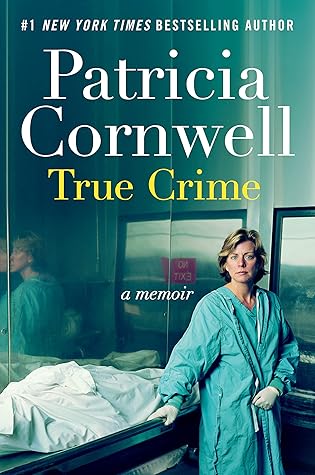
True Crime, by Patricia Cornwell*****

Legendary mystery writer Patricia Cornwell didn’t intend to write a memoir, but when someone decided to put her life’s story on television, she realized that if she didn’t write it, they’d make it up as they went. What began as a treatment for television writers to use as a guide morphed into a full-length book, and this is a perfect example of what an overachiever Cornwell has become.

My thanks go to NetGalley and Grand Central Publishing for the review copy. This book is for sale now.

Cornwell grew up in Miami, but moved with her mother to Montreat, North Carolina following her parents’ separation when she was five years old. It’s a miracle that anyone whose childhood was so riddled with trauma could grow up and pass for normal, let alone accomplish the things that she has done. First, her father had a breakdown, kidnapped her and her brothers, and then tried to hand them off—permanently—to his law partner. Her mother was a hot mess most of the time, and so there were periods when there was no food prepared, and she and her brothers made do by scrounging raw hamburger out of the freezer and eating it raw! Then there was the time her mom went into a fugue state and began systematically burning all of the children’s clothing—and there was no money to replace it with. Neglected children are often a lightning rod that attracts bad actors, and so the local security cop began molesting her—up until he was caught by her older brother, who put a stop to it. And the list goes on.

Nobody walks away from such experiences unscarred, but since Cornell—who was then Patsy Daniels—was a good kid, she internalized all of it, aided by a dreadful first grade teacher that told her that her constant talking in class was probably why her father had left! (As a teacher, this reviewer wants to find that person and have her license pulled, although she is probably gone from this earth by now.) Patsy gained control of her life—sort of—by developing eating disorders. She was hospitalized, but medical science actually didn’t know what to do about anorexia or bulimia, and after months in the institution with no improvement whatever, she gave up and went home. The problem vanished many years later when other aspects of her life changed.

Her love of writing and her feverish work ethic are what has made her such a success (along with great intelligence, though she doesn’t say as much.) She rode with cops and served as a volunteer in order to gain insights into that world; she went to Quantico and studied profiling; and of course, worked in the medical examiner’s office so that she could legitimately view autopsies, which are of course not open to the public. Anything she needed to learn, she found a way to do, leaving no stone unturned. She was aided and mentored by what seems to me an unlikely cast of friends and surrogate parents, including Senator Orin Hatch, Ruth and Billy Graham (mostly Ruth,) and President H.W. Bush.

The thing I appreciate about this memoir, apart from its outstanding prose and organization, is Cornwell’s willingness to disclose personal information. Sometimes, when someone is deeply private but finds herself writing a memoir anyway, she will stay on the surface and give up as little of herself as possible. Such memoirs are frustrating to read and for those that pay money for the privilege, a bit of a cheat. But once Cornwell decided to do this thing, she really did it right. And while, on the one hand, there’s a certain amount of namedropping and braggadocio, even that aspect of it is interesting; given everything she went through to arrive at the station she’s gained in life, one can hardly begrudge her.

For those that love her books, and also for those that simply enjoy a well written memoir, this book is highly recommended.

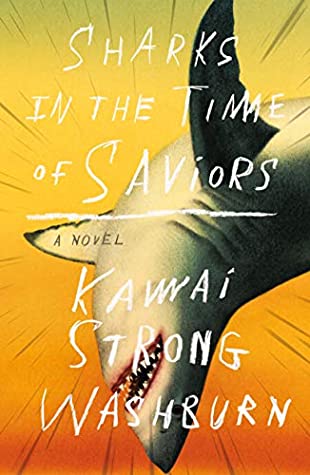
Sharks In the Time of Saviors, by Kawai Strong Washburn*****

A story like this one only comes along once in a rare while, luminous, intimate, and deeply affecting. My great thanks go to NetGalley and also Farrar, Strauss and Giroux for the review copy. This book is available to the public, and you should get it and read it.

Initially I was drawn to this book for several fairly superficial reasons. The cover is certainly arresting; the title is perplexing. But the biggest draw for me was that it was set in Hawaii, and all of the characters are native Hawaiians. In my corner of the world, the Pacific Northwest, there are a lot of Pacific Islanders. Why anyone would leave such an idyllic climate for the dark, soggy winters we see here used to be a mystery to me, but ultimately, people follow the jobs, and so many Seattle residents come from there.

As a history teacher, I’ve always felt that my students deserve to be included in the curriculum, and so in addition to teaching about Caucasians during whatever time period we’re examining, I work in African-Americans, Latinx, Native peoples, and a variety of Asian ethnicities, but time and again I hit a wall when I tried to find something for my Islander students. And when I’ve taught literature, it’s been the same struggle. Islander kids get shut out every time.  And so now I am retired, and here’s my appeal to other educators out there. Put this book in your classroom.

For the rest of you: apologies. Let’s get on with it.

As we open, the setting is Hawaii in 1995, and the protagonists are two parents and three children, all members of the Flores family. They’re on vacation when seven year old Noa falls into the ocean where sharks are circulating. But instead of devouring the boy, one of the sharks delivers him back to his family, carrying him gently in its jaws, “Like you were made of glass, like you were its child.” The first chapter is told in the second person, with Malia, the mother, recalling the event, speaking to Noa. She tells him, “The gods were hungry for change, and you were that change.” It’s obviously a miracle, and others see it happen also. Their lives will never be the same.

As the story continues, we hear from all of the family members. At first, Noa appears to be gifted with a magical healing ability, but he is still a child, and the demands on him are grueling, exhausting. But this is not the only change his magical abilities produce. Noa is the youngest child in the family, but now the siblings’ hierarchy is completely flipped, and the resentment felt by his brother and sister is dreadful. At one point Kaui, who is academically talented, fumes that she is “just his shadow, shaped like a sister.”  And his brother Dean, who is an athlete, explains:

You’re out at breakfast without him, eating cereal and joking with Mom and Dad, Kaui coming in, and you get them all laughing and smiling, just because of you. But then Noa shows up right, and suddenly it’s all questions about what’s happening with his day and did he sleep okay and here’s some thoughts about which extracurricular program he should enroll in…Hard not for get angry at that. I felt it like a fist flexing inside my own chest.

To make matters even more fraught, there’s an economic downturn that makes it impossible for the parents to support the family. They begin charging people that come to be healed by Noa, and so the youngest child is not only the golden favorite because of his miraculous ability; he’s also the family breadwinner. And again: it’s an awful lot to put on the shoulders of one small child.

The dialect combines with the authorial voice to create characters that I swear I would know if I ran into them, and in many ways, they remind me of the adolescents that I taught. Because I was so unconscionably late here, I checked out the audio version at Seattle Bibliocommons, and I have never heard an audiobook I loved more. The voice actors are so convincing that I can hear them now, more than a month and several other audiobooks, after I finished it.

For me, that would be enough. Create visceral enough characters and I don’t even care much about the plot. But the plot is also gobsmackingly brilliant! I believed I could track where it was headed up until perhaps the 60% mark, and then there’s one surprise turn, and another, and another, till at the end I was simply sitting with my mouth open and my eyes on the text as the audio gave way to the afterword and credits. I had to remind myself to breathe.

This is one of those rare galleys that I could see reading again just for the love of it. This review is my 923rd for NetGalley, and I have chosen to reread fewer than 10 of them, so let that indicate the measure of esteem in which I hold this novel.