The Children of Eve, by John Connolly*****

If Stephen King and James Lee Burke had a baby—an unnatural one, of course—it would probably look a lot like John Connolly. Connolly has a genius for creating tales that take place on Earth, and are in most regards realistic, while adding elements of the supernatural that go well beyond magical realism. There’s the mystery, and there’s the horror, and if we’re reading a Charlie Parker mystery, we cannot have one without the other, nor should we.

My tremendous thanks go to NetGalley and Atria Books for the review copy of The Children of Eve, the 22nd Charlie Parker mystery. This book is for sale now.

The story commences when Charlie is contracted to find and protect a man named Wyatt Riggins, who has disappeared. Riggins has thrown in his lot with some baddies, and may have bitten off more than he can chew. As Charlie—and we—pursue Riggins, we learn of some seriously nasty skullduggery that’s afoot involving international art thieves. Added to the mix are four missing children, believed to have been kidnapped. There’s not a single slow moment as Charlie tracks Riggins, and we see, through the third person omnipotent, the manner in which these thieves have fallen out, and the trail of bodies that are left in their wake. This is grisly business, and not for the squeamish, although I will say that some horror and hardcore detective novels do go places that I can’t, but Parker novels always manage to stay just inside my own boundaries.

Recurring characters Angel and Louis, perennial favorites, return briefly. At one point, Parker has been roughed up and is in the hospital. Angel and Louis have been listed as his next of kin, and they seem unlikely nurturers. While guarding Parker’s room, for instance, Louis amuses himself by making those that pass by him nervous. And when he is discharged on the condition that he not be alone for the next 24 hours, Angel and Louis make the doctor uneasy as well. She asks Parker whether he has “any other friends? Any at all?” I would have loved to see more of these two, but perhaps Connolly is keeping them in the shadows, lest they grow stale. That’s hard to imagine, but no other reason makes sense. I also enjoyed the brief glimpse of the Fulci Brothers, hired (but not brilliant) muscle men that resemble “bears in green leisure suits.”

Perhaps the most disquieting aspect of this novel—scratch that, not “perhaps”—is the development of Connolly’s dead daughter, Jennifer, who has come to him periodically and watches over him. I won’t say anymore about that, but I finished this book 2 days ago, have been reading several other books, and yet I can’t get Jennifer out of my head. For those that love gritty detective novels, and for those that are drawn to things that go bump in the night, this book, and this series is strongly recommended.

The Great Divide, by Cristina Henriquez*****

I found The Great Divide, by Cristina Henriquez, on a short list of most anticipated novels of 2024. I don’t like to get shut out when a book gets this much buzz; then there’s the added draw of an unusual setting. The U.S. doesn’t see a lot of fiction published that’s set primarily in Panama during the early 1900s, and so that sealed it. My thanks go to NetGalley and Harper Collins for the review copies, both audio and digital. This story lives up to the hype, and I recommend it to you.

I am not so sure about it at the outset. There is a robust quantity of characters that are important to the story, and each of them is given a brief chapter all to themselves. I wonder whether they will ever intersect, or if this will turn out to be a collection of short stories, but before much longer, characters are meeting other characters. They don’t all end up together in the end, but we can see the ties that have formed. There are a lot of people to keep track of, and for me, having both the print version and the audio is tremendously helpful. Robin Miles narrates in a way that is natural and fluid, and I don’t notice much of what is around me when I listen to her. But once in awhile a character is mentioned and I draw a blank; here is where the Kindle version is essential, because I highlight the names of each of the characters, and this enables me to instantly flip back to where they were introduced to us without having to stop listening. Eventually, of course, I no longer need to do so, but knowing that I can makes for stress-free reading.

I am engaged with these characters, each of whom feels real to me, and I groan when I see them get into trouble, and sigh with relief once they are in the clear again. The ones that I care about most are a father and son that are estranged from each other, neither wanting to stay that way, yet both of them incorrectly interpreting the silence of the other. As we reach the climax, I can tell there are three ways for this situation to resolve: they can reconcile; one of them can die; or the son can decide to follow another character back to the U.S.A. without reconnecting with his dad.  It only now occurs to me that there was a fourth possibility, which was to leave them still estranged at the end; but by this time, Henriquez had shown herself to be a better writer than that, and while I won’t tell you how they wound up, I will say that she didn’t leave her readers dangling.

Because this is an intricately woven tale with a lot of equally important characters, I’m not including any quotes, but I will say that Henriquez is a talented writer, and anyone that loves good historical fiction should get this book and read it. This applies even more so to those interested in Latin American history and the building of the canal. I hadn’t read her work before, but she’s on my radar now, and I look forward to seeing what she writes next.

Those We Thought We Knew, by David Joy*****

David Joy is a brilliant writer. His stories, set in the Carolina mountains that he calls home are resonant, visceral, and always about believable characters that hail from the hardscrabble working class. Those We Thought We Knew is his best. My thanks go to Net Galley and Putnam Penguin for the review copy. This book is for sale now.
Sylva, North Carolina is the sort of insular, homespun community that you don’t see much of anymore. Everybody knows everybody, not only by name but by family, religion, and a host of salient details that form their backstories. There’s not a lot of traffic in or out of Sylva, nestled as it is in a hollow of the mountains. Now, however, two newcomers have arrived, but they aren’t together. Surely not. One is a lowlife vagrant, a pencil-necked, mullet-headed, greasy drunk in an ’84 Caprice named William Dean Cawthorne. When the sheriff’s deputies roust him, one of them finds a small notebook that contains some surprising names; he also has a long, white robe in the car, and with it, a conical white head covering with eyeholes in it. Mr. Cawthorne, you see, is a recruiter for the Klan.

Toya Gardner comes to town at about the same time to visit her grandmother and work on her thesis. She’s a graduate student from Atlanta; she creates meaningful African-American sculptures and other art works. But when she finds the statue of the Confederate soldier in the town square, she is inspired to make a different artistic statement than she’d originally planned, and when she does, all hell breaks loose.

This searing story sees two terrible crimes unfold in sleepy little Sylva. The dynamics that exist between the county sheriff, the Sylva police force, and the local citizenry—particularly Toya’s family—are rich and complex, and they showcase Joy’s best character development to date. In the end, we must concede that alongside the horrors represented by overt white supremacists, the more chilling may be that which simmers below the surface of men and women that, yes, We Thought We Knew.

This is brave writing. Joy will no doubt be the subject of some unfriendly attention because of it. My hope is that it draws the accolades that it deserves from those that seek true social justice, and that it will inspire useful, critical introspection and conversation on the part of its readers.

Highly recommended.

Swamp Story, by Dave Barry*****

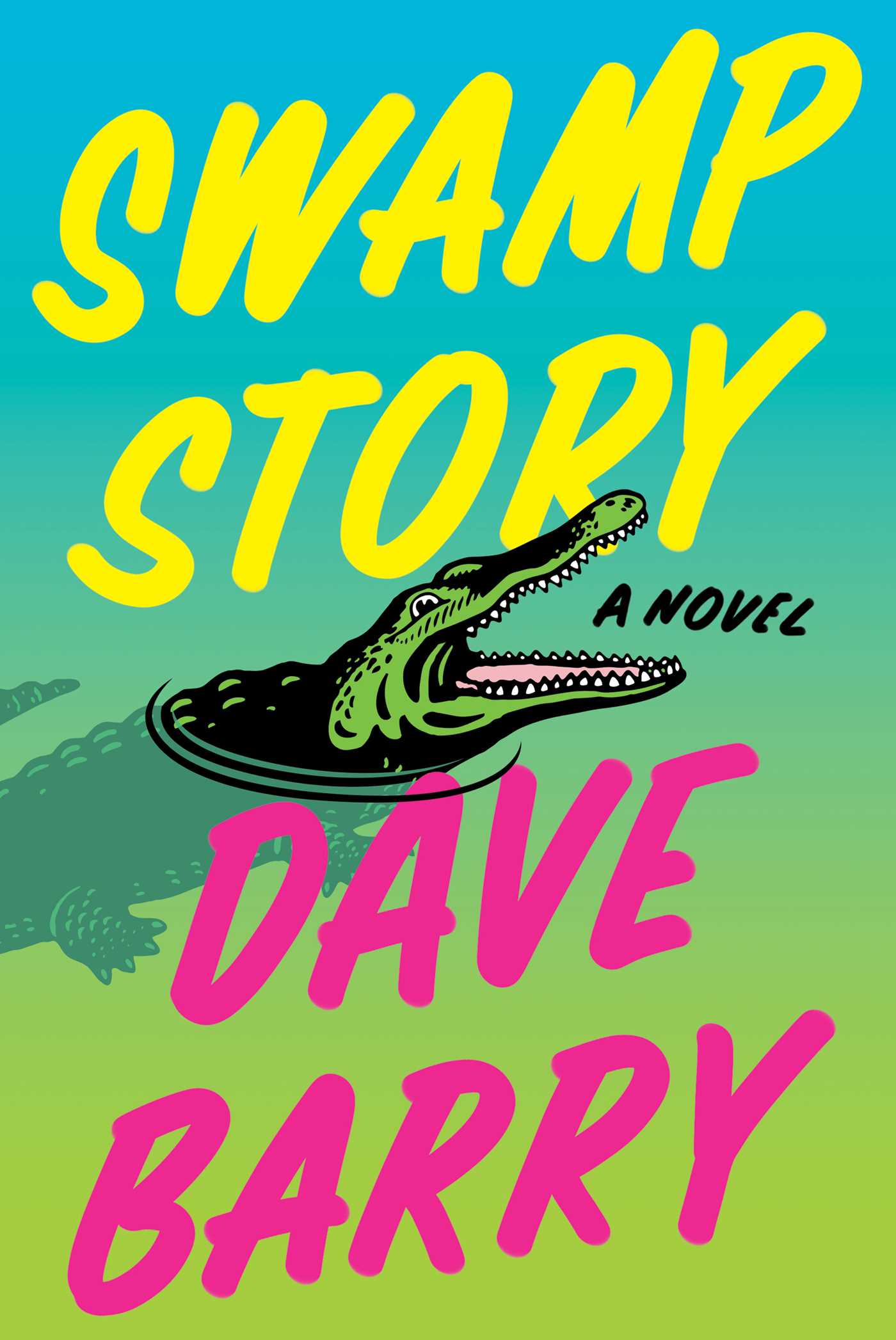
Dave Barry’s new novel, Swamp Story, should come with a warning label: Danger. Do not read in area where explosive laughter is not permitted. Fans of Barry’s will be pleased to hear that this is possibly the best thing he’s ever written. Readers new to Barry will want to read more. This book will be available to the public May 2, 2023.

My thanks go to Net Galley and Simon and Schuster for the invitation to read and review.

Our protagonist is Jesse, a lovely person that has made a huge mistake. She feel hard for Slater, a young man with a smokin’ hot body, a limited brain, and a solipsistic world view. Now she’s stuck in a cabin in the Everglades with him and his camera wielding buddy Kark, and oh yes—their baby, Willa; not to mention all of the flora and fauna that live here:

“Kark! You need to get this!”

“What?” said a voice, as hoarse as Slater’s, maybe hoarser.

“Big fucking snake,” said Slater. “I mean big.”

The snake slid forward another two feet, directly toward Jesse and Willa. Jesse saw that she now no longer had the option of even trying to run past it.

“Slater!” she said, trying to keep the panic out of her voice, not wanting Willa to pick up on it.

Slater held up his hands in a Calm down gesture.

“It’s cool,” he said. “This’ll be good. Good footage.”

“Good footage?” said Jesse. “Are you—”

“Goddammit, Kark,” yelled Slater, “get the camera out here!”

“OKOKOK,” said Kark, emerging from the cabin, holding the video camera. ” Fuck. The battery’s dead.”

Things appear to improve for Jesse when she stumbles across a cache of gold bars hidden in the glades, but this proves to be a mixed blessing, as some truly bad men learn of her good fortune and seek to take it from her, using any means necessary. However, the first such men, Billy and Duck, are not only evil, but also hilariously bumbling at times. And then, of course, there are the others.

Meanwhile, the owner of Bartle Brothers Bait and Beer decides to give his languishing business a shot in the arm by manufacturing an internet hoax. The Everglades Melon Monster is a sketchy, low budget creation whose star is an inebriated fellow wearing a Dora the Explorer head, and yet, somehow it works. Now it seems that everyone is descending on the Everglades, and almost every person that arrives is “batshit crazy.”

I’m not telling you how this thing ends; you’ll need the book for that. Don’t wait for the movie. You can thank me later!  As for me, I’m off to order a Bartle Brothers Bait and Beer tee shirt.

Damn Lucky, by Kevin Maurer****

John “Lucky” Luckadoo was a bomber pilot in World War II in the most dangerous period of the European theater, and he survived twenty-five bombing runs, which was unusual. This is his story, told to us by the skilled wordsmith Kevin Maurer, and narrated by Holter Graham and Luckadoo himself. My thanks go to Net Galley, St. Martin’s Press, and Macmillan audio for the invitation to read and review.

The first portion of the narrative tells about Lucky’s early years, as well as his yearning to learn to fly. I feel a bit impatient as I read this segment, because I’m dying, like Lucky, to go to war. However, some of what I think is extraneous material proves to be important later on, so I’m glad not to have skipped anything.

A quarter of the way into the story, and we’re off. I am impressed by the descriptions, which are brief and unmistakably clear, written for general audiences of today. An example is when he tells us that a Quonset hut looks like a tin can that has been split lengthwise, then put on the ground, cut side down. Everything, from the planes, to the target, to the flying conditions is easily understood without talking down to the reader. The chapters are a good length, and the dialogue crackles. But now, we have to talk about that.

When anyone writes military history, whether it’s a biography, a memoir, a reference book, or any other nonfiction work, there must be citations for the facts and especially for quotations and dialogue. (I am proud of myself for not using twelve exclamation marks here; if there were an audio version of this review, I would be shrieking, so it’s just as well that we’ve stuck to print.) The author provides a bibliography at the end, and it. Is. Not. Enough. No, no, no! This is why so many writers in this field use historical fiction as a vehicle; the very best historical fiction communicates the same material, but is not bound to document facts. A bibliography alone would be just dandy for a work of historical fiction…which this is not. In fact, (said the American history and government teacher,) the four star rating is evidence of my appreciation for the clarity, organization, and pacing of this story; ordinarily I would go no higher than three stars for anyone in violation of this clear requirement. (Where was the editor?)

Moving on. The pace in the middle segment is brisk, but I have no problem putting it down and walking away when I am interrupted in my reading. That all changes at the sixty-sixth percentile, when the B-17 pilots and crews are sent on a mission to bomb Bremen. This is a huge mission, and a very dangerous one, as they are trying to bomb the canal where German U-boats are housed in broad daylight. At the same time, Goering is done watching his pilots get pounded, and he orders them to fight to the last man, and those that will not will be transferred to the infantry (note here that the German infantry is starving and freezing; pilots are much better fed.) Consequently, their aggression in the air is unprecedented, with kamikaze-like maneuvers that none of the Allies have seen from Germany up till now. During the portion of the book, I would not have left this story unless my house was on fire.

The callous decisions by higher-ups as to what an acceptable attrition level looks like, with about sixteen percent of active American airmen making it home alive after their service is done, is horrifying.

I have read a number of biographies and other historical works regarding this topic, but nevertheless, I learned some new information. I recommend this book to readers that are interested, but not to researchers or students.

Although the narrators do a perfectly fine job, I realize early that I cannot keep up with this level of detail without seeing the words, so I jettison the audio version and stick to the digital review copy. I recommend the audio version for those quirky souls that understand and retain spoken information better than print.