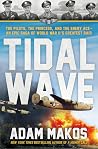
Tidal Wave, by Adam Makos*****

“You can handle more than you think you can.”

Adam Makos is the author of Spearhead, which is one of the most engaging, well researched and written, readable military history books I’ve ever read. It came out in 2019, and I’ve been watching for his next book ever since. It’s here! Tidal Wave is the sort of story that, if it were published as historical fiction, would be panned by many as simply unbelievable. Where’s the credibility? But it did happen, and this is not fiction.

My thanks go to NetGalley and Ballantine Books for the review copy. This book will be available to the public November 3, 2026.

We start with an elite group of pilots from the U.S. Air Force. It’s the autumn of 1943, and the boys—and back then, they were all boys and young men—have been sent to North Africa on a top secret mission. They are to fly nonstop to Romania, which is an Axis nation, also known as “Hitler’s Gas Station” for its large-scale oil refineries, and they are to bomb the living hell out of those refineries in broad daylight at low altitude, to avoid radar detection and diminish civilian casualties. It’s massively dangerous; some might call it a suicide mission. But if successful, it will deal a massive blow to the Nazi war machine.

“If not one bomber returns tomorrow, but that target is wiped out, the mission will still be a success.”

Meanwhile, Romanians are chafing under Nazi rule. Nobody there volunteered for this; the Nazis came in and announced they were taking all the oil, and they would pay for it at below market prices. The Nazis were tolerated because they promised to return territory that was usurped by the Soviet Union at the conclusion of World War I.

Add to this story a royal family that determines to covertly help the American pilots that have been shot down over their country, and for good measure, sprinkle it with local orphans, and you have—in author Makos’s capable hands—one hell of a war story. The captured pilots make a break for it, and their struggle, along with the danger they face, makes this story a nail-biter even though we know how it’s going to turn out, at least in large measure.

Those that sigh and sit back after seeing the genre—military history—should know that this reads like narrative nonfiction. I was reading a couple of pretty good novels alternately with this one, but this is the one that kept me awake late at night, because I had to know who made it and who did not. Add into this the twist at the end regarding the Romanian princess and the enemy pilot, and you have a matchless story.

Highly recommended to all.

Damn Lucky, by Kevin Maurer****

John “Lucky” Luckadoo was a bomber pilot in World War II in the most dangerous period of the European theater, and he survived twenty-five bombing runs, which was unusual. This is his story, told to us by the skilled wordsmith Kevin Maurer, and narrated by Holter Graham and Luckadoo himself. My thanks go to Net Galley, St. Martin’s Press, and Macmillan audio for the invitation to read and review.

The first portion of the narrative tells about Lucky’s early years, as well as his yearning to learn to fly. I feel a bit impatient as I read this segment, because I’m dying, like Lucky, to go to war. However, some of what I think is extraneous material proves to be important later on, so I’m glad not to have skipped anything.

A quarter of the way into the story, and we’re off. I am impressed by the descriptions, which are brief and unmistakably clear, written for general audiences of today. An example is when he tells us that a Quonset hut looks like a tin can that has been split lengthwise, then put on the ground, cut side down. Everything, from the planes, to the target, to the flying conditions is easily understood without talking down to the reader. The chapters are a good length, and the dialogue crackles. But now, we have to talk about that.

When anyone writes military history, whether it’s a biography, a memoir, a reference book, or any other nonfiction work, there must be citations for the facts and especially for quotations and dialogue. (I am proud of myself for not using twelve exclamation marks here; if there were an audio version of this review, I would be shrieking, so it’s just as well that we’ve stuck to print.) The author provides a bibliography at the end, and it. Is. Not. Enough. No, no, no! This is why so many writers in this field use historical fiction as a vehicle; the very best historical fiction communicates the same material, but is not bound to document facts. A bibliography alone would be just dandy for a work of historical fiction…which this is not. In fact, (said the American history and government teacher,) the four star rating is evidence of my appreciation for the clarity, organization, and pacing of this story; ordinarily I would go no higher than three stars for anyone in violation of this clear requirement. (Where was the editor?)

Moving on. The pace in the middle segment is brisk, but I have no problem putting it down and walking away when I am interrupted in my reading. That all changes at the sixty-sixth percentile, when the B-17 pilots and crews are sent on a mission to bomb Bremen. This is a huge mission, and a very dangerous one, as they are trying to bomb the canal where German U-boats are housed in broad daylight. At the same time, Goering is done watching his pilots get pounded, and he orders them to fight to the last man, and those that will not will be transferred to the infantry (note here that the German infantry is starving and freezing; pilots are much better fed.) Consequently, their aggression in the air is unprecedented, with kamikaze-like maneuvers that none of the Allies have seen from Germany up till now. During the portion of the book, I would not have left this story unless my house was on fire.

The callous decisions by higher-ups as to what an acceptable attrition level looks like, with about sixteen percent of active American airmen making it home alive after their service is done, is horrifying.

I have read a number of biographies and other historical works regarding this topic, but nevertheless, I learned some new information. I recommend this book to readers that are interested, but not to researchers or students.

Although the narrators do a perfectly fine job, I realize early that I cannot keep up with this level of detail without seeing the words, so I jettison the audio version and stick to the digital review copy. I recommend the audio version for those quirky souls that understand and retain spoken information better than print.