The Butler’s Child: An Autobiography, by Lewis M. Steel****

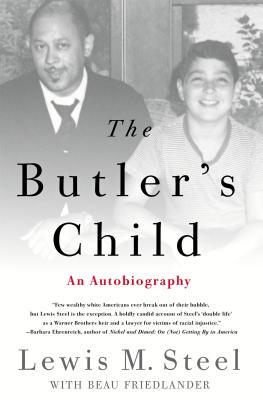
thebutlerschildLewis M. Steel has a long, noteworthy career as a civil rights attorney.  He was an observer during the Attica Prison riots; worked for the NAACP during the Civil Rights movement, and later defended boxer Hurricane Carter against a frame-up charge of murder. And I was permitted to read this story free and in advance, thanks to Net Galley and St. Martin’s Press in exchange for this honest review. I rate it 3.5 stars and round upwards; it is now available to the public.

When I first approached this title I expected to see what the life of a butler’s son was like. In fact, Steel’s social class is at the other end of the spectrum. An heir to the Warner Brothers fortune, he spent much of his time in the company of the family butler, and he was deeply affected by the emotional distance that this family servant, whom he had innocently regarded as a father figure, began to demonstrate as Steel grew older. Later, as an adult, he realized that this faithful retainer, an African-American man, surely had a family and life of his own that he went to visit on his two half-days off work, and he began to wonder what he might do to tear down the wall between the worlds of Caucasian families and Black folk. Ultimately he decided to become a civil rights attorney, and he credits the man that helped raise him as a key reason.

The NAACP of the Civil Rights era—the National Association for the Advancement of Colored People– was deeply immersed in litigation as a means to end segregation. Again and again, racist judges sat in court, north and south alike, and they told the NAACP to go to hell even when their evidence and research was baldly, plainly in the plaintiff’s favor. The NAACP continued to push litigation over mass action because of a strong conviction that if they could get a case heard by the Supreme Court, relatively liberal in many regards and headed by Chief Justice Warren, then surely justice would be done.

It didn’t shake out that way. Outraged over the way the nation’s highest court failed to provide equal protection to its Black citizens, Steel wrote an article for Time Magazine titled “Nine Men in Black Who Think White”, and was summarily fired from the NAACP, who still wanted to curry favor with that court. Many of his colleagues walked out of the NAACP offices in protest.

A common question among Caucasians that want to fight for the rights of people of color in the USA is what can we do?  How can one use this white privilege that exists whether it should or not, to change US laws and society for the better? And this question is raised exponentially when one is an heir, a ruling class scion that can do a tremendous amount for the cause in which he believes.

This reviewer has a friend that found himself in this situation. The distant but only heir of a corset magnate’s fortune, he decided that the best way to seek justice was to walk his talk. Reserving a small percentage of the fortune for himself—which is still a tasty enough chunk to own a middle class home in Seattle, take a vacation abroad annually, and eat in restaurants instead of his own kitchen—he donated the vast majority of his personal wealth to the organization he thought best. He doesn’t live in an all white neighborhood; doesn’t have a household staff; and he does blue collar work on the railroad so that he can talk politics with other working people. Because to help people the most, one needs to be among them and facing similar circumstances to those they face. So he gets up at crazy o’clock in the morning, goes out and gets greasy and banged up with everybody else, and then he goes home and cleans his own house and mows his own grass. He gets that more people listen when you put your life where your mouth is, and he believes the future of the world lies with the working class.

So when Steel commences his hand wringing over how wealthy, how privileged he is and how bad he feels about it, I want to say, Cry me a river. Steel freely admits that he enjoys his lovely home that looks down on Central Park and allows him a lovely view of the Macy’s Parade every Thanksgiving. He enjoys the servants, and his neighborhood is all white. He sent his children to all white private schools even as he fought to integrate the public schools that he wouldn’t let his own children attend in any case.

At one point, Steel mentions that his therapist told him to stop whining, and I wanted that doctor here in the room so I could offer him a high five.

Now that I have addressed the elephant in the room, I have to say that Steel’s memoir, despite the wealthy liberal whining, is worth a read for those interested in Civil Rights history and in particular the part of it that has played out in the courtrooms. You don’t have to like the author to benefit from the treasure trove of information in the pages of this memoir. Steel has been involved in some landmark cases, and he is at his best when he talks about the cases he has taken and how they shook out.

Black lives DO matter, and those of  us that think so need all the information available to fight that fight, and there are many worthwhile lessons that still apply right here, this book is worth your time and money regardless of whose memoir it is.

This book was released earlier this month, and is available for sale now.

Fragments of Isabella: A Memoir of Auschwitz, by Isabella Leitner****

fragmentsofisabellaIsabella Leitner was a Holocaust survivor, and she scribed her memoir using brief entries similar to a diary in format. The length is just 120 pages, about the size of a novella. I was asked to read and review this memoir free of charge before it was released digitally. Thanks go to Net Galley and Open Road Integrated Media for the invitation. This title was just released, so it is available now for purchase.

I confess I struggle with Holocaust memoirs these days. Part of me has decided not to read any more of them. I am out of the classroom, so my ability to educate young people of today about the horrors of the past is nearly at a standstill, apart from the knowledge I pass on to my grandchildren. Reading another Holocaust memoir isn’t going to make the ending any better; it’s always going to be horrifying, and heaven help me if I should become so accustomed to reading about the Holocaust that it doesn’t affect me that way anymore.

So though I swear off Holocaust memoirs from time to time (and am doing so right now, again), when a particular memoir is offered, frequently there is some aspect of this one that sets it apart from the crowd, and so it is with Isabella’s memories. Not many survivors managed to get out with family members at their side; Isabella and her sisters were unusually clever and imaginative in finding ways to survive. This along with the invitation induced me to roll up my sleeves and revisit this calamitous part of history once more.

When the notorious Mengele motioned with his deadly white glove to send Isabella and one of her sisters to the extermination side, they found a way to creep back around and intermingle with the side selected to be kept alive as workers. At one point they escaped and found an outstanding hiding place…but before they were identified as missing, the Germans began cooking potatoes, a luxury Isabella and her sisters could not resist, and they slunk out of their haystack and into the food line. There are a number of these instances, and I found the short chapters merciful, because I could only read this in small bits and pieces.

Most powerful of all, as far as I am concerned, is the clear, unmistakable truth that Germans knew, absolutely had to know, exactly what was going on around them. As their own lives improved materially, they chose to look the other way as skeletal work crews of Jewish and other prisoners were marched directly down the main streets of towns and villages on a daily basis:

“Germany was one giant concentration camp, with Jews marching the length and breadth of the country, but these refined, sensitive Germans never saw us. Find me a German who ever saw me. Find me one who ever harmed us.”

The memoir is of necessity harsh in its remembrance. The teaser for this story bills it as having been written for young adults, but the background material required to understand some of what is said requires a good deal of pre-teaching.  In other words, if a teacher or home-school supervisor has run out of social studies time and is looking for a shortcut to make up for teaching about the Holocaust, this isn’t it. Frankly, this reviewer and teacher wonders how a full unit regarding the Holocaust could be lower on the chain of important social studies curriculum than anything else, apart from possibly the Bill of Rights (for US students). But if one is determined to substitute one memoir for a longer unit that gives more information, use Elie Wiesel’s Night, which stands on its own.

Finally, any teacher or prospective reader needs to consider exactly how searing this material is, and all the more so to the young mind; to Jewish readers; to anyone with triggers.

I should also mention that a bisexual guard at Auschwitz, a woman that was interested sexually in one of the prisoners, is referred to as “aberrant”, not for being a guard at such a place, but for her sexual orientation.

Do I recommend this memoir to you? Those that are studying the Holocaust should read it; the fact that it’s written by a survivor makes it a primary document. But those that are looking for an engaging, enjoyable slice of history should look elsewhere. There are no light moments, no surprisingly kindly individuals that go out of their way to help. It’s a cold, hard story, and the only joy is provided up front when we learn that she gets out alive and not alone, as so many Holocaust survivors found themselves.

It’s a hard, hard lesson, but given that revisionists are diligently trying to deny that the Holocaust actually occurred, attempting to rake over the evidence as if it were not nearly as serious as we may believe, it also has a great deal of value.

Because Isabella was there.

Radio Girls, by Sarah-Jane Stratford*****

radiogirlsFearless women change history.

Radio Girls is a fictionalized account of the British Broadcasting Corporation and the remarkable women that shaped it. As we near the centennial of women’s right to vote in the USA and the UK, Stratford’s riveting historical fiction could not be better timed. I received my copy free and in advance thanks to Net Galley and Berkley Press in exchange for this honest review. I am overjoyed to be able to recommend this new release unequivocally. You have to read it.

Maisie Musgrave is born in Canada and raised in New York City. Tossed out of the nest without a parachute by unloving family, she makes her way to Britain, the place her heritage began. She wanders into the BBC half-starved and looking for an honest way to pay for her room and board, hoping in the meanwhile to meet a man she can marry for financial security.

At the BBC she meets supervisor Hilda Matheson, who fears nothing:  “Give that woman an inch and she takes the entire British Isles,” a colleague remarks.

Under the firm and commanding wing of Matheson, Maisie’s confidence and talent grow daily. It’s a very good thing, because over the course of time, more will be demanded of her than secretarial skills and errand-running.  My busy fingers marked one clever, articulate passage after another to share with you, but to enjoy Stratford’s fresh, humorous word-smithery, you really need the book itself.

Occasional historical figures drop in—Lady Astor, who was a moving force in the development of the BBC and a champion of women; Virginia Woolf, early feminist writer and crusader. Yet Stratford metes out these references in small enough batches that it’s clear she isn’t relying on them to hold her story together; rather, they are the cherry on the sundae.

Setting of time and place, pacing, and a million twists and turns in plot make this a good read, but it’s the character development that makes it a great one. I found myself wanting to talk to Maisie and cheering her on when she broke through to higher ground personally and professionally. I feared for her when she veered into dangerous waters and nearly wept with relief each time she was able to extricate herself and move forward. There isn’t a slow moment or an inconsistent one, and the protagonist is just the character women need to see right now as we move forward too.

How much of this is based on truth and how much made up for the sake of a great story? Read the author’s notes; she spills it all.

All told, Sarah-Jane Stratford’s historical feminist tale is perfect for today’s modern feminists—and those that love us.

This book is available to the public Tuesday, June 14. Change the screen and order a copy for yourself now. You won’t want to miss it!


Union Soldier, by Gordon Landsborough***

unionsoldierI received this title courtesy of Endeavor Press, who invited me to read and review their material directly; I thank them for the invitation to read and review this Digital Review Copy free in exchange for an honest review.
Our protagonist is McGaughey, a physician with a troubled past who enlists as a Union soldier because he cannot enlist as a doctor. He falls in love with a young woman named Sara, and so this relationship is a key aspect of the book. He moves heaven and Earth to see that she is allowed to stay with his unit, even introducing her as a laundress, a thing I never knew Union troops enjoyed.

Landsborough does a middling job of character development and creates an aura of mystery around McGaughey. I found his depiction of Union soldiers in general alienating. For me, the American Civil War was the last really righteous war the US fought, and so his characterization of most recruits as men that would do anything rather than serve, men that were rough, dishonest and usually of poor character demeaning. I suspect he was striving for realism, or perhaps he truly believes the war should never have occurred at all. Those that take this position may find themselves enjoying the novel more than I did.

Setting was a problem for me. Whereas his descriptions of the immediate area in any given situation were well done, I could never place this story on the map. On the one hand, Flagstaff is mentioned several times and so I was thinking of Arizona. The prominent role given American Indians tells us he has to be in the West. But the Sioux confederation is in the North, primarily in the mid-western USA, and so I was confused.

Landsborough does a creditable job of pointing out that the American Indian was still fighting for justice during this time period. The US government strove to fulfill the integrity of the nation, but didn’t do well by native peoples.

The stereotype that McClellan was an unskilled general whereas Lee and Jackson were brilliant is a tired old saw. A more in-depth look at these generals demonstrates that McClellan was entirely capable but actually sympathetic to the Confederate cause. Considerable evidence proves that his failure to succeed militarily in most situations was intentional. Lee made a number of errors as did Jackson, who was often unreliable when he was expected to show up, but both were bold, and for a time their energy and boldness paid off. I would have liked to see more knowledge of the war itself in this story, which turns out to be more a Western and also a romance than a Civil War tale. To be fair, it was billed as a western, but I latched onto the title and expected something more.

For those that enjoy Westerns or historical fiction that contains romance, this book may be of interest.

The Center, by Stewart Alsop**

thecenterAlsop’s book is a collection of essays describing Washington, DC as it was in the 1960’s. Everything here was written then, so it’s a chance to jump back in time and see what the media—and this reporter in particular– thought was appropriate for mainstream Americans reading the news of the day.  I was invited to read and review this book thanks to Open Road Integrated Media and Net Galley in exchange for this honest review. I always hate to pan a book when I’ve been invited; it sounds as if I am insulting the host after eating at his table. However, the truth is the truth, and I see this title as fitting a narrow niche audience, but not so much the general public.

Alsop takes us back to the time that the USSR was a country and looked as if it was going to stay that way. He refers to Latvia and Estonia as former countries. Journalists that are female are referred to as “lady reporters”, and sodomy was still a crime on which the journalist frowned and assumed we would, also. He refers to justices of the Supreme Court and elsewhere as men, and with the assumption that this also is according to nature and will never change.

Perhaps the most chilling aspect of this collection is the chummy way he refers to the Miranda case, in which it was determined that those about to be charged with a crime had to be told that they had the right not to speak against themselves and to have an attorney. He explains that most of the court’s decision making was done in restaurants and over the phone long before they ever met, and so this case was “almost certainly” decided before the justices ever met in chambers.

This reviewer’s father-in-law is a retired judge that served many ethical decades for the State of Oregon, ending his career on the State Court of Appeals. Talk like Alsop’s would make his blood run cold—or maybe extra hot, actually. His ethics were so firm and fair that he would not tell his own family, when we dined in the privacy of our home or his, who he planned to vote for in the upcoming election…because judges are supposed to be above partisan politics. He did not discuss his cases with family, and I would stake the deed to my house on his not having entered into any chummy agreements over the phone when serving at any level on the bench.

So for those interested in the journalism of the 1960s, here’s a trip down the rabbit hole that will take you there, or at least to one version of it. Those interested in the sociology of that time period might also find this useful.

Those interested in building a better world may be encouraged to see how far society has come since this dark time. If you think things are bad now, check out what they were like 50 years ago. But don’t pay full jacket price unless it’s important to you.

You can have this book now if you want it.

The Girls in the Garden, by Lisa Jewell****

thegirlsinthegardenLisa Jewell is an experienced author, but she is new to me. The Girls in the Garden, published in the UK last summer and soon to be in bookstores in the USA, is good strong fiction, and you should read it. I was fortunate and obtained an advance copy thanks to Net Galley and Atria Books for the purpose of a review. One night I stayed up late, unable to put it down until it was done.

Clare and Adele both have daughters, and both live in mixed-use residences that enclose a very large private garden. It’s been a great place to raise children for generations; in fact, some of the adults raising families here were also here as children. And there are so many children, introduced so quickly! I can usually juggle a hefty cast of characters just fine while also reading other books on the side, but in this case, the combination of all these characters and a surprising amount of culture shock—I am not as well informed with regard to British culture as I thought I was—left me staggering during the first ten percent of the book. My e-reader has notes that say, “Wait! Who?” and “Whose kid is this now?” and twice, “The fuck??” “What is a onesie, other than baby clothing?” Context wasn’t helping, so I did a web crawl. Okay, now I know. And isn’t tea usually mid-afternoon, with cookies or cake, and isn’t high tea formal and later? Do they have tea instead of lunch, instead of dinner, or are there four meals here?

And when I ran across spaghetti and peas for tea at 5 PM, again I wrote, “THE FUCK?”  Who eats peas in their spaghetti?

If a reader has to be confused, it’s better to have it be at the beginning and then catch up, than at the end, where one may walk away feeling stung and bewildered. Although I never did fully feel I had placed all of the characters, by the twenty percent mark I had a good feel for the primary ones and most of the others, and that was enough to make this an enjoyable read once I was oriented.

The story builds up to, and then centers around a party at the end of which adolescent Grace is found bloody and half-dressed, lying in the bushes. What has been done to her, and who has done it?

Ordinarily I would consider this a spoiler, but it’s provided on the book’s blurb and jacket, so readers are told right away this is our central problem. But there are layers that delve deeper, and these are what make this such an interesting read.

When is a parent over-protective, and when are they not careful enough? What makes someone a good parent? How much do we hold tight to keep our children safe, and when is it right to let things go; not only to trust our kids, but also to trust the world with our children?

There are no easy answers, but I found myself making small clucking noises when one parent or another makes what appears to me to be an error in judgment. Likely you’ll do the same, though perhaps not in the same places. The ambiguity makes it delicious.

The narrative point of view shifts from that of Pip, who is twelve, to that of Adele, one of the mothers. This is effective. Pip writes letters to her father, and they assume a portion of her narrative, adding a first person perspective, and at first I thought this device was too cutesy, but I changed my mind by the halfway point. It adds something that would be hard to inject as effectively any other way.

As to what has happened to Grace, there are so many possible villains, so many motivations and opportunities, but when the solution is finally reached, I feel as though the author has played us fairly. Sometimes a mystery writer will reach clear into left field for a solution. Perhaps they may discover a secret twin during the last ten percent of the story, or perhaps the villain is someone everyone had believed long dead. And that doesn’t happen here.

Ultimately I don’t think the story is really about Grace. The story is about trust within adult relationships. Misplaced trust can be dangerous; too much suspicion is toxic. And so the dance women do—and perhaps everyone does—is in trying to find the balance. It isn’t easy, especially when we are young parents, still learning the ropes ourselves.

Despite the tumble of characters at the beginning that I suspect will challenge many readers as it did me, I recommend that you read this book. It offers us something I haven’t seen anywhere lately.

The Girls in the Garden becomes available to readers in the USA Tuesday June 7, 2016.

The Last Good Girl, by Allison Leotta**

thelastgoodgirl This title appeared to be a sure fire winner, a thriller that would also spotlight domestic violence and even more so, campus rape. I was pleased when Net Galley and Touchstone Publishers green-lighted my request for a DRC, which I received free of charge in exchange for this review. And without the social issues, which are a mixed bag but still partially useful, this would be a 1.5 star review, because as a mystery, as a thriller, as any kind of fiction, it doesn’t stand up.

A few months back I unfavorably reviewed a title that I said appeared to be a story that was invented purely to make use of some research; the author appeared to have done a lot of digging and was determined to stretch her story to include the information she’d dug up. But this one is even worse, because it really appears to be stretched around a large number of name brands. In fact, I can save you some time and money just by giving you the majority of the story now, though of course I can’t tell you how it ends, because that would be a spoiler. So, here are the key points, bulleted for easy digestion:

  • Pottery Barn
  • Urban Outfitters
  • Nordstrom
  • Calvin Klein
  • Domino’s Pizza
  • Wall Street Journal
  • Louis Vuitton
  • Tory Burch Shoes
  • Ford
  • Sephora
  • Zagat
  • Bank of America
  • iphone
  • Jim Beam
  • US News and World Report
  • Dodge Viper
  • Netflix
  • Jell-O
  • Krispy Kremes

Even without the endless product placement, many of the above-mentioned names being plugged numerous times, it’s a hard story to appreciate. In place of using plot and character development to tell a story, we are given two premises that are hard to embrace. The first is that our victim, Emily Shapiro, put all her deepest, most heartfelt feelings and experiences into a vlog that serves as a class assignment. All of it. Of course she did! And so the author has relieved herself of the main burden here and instead is dumping all of her Emily information into a single lengthy narrative that alternates with the third person story she has shaped around her merchandise promotions.

The initial premise is that a federal prosecutor, the one and only in fact, is somehow able to assist her old flame with a local case. “We could investigate it as a federal hate crime”, Anna tells Jack.

Sure we could.

The social message that there is too much campus rape that college administrators try to sweep aside to protect the reputation of their university’s brand, is somewhat undermined by other messages that struck me as reactionary. Anna sees condoms for sale in vending machines and “…she wasn’t sure about the wisdom of packaging sex as an option as casual as a snack.”

Maybe we should just go back to the age of the chastity belt. That will take care of that darn AIDS virus and the other STDs, too!

Finally, though it’s a relatively small part of the story, an unwanted pregnancy is treated as an automatic gonna-have-a-baby. I could (and have) seen stories in which the pregnant woman decides she doesn’t like the idea of abortion, and that’s fine. Roe v. Wade and the right to choose it confers isn’t about every pregnant woman terminating a pregnancy; it’s about a choice. What grates on my nerves is the suggestion that no such choice even exists.

If you can find a credible story here to hang your hat on, more power to you. The vocabulary is certainly accessible, if a trifle trite in a number of places. But for me, the joy of getting to read the story free has been displaced by the realization that I’ve been snookered into reading a host of obnoxious advertising because I have agreed to produce a review.

It’s for sale now. If you want it, you can have it.


The Last One, by Alexandra Oliva****

thelastoneThose that occasionally hole up on their days off and binge on reality TV shows will love this book; those that don’t will love it too.  This reviewer has never watched a single episode of “Survivor” or any other reality-survival show, and yet once I began reading this novel, it elbowed aside all the other books I was reading till I was done. Thanks go to Net Galley and Random House Ballantine for the DRC, which I received in exchange for this honest review.

In an interesting twist, readers are told up front that part way through this competition, most of the other contestants, along with the cameraman, producer, and a number of other support staff that would ordinarily be in charge of extricating her or announcing her victory, will die. Our protagonist, whom the show’s producers call “Zoo” because she has a job involving animals in real life, won’t know that the show is over, because the people in charge of telling her will be gone.  And so the suspenseful aspect of this story for readers is at what point does the competition actually end, and once we are sure it’s over, when will Zoo figure it out? What will she find when she finally makes it home, assuming she does?


The production team tries to get everyone out, but they’re on Solo Challenges and widespread. There were contingency emergency plans in place, but not for this. It’s a spiral like that child’s toy; a pen on paper, guided by plastic. A pattern, then something slips and—madness. Incompetency and panic collide. Good intentions give way to self-preservation.


Oliva is a champ when it comes to examining media and its effect on the thinking of ordinary people living in the real world, and in this case, even in a virtual one. And as the competition begins, we see how real people are being warped and cast as characters for a viewing audience; a sympathetic  contestant’s ungentle words during a stressful moment are edited out; an introverted, serious individual is billed as arrogant, and so his small acts of kindness will be cut from the final film.

It’s an unreal sort of reality programming, stories retold to make them more saleable to the viewing audience. Oliva nails the way that mainstream media manipulates our thinking; it’s one reason I watch so little television, but it’s not a book that will ruin your favorite shows for you.

Those looking for an absorbing beach read or a thriller to curl up with at the family cabin could do a lot worse.  This guilty pleasure becomes available to the public July 12, 2016.

Florence “Flo” Kennedy: the Life of a Black Feminist Radical, by Sherie M. Randolph***

Florynce Flo KennedyFlo Kennedy was a force to be reckoned with, dismissed by a portion of mainstream Caucasian America as a kook, yet far too clever, too cagey, and too damn smart to be wished away by those that wanted to defend the racist, sexist status quo. When I saw that a memoir of her life was up for grabs at Net Galley I requested a copy immediately, and then took a long time to finish reading it. Part of my tardiness is a stubborn dislike for the PDF format, and so I apologize to University of North Carolina Press and my readers for being so slow; yet a small part of it was the surprisingly dry quality of the memoir. Given the subject, I had expected this biography to set my hair on fire.

Though she was new to Randolph, according to the introduction, Kennedy was no stranger to those of us in the Boomer generation. Her audacity, her wit, and her raw courage that at times bordered on recklessness made for great theater and fascinating press coverage. Raised by parents that taught her not “to take any shit” long before the Black Power movement or even the end of Jim Crow, Kennedy pushed the margins. She studied, worked, and fought her way into Columbia Law; she defended famous individuals like Billie Holliday and Stokely Carmichael, and she did it with style.

By far the most significant part of her legacy was the leadership she demonstrated in bringing together the women’s movement of the late 1960’s and 1970’s with the Black Power movement. As a young woman sending out my own tendrils into the larger world apart from high school and my parents’ home, some of the most influential feminist speeches given were by Kennedy and Gloria Steinem, and sometimes they appeared together. I never got to see them in person, but it didn’t matter that much, because I knew what they had written and what they had said, and soon I was attending meetings of NOW, the National Organization for Women, which was the leading women’s rights organization in the US before their split over women in the military later in the 20th century. Because of women like Kennedy and Steinem, I fundraised my fare to national marches on the Capitol for women’s right to choose whether to reproduce, and to fight for the Equal Rights Amendment.

So I owe Kennedy a great deal.

Kennedy’s confidence and controlled rage positively crackled; she made headlines and was often seen on the evening news. Once when I told a classmate that I wanted to support a female candidate for president of the US, he told me that if I was going to vote for a protest candidate, I should shoot for the moon and vote for Flo Kennedy.

He had a point.

I don’t agree with everything Kennedy said or did, particularly her suggestion that rather than expending great effort to end the US war against the Vietnamese people, Americans should focus their energy toward supporting Black owned businesses. Say what? But nearly everything else she did was so vastly ahead of her time that it made me gasp in awe.

I understand that a memoir produced by a university press is generally going to be scholarly in nature, and that’s one reason I request works like this that are associated with such reputable sources. But a scholarly treatment doesn’t have to drone. By arranging a few of Kennedy’s livelier quotes up front and at chapter beginnings and endings, she might receive the treatment she deserves, instead of being consigned to the dustbin of history a mere decade, give or take a year, after she wore a tee shirt reading “I had an abortion” during her most senior years.

So although I know Randolph is new to Kennedy and probably also has some academic parameters within which she has to work, I still feel that Flo’s memoir should reflect her verve and character to a greater degree.

Nevertheless reader, if you care about women’s rights and the rights of African-Americans, if women’s history and African-American history hold meaning and importance for you, I think you should read this memoir anyway, because as of this writing, it’s really the only memoir of Kennedy that’s available. You can find some of her speeches in feminist collections, but no one else has tackled this woman’s life, and so until and unless something better comes along, you should get this and read it. Because a dry, somewhat conservative treatment of Kennedy is better than nothing.

Chancers: Addiction, Prison, Recovery, Love: One Couple’s Memoir, by Susan Stellin and Graham Macindoe****

ChancersI decided to read and review this title because I anticipated that it would be, by and large, a depiction and critique of the American prison system and Homeland Security. As it happens, that is really only a small part of this memoir, which focuses more on the couple’s relationship and the way that addiction warps and undermines trust and affection. Nevertheless, I found it really compelling, and so thank you Net Galley and Random House Ballantine for the opportunity to read and review free and ahead of the public in exchange for this honest review. The memoir will be available to the public June 7, 2016.
Susan met Graham at a beach getaway where they were two of the people sharing a large house over the course of a vacation. Later, when she needed an author photo done for a book she had written, she remembered that he was a photographer that had worked for the Guardian, and she called him to see if he was interested.
That’s when everything began.
The memoir was originally going to be Susan’s alone, but eventually it occurred to her that Graham could contribute a lot in sharing his experiences with addiction and the point of view from which he saw the world when he was in that condition.
Imagine using heroin because it is easier to hide than alcoholism. From the frying pan into the fire! And hide it he did through the first stages of their relationship. He did romance like nobody’s business and she tried to remain objective, but there’s nothing all that objective about falling in love. And so although he made some highly questionable decisions, it took her awhile to find out about the heroin, which he had told her was behind him. But the heroin wasn’t behind him, and neither was the crack. And before she knows it, she is drawn partially down his rabbit hole while keeping one foot in that of mainstream journalism. It’s a strange place to be.
This reviewer has never minced words about my dislike for cops in general and the punitive, demoralizing, racist, class-based system that is the so-called American Justice System; yet Macindoe didn’t earn much sympathy from me. His narrative is in turns puling, angry with no justification, whiny and full of self pity, up until the end when he has finally shucked the monkey from his back as he reaches his golden years.
Macindoe had climbed from his early impoverished years as a child of a Scottish miner to the middle class world of photo-journalism. He was in the USA by preference and because his son from an earlier marriage was here; thus it was hard to feel the kind of solidarity with him that automatically comes to me regarding Third World citizens that are in the US as the only means by which they can feed their families. He owned a brownstone in New York City and had published photos internationally, garnering praise and a certain level of renown. And so…seriously? Heroin?
It was Stellin that kept me turning the pages. Every time she decided to step back from the relationship I wanted to yank her into the nearest lady’s room and tell her one woman to another to lose this guy entirely. Even her former husband, now in a gay relationship, advised her to “cut bait”. And every time she decided she could offer him some assistance even though they were no longer romantically involved, every time she wondered what their relationship could be like if only he were off the smack, I wanted to howl. After all, the relationship might be interesting if one of them grew a second head or a third eye in the middle of the forehead, but what were the chances?
“Chancers” turns out to be a Scottish expression, and I will leave the reader to find out what it means.
I found this story had an addictive quality of its own, a romantic drama not unlike the soap operas that were the only adult voices I heard most days when I was a stay-at-home mother in the 1980’s. Graham was full of shit, I figured, but I still had to know what happened next.
In the course of hearing Susan and Graham’s story, I did learn a number of things about Homeland Security that I had not known before. Imagine feeling nostalgic for Riker’s Island because it was so much more compassionate than the one for potential deportees!
And so I have to say this is a good read, an ideal book to take on vacation and flop on the beach with; just don’t get so absorbed that you scorch your tender skin, because it’s mighty distracting regardless of what is happening around you.
Fascinating and recommended to those that like compelling memoirs or are interested in addiction issues and the US penal system.