The Song and the Silence, by Yvette Johnson*****

TheSongandtheSilenceI was browsing the pages of Net Galley and ran across this gem of a memoir. Often when someone that isn’t famous gets an autobiography published by a major publisher, it’s a hint to the reader that the story will be riveting. Such is the case here; my many thanks go to Net Galley and Atria for the DRC, which I read free in exchange for this honest review. You can order it now’ it comes out Tuesday, May 9.
It probably says a great deal, all by itself, that I had never heard of Booker Wright before this. I have a history degree and chose, at every possible opportunity, to take classes, both undergraduate and graduate level, that examined the Civil Rights Movement, right up until my retirement a few years ago. As a history teacher, I made a point of teaching about it even when it wasn’t part of my assigned curriculum, and I prided myself on reaching beyond what has become the standard list that most school children learned. I looked in nooks and crannies and did my best to pull down myths that cover up the heat and light of that critical time in American history, and I told my students that racism is an ongoing struggle, not something we can tidy away as a fait accompli.

But I had never heard of Booker.

Booker Wright, for those that (also) didn’t know, was the courageous Black Mississippian that stepped forward in 1965 and told his story on camera for documentary makers. He did it knowing that it was dangerous to do so, and knowing that it would probably cost him a very good job he’d had for 25 years. It was shown in a documentary that Johnson discusses, but if you want to see the clip of his remarks, here’s what he said. You may need to see it a couple of times, because he speaks rapidly and with an accent. Here is Booker, beginning with his well-known routine waiting tables at a swank local restaurant, and then saying more:

https://www.youtube.com/watch?v=GM-zG…

So it was Booker and his new-to-me story that made me want to read the DRC. Johnson opens with information from that time, but as she begins sharing her own story, discussing not only Booker but her family’s story and in particular, her own alienation from her mother, who is Booker’s daughter, I waited for the oh-no feeling. Perhaps you’ve felt it too, when reading a biography; it’s the sensation we sometimes feel when it appears that a writer is using a famous subject in order to talk about themselves, instead. I’ve had that feeling several times since I’ve been reading and reviewing, and I have news: it never happened here. Johnson’s own story is an eloquent one, and it makes Booker’s story more relevant today as we see how this violent time and place has bled through to color the lives of its descendants.

The family’s history is one of silences, and each of those estrangements and sometimes even physical disappearance is rooted in America’s racist heritage. Johnson chronicles her own privileged upbringing, the daughter of a professional football player. She went to well-funded schools where she was usually the only African-American student in class. She responded to her mother’s angry mistrust of Caucasians by pretending to herself that race was not even worth noticing.

But as children, she and her sister had played a game in which they were both white girls. They practiced tossing their tresses over their shoulders. Imagine it.

Johnson is a strong writer, and her story is mesmerizing. I had initially expected an academic treatment, something fairly dry, when I saw the title. I chose this to be the book I was going to read at bedtime because it would not excite me, expecting it to be linear and to primarily deal with aspects of the Civil Rights movement and the Jim Crow South that, while terrible, would be things that I had heard many times before. I was soon disabused of this notion. But there came a point when this story was not only moving and fascinating, but also one I didn’t want to put down. I suspect it will do the same for you.

YouTube has a number of clips regarding this topic and the documentary Johnson helped create, but here is an NPR spot on cop violence, and it contains an interview of Johnson herself from when the project was released. It’s about 20 minutes long, and I found it useful once I had read the book; reading it before you do so would likely work just as well:

https://www.youtube.com/watch?v=_xxeh…

Johnson tells Booker’s story and her own in a way that looks like effortless synthesis, and the pace never slackens. For anyone with a post-high-school literacy level, an interest in civil rights in the USA, and a beating heart, this is a must-read. Do it.

Grit, by Gillian French**

gritSometimes there is so much in a novelist’s heart that their debut novel tries to do too much. Perhaps that is what happened here. I expected to enjoy Grit, and I tried to engage with the story, but every time I thought we were on our way, it turned out we were going somewhere else. Regardless, my thanks go to Edelweiss, Above the Treeline, and Harper Teen for the DRC, which I received free in exchange for this honest review. It is scheduled for release May 16, 2017.
The novel starts out strong. Darcy Prentiss is a rebellious teenager, and the voice of the rural working class of Maine is a resonant one, and it’s what keeps this from becoming a one-star review. The teens of the small town of Sasanoa rake blueberries for summer spending money. The story devolves around the disappearance of Darcy’s best friend, Rhiannon; there are so many side stories and diversions here that I feel as if Rhiannon gets lost in the muddle.

The mores of this tale are to some degree set to the values of the Caucasian middle and working classes of 1950. All teenagers are assumed to be heterosexual by the default of the story line, but there are a lot of novels that still do this, and if it were the only issue here I would have smiled, nodded, and moved on. The plot, however, is partly teen romance, with girls that have crushes on this boy, that one, and the other, and the plot is also partly about our protagonist’s obsession with—wait for it—the local beauty pageant.

Seriously.

I keep turning the pages, waiting for this story to either become a real mystery, or to take us somewhere important. There are some tense moments in which the local kids are forbidden to mix with the migrant workers; immigration is a huge issue right now in the USA, and so my pulse beat a bit quicker as I waited to see where French would take this thread. I could happily forget all about the missing-or-dead ex-pal Rhiannon if some sort of social justice theme was in the offing. Instead, this aspect of the story leads nowhere and is abandoned. I am sad.

During a conversation that Darcy overhears between her mother and aunt another red-hot issue is raised and again, my heart beats quicker. The aunt refers to Darcy’s clothing and says,

“‘She’s asking for it. Every time she walks out that door in those skimpy little shorts with her shirt cut way down to here, she’s asking for it.'”

I think perhaps this is where things will start to move, perhaps using the narrative to explore body image issues among teenagers along with stereotypes and the slut-shaming that sometimes causes girls to hate themselves and sometimes hurt themselves, or perhaps to look at sexual assault and the way that society enables sexual violence by blaming the victims. But once again, the opportunity is squandered.

Add to this strange, wandering plot some nasty stereotypes about fat women and we end up with a story more likely to do harm than good, although there is really no message here powerful enough to do much of anything. We find our way back to Rhiannon eventually, but it’s a waste because the momentum has been lost. When the story is finally over, I am delighted to be finished with it.

In the end, we have a resonant setting with dubious characters to populate it and a plot that has too many dead ends to gain momentum. Clear focus and assistance from a high profile editor might make this story a winner, but as it stands now, I cannot recommend it.

The Standard Grand, by Jay Baron Nicorvo*****

thestandardgrand“A loaded gun wants to go off.”

Critics have compared Nicorvo’s brilliant debut novel to the work of Heller, and indeed, it seems destined to become the go-to story of those that have served in the unwinnable morass created by the US government against the people of the Middle East: “a drawdown war forever flaring up”. It’s created a tremendous amount of buzz already. I was lucky enough to read it free and in advance for the purpose of a review, thanks to Net Galley and St. Martin’s Press, but today it’s available to the public. You should buy it and read it, maybe more than once.

The story starts with a list of the characters involved, but the way it’s presented provides a tantalizing taste of the author’s voice. The page heading tells us these are “The Concerns”, and the subheadings divide them into practical categories, such as The Smith Family, the Employees of IRJ, Inc., and The Veterans of The Standard Grande (misspelling is mentioned later in the story). Then we proceed to list The Beasts, and The Dead, and The Rest, and right then I know this is going to be good.

Antebellum Smith is our protagonist, and she’s AWOL, half out of her mind due to PTSD, anxiety, and grief. She’s sleeping in a tree in New York City’s Central Park when Wright finds her there and invites her to join his encampment at The Standard Grand. Here the walking wounded function as best they can in what was once an upscale resort. One of the most immediately noticeable aspects of the story is the way extreme luxury and miserable, wretched poverty slam up against one another. Although the veterans are grateful for The Standard Grand, the fact is that without central heat, with caved in ceilings, rot, and dangerous disrepair, the place resembles a Third World nation much more than it resembles the wealthiest nation on the planet.

On the other hand, it’s also perched, unbeknownst to most of its denizens, on top of a valuable vein of fossil fuel, and the IRJ, Incorporated is sending Evangelina Cavek, their landsman, out in a well-appointed private jet to try to close the deal with Wright. She is ordered off the property, and from there things go straight to hell.

Secondary and side characters are introduced at warp speed, and at first I highlight and number them in my reader, afraid I’ll lose track of who’s who. Although I do refer several times to that wonderful list, which is happily located right at the beginning where there’s no need for a bookmark, I am also amazed at how well each character is made known to me. Nicorvo is talented at rendering characters in tight, snapshot-like sketches that trace for us, with a few phrases and deeds, an immediate picture that is resonant and lasting. Well drawn settings and quirky characters remind me at first of author James Lee Burke; on the other hand, the frequently surreal events, sometimes fall-down-funny, sometimes dark and pulse-pounding, make me think of Michael Chabon and Kurt Vonnegut. But nothing here is derivative. The descriptions of the main setting, The Standard Grand, are meted out with discipline, and it pays off.

As for Smith, she still has nightmares, still wakes up to “the voices of all the boys and girls of the wars—Afghan, Iraqi, American—like a choir lost in a dust storm.”

There’s so much more here, and you’re going to have to go get it for yourself. It’s gritty, profane, and requires a reasonably strong vocabulary level; I’m tempted to say it isn’t for the squeamish, yet I think the squeamish may need it most.

Strongly recommended for those that love excellent fiction.

Beartown, by Fredrik Backman****

beartown“You can fuck any girl you like here tonight; they’re all hockey-whores when we win.”
Fredrik Backman is a sly writer, and he has a way of spiraling around his central point so that readers are mighty close by the time they recognize where they are. He writes with philosophical grace tinged with wit, and his novels are popular because of it. And so it cheers me to see him examine what might happen to a small depressed town whose hopes are all hinged on youth sports. Thanks go to Net Galley and Atria Books for the DRC, which I read free of charge in exchange for this honest review. Beartown is available to the public today.

In Beartown, everyone dreams of hockey, and those that don’t are stuck on the outside looking in. A man’s glory days are done before he’s 40; a woman has no glory days at all, since women cannot play on the men’s team and there is no women’s team. Everything comes second to hockey: education, social skills, and even the law are bent, sometimes to the breaking point, in order to accommodate star athletes. Hockey is the town’s only remaining business, and it seems to provide the only possible hope for young men that have grown up in the forest and don’t want to leave it to seek work.

Backman has a genius for drawing the reader in. Some of the scenes in this story actually make me laugh out loud. His respect for women is a breath of fresh air as well. In literary terms, though, the greatest success of this piece is the way a large number of characters are developed so that readers genuinely feel that we know not just a protagonist, but a whole town. We know who is related, what private baggage exists between individuals and families, which marriage is happy and which is not, and it’s delivered to us in a way that never feels gossipy or prurient. Rather, Backman makes us feel as if we are part of the town, and so everything is important to us as well.

Fans of Backman’s will be pleased once again here. My sole quibble is that I see a character at the end behave in a way that is so inconsistent with what we know of him so far that I can hear the violins play. It’s heartwarming, but if the same thing had been achieved more subtly, it would be credible as well.

Nevertheless, you won’t want to miss this book. Regardless of the ugly things that are said and done at various points, the author comes back, as he always has before, to the innate goodness of the human spirit, and it’s messages like this one that we need so badly today. Recommended to those that enjoy good fiction.

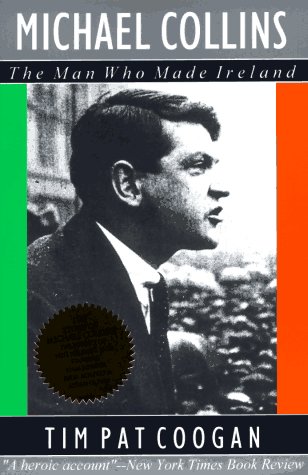
Michael Collins, by Tim Pat Coogan****

MichaelCollinsTo date, this is the single best volume that’s been written about Collins, and it’s a meal. I purchased this title on an annual pilgrimage to Powell’s City of Books in Portland, Oregon when I was there to visit family a few years ago. Although the length of the book is listed as 480 pages in paperback, the reader needs to come prepared. The type is tiny and dense, and it took me a long time to wade through it. If it were formatted using more standard guidelines, it would be a great deal longer.
As I write this review I am halfway through Coogan’s epic history of the IRA (Irish Republican Army), and the style in which he writes is consistent in both books. Coogan tells us everything that is historically important, and he also tells us everything else he finds out, with no apparent filtering. His writing is half Irish history, half family Bible in the sense that if someone was briefly or peripherally involved with Collins, their proud relatives can probably find that person and his or her historical role somewhere in these pages. His shoe size is here, and the names of every girl he flirted with. For a man that lived so briefly, he left a large shadow, and the author was plainly unwilling to let even the tiniest bit of research go to waste, relevant or no.

I am somewhat surprised that Collins doesn’t rate more favorably with the author, given that his name is the one most associated with the creation of an independent Ireland. But Coogan does due diligence in establishing the brutality of the British occupiers, who killed indiscriminately with the use of terror. At one point, soldiers opened fire on a school yard where little children were at play; these royal ambassadors were the original school shooters, killing six little ones for being Catholic. In the protests that followed, women and girls knelt before British tanks and said their rosaries for those that had been killed for their Fenian identities.

The Irish freedom struggle took place at a time when the whole world was on fire. The Russian Revolution was unfurling with breathtaking speed; at the same time, there was no established Marxist revolution to look to for guidance, and Irish freedom fighters had no single idea of what political ideology should shape the struggle. Most of the revolutionaries were barely old enough to shave, and a lot of errors were made because of this lack of clear vision. The results were often tragic.

There’s an interesting discussion of whether Irishmen should become German allies during World War I. There is a strong resistance to becoming shills for the British, and so the question, then, is whether to remain neutral, or take the side of Britain’s enemy in the hope of receiving reciprocal assistance. In the end, nobody was organized enough, in this era of little technology, to come up with a cohesive plan, so the point was a moot one.

Should you read this biography? I think it depends upon how much time you have, and how strong your interest level is. One consideration might be to purchase it as a reference volume and flip through it to tease out the most relevant information, but be forewarned: sifting through the minutiae is not an easy enterprise. For researchers, the photos alone might be of interest, since they constitute primary documents.

Recommended for those with strong basic knowledge of Irish history that want to flesh out the details, and for those building a reference library.

Three minutes to Doomsday, by Joe Navarro***

threeminutestodoomsday“Nothing’s ever over till the fat lady sings.”

Trite? Yes. Abrasive? Absolutely!  Sexist? All the damn time. Profane? Seriously profane, and not in a way that some of us might find amusing. And yet, this memoir has a strangely fascinating aspect as well.  It combines two stories, the primary one an espionage case in which the author plays the primary role, and a secondary one, the implosion of the author’s personality and marriage. It’s not fun reading, but after a certain point, there’s no turning away from it either. Thanks go to Net Galley and Scribner for the DRC, which I received free of charge in exchange for an honest review.

Navarro is a hot-shot young FBI agent in 1988, and it is while conducting what is expected to be a fairly routine interview that he notes a “tell” from former US soldier Rod Ramsey. It becomes the basis of an espionage case that goes much deeper than anyone anticipated. Navarro uses his expertise in nonverbal communication to tell what Ramsey is feeling during the various phases of his interviews, and he also uses it to control and manipulate Ramsey into cooperating with the investigation. Ramsey is the one soul on this planet with fewer friends than Navarro, and so Navarro spends years making Ramsey believe that he himself is that friend, practically family. He does it so he can have this kid busted and send him away for a really long time.

Navarro knows a lot about reading and controlling others nonverbally, but he doesn’t know a thing about building a family life or about how to make friends, and it’s clear he knows this, yet he can’t help himself. He tells us that an agent he wants to assist him tells a supervisor that she would prefer to work with someone else, and specifically, with anyone, anyone, anyone else but him. A number of other people echo this, and yet his personality continues on its hell-bent-for-leather downhill trajectory.

While he continues his self-aggrandizement with a hearty side-serving of brazen braggadocio, Navarro recounts again and again how much he hates the office staff at work, little people that are getting in his way by attempting to do their jobs. Clearly they just don’t understand how very important he is, but that’s okay, because he is letting the world know now.  Regarding the office manager that dares remind him of small requirements like changing the oil in his official vehicle, he uses a tired aphorism:

“Don’t try to teach a pig to sing. It annoys the pig and it wastes your time.”

He lets us know that he swore at, patronized, and berated her constantly, and lest we take his admissions as a sign of penitence, he also lets us know that he hates her still. He has changed her name for obvious legal reasons, but he hasn’t changed his obnoxious attitude or gained a speck of humility.

Add to this the fact that, though this case is terrific book material, the guy isn’t much of a writer. Clichés abound, and very basic principles of narrative writing are either never learned or disregarded. He starts chapters with lists, apparently too busy and important to transform these into paragraphs. I’m not all that sure he ever edited his work (because he might have noticed his overuse of parenthesis) and I’m not sure he permitted anyone else to do so either (because surely they would have come to his rescue).

Still, it’s an interesting story. Whereas someone else could no doubt do a finer job of writing this thing, it’s undeniably compelling. I recommend this memoir to those that enjoy espionage thrillers and true crime stories, but don’t give up the full sticker price. Read it for free or cheap, and save your serious dollars for serious writers.

Something To Be Brave For, by Priscilla Bennett***

Bennett’s provocative new novel tackles domestic abuse. I was invited to read this one free and in advance by a representative from Endeavor Press in exchange for an honest review.

somethingtobebraveforKatie Giraud is the daughter of a successful surgeon. Her father is disappointed when she chooses not to go into medicine, but he is overjoyed when she falls in love with his protégé, Claude Giraud. Claude is the son he never had. Katie is an art lover, and now she can enjoy her passion while being well provided for. Her husband is a handsome, charming Frenchman who woos her with roses and jewelry. It’s like something out of a fairy tale.

The trouble commences when the wedding is done and real life begins. You see, Claude has a wicked temper. He has enormous control issues, and he’s unpredictable. You just don’t know when he’s going to lash out. Next thing she knows, Katie is bleeding and cowering beneath the grand piano. But after daughter Rose is born, things are better, but they’re worse; Katie is more willing to try to escape this abusive relationship because she knows that it traumatizes her little girl to see Claude hurt her, but having a daughter also makes flight more complicated.

It isn’t as easy as it sounds.

Feminists everywhere can rejoice that the problem is so well demonstrated. Even in a home where there is such affluence, leaving isn’t as easy as it sounds. Her husband’s reputation is excellent, and he’s a smooth liar. Her parents love him, and he’s friends with the chief of police. Every effort she makes is thwarted. I appreciate this as I read it, because in cases of domestic abuse, societal conversation tends to question the victim: what is wrong with her, to make her stay in a situation like that? Why not develop a spine, get up, walk out? And yet statistics tell us that a woman is much more likely to be killed by a violent spouse, or former spouse, after she has left him, than to be killed by him while still in the marriage.

Leaving is dangerous.

That said, it seems strange that I never feel bonded to Katie. I know she is an art lover, a battered wife, and a devoted mother, and I know some of her physical attributes, but beyond these things her character remains blurry and underdeveloped. Better character development would move the entire story forward and add greater impact to the overall message.

The ending feels simplistic and somewhat formulaic. But those that care about domestic violence and champion women’s issues may want to read it anyway because it adds to the discussion, one that so often is stifled as its victims remain isolated in the shadows.

This book was published April 3, 2017 and is available for sale now.

Anything is Possible, by Elizabeth Strout*****

anythingispossibleStrout is a writer of enormous talent and the owner of a Pulitzer. Here she builds on the characters she introduced in 2016 with My Name is Lucy Barton. Lucy is back, along with various relations and everyday people. I read this book free and early, thanks to Net Galley and Random House, for the purpose of generating an honest review. This title will be sold April 25, 2017, and those that love strong literary fiction won’t want to miss it.

Lucy has become a successful writer, and she has left behind her early life of extreme poverty and the people she spent it with. They’re still there, and some of them are bitter. Strout crafts each character in a series of consecutive short stories that build on one another, and although most of the people she features here are not ones you might want to spend time with if they were real, she designs them with so many layers and with so much nuance that it’s hard to remember they aren’t. We revisit the Pretty Nicely girls, and Lucy comes home for a visit. But facing the demons of the past, those that her siblings still speak about freely but that she has kept carefully compartmentalized in an emotional deep freeze is too much for her, and she has to leave earlier than she had planned.

One thing I appreciate about Strout’s writing is her affection for the working class and the down-and-out. Some of her characters have been kept from success by hard luck, and others by lack of talent, but they are still people, and they’re sometimes capable of more care and greater compassion than other folks that haven’t ever suffered. Strout develops these characters like nobody’s business, and you almost don’t need a plot, because the people themselves are the whole story. I like the chapter that features the Hit Thumb Theory, and the ramification of privilege it conveys.

Strout writes with an implied intimacy that is rarely found. Sometimes I feel as if I have entered in the middle of a conversation, and there’s a shorthand among the family members present that I have to watch for carefully before I understand what’s happening between them. Most writers don’t even attempt this kind of subtlety because it’s so difficult to achieve. In someone else’s hands, the reader might come away wondering just what that whole thing was about, but here I find myself leaning in, absorbing details carefully meted out with great discipline and flawless pacing.

If you’ve read this author’s work and liked it, you can be assured you will like this as well. If not, be aware that it isn’t warm and fuzzy writing; don’t take it to the beach. Rather, the joy comes from witnessing the way she draws her characters and their lives without trying to put a shine on them, leaving them as stark and real as human beings often are.

I highly recommend this book to those that enjoy brilliantly written fiction, and to teachers of creative writing.

Evicted: Poverty and Profit in the American City, by Matthew Desmond*****

Oh hey, congratulations, Mr. Desmond! I read this and reviewed it a little over a year ago; it’s been riding the best seller list for a long, long time and now…the Pulitzer! If you haven’t checked this one out, do it now.

seattlebookmama's avatarSeattle Book Mama

EvictedI was cruising for something new to read, something that wasn’t yet another mystery or thriller. I ran across this title and requested it from Net Galley, then asked myself what I had been thinking! Who wants to read an entire book about eviction? What a grim prospect. I was even more surprised, then, when I opened it and couldn’t put it down. Desmond approaches his subject in a way that makes it not only readable but compelling. Thanks go to the people at Crown Publishing and Penguin Random House for approving my request for a DRC. This book is available to the public March 1.

Desmond undertook his study as part of his study of sociology while attending the University of Wisconsin, and continued it into his graduate studies at Harvard. The whole book is based on rentals among high-poverty families living in Milwaukee, Wisconsin, and Desmond explains why…

View original post 697 more words

The Road to Jonestown, by Jeff Guinn*****

Jim Jones and the Peoples Temple

theroadtojonestownThe good news is that Jeff Guinn tells us everything there is to know about Jim Jones and the Peoples Temple.

The bad news is that Jeff Guinn tells everything there is to know about Jim Jones and the Peoples Temple.

This reviewer was just out of high school when the media frenzy emerged around the mass suicide of hundreds of Americans living in a cult called The Peoples Temple, which was sequestered in the equatorial jungles in Guyana, South America. No one could understand it; why would so many people follow such a flimflam man, and why would they be persuaded to ‘drink the Koolaid’?  I wanted to know; the whole thing boggles the imagination. I read it free and early, thanks to Net Galley and Simon and Schuster. I read it more slowly than I usually do, not because the narrative isn’t compelling, but because of the content.  The opening chapters of the story are darkly funny, but as we move forward, there are times when I feel as if I am gargling sewage. I deal with the conflicting emotions by alternating it with other books, and I finish all of them and move on to other things before I finish this one.  I could only take so much in one sitting! Just so you know; you’ve been warned.

Jones was obsessed with religion, even as a child. Unfortunately, he was also the kind of kid that would trick a puppy into walking out of a high window and falling to its death.

He just really liked control, and as he got older, the compulsion grew worse instead of better.

In the early 1960s, Jones started a church in Indianapolis. His wife, Marceline, was proud to be the preacher’s wife, and they shared a genuine desire to integrate the city at a time when the deep South was being forced to end Jim Crow, but nobody else was asking anything of the sort of Northern industrial cities. He funded his mission by conducting traveling revivals tent-style. He persuaded gullible audiences that he had a supernatural capacity to heal others; the audience plants that he brought understood that sometimes faith required a little help.

Fear and control enabled Jones to move much of his congregation with him when he packed up and headed for the supposedly nuke-proof town of Ukiah, California. After that, it was like a downhill snowball.  The amazing thing is that this man and his oddball group were so widely accepted for many years, even praised by local politicians and celebrities. But then things began to unravel, and he told his followers it was time for the most ardent believers to move with him to The Promised Land.

The most amazing thing to me is that he didn’t have to rope people in to move to the jungle; he made them compete for the honor.

Guinn’s documentation is strong, mostly based on interviews with survivors and the vast files left behind by Jones and his people. The narrative flows well and never slows, and part of that is due to the lack of formal footnotes, but the endnotes provided for each chapter, along with the list of interviews, in-text source references, and bibliography are beyond reproach. Best of all, he has no axe to grind.

For those that want to know, this is it. I doubt you’ll find a better single book on this subject anywhere. It’s available for sale as of today.