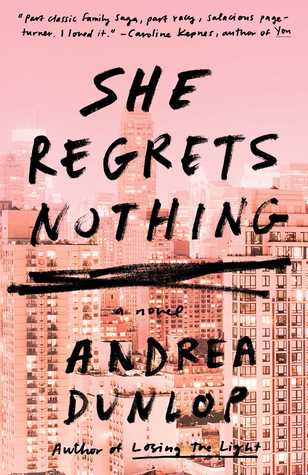
She Regrets Nothing, by Andrea Dunlop****

“Love,” she thought, “is for the rich and foolish.”

SheregretsLaila is just twenty-three when her mother dies, and she is astonished when her cousins appear at the funeral. Cousins? What cousins? In fact, they are from her father’s side of the family, long estranged—and they are very wealthy. Cousin Liberty wants to make amends, and nobody has to tell Laila twice. She ditches her home in Michigan, leaves her spouse, a dull dentist who’s blindsided by her sudden departure, and heads for New York City, to live in the style to which she would like to become accustomed.

Lucky me, I read this darkly funny story free courtesy of Atria Books and Net Galley. It was released Tuesday, so you can get a copy of your own now.

As Laila arrives in New York, the reader cannot help but worry for her. She’s never been to New York before, and she has very little money. She’s brought a few pieces of her mother’s jewelry, the only things of any value her mom had owned, but she doesn’t want to sell them. As she meets her newly found kinfolk and settles into a guest bedroom, it’s instinctual to wish we could grab her by the wrist and yank her back out of there. Careful Sweetie, you’re playing with fire. They’re being nice to you now because you’re new. When the novelty wears off, they’ll spit you back out again. New Yorkers are tough, and nobody uses people and discards them as quickly as the very rich—right?

There are at least a dozen places where I make predictions that prove incorrect. For example, given Laila’s trump card that makes her a possible heir, I find myself waiting for the DNA test that will prove she actually isn’t related to them at all…but that doesn’t happen. I can tell things won’t work out the way she anticipates because the author drops so much wry foreshadowing. But what she does with it at the end is both completely consistent with the protagonist as we know her, and a complete surprise as well.

Part of the joy this novel sparks is its understated quality. Some writers will drop something amusing into the storyline, but then they have to go back to it, explain it, make sure the reader got it and at that point it’s cold and lifeless. None of that for Dunlop. Stay on your toes; if you’re paying attention you’ll get it, but if you are distracted, oh well. Think of it like trying to catch a cab right after the theater lets out; watch out or you’ll be left behind.

I confess that I have read neither of the novels to which this one is compared in the promotional blurb, but to me, the humor is similar in some ways to that in The Nanny Diaries.

If you need a giggle—and frankly who doesn’t—you should order this snappy, cleverly turned novel. It’s a fast read and it made me laugh out loud.

The Pearl Sister, by Lucinda Riley**

ThePearlSisterI was invited to read and review this title, and I thank Net Galley and Atria for thinking of me. Sadly, though I tried more than once, I just couldn’t engage with the story. I couldn’t put my finger on it; whereas the character development could do with a little boost, generally a series mystery can inspire at minimum a 3 or 4 star review from me. What is it that stands in the way now?

Had I not been distracted by a major household disaster, I would have realized it sooner. The premise itself is a disturbing one to me. The sisters are all adopted children that were sought out by a now-deceased, very wealthy man, who wanted a child for each continent. No, wait. A daughter from each continent.

How do children become tchotchkes? What gives any adult a right to treat orphans like collector’s items?

Props to Riley for her resonant settings and for developing a dedicated readership. The fact that the series has developed such high reviews tells me that there are a great many people that genuinely admire this series and look forward to the next before it’s available. But try though I might, I don’t see it that way, and I cannot provide a review based on what other readers think.

For those that are already among Riley’s readers, here it is, another one. But for me? Not so much.

Where the Line Bleeds, by Jesmyn Ward*****

WheretheLineBleedsWard is a force to be reckoned with, a literary power house whose books everyone should read. I read the third book in this trilogy, the National Book Award winning Sing, Unburied, Sing last summer, and then I knew I had to read everything else she had ever written. When I saw that this title, the first in the same trilogy, was being released again and that review copies were available, it seemed like Christmas. Many thanks to Net Galley and Scribner. This book was released again last week and is now for sale.

Twins Christophe and Joshua are graduating from high school, exuberant and full of plans for the future. The sole source of tension, a longstanding one that is integral to their deepest senses of self, is whether their mother, Cille, will put in an appearance. She lives in Atlanta, but she might come home to see them walk. Then again, she might not. They assure each other that really, only Ma-mee matters. Ma-mee is their grandmother, but she is the one that raised them since they were tiny; in fact, their grandmother really wanted them, and their mother really didn’t.

When their graduation present arrives—a used but still nice car for the two of them to share—they snicker to one another and say this means Cille isn’t coming. She’s done with them for sure now, bought her way out of a personal appearance. But Joshua still hopes; Joshua still longs for her.

Their father, Samuel, lives locally, and it is at him their anger is unequivocally directed. Known as the Sandman, he is beneath the contempt of even the most humble local citizens, a meth addict with a mouth full of rotting teeth that will do anything, no matter how humiliating or unprincipled, for even the smallest sum of drug money. Samuel has never pitched in a dime to help Ma-mee raise them, but now that they are adults—at least officially—he has come sniffing around.  The twins’ rage toward him is measureless.

The thing that makes this story so visceral, so moving, and so deeply absorbing is the character development and the complexity of the relationships between and among the twins and the two women. Cille’s insensitivity makes me punch my pillow a couple of times. Can she not see how little food they have, despite their proud claim to be fine, just fine?  Every gesture, every word is weighted with meaning. No statement, no financial transaction, no arrival or departure is without weight. The blues festival Cille has planned to attend as part of her vacation—to which the twins are of course not invited—and the money carelessly dropped on a rental car could go so much farther to help her elderly mother, who is legally blind now, but instead she leaves Ma-mee to her eighteen year old sons to care for. They both assume they will be able to get jobs once they have high school diplomas; they have no police record, and they’re not too proud to apply at fast food outlets and other retail locations.

The best jobs to be had are on the docks, but not everyone can get one. Their cousin observes, “Everybody and they mama want a job at the pier and the shipyard. Everybody want a job down there can’t get one.”

And so  “reality [rolled] over them like an opaque fog…” Joshua, the lighter of the twins, is hired, but Christophe can’t get a job there or anywhere else.  And so a new division is born, and a new source of tension develops. Joshua feels guilty, apologetic, and yet as time goes on, as he sweats for long hours in the Mississippi summer sun carrying chicken guts and who knows what else, his brother absents himself and comes home high; he sleeps into the day, and sometimes shows up late to pick Joshua up from work.  He’s given in to his cousin’s invitation to deal drugs, and that puts everyone at risk.

Over and again, I can see that the twins are still children. Young men don’t grow up quickly anymore. They are children emotionally and developmentally until their mid-twenties, and yet this burden is Joshua and Christopher’s to carry; the choices they make are not the choices of criminals or saints, but the choices of children. Yet they carry the burdens of men, and they are aware this is because of the defection of their mother.

Ward’s more recent work is even better written than this one, and yet it’s harsher, too; I had to put it down from time to time, because it was getting dark out there. This story in contrast is one I could read for hours on end, and I did. There’s violence aplenty as well as tragedy, but this is a reality I can look at without flinching, and that’s worth a great deal too.


Highly recommended to those that love outstanding literary fiction, African-American fiction, Southern fiction, and family stories.

Dangerous Crossing, by Rachel Rhys***

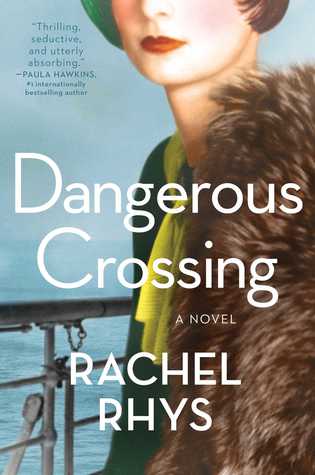
dangerouscrossingDangerous Crossing is an historical mystery set at the outset of World War II. I was invited to review it by Atria Books and Net Galley; it was published earlier this month, and you can buy it now.
Our protagonist is Lily Shepherd, a young woman in need of a fresh start. Her family’s scant resources are tapped in order to send her via cruise ship to Australia, where she is to enter domestic service. On board she meets Max and Eliza Campbell, wealthy, obnoxious, and carrying some skeletons of their own. We have Maria, a Jewish refugee, along with George, a Nazi sympathizer.  Helena and Edward are adult siblings, and there’s romantic tension crackling between Lily and Edward. Along the way are exotic ports of call such as Cairo, Egypt and Ceylon; these are places Lily would never have hoped to see under ordinary circumstances, but fate surprises her.

Rhys does a fine job of managing historical details, and in particular the social stratifications that existed in British society during this time period and the limitations they imposed.  The ending has more than one interesting twist. On the down side, I find the figurative language to be stale at times and the relationships overwrought in places. I felt that the story could do with some tightening up. However, fans of a traditional mystery will find this is a fine mystery to curl up with on a chilly winter night. The varying perspectives of the cruise’s passengers dovetail in many ways with those we see today, and many will notice an eerie familiarity in these characters from an earlier time.

Recommended to those that enjoy cozy mysteries and traditional historical mysteries.

I Can’t Breathe, by Matt Taibbi*****

“Try to imagine a world where there isn’t a vast unspoken consensus that black men are inherently scary, and most of these police assaults would play in the media like spontaneous attacks of madness. Instead, they’re sold as battle scenes from an occupation story, where a quick trigger finger while patrolling the planet of a violent alien race is easy to understand.”

ICantBreathe
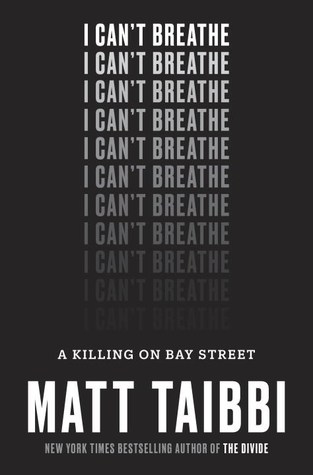
I received an advance review copy of I Can’t Breathe: A Killing On Bay Street, courtesy of Random House and Net Galley. I had expected this civil rights title to be a good read but also to be anticlimactic, coming out as it did just after publications by literary lions like Ta-Nehisi Coates and Angela Davis. I am surprised and gratified to see that Taibbi, a journalist for Rolling Stone, holds his own quite capably. The title is for sale, and if you care about justice and an end to cop violence in the US, then you should get it and read it.

Many readers will recognize the title, which constitutes Eric Gardner’s last words and became a rallying cry for protests that spanned the globe. Why would any cop, especially one not acting alone, find it necessary to put an elderly man, a large person but not a violent one, in a choke hold over what was, after all, a misdemeanor at most? Taibbi takes us down the terrible urban rabbit hole, deftly segueing from Garner’s story, the events that led up to his death and the legal and political fight that took place afterward, to the cop killings of others, and the bizarre, farcical prosecution that takes place in the unlikely event that a cop is ever charged with having unlawfully killed another person.

Though my own life is free from this type of harassment and though I benefit from White privilege and have done so since birth, I found it hard to breathe myself as I read Garner’s story, and the behind-the-scenes machinations that result in the maintenance of the status quo. And I trembled, and still do, for the Black men in my family.

I think many people over the age of 40 understand that the attacks we see publicized online, one by one, Black boys and men that have done either nothing wrong or committed a minor offense that most Caucasian people would never be stopped for, have been taking place for a very long time. What we didn’t have was proof; what we didn’t have was the long view that allows us to see into cities, rural areas, and small towns in America such as Ferguson, where Michael Brown was killed. And there’s one other thing: we didn’t have to look at it before if it wasn’t happening in our own community, our own neighborhood. Even those of us with racially mixed families didn’t see the scope of it. Some would prefer not to know.

Here’s Taibbi’s take on how it unspooled:

“The civil rights movement ended in a kind of negotiated compromise. Black Americans were granted legal equality, while white America was allowed to nurture and maintain an illusion of innocence, even as it continued to live in almost complete separation. Black America always saw the continuing schism, but white America has traditionally been free to ignore and be untroubled by it and to believe it had reached the “postracial” stage of its otherwise proud history. That was until cell phones and the internet came along. When the murder of Eric Garner hit the headlines, it at first seemed to lift the veil.”

Taibbi’s smooth narrative and expert pacing doesn’t make this any easy book to read; nothing can. If it’s easy, you’re not paying attention. But if we ignore Eric Gardner, Michael and Trayvon and Freddie and Sandra and all the rest, we are complicit in their deaths. Highly recommended, even at full jacket price.

Smoke City, by Keith Rosson*****

SmokeCityNerds, geeks, and bibliophiles be ready. Marvin Dietz, who in an earlier life was the executioner of Joan of Arc, is leaving Portland, and he’s collected some unlikely traveling companions. Why not join him?  I read this story free and early thanks to Meerkat Press, but it’s worth your nickel to seek it out, because there is nothing else like it. This book is available to the public Tuesday, January 23, 2018.

Mike Vale was once a great painter, and now he has been forced out of his record store by a shifty, corrupt landlord, so he heads south to Los Angeles to attend the funeral of his ex-wife. En route he picks up Dietz, who is hitchhiking, and further along the way Casper stows away in the back. The voice with which their story is told is resonant and the word-smithery makes me shake my head in some places—who writes like this?—and in others I laugh out loud. Here’s a sample from the passage where we meet Casper:


‘I want my money,’ Casper said. “My money or my gear. You pick.’
‘Jesus wept,’ the last counterman said before wheeling around on his stool. Then Gary, our mechanic, walked past me and threaded his way through the tables. He laid his hand on the end of the bat… Casper turned and looked at him. What little fight there was deflated out of him like a balloon. Almost lovingly, Gary put him in a headlock.

‘Casper, Duncan sold your meter for a bag of crank days ago. Give it a break. Getting money from him is like getting Thousand Island from a basset hound’s tits, man. You can squeeze all you want, but it ain’t happening.’


As the journey continues, somewhere in California, the Smokes appear. They’re the undead, and they appear as if they are made of smoke. They can’t hear live people or see them, but their personal dramas and torments play out for people in the here and now, and they don’t observe the laws and conventions regarding private safety and property, either.  They show up at random times and in random places, causing traffic accidents and other complications. And so we have to wonder if there’s a connection between Marvin, whose many incarnations are recounted to us in his confidential narrative, and these apparitions. The government and the military are at a total loss; the press is enjoying itself, but even the most ambitious journalist recognizes that things have spun out of control.

The plot is complex, and readers must bring their literary skills along for the ride or there’s no point in coming.  It’s a story that takes awhile to develop, but it’s more than worth the slow build. The playful use of language and quixotic spirit of the prose are reminiscent of Michael Chabon at his finest hour.

Highly recommended; get it in hardcover.

Straying, by Molly McCloskey*****

StrayingThis title is the first fictional work McCloskey has published in the US, but surely it cannot be the last. This addictive novel came to me free and early, courtesy of Scribner and Net Galley in exchange for this honest review. It becomes available to the public February 20, 2018.

Alice has returned to Ireland. As a young woman of 24, she had gone there intending to visit, gain some perspective about what to do with her life, and then return to Portland, Oregon, but instead she met Eddie and married. “I was not sure how grown-up love was supposed to feel.” Now she is more mature and single again; she returns to Ireland and in a deeply intimate, gently philosophical narrative, tells us about what happened, and about the affair with Cauley that was instrumental in ending her marriage.

Here I must confess that I have old-fashioned ideas about cheating on a spouse. If your marriage is solid, you should respect it and be faithful. If your marriage is dying, get out before you start something new; don’t sneak around and tell lies. If your marriage is troubled and you aren’t sure what you want, address that first, but don’t poison the well with a fling. It’s unethical and unfair. Have some integrity, for goodness sake.

And so, why am I reading this novel, and more to the point, why am I loving it? It goes to show that a strong writer can make me want to read almost anything, whereas an indifferent one may start with a promising scenario that fizzles. McCloskey pulls me in and doesn’t let me go.

The cover art tells the reader right away that despite the title, this is not erotica. Those looking for a novel that will make them breathe hard will have to find something else. Straying gives us something far better, in my view. I feel as if Alice is my dear friend. I usually read several titles at once, drifting from one to another over the course of a day or evening. But Alice interrupts my literary smorgasbord because in a way, I feel disloyal for reading anything else. The narrative here, told in the first person, is so deeply personal that it’s as if she is sitting across from me at a coffee shop (or since we’re in Ireland, in a pub perhaps), and she’s spilling the beans, confessing everything that she did, and the consequences that followed. She isn’t beating herself up Anna Karenina-style, nor is she proud of her mistakes; rather, she is explaining what happened, what she’s learned from it, and what she still wonders about. It’s not prose you can walk away from until it’s over.

Those that love excellent fiction should buy this book and read it. If you can get it cheap, do that; if you have to pay full jacket price, do it anyway. You don’t want to miss this one.

Need to Know, by Karen Cleveland***

NeedtoKnow

“My God, Vivian, what’s it going to take for you to trust me?”

 Need to Know is an espionage thriller written by a former CIA analyst. I read it free and early thanks to Random House and Net Galley. This book will be available to the public on Tuesday, January 23, 2018.

Our story is told in the first person by Vivian Miller, a CIA analyst with a mortgage to meet and four small children. In the course of her research she comes across the identity of someone she knows and then the whole house starts to tumble, as she makes one bad decision after another, punctuated with the occasional wise choice to heighten suspense.  Around the sixty percentile I found myself reading it for giggles as it becomes increasingly clear that our protagonist is as dumb as a box of rocks.

With this in mind, I have devised a drinking game for rowdy book clubs that meet in real life. Here are some ideas:

  • Take a drink every time Vivian refers to Matt as her “rock”.
  • Take two drinks every time she refers to Matt as their children’s “rock”.
  • Take a drink every time you run across the word “ringleader”.
  • Spin around three times and take a drink for every rhetorical question you find in the narrative.
  • Take a drink for every stereotype you see.


Spoiler alert (*snerk*): you may want to clear your calendar the day after your book club meets, because it’s going to be a rough one.

Now I understand that there may be abstainers in your drinking book club, patient souls that either really like the people in your club, or that can’t find a book club made up of tea-totters. For those people I have special instructions:

  • Take a drink when you find a well developed character.
  • Take a drink when you find a positive female role model .


Another spoiler alert: provide this second group of people with water, because otherwise they are going home thirsty.

I can also recommend this title to women that are newly divorced, mad as hell, and looking for something to throw. For these ladies, I recommend obtaining a hard copy, because you won’t want to ruin your expensive electronic devices. Before commencing with this title, remove pictures, monitors, and china from the wall where you’ll be reading. Broken glass is nobody’s idea of a fun Tuesday night.

“They’re good, the Russians.”

Newly divorced, mad-as-hell, book-throwing women that have recently divorced a Russian man may even want to pre-order a copy. I’d do that right now if I were you.

Купить книгу.

The Immortalists, by Chloe Benjamin****

TheImmortalistsFour adolescent siblings growing up in New York City learn that a traveling psychic has hit town, a woman that can tell each person the date that he or she will die. Against the wishes of their parents, they sneak out to find her. I received my copy free and early in exchange for this honest review, thanks to Net Galley and G.P. Putnam’s Sons. This book is now available to the public.

The book is divided approximately into fourths, a quarter for each of the Gold children and across five decades. To my own way of thinking the first half of the story is far more resonant than the second half. Simon, the “golden boy”, dies of AIDS before the disease has been named, but before he is gone, the San Francisco of that time period is set out in such meticulous, immediate detail that I feel as if I am back there, back then. The portion of the book devoted to Klara, who becomes a magician, is nearly tangible in different ways, and older women that have worked in unconventional professions—before the year 2000, that meant just about all of them—will recognize themselves when they see how she is dismissed, harassed, and stigmatized.

Then I read a review by someone that felt exactly the opposite, claiming that the story didn’t really wake up until the second half. And so I suspect that the age and background of the reader will inform which part of the book stands out best.

However, once I have seen Simon and Klara die, I have other reasons for reading more slowly. If both of them die during the first and second quarters of the book, I have a pretty good idea what is about to happen to Daniel and Varya in the third and fourth quarters.  These characters, a Naval physician and a primate researcher, don’t reach me the way that Simon and Klara do. With Simon and Klara, I am right there with them, and at times I am peeking out and seeing the world through their eyes. With Daniel and Varya, I am along for the ride, checking to see how many pages are left in this thing so I can go write my review and be done.

Benjamin’s  greatest gift is setting. There are aspects of each place and time that I remember, and others that I have nearly forgotten until she brings them back again. But for those expecting to see a fantasy plot, as this has been billed, or magical realism, it’s going to prove disappointing; really it is literary fiction, and some reviewers will be unhappy because of the genre issue.

Those that love good literary fiction are going to want to read this novel. There’s been a tremendous amount of buzz, and there’s nothing else like it.

Two Girls Down, by Louisa Luna*****

TwoGirlsDownThis is a quick read and a fun one. I received my copy free and early in exchange for this honest review courtesy of Net Galley and Doubleday. It becomes available to the public tomorrow, January 9, 2018.

A frazzled mother in a small Pennsylvania town pops into a big-box store one afternoon, leaving her two elementary-aged girls in the car. They’re old enough not to wander off with some weirdo, and she’s just going to be a minute. When she comes back, they’re gone.

Our protagonists in equal measure are Cap, a former cop who’s left the force in disgrace, and Vega, an out-of-state PI brought in by the girls’ relatives. Vega seeks Cap out after the local cop shop refuses to work with her; sparks fly.

If you take the story apart and look at its elements, it is all old material and should be stale. We have the missing children; a single grieving female detective, a vigilante type with little to lose; a slightly-older, single-dad, lonely older male detective, all of which leads to romance, because heaven forbid we should ever have a competent female private eye without a sizzling chemical frisson to keep readers from feeling threatened by her competence. We have the single dad’s (also-competent) teenage daughter left alone for long periods of time, vulnerable to the forces of evil. And of course our female detective has to be diminutive, a tiny-firecracker type.  Even Vega’s love of firearms isn’t new; consider Kinsey Millhone and Stephanie Plum. And our female detective has to be a very light eater. God forbid she should chow down at dinner time; no, she pushes her food around and away.

The pieces of this thing have been done to death. And yet.

And yet, the whole of the story is so much more than the sum of its parts. A strong writer can take overdone elements and make them gleam, and that’s what Luna has done here.

The thing that makes it work is the element of surprise. When I am looking ahead, I can often see, in a broad sense, where we are going, but when I try to predict how we’ll get there, I see three possibilities, and Luna always comes up with a fourth at the most unexpected of times.  Vega’s “roofless rage” gives her a no-holds-barred, Dirty-Harry-Lite kind of approach; she’s never killed anyone, but if she’s always as off the wall as she is here, it’s a miracle. But the other miracle? The fact that I am wondering what she is like at other times demonstrates how well Luna has developed her characters. Cap is a well of timeworn chivalrous decency, but Vega wants to take the kind of people that would deliberately hurt a child and “put them in the fucking earth.”

Luna uses lots of crackling dialogue and a spare prose style that makes this book accessible to anyone that finished the eighth grade, and possibly some that didn’t. Although there’s no indication that this will become a series, one has to wonder if such a thing might happen.  My own preference would be to see Vega act independently of romantic entanglements, because she has the potential to be a feminist hero, and we need one of those right now.

One way or another, this is a read you won’t want to miss. Highly recommended.