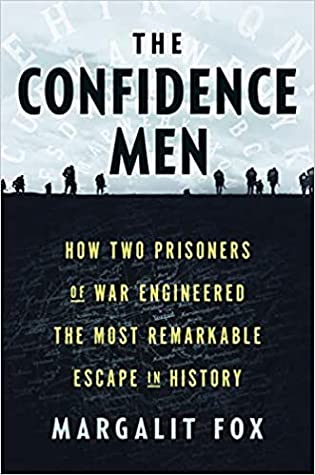
The Confidence Men, by Margalit Fox****

This stranger-than-fiction story of two World War I captives, one an English officer, the other Australian, that trick their way out of a Turkish prison camp via a long, elaborate con centered on a Ouija board is compelling and at times, funny as hell. My thanks go to Net Galley and Random House for the invitation to read and review. This book is for sale now.

The beginning is grim; grim enough that I abandon this story twice before ordering the audio version from Seattle Bibliocommons to help me get over the hump. There’s torture, deprivation, and every ugly thing that the notion of an enemy prison brings to mind. I am especially horrified because I thought this book was going to be funny! Reader, it is, but you have to get past the grim and at times, dull beginning to get to the amusing bits. Somewhere between the fifteenth and twentieth percentiles, the shift occurs, and that’s when you can expect to enjoy yourself. You may want to skim a bit through this part; I do, and it works out well.

Harry Jones was an attorney before the Great War commenced; Cedric Hill was an Aussie auto mechanic. Once captured, the two have no chance at all making a conventional escape; the camp is too isolated for either of them to get anywhere, even if they were able to leave. Instead, what they have is nothing but time, and ultimately, that and their excellent imaginations and problem-solving skills, aided by some genuinely stupid captors, is what saves them.

The most impressive aspect of their scheme is that it takes place over a very long period of time. Not many con artists would be able to keep their story straight for so long. Jones and Hill have a great deal of self-discipline and organizational skill. Also, they’re afraid, and fear can improve one’s consistency and attention to detail. Once the meat of the story begins, it is absolutely riveting!

I flipped back and forth between my digital galley and the audio version. Both are equally good, but I would give a slight edge to the audio version, assuming the reader is primarily seeking entertainment. For a researcher, the print version is better for keeping details and sources straight.

Recommended to those that enjoy history and intelligent humor.

The Guncle, by Steven Rowley*****

How do you spell instant parenthood? It’s the last thing GUP—the appellation bestowed on Gay Uncle Patrick—expected, and the transition is hilariously rocky. My thanks go to Net Galley and Putnam Penguin for the review copy; this book is for sale now.

Patrick’s whole life appears to be on hold. He was on television for a good long while, and so both fame and fortune are his. He doesn’t actually have to do anything, and since the demise of his beloved partner, he hasn’t wanted to. Then one of his closest friends, Sarah, who had been his college roommate, dies, and everything changes.

Grant and Maisie, Sarah’s children, are six and nine years old respectively. When the memorial service concludes, Patrick is blindsided by Joe, Sarah’s husband. While she was on her deathbed, she made Joe promise that when she was gone, he’d go into rehab—but of course, someone has to take the children. Joe wants that someone to be Patrick.

The humor is ribald at times, but never over-the-top. Patrick knows nothing about children. Nothing! In a daze, he returns home with his charges in tow, and he has to learn on the job. Maisie is at a somewhat bossy age and is only too happy to tell him what to do and how to do it, and oh is it fun to watch. As the fog lifts, Patrick begins making small changes to create a more child-friendly space, but mostly, he embraces his unconventional situation. There’s a Christmas celebration in the middle of summer; there’s a party. And as he steps up to his new role, he realizes that he should return to work; he has heirs now, after all.

Aunt Clara arrives, and she demands the children return with her. She knows how to do this. She frowns on nearly every aspect of Patrick’s life. But Patrick is amazed to realize he is willing to fight to hang onto them.

Some may be surprised to find a book like this earning a five star rating; it’s not serious literature. It’s fun; it’s fluffy. But this reviewer rates each book on its excellence compared to others of its genre. As a humorous novel, it shines. As a feel-good book, it’s terrific. As beach reads go, what can be better?

Perhaps it’s indicative of Rowley’s skill that I have found myself writing review notes in his voice. This doesn’t happen often. But as for you? You should get this book and read it, because all of us need a mood elevator, and in that respect, it’s a bargain. Highly recommended!

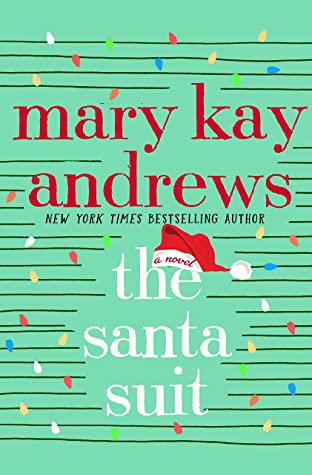
The Santa Suit, by Mary Kay Andrews***-****

3.75 rounded up.

I love a good Christmas story, but so many of them are cloying or insipid. A friend recommended this one to me, and she wasn’t wrong. My thanks go to Net Galley and St. Martin’s Press for the review copy.

Ivy is newly divorced, and she comes away from it with bruised feelings, but also money. Since she works from home, she has the choice to go anywhere, so she buys a farmhouse in a tiny town in North Carolina. She pays for it without ever seeing it in person, and it comes “as is.” At this point, I say, Welp, you’re in for it now, hon. And she is, sort of.

The realtor, Ezra, known locally as “The House Hunk,” has taken a shine to Ivy. He helps her with the heat; when she discovers that the old furniture is still there in the house, he and a friend cart it off for her, and when there’s a problem with her own furniture, he helps bring it all back in. And initially, she regards his attention as a nuisance, maybe even a stalker; but between the fine reputation he enjoys locally, and the number of times he helps her out of difficult situations, she gradually warms to him.

Ivy is a likable protagonist. She’s self-sufficient, but she isn’t cold. She sets about making friends right away. Her new bud, Phoebe, is in a state because she’s fallen in love with someone she met online, and has used a picture of someone else. Now the man Is coming to see her, and she’s panic-stricken. Other new friends include a local business person for whom she does some free, and very good, advertising, and a 96 year old man. Her dog, Punkin, goes everywhere with her, and she talks to him all the time, the way that some of us also do. When she needs assistance it’s because she doesn’t know the area, or because a job requires an extra set of hands, not because she is some helpless airhead. An engaging character indeed.

My rating reflects a couple of sloppy bits that the author and editor should have caught and dealt with immediately. They’re small, but they interrupt the magic, because they cause me to think about the two slackers rather than the story and characters. The first is when she offers Ezra coffee, but warns him that all she has is instant. Two paragraphs later, she is brewing the coffee. Oh, come on! Clean it up. A bit later, after Ezra and a friend have schlepped furniture in from the truck, he asks if she’s been out to play in the snow, and she tells him she doesn’t want to spoil its beauty. “It’s so beautiful, all that clean, untouched white.” And so I wonder: did they teleport the furniture indoors? Because otherwise, surely that snow would have been touched in a whole lot of places.

There are a couple of other inconsistencies, albeit smaller ones, and I am using a fair amount of ink to discuss problems that may seem trivial, but this is no debut author, this is a successful writer with a host of books in her repertoire, and she should know better.

The plot, on the other hand, is excellent. There was one development that I thought was obvious, but when I finished my eyeroll, I was surprised to see that she didn’t take it where I expected, and instead did something much better. I particularly like the way the romance unfolds, and the way that Ivy helps Phoebe out of her dilemma. There are other threads—involving a Santa suit, of course—that are equally delightful.

So, in spite of my complaints, I do recommend this charming, fluffy tale to you. It’s a mood elevator, and we can all use some of that. It’s for sale now.

The Ride of Her Life, by Elizabeth Letts*****

Elizabeth Letts has become one of my drop-everything authors. Instead of writing about the same historical figures that everybody else writes about, she finds noteworthy women that have fallen through the cracks of history. The Ride of Her Life chronicles the latter years of Annie Wilkins, a senior citizen that given not long to live, and not much to lose, decides to embark on a cross-country journey on horseback so that she can see the Pacific Ocean before she dies. I was invited to read and review this remarkable novel by Net Galley and Random House Ballantine. It’s for sale now.

Annie Wilkins lives in rural Maine, and is endeavoring to continue to run the family farm. It hasn’t gone well. Between a series of events beyond her control and an aging body, she falls behind, and then more so, until the bank gives notice of foreclosure. At the same time her lungs aren’t doing well; the doctor gives her two or three years to live, but only if she does so restfully. She is offered a place at the county home, which is essentially a charity lodging for the indigent.

Under similar circumstances and with no family to fall back on, most of us would have sold the farm and gone to rest in the county poorhouse, but Annie is not like most people. She sells up, and she plans her next move carefully. She packs up the things she and her dog will need for their trip, and since the purchase and maintenance of a car are beyond her means, she buys a good horse. That’s it. She packs up her maps and gets on the horse. (The dog alternates between walking and riding.)

Part of the joy in reading of her adventures is the window it provides into the United States in 1954, before most of us were born. For those outside of cities, horseback travel is still not unusual; Annie’s greatest challenge, of course, is her lack of awareness about highway safety. Her initial plan is to ride alongside the road when possible, and on the shoulder when it isn’t, but there are a host of dangers out there, and almost everything that can happen to her, does. But people are essentially goodhearted, and in every instance, someone kind and decent comes along and does right by her and her critters.

In the polarized time in which we live, this is exactly the story we need. I suspect that if Annie were to do the same thing today, there would still be people that would come along, and without inquiring who she voted for in the most recent election or whether she has received a vaccine, would feed her, or offer up their guest room for a night or two, or would drive her to the hospital. Those people were there then; their descendants are here still. We have not changed all that much.

Letts has told an engaging story, but part of my mad respect for her has to do with her attention to detail. The very best historical fiction is essentially true, with dialogue added for interest, and Letts writes the best, no doubt about it. Her endnotes are impressive, and she tells us that she drove more than 10,000 miles while researching her book.

Because I had fallen behind with my reviews, I checked out the audio version from Seattle Bibliocommons and alternated it with my digital galley. Both are outstanding; you can’t go wrong either way. Highly recommended!

Let’s Do Dinner, by Antoni Porowski

I’ve got a soft spot for cookbooks. Some are useful, and some are less practical, but fun to read anyway. Fans of Antoni’s television programs can hardly go wrong with Let’s Do Dinner, but his work is new to me. My thanks go to Net Galley and Mariner Books for the review copy. This book is for sale now.

The promotional blurb for this cookbook tells us that some of these recipes will be decadent, whereas others are designed for weekday dining. Apart from a couple of nice egg dishes (omelet, scramble,) I don’t see anything here that I would make. Some involve great loads of dishes, and others involve unusual flavor combinations, and I am a coward. That being said, I am plainly not his target audience. I suspect that his cooking tips are geared toward the young and childless; I, on the other hand, am a Grammy. For me, this cookbook is more of a three star read—the sort of thing I’d browse through, but wouldn’t spend money on. However, for twenty-and-thirty-somethings, I suspect the appeal will be greater, perhaps a four star read, and for his loyal fans, five stars.

I recommend this cookbook to Antoni’s fans, and to the young and adventurous cook that wants to try new things.

Harlem Shuffle, by Colson Whitehead*****

Ray Carney has a foot in both worlds, and he isn’t given to thinking too deeply about that. As the son of a badass criminal, he considers that he has turned out quite respectably; yet, when Cousin Freddie occasionally brings a consignment piece of jewelry to his store, he doesn’t ask many questions about its history. Thus begins a slow, steady slide, from being a mostly-straight retailer, to a mostly-crooked fence. But oh, what a glorious story it makes!

My thanks go to Doubleday and Net Galley for the invitation to read and review. You can buy this book now.

The first time I read Colson Whitehead was when The Underground Railroad was published five years ago. It was unquestionably a work of genius, but it was also a fair amount of work to read. Then The Nickel Boys came out, and when I finally found a copy, it was well written yet so harsh, and at a difficult time for me personally, that I thanked my lucky stars that it wasn’t a review copy, and I gave myself permission to abandon it. So thus far, my admiration for this author has been tempered by the awareness that I would need to roll up my sleeves, or to brace myself, or both.

Harlem Shuffle contains none of that. It’s told in linear fashion, beginning in the late 1950s and ending in the late 1960s. The writing is first rate, as one might anticipate, but it’s also an unmitigated pleasure to read.

Our protagonist, Carney, has married up. His beautiful wife Elizabeth comes from a family with lighter skin, higher social position, and a good deal more money. Elizabeth loves him, but she has expectations. As his young family grows to include a son and daughter, the pressure increases. But let’s not kid ourselves; this isn’t just about Carney supporting his family:

“If he got a thrill out of transforming these ill-gotten goods into legit merchandise, a zap-charge in his blood like he’d plugged into a socket, he was in control of it and not the other way around. Dizzying and powerful as it was. Everyone had secret corners and alleys that no one else saw…The thing inside him that gave a yell or tug or shout now and again was not the same thing his father had. The sickness drawing every moment into its service…Carney had a bent to his personality, how could he not, growing up with a father like that. You had to know your limits as a man and master them…His intent was bent but he was mostly straight, deep down.”

Freddie comes to Carney with a plan: he and his confederates intend to rob the Hotel Theresa, which is the pride of Harlem, the place to stay for Negro patrons of breeding and taste. It was almost sacrilege; and yet, it would also be a fantastic take. Would Ray Carney put out some feelers to find out who could move the sorts of valuable baubles that might be found in the hotel safe? Ray tells him of course not. No no no no no. A thousand times no! And then, he commences doing exactly that.

There are several aspects of this tale that make it exceptional. Whitehead resists the amateurish urge to fall back on pop culture of the period, instead imparting the culture and the pressures of the time more subtly. Racism against Negroes (the acceptable term of the time) by Caucasians; racism by light-skinned Negroes against darker ones, such as Carney; cop violence against all of them; the difficulty faced by Harlem merchants that want to carry first-class products but must first persuade snooty Caucasian company representatives; protection rackets endemic to Harlem, run by Negro criminals as well as cops, so that envelopes had to be passed to multiple representatives every month; and a plethora of other obstacles, stewed into the plot seamlessly, never resembling a manifesto. There’s Whitehead’s matchless ability to craft his characters, introducing each with a sketch so resonant that I had to reread them before moving on; highlight them; then go back and read them a third time after I’d finished the book. My favorite secondary character is Pepper, an older thug so terrifying that even the cops wince when they’re near him. And then there are brief shifts in point of view, and again, my favorite of these is Pepper’s.

Carney isn’t a brilliant decision maker, but he is an underdog, and he’s a survivor as well, and both of these things make me cheer him on. I haven’t had so much fun in a long damn time. When events escalate, Carney finds himself rolling a corpse into a fine carpet, and I can only hope that he chose a relatively cheap rug, because otherwise, what a waste! Those that love the genre mustn’t miss this book, filled with everything anyone could ever want in a noir-style crime novel. Do it, do it, do it!

Bare Minimum Dinners, by Jenna Helwig****

What a good idea! Helwig’s approachable, practical guide is one of the most useful cookbooks I’ve seen in recent years. My thanks go to Net Galley and Mariner Books for the review copy. This book is for sale today.

One of the drawbacks to growing up with easily available readymade meals, as most Americans have done, is that nobody has to learn to cook anymore. It’s optional, the way that baking elaborate meals and desserts used to be. But it’s always more expensive to order take-out food than to make it yourself; it has to be, since you are essentially paying them for not just ingredients, but also the labor costs, utility and rent, and other expenses associated with producing it. The meal that you pull out of your freezer is a bit cheaper, and so is the ubiquitous ramen, but neither is useful nutritionally. A lot of people have become born-again cooks over the course of the pandemic, and after all we have been through, it’s nice that at least some of us have benefited in small ways.

Most cookbooks—and I love the things, even the useless ones—aren’t especially helpful. They call for elaborate preparation; tools you probably don’t own; unusual ingredients that have to be hunted down; and then in some cases, produce far more food than a single person or couple can make use of. Helwig’s is different. Her recipes call for ordinary, inexpensive ingredients, and most of them require only basic kitchen equipment. Right up front she explains what pans, machinery, cutlery and other tools she recommends we buy, and although this chapter looks like the one that a lot of people will skip on their way to find a recipe for tonight’s dinner, I recommend you read it when you purchase the book. This reviewer is a Boomer, and I was thirty before I had a microwave oven. I know how to cook and am fairly good at it. Nevertheless, reading this chapter persuaded me to add one more item to my collection. Her practicality is undeniable.

The recipes that look the most tempting to me also require the largest number of dishes to be washed. That’s the way it goes, right? Chilaquiles; Apple Dutch Baby; Mushroom and Gruyere Quesadillas; yum! But she also has an entire chapter titled “Bare Minimum Cleanup” which faithfully adheres to a rule of one pot or pan, period. Because some nights we don’t care to be creative. We just want to grab the food, fix it, and get dinner out of the way so we can move forward with our evening. Helwig gets that.

The sole complaint that prevents my fifth star for jumping on board is that there are certain ingredients and flavors that appear too frequently. Not everybody loves cabbage, for example. Helwig rhapsodizes about its taste, low price, and versatility, and whereas the latter two claims are obviously true, the first is subject to the cook’s preferences. As for me, I do like cabbage once in awhile, but I don’t want it all the time. There are also a few other places where I would have preferred some more versatility.

Nevertheless, this book is a gem, and every recipe in this cookbook has more appeal than that freezer-burnt burrito you bought last March. If you are a newbie with a limited income and not much kitchen experience, you should get this book now. If you are more seasoned, you might want it anyway. And as a bonus feature, I notice that although almost every cookbook is frustrating to read digitally, this one is better than most. If you can get it in print, I still advise doing so, but if your budget only runs to digital versions, that shouldn’t stop you. Someday you’ll wonder how you got by without it.

Another Kind of Eden, by James Lee Burke****

James Lee Burke is a living legend, a novelist who’s won just about every prize there is, and whose published work has spanned more than fifty years.  My thanks go to Net Galley and Simon and Schuster for the invitation to read and review. This book is for sale now.

Another Kind of Eden is a prequel to Burke’s Holland family trilogy. The time is the 1960s, and protagonist Aaron Holland Broussard is in Colorado working a summer job. He falls in love with a waitress named JoAnne, but there are obstacles to their happiness everywhere he looks. There’s a charismatic professor that won’t leave her alone, a bus full of drugged-out young people that have fallen under his influence, and of course, there’s corruption among the local wealthy residents, which is a signature feature in Burke’s work. Aaron is a Vietnam veteran, and he has residual guilt and grief that get in his way as well. He’s got some sort of an associative disorder, though I am not sure that’s the term used; at any rate, he blacks out parts of his life and cannot remember them. He also has anger issues, and he melts down from time to time; there’s an incident involving a gun that he forces a man to point at him that I will never get entirely out of my head, and kind of wish I hadn’t read.

I had a hard time rating this novel. If I stack it up against the author’s other titles, it is a disappointment; a lot of the plot elements and other devices feel recycled from his other work, dressed up a bit differently. But if I pretend that this is written by some unknown author, then I have to admit it’s not badly written at all. By the standards of Burke’s other work, it’s a three star book; compared to most other writers, it’s somewhere on the continuum between four and five. Since I have to come up with something, I decided to call it four stars.

All that being said, if you have never read anything by this luminary, I advise you to start with one of his earlier books–almost any of them, actually.

Lightning Strike, by William Kent Krueger*****

Lightning Strike is the prequel to William Kent Krueger’s successful, long-running mystery series based on a Minnesota sheriff, Cork O’Connor. This is my introduction to the series; my introduction to this author came in 2019, when I read and reviewed This Tender Land.  I read this free and early, thanks to Net Galley and Atria Books. It will be available to the public Tuesday, August 24, 2021.

In the prequel, Cork is twelve, and he’s on a camping expedition with his friend Jorge when they come across a body hanging off the maple tree at Lightning Strike. What’s worse, it’s someone they know; the corpse is that of Big John Manydeeds, the uncle of a close friend. Cork’s father, Liam, is the sheriff, and although he’s been told to let the adults investigate this horrific event, Cork keeps coming up with useful bits of information.

Seems he has a knack.

One of the most admirable aspects of Krueger’s writing is the way he folds his setting, characters, and plot seamlessly to create an atmospheric stew that’s impossible to look away from. The story takes place in the far northern reaches of Minnesota in (fictitious) Tamarack County, near Iron Lake and the iron range, as well as the Ojibwe (Chippewa) Indian Reservation, and the tension and conflict between tribal members, which include Cork’s mother and grandmother, toward Caucasians, which include Liam, are a central feature of this mystery. Tribal members insist that Big John would never have taken his own life, and even had he done so, he would never done it at this sacred location. At first they aren’t taken seriously, but as events unfold, it becomes increasingly clear that they are right. This was no suicide.

The key suspect in Big John’s murder proves to be the town’s wealthiest citizen, a tightfisted, overtly racist, elderly Scotsman that owns practically everything. He’s a suspect too soon to be the actual killer, I figure, and I think I can see where the story is headed, but without giving anything away, I have to tell you, Krueger introduces all sorts of twists and turns I don’t see coming, and they aren’t far-fetched ones, either.

There is dark foreshadowing all over the place, and the tension and outrage that exists between the tribe and law enforcement—well, the sheriff, really—grow to ominous proportions. Liam insists on examining facts and hard evidence; the Ojibwe are eager to include portents and messages from the great beyond. They want that nasty rich guy arrested now, if not sooner, and when Liam tells them that it doesn’t work that way because circumstantial evidence isn’t enough, that hearsay can’t win a conviction, they scoff and point out that when the suspect is Ojibwe, those things are always more than adequate. And again, they have a point. A local business owner who is Ojibwe tells him, “Sheriff, you better believe every Shinnob on the rez is watching you right now. Every step you take.”

While Liam is busy with his work, nobody is paying much attention to the boys; Cork, Jorge, and their friend Billy Downwind, who is related to Big John, poke around some more, and what they unearth is both shocking and dangerous.

Lightning Strike owned me until it was done, and though I rarely do this, I’m headed to the Seattle Bibliocommons to find the next book, which is technically the first in the series, because for this series and this writer, once cannot possibly be enough. Highly recommended!

Bird Uncaged, by Marlon Peterson****

I’ve never felt so ambivalent about a Civil Rights memoir. I read this book free and early, thanks to Net Galley and Public Affairs. It’s for sale now.

At the outset, Peterson describes his early years as the son of Trinidadian immigrants living in Brooklyn. His family belongs to the Jehovah’s Witnesses, and so that is an angle I haven’t encountered before. He describes his brilliance as a student, and the glowing future that has been predicted for him, scholarships, fine schools, and a ticket to the top. It doesn’t happen that way, though. He is involved in a robbery that becomes a homicide, and he wants us to know none of it was his fault.

What?

This is what concerns me throughout most of the book. He describes the limitations on young Black men in America, the limitations of poverty; the racist assumptions; and the “toxic masculinity.” He is sexually assaulted as a youngster, and he considers that an element in his decision-making, the trauma of his past informing the crimes he commits later. He talks about this at length, but I’ll tell you what he doesn’t talk about much. He doesn’t talk much about the near-rape in which his was the pivotal role. He asks a “chick” out, and he and his friends are planning to “run a train” on her. But she is alarmed when she realizes that there are other men in the bedroom where they’re making out, and she gets away fast. He doesn’t recall her name, and he wants us to know he wasn’t that interested in her, anyway. She wasn’t “the pretty one,” she was the friend of the pretty one. And I keep wondering why he includes this if he feels so badly about what he and his homies nearly did to her. He pleads ignorance; he was a virgin. He just wanted to lose his virginity. He had believed she would welcome a roomful of men lining up to use her.

Uh huh.

There are also a good number of solid aspects to this memoir, most of them having to do with the dehumanizing American prison system. There’s not a lot that I haven’t seen before, but obviously, the system hasn’t been significantly altered as a result of the other memoirs that have seen publication, and so there’s a further need for stories like his. He speaks of how, while doing his time, after a visit from his mother, he kisses her on the cheek, and the guards swarm him to check the inside of his mouth before his mama is out the door. I’m guessing that after that farewell, the woman is out the door in a matter of seconds. What would it hurt to hold him there for 30 seconds, let the parent get out of the room, and then check him? It’s little things like this that increase the alienation felt by those that are incarcerated. Other countries don’t do it this way, and you have to wonder why the U.S. has to be so ugly about it. He leads a program and conducts protests while he’s inside, and is successful in making small changes. Other men learn from his work and are improved by it, and that’s something to be proud of.

But back to the robbery. He keeps reminding us that he was only nineteen years old, and I cannot, for the life of me, think why he considers this a mitigating circumstance. Ask a youth psychiatrist or counselor when men are at their most dangerous, and they will tell you that the teenage years are the worst, hands-down, because young men haven’t developed impulse control. And Peterson himself points out, later in the book, that when ex-cons get out of prison after spending a long time inside, they don’t go straight because they’re rehabilitated; they go straight because they’re older, and have outgrown that nonsense. It’s inconsistencies such as this one that weaken the narrative.

Toward the end, he pulls it together and claims responsibility, and he does so eloquently. But it makes me wonder why he didn’t go back and rewrite the earlier passages. Because there are a lot of red flags back there, things that those of us that have worked with at-risk youth know to listen and look for. For example, there are a lot of passive references to his crimes, things that “happened” rather than things that he did, or things that went differently than he expected; there’s an awful lot about his trauma, the environment, and allll the “toxic masculinity,” but thefts, robberies, and the homicide for which he was the lookout man but “didn’t even have a gun,” are given relatively little ink.

I’m carrying on quite a bit about this, but I have seen glowing reviews, and he’s gotten awards for this book, and nobody is talking about the red flags, and so I feel it’s important to mention them. The fact that the book ends with much more accountability is what’s kicked my rating up to four stars.

Read this book, but do it critically. There are lessons here that are intentional, and others that aren’t.